suprememe

136 posts

suprememe banner
suprememe

suprememe

@_suprememe

fan of crypto, ethereum, NFTs, AI, AR/VR. posts not expert opinions or advice.

Katılım Mayıs 2024
2.1K Takip Edilen77 Takipçiler
suprememe retweetledi
moneyfetishist
moneyfetishist@moneyfetishist·
I am not going to motivate you because if you need motivation from a stranger on a plane the answer is stay but I will give you the game theory your corporate M&A gig is a repeated game with diminishing marginal returns. year 1 you learn everything. year 2 you refine it. year 3 you are executing pattern recognition. year 4+ you are being paid more to do the same thing with slightly larger numbers. the learning curve flattens but the golden handcuffs tighten because every year the comp goes up and the opportunity cost of leaving gets more painful on paper this is a classic status quo bias trap. the payoff of staying is known and comfortable. the payoff of leaving is uncertain and scary. so you stay not because staying is optimal but because the asymmetry of regret is lopsided. you can imagine regretting the leap. you cannot as easily imagine regretting the years you stayed too long because that regret builds slowly and never hits you in one moment here is where game theory actually helps: in your M&A seat you are playing someone else's game. the firm sets the rules, the deal flow, the comp structure, the promotion timeline. you optimize within their framework. you are a very well-compensated player in a game you did not design. your upside is capped by whatever the partnership or MD economics look like. your downside is protected by a salary. that is the trade owning a local business flips the entire payoff matrix. you design the game. you set the rules. the downside is real and unprotected but the upside is uncapped and compounds in ways a salary never does because you own the equity. a $2M EBITDA business bought at 4x and grown to $3M EBITDA over 3 years is worth $12-15M on exit. no M&A salary trajectory produces that kind of wealth creation in that timeframe unless you are a founding partner the Nash equilibrium of your current situation: you and every other M&A professional are competing for the same promotions, same deal credit, same bonus pool. the competition is fierce because the players are identical. same schools, same skills, same hours. you are in a crowded equilibrium where everyone works 80 hours to stay in the same relative position local business ownership is a different game with different players. the competition is a 62-year-old owner who stopped innovating in 2014 and a 35-year-old who inherited the business and does not want to be there. you walk in with financial sophistication, deal structuring experience, and the ability to read a balance sheet faster than anyone in the room. you are overqualified for the game which is exactly where you want to be. the best strategy in game theory is to play games where your existing skill set gives you an asymmetric advantage over the other players the timing question is about optionality. every year you stay in M&A your financial optionality goes up slightly because you save more. but your operational optionality goes down because you get further from the reality of running anything. the M&A guy who leaves at 28 adapts to operations in 6 months. the one who leaves at 38 has a decade of habits built around delegating to analysts and reviewing decks, and managing a P&L feels foreign in a way it would not have 10 years earlier but again. if you need me to motivate you, stay. the people who actually do this do not need motivation. they need a spreadsheet that shows the math works and then they cannot NOT do it. if you have the spreadsheet and you are still asking strangers for motivation the spreadsheet is not the problem
English
49
193
2.4K
452K
suprememe retweetledi
Boring_Business
Boring_Business@BoringBiz_·
This 40 minute lecture from Peter Thiel at Stanford will teach you more about business competition than a 2 year MBA program
English
385
6.8K
34K
3.4M
suprememe retweetledi
Surge
Surge@Surgexyz_·
Surge launchpad going live next week. AI Supercycle incoming. Our platform is powered by @lablabai, the largest AI ecosystem housing 240K AI builders, 200+ yearly hackathons, and 4K+ AI start ups. Surge pipeline is accelerated through foundational partnerships with Google, Gemini, Meta, and OpenAI. Slowly, then all at once.
English
204
79
578
955.4K
Jailed
Jailed@Jaileddotfun·
Open in less than 24 hours. Reply below for a code.
Jailed tweet media
English
4.6K
530
3.1K
364.4K
suprememe retweetledi
Claude
Claude@claudeai·
Introducing Cowork: Claude Code for the rest of your work. Cowork lets you complete non-technical tasks much like how developers use Claude Code.
English
2.6K
8.4K
86.8K
49.6M
suprememe retweetledi
Shaw (spirit/acc)
Shaw (spirit/acc)@shawmakesmagic·
We've been working on R&D for our Big Project. I asked myself... if I could build anything, what would I build? And I've been doing almost nothing but building that for the last few months. An open, decentralized permissionless internet with compute, storage, DNS, support for common infrastructure as code tools, powered by agents who attack, protect and moderate the network. Right now, there are more L1s than usable crypto apps because the incentive structure is broken. The only apps that can survive make money on fees, and generally exist at the top of the funnel on short term plays-- launchpads, etc. I wanted to build something that changed this structure. Where the apps made the money. Where the elizaOS token can make huge fees on the apps we build without giving them to someone else, but other projects could also join us. "App chain" is a silly idea. Every chain should be an app chain. We do that by changing what apps get from being on a chain the first place. I've always thought bridging was a dumb idea. With Ethereum Interoperability Layer and Open Intent Framework, we are able to do routing so you can spend your elizaOS or ETH or other participating project tokens directly from Base, BSC, Mainnet, etc, for gas and for *everything*. Every project token is the gas token of the network, and you never have to leave your favorite chain. We even support Solana through zkvm. The project is called Jeju. The repo is open and the project is live on testnet already. There is no token. It doesn't need a token. elizaOS and the other projects that participate are the network tokens of the network. I'll show it off on stream once we've squashed all the bugs and run our apps in production on it for a bit. I asked ChatGPT to read it and explain why it's cool. It's a bit nerdy, but hopefully some of you like that stuf chatgpt.com/s/dr_6954e69ae…
English
59
34
272
25K
suprememe retweetledi
vitalik.eth
vitalik.eth@VitalikButerin·
“Ethereum was not created to make finance efficient or apps convenient. It was created to set people free” This was an important - and controversial - line from the Trustless Manifesto ( trustlessness.eth.limo ), and it is worth revisiting it and better understanding what it means. “efficient” and “convenient” have the connotation of improving the average case, in situations where it’s already pretty good. Efficiency is about telling the world's best engineers to put their souls into reducing latency from 473 ms to 368ms, or increasing yields from 4.5% APY to 5.3% APY. Convenience is about people making one click instead of three, and reducing signup times from 1 min to 20 sec. These things can be good to do. But we must do them under the understanding that we will never be as good at this game as the Silicon Valley corporate players. And so the primary underlying game that Ethereum plays must be a different game. What is the game? Resilience. Resilience is the game where it’s not about 4.5% APY vs 5.3% APY - rather, it’s about minimizing the chance that you get -100% APY. Resilience is the game where if you become politically unpopular and get deplatformed, or if a the developers of your application go bankrupt or disappear, or if Cloudflare goes down, or if an internet cyberwar breaks out, your 2000ms latency continues to be 2000ms. Resilience is the game where anyone, anywhere in the world will be able to access the network and be a first-class participant. Resilience is sovereignty. Not sovereignty in the sense of lobbying to become a UN member state and shaking hands at Davos in two weeks, but sovereignty in the sense that people talk about "digital sovereignty" or "food sovereignty" - aggressively reducing your vulnerabilities to external dependencies that can be taken away from you on a whim. This is the sense in which the world computer can be sovereign, and in doing so make its users also sovereign. This baseline is what enables interdependence as equals, and not as vassals of corporate overlords thousands of kilometers away. This is the game that Ethereum is suited to win, and it delivers a type of value that, in our increasingly unstable world, a lot of people are going to need. The fundamental DNA of web2 consumer tech is not suited to resilience. The fundamental DNA of _finance_ often spends considerable effort on resilience, but it is a very partial form of resilience, good at solving for some types of risks but not others. Blockspace is abundant. Decentralized, permissionless and resilient blockspace is not. Ethereum must first and foremost be decentralized, permissionless and resilient block space - and then make that abundant.
English
1.2K
1.2K
7K
1.1M
suprememe retweetledi
Zama
Zama@zama·
Announcing the Zama Public Auction. We’re selling 10% of the $ZAMA supply via a sealed-bid Dutch auction on Ethereum, using the Zama Protocol itself to keep bids confidential with FHE. Why this matters: ◼️ Fair distribution & real price discovery ◼️ No bot sniping or gas wars ◼️ Tokens are unlocked immediately 🗓️ Auction: Jan 12–15 🗓️ Claim: Jan 20 $ZAMA is the utility token of the Zama Protocol, a confidentiality layer for existing L1s/L2s: ◼️ Pay encryption & decryption fees ◼️ Stake or delegate to operators ◼️ Help secure FHE coprocessors & KMS nodes Mainnet is expected to launch by year-end, with $ZAMA fully functional before the auction. Get notified at launch: auction.zama.org
English
1.1K
1K
4.2K
1.7M
suprememe retweetledi
Boris Cherny
Boris Cherny@bcherny·
I'm Boris and I created Claude Code. Lots of people have asked how I use Claude Code, so I wanted to show off my setup a bit. My setup might be surprisingly vanilla! Claude Code works great out of the box, so I personally don't customize it much. There is no one correct way to use Claude Code: we intentionally build it in a way that you can use it, customize it, and hack it however you like. Each person on the Claude Code team uses it very differently. So, here goes.
English
1.3K
7K
54.3K
8.1M
suprememe retweetledi
Morsy
Morsy@morsyxbt·
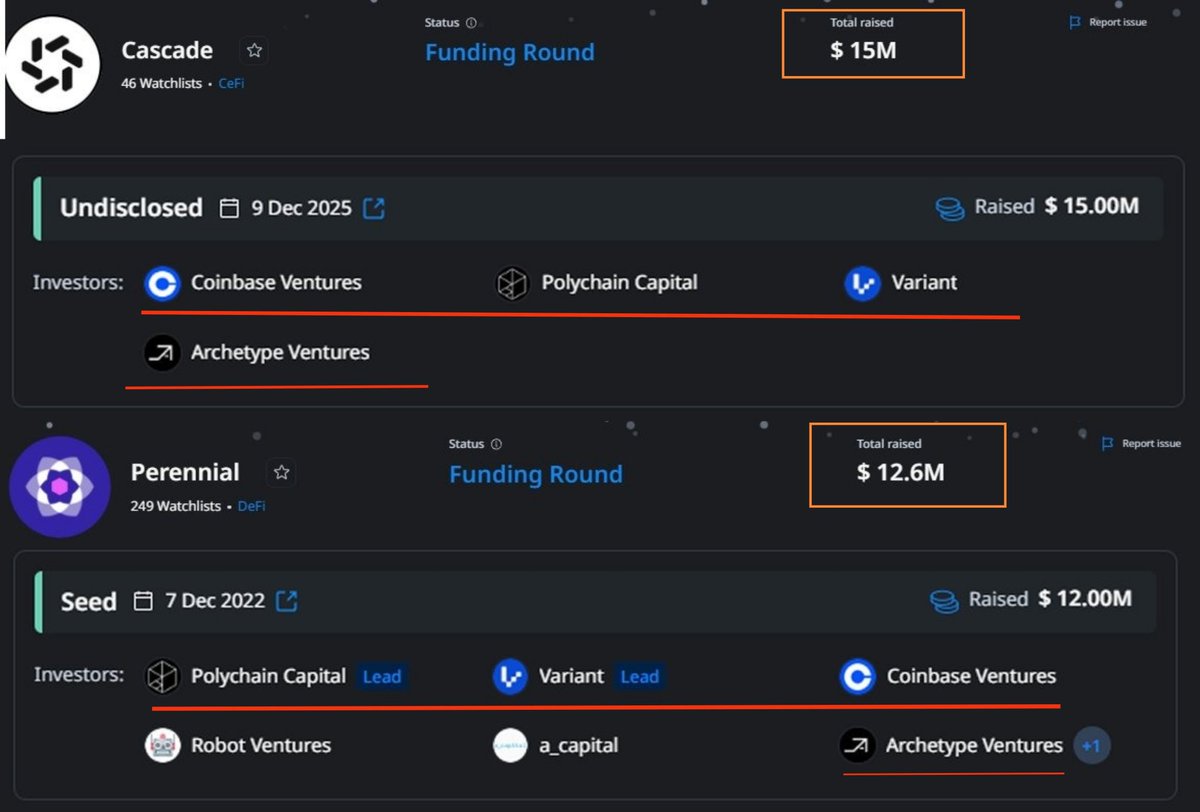
Is @cascade_xyz a rebrand or linked with @perenniallabs and @Equilibriafi ? but first what were perennial labs equilibriafi : perennial was a defi derivative protocol that has raised $12.6M in dec 2022 and was backed by polychain capital, variant, archetype and coinbase ventures (exactly same backers as cascade) in 2024 they even launched long term points based reward initiative designed to incentivize early adopters, loyal traders and LP providers in the form of "Petals" and they hitting $18M+ highs but they couldn't stay relevant for longer and user demand disappeared, team started ghosting AMAs and tvl dropped to Zero ultimately no token was launched Equilibriafi : it was a defi yield optimization protocol on top of Pendle Finance, they promised 2% airdrop to users and introduced a sale in may 2023 where they raised $1.5M at $20 FDV hard cap with 50% vesting they successfully launched the token at IDO price and the token is still holding around IDO price, those who invested in sale got their rest 50% capital back after 6 months with around no loss/profit how are these projects and @cascade_xyz linked : 1. Perennial was co founded by Kevin Britz ( @kbrizzle_ ) and Arjun Rao 2. Equilibriafi was co founded by Kevin Britz verified from multiple sources as under perennial 3. Perennial hinted S2 petal campaign then announced they will be pivoting to a new perps venue most important : 4. cascade(.)xyz official domain uses Ambire embedded wallets for auth + Perennial Finance as their derivatives backend basically the urls found in cascade network tabs are the preview are the staging version of Cascade's frontend interface hosted on Perennial's infrastructure 5. the Block and coindesk hinted, "Kevin" as Cascade co founder so putting all this together, it can be verified that they came up Cascade idea in july 2025 after they announced no S2 petal campaign for Perennial conclusion : am i calling Cascade a scam? no but should i be careful? yes they didn't launch the token for Perennial even after millions of perps volume, and people using the platform, spending capital until they won't clarify these issues and come up with reasonable answers for why they need to launch so many projects which are not able to find PMFs and deliver and disclose the team behind Cascade publicly i will stay away nobody would want to lock funds for months into something who are riding the meta hype and no team info, because i don't want to miss other opportunities for nothing dyor
Morsy tweet mediaMorsy tweet mediaMorsy tweet mediaMorsy tweet media
English
109
47
520
98.4K
suprememe retweetledi
Observe
Observe@obsrvgmi·
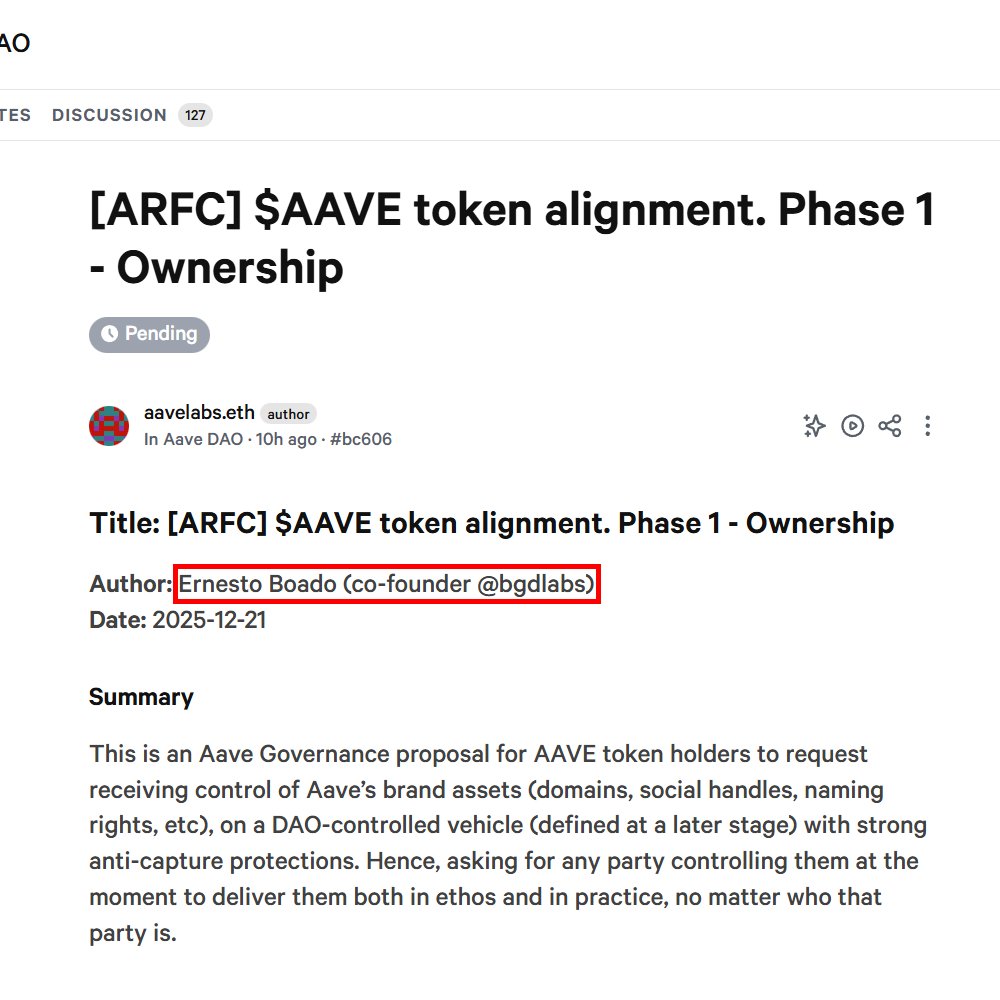
🚨 @aave is having a full blown civil war And it might be the biggest governance fight defi has ever seen. Heres a clean breakdown 👇 Aave has two sides: – Aave labs → a centralised entity founded by stani – Aave dao → token holders who govern the protocol Now heres what happening, Dec 4, 2025: Aave labs announces a partnership with @CoWSwap to improve swap pricing + mev protection on the aave interface. Dec 11, 2025: A popular delegate, @DeFi_EzR3aL drops onchain analysis stating that swap fees from the new cow swap contract are being routed to a private wallet controlled by aave labs. Not the dao. Translation: DAO revenue just got quietly cut off. Dec 12, 2025: Marc zeller (largest delegate, aave chan initiative) calls it stealth privatization. Claims ~$10m per year that should go to the dao is gone. Dec 16, 2025: Things go nuclear ☢️ A. Proposal called “poison pill” by Tulip King. The demands: – Seize all aave ip, code, and brand – Force aave labs to become a dao owned subsidiary – Claw back all past revenue earned using the aave brand B. Then comes proposal #2 — “brand seizure” by former cto of aave labs @eboadom, – Move trademarks, domains, socials to the dao immediately. Logic: If dao pays for dev + marketing then dao should own the brand, domains, socials. Aave Labs / Stani’s defense: – This (cowswap thing) was never a fee switch. – Frontend revenue was a surplus labs donated voluntarily. – Aave labs is a private company. – DAO owns the contracts, not the website. – Labs pays for hosting, security, and frontend engineers. Now the plot twist, amid all this chaos, Aave labs opens a snapshot vote on dec 23👇 Proposal: Give aave token (aave dao) holders explicit control over brand assets, domains, socials, naming rights, github, npm, everything. (baed on @eboadom's proposal) Except… The author of the proposal @eboadom says he never approved it. He claims it was rushed to vote with his name on it while discussion was still active. Calls it “disgraceful.” Urges people to abstain. @Marczeller says the proposal was rushed during holidays, with fresh delegations gaining voting power. Zoom out. This isn’t about cow swap. This isn’t about one wallet. This is the unresolved question of defi: Who actually owns a protocol? The code? The frontend? Or the brand? Aave is about to set a precedent. And everyone is watching.
Observe tweet mediaObserve tweet media
English
305
341
2.7K
693.9K