Zero Knowledge Network

1.5K posts

Zero Knowledge Network banner
Zero Knowledge Network

Zero Knowledge Network

@_zknet

Bringing Metadata-Private Zero-Knowledge to the Edge

No where Katılım Şubat 2023
307 Takip Edilen21K Takipçiler
Zero Knowledge Network
ZKNetwork Project Update - 2026-03-20 Spring equinox. Day and night in balance, and the light begins to lead. In regenerative systems, these thresholds matter: accumulated energy finds its form and starts to move. What grew roots in the dark reaches for light. For ZKNetwork, this moment carries particular resonance. After seasons of deep research, iterative testnet deployments, hardware prototyping, and the careful composition of a privacy-first technology stack, the project emerges from the encrypted quiet of construction into visible expression. ➡️ The Dawn of Regenerative Privacy Infrastructure Our latest article maps where ZKNetwork stands, what it has built, and where the architecture points next: Dual-Layer Architecture: ZKNetwork’s infrastructure follows the pattern of mycelial networks beneath a forest floor. A Lunar Layer of encrypted privacy protocols, including post-quantum mixnets, zero-knowledge trust systems, and decentralized coordination, runs beneath a Solar Layer of sovereign hardware, privacy-first applications, and community-owned DePIN infrastructure. Together they form an adaptive system: under permissive conditions, applications flourish openly; under pressure, the encrypted substrate expands to shelter more of what matters. Platform Capabilities: Interconnected utility layers designed for independent adoption or seamless composition: Mix Network transport, Metadata-Private Group Chat, ZK Trust Registry, ZK-Firewall, ZK Provenance Services, and Secure Edge Hardware. Each new participant widens the coordination surface and strengthens the privacy set. Phased Roadmap: From completed Genesis Research through Network Activation, Developer Ecosystem, Enterprise Infrastructure, and Institutional Scale, a 24-month arc where each phase builds deliberately on the last. Regenerative Tokenomics: The ZKN token as the network’s circulatory system, with protocol revenue flowing through the Regenerative Tokenomics Router across four interlocking pools creating continuous feedback loops between revenue, supply dynamics, and ecosystem development. This is infrastructure for the Intelligence Era: privacy as foundation, verification without exposure, value that regenerates through participation. Read the full article on our newly launched Substack: 🔗 zknet.substack.com/p/the-dawn-of-… 🔗 @zknetwork/the-dawn-of-regenerative-privacy-infrastructure-62ae632b31cc" target="_blank" rel="nofollow noopener">medium.com/@zknetwork/the… Subscribe and share to help spread the signal. Stay tuned. Stay private. BE THE N E T W O R K…
Zero Knowledge Network tweet media
English
7
17
23
457
Voidly
Voidly@Voidly_ai·
@juliecbarrett If protecting kids requires every user to submit identity data, the policy was never just about children. It builds a mass verification system that benefits large platforms and governments while normalizing surveillance for everyone.
English
1
0
7
168
Julie Barrett
Julie Barrett@juliecbarrett·
It’s got nothing to do with protecting kids. It’s government control, the implementation of a mass surveillance framework that will only expand - and rapidly. Every single user having to share age verification data (especially kids!!!!) is a huge win for Big Tech and Big Government
Reuters@Reuters

Governments worldwide are ramping up efforts to keep minors off social media. An identity-verification company is testing scenarios teenagers may use to appear older than they are

English
20
334
918
15.4K
Zero Knowledge Network
ZKNetwork Project Update ~ 2026-03-06 The Zero Knowledge Network turns the page to a new chapter with a sharpened trajectory, deepening partnerships, and progress that pushes privacy-first infrastructure forward. ➡️ Home Stations, Future Forward After an extraordinary run at ETHBoulder and ETHDenver, the team has regrouped across home stations, organizing a wealth of new contacts and translating field connections into active collaborations. From aligned partnership explorations and new industry cohorts to ecosystem builders, stewards, and regenerative technologists, the conversations are moving into structured engagement. A consistent signal: the future of coordination technology is non-extractive, privacy-preserving, and aligned with ecological health and civic resilience. Infrastructure that does not spy, but sustains. That does not extract, but protects. That enriches communities at the level of their local health, not for remote intermediaries. Peer-for-peer technologies. The People's DePIN. ZKNetwork is actively engaged across a multitude of aligned ecosystems, sharing tools and brainpower to explore new ways to coordinate our collective future. ➡️ Why AI Needs a Metadata-Private Layer We are living through a revolution from data to knowledge to intelligence, and with increasing capability comes an increasing shadow: surveillance infrastructure hungry for the metadata that reveals who communicates with whom, when, from where, and how often. Even when content is encrypted, AI-powered traffic analysis can reconstruct behavioral patterns, identity correlations, and strategic intent from metadata alone. AI systems are not just vulnerable to surveillance; they are becoming the tools of surveillance. AI must be protected from AI. ZKNetwork addresses this at the infrastructure level. Rather than treating privacy as an optional checkbox, the network embeds metadata privacy into the transport layer by default. AI agents, inference nodes, decentralized compute providers, and enterprise APIs can route interactions through ZKNetwork's mixnet framework, hiding query origins, timing correlations, and usage patterns. This is the opt-in future: privacy is the baseline, disclosure is intentional, and trust is cryptographic. You are private unless you choose to reveal. ➡️ Mixnet Infrastructure: Katzenpost Progress Upstream development on the Katzenpost mixnet continues advancing production readiness across the stack. The core repository has seen active development focused on stability and security, including a new vulnerability-checking CI workflow, significant refactoring to modularize configuration generation, and ongoing maintenance of the HPQC (Hybrid Post-Quantum Cryptography) library underpinning all cryptographic operations. The messaging client libraries (Rust/Python) for application integration continue receiving updates, preparing connectivity for upcoming ZKNetwork infrastructure rollouts. Work continues on the replica courier decoy traffic system and the pigeonhole protocol for persistent anonymous messaging as core capabilities within a privacy-first application layer. Continuous updates to the HPQC and CIRCL fork libraries reflect an ongoing focus on cryptographic agility, integrating ML-KEM (Kyber) and evolving Sphinx packet formats to ensure the network remains resistant to future quantum threats. ➡️ Building Forward From field-forged partnerships to hardening mixnet infrastructure, all vectors converge toward a network where privacy is the default, verification is trustless, and value regenerates through participation. More to share soon. Stay tuned. Stay private. BE THE N E T W O R K…
Zero Knowledge Network tweet media
English
10
17
32
901
Zero Knowledge Network
Zero Knowledge Network@_zknet·
ZKNetwork Project Update – 2026-02-20 The Zero Knowledge Network emerges from an extraordinary Colorado chapter, bringing deep field connections, ecosystem visibility, and renewed momentum into 2026. ➡️ From the Field: ETHBoulder and ETHDenver Seven-plus ZKNetwork contributors descended on Colorado for back-to-back events, with additional collaborative teams joining the mix. For many, it was the first time meeting in person, and the synergy was immediate. ETHBoulder provided a powerful nexus for aligned builders, where ZKNetwork found deep resonance with builders exploring cosmolocalism, civic resilience, and community-first infrastructure. A shared premise: global protocols should empower local sovereignty, not extract from it. ETHDenver scaled these conversations globally. ZKNetwork was featured in a Privacy Stewards of Ethereum presentation mapping where privacy matters most across the Ethereum stack, with ZKNetwork's Metadata-Private Networking Layer highlighted among ecosystem solutions. The team also connected with the Aztec team, gaining a development supercharge from discussions on efficient agentic coding with the Aztec/Noir toolchain, directly applicable to ZKNetwork's ZK-native developments. A consistent theme across both events: AI-assisted tools are accelerating at a pace most ecosystems are not prepared for, and privacy remains underaddressed. ZKNetwork joined an active chorus declaring Privacy Matters, not only for content, but for metadata, the invisible layer surveillance infrastructure is most hungry for. ➡️ Ecosystem Alignment: Gaia AI and MycoFi Deep cross-pollinations are crystallizing with Gaia AI and MycoFi, exploring how privacy-preserving peer-for-peer technologies, AI-native verification, and secured edge infrastructure can serve regenerative bioregions, from ecological data coordination to community-level economic flows. The cosmo-local and regenerative movements are not abstract. They are building, coordinating, and running into the same unsolved problem: how do you coordinate at scale without extracting data or centralizing trust? ZKNetwork exists to answer that question. ➡️ Why Metadata Privacy Is More Urgent Than Ever Consider the cell membrane. Biological cells maintain selective permeability, allowing necessary exchanges while blocking harm. This boundary is not a limitation; it is what makes complex life possible. Social organisms work the same way. As AI reshapes human coordination, the metadata layer, who talks to whom, when, from where, becomes the map that surveillance systems and adversarial models are trained to read. ZKNetwork builds protective boundaries into infrastructure: - Mixnet transport obfuscates communication patterns, breaking sender-receiver linkage - Zero-Knowledge Proofs enable verification without disclosure - Tamper-resistant edge hardware establishes roots of trust at the physical layer Privacy by default. Verification without exposure. Coordination without extraction. ➡️ Building Forward The connections made across Colorado events are moving into active collaboration, with more to share soon. Stay tuned. Stay private. BE THE N E T W O R K…
Zero Knowledge Network tweet media
English
18
21
48
1K
Aleo
Aleo@AleoHQ·
Privacy isn’t broken in crypto. It’s just optional. And when privacy is optional, most systems quietly default to exposure.
English
117
18
207
12.8K
Aleo
Aleo@AleoHQ·
ɹǝʍod sı̣ ʎɔɐʌı̣ɹd
97
9
230
17.5K
Nillion
Nillion@nillion·
The world wants privacy.
English
84
37
371
54.4K
Cointelegraph
Cointelegraph@Cointelegraph·
⚡ LATEST: Vitalik Buterin endorses ZK privacy-preserving payments and reputation systems as a path to make Ethereum the home for AI, rather than copying existing models.
Cointelegraph tweet mediaCointelegraph tweet media
English
180
141
1.1K
86.6K
fabda.gold
fabda.gold@fabdarice·
Bearish crypto? Don't. The new age of the Agentic economy will operate in majority via micropayments. Only possible via blockchain and cryptocurrencies.
English
8
4
36
2.6K
Inco ☁️
Inco ☁️@inconetwork·
thinking about privacy...
English
49
4
94
2.8K
Justin Bons
Justin Bons@Justin_Bons·
Without decentralization, crypto is pointless: The benefits of decentralization are the innovation! All centralized "crypto" is bogus from L2s, single servers & permissioned designs That is how we travel from the shackles of fiat oppression to a new anarchist financial order!
English
76
11
156
8.1K
nairolf
nairolf@0xNairolf·
privacy on demand really is an insane potential mainstream use case for crypto private payments, private computing, private ai and prolly 100+ other real use cases best part: you dont even need to mention crypto or slap a token on it
English
80
6
141
8.3K
RYAN SΞAN ADAMS - rsa.eth 🦄
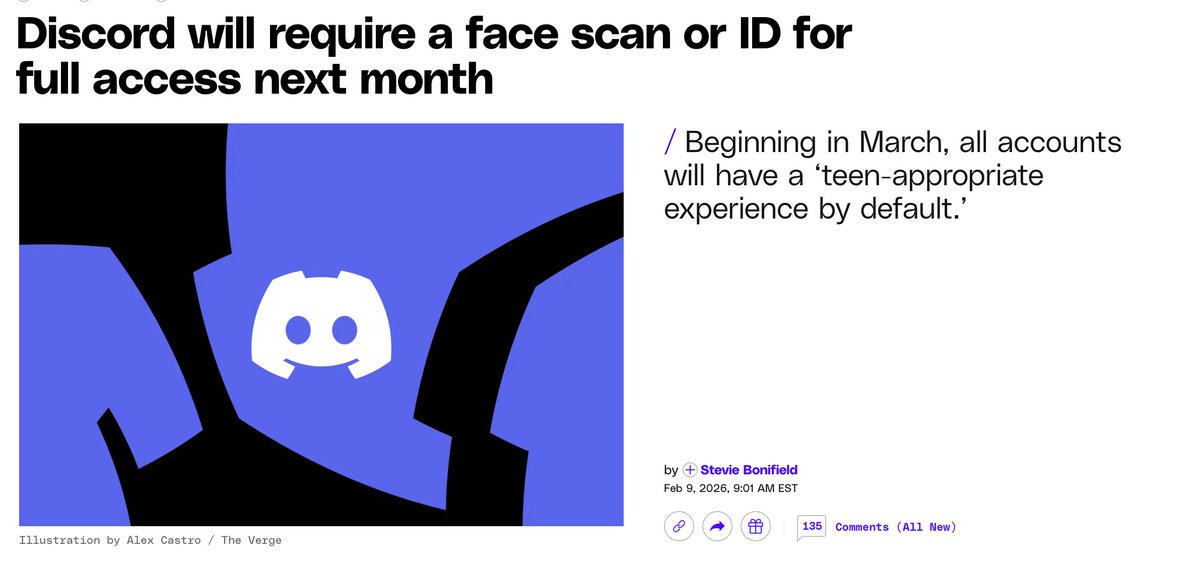
Absolute privacy nightmare. Governments pushing AML/KYC on the app layer - they think its a good idea to have citizens submit biometrics and IDs to every third party who requests it. Can they at least mandate zk solutions where the user can prove identity without submitting it to every corporation on the planet? Bureaucrats "accidentally" legislating a surveillance state and broken security for their citizens. We need a digital civil rights act now.
RYAN SΞAN ADAMS - rsa.eth 🦄 tweet media
English
203
233
1.5K
126K
vitalik.eth
vitalik.eth@VitalikButerin·
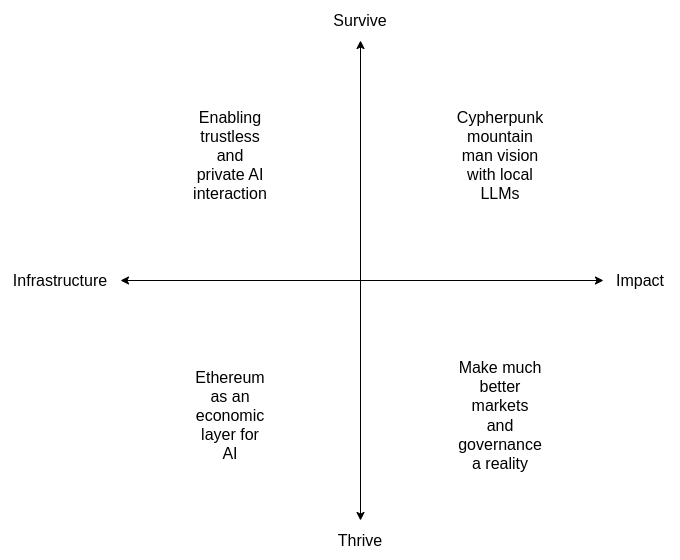
Two years ago, I wrote this post on the possible areas that I see for ethereum + AI intersections: vitalik.eth.limo/general/2024/0… This is a topic that many people are excited about, but where I always worry that we think about the two from completely separate philosophical perspectives. I am reminded of Toly's recent tweet that I should "work on AGI". I appreciate the compliment, for him to think that I am capable of contributing to such a lofty thing. However, I get this feeling that the frame of "work on AGI" itself contains an error: it is fundamentally undifferentiated, and has the connotation of "do the thing that, if you don't do it, someone else will do anyway two months later; the main difference is that you get to be the one at the top" (though this may not have been Toly's intention). It would be like describing Ethereum as "working in finance" or "working on computing". To me, Ethereum, and my own view of how our civilization should do AGI, are precisely about choosing a positive direction rather than embracing undifferentiated acceleration of the arrow, and also I think it's actually important to integrate the crypto and AI perspectives. I want an AI future where: * We foster human freedom and empowerment (ie. we avoid both humans being relegated to retirement by AIs, and permanently stripped of power by human power structures that become impossible to surpass or escape) * The world does not blow up (both "classic" superintelligent AI doom, and more chaotic scenarios from various forms of offense outpacing defense, cf. the four defense quadrants from the d/acc posts) In the long term, this may involve crazy things like humans uploading or merging with AI, for those who want to be able to keep up with highly intelligent entities that can think a million times faster on silicon substrate. In the shorter term, it involves much more "ordinary" ideas, but still ideas that require deep rethinking compared to previous computing paradigms. So now, my updated view, which definitely focuses on that shorter term, and where Ethereum plays an important role but is only one piece of a bigger puzzle: # Building tooling to make more trustless and/or private interaction with AIs possible. This includes: * Local LLM tooling * ZK-payment for API calls (so you can call remote models without linking your identity from call to call) * Ongoing work into cryptographic ways to improve AI privacy * Client-side verification of cryptographic proofs, TEE attestations, and any other forms of server-side assurance Basically, the kinds of things we might also build for non-LLM compute (see eg. my ethereum privacy roadmap from a year ago ethereum-magicians.org/t/a-maximally-… ), but for LLM calls as the compute we are protecting. # Ethereum as an economic layer for AI-related interactions This includes: * API calls * Bots hiring bots * Security deposits, potentially eventually more complicated contraptions like onchain dispute resolution * ERC-8004, AI reputation ideas The goal here is to enable AIs to interact economically, which makes viable more decentralized AI architectures (as opposed to non-economic coordination between AIs that are all designed and run by one organization "in-house"). Economies not for the sake of economies, but to enable more decentralized authority. # Make the cypherpunk "mountain man" vision a reality Basically, take the vision that cypherpunk radicals have always dreamed of (don't trust; verify everything), that has been nonviable in reality because humans are never actually going to verify all the code ourselves. Now, we can finally make that vision happen, with LLMs doing the hard parts. This includes: * Interacting with ethereum apps without needing third party UIs * Having a local model propose transactions for you on its own * Having a local model verify transactions created by dapp UIs * Local smart contract auditing, and assistance interpreting the meaning of FV proofs provided by others * Verifying trust models of applications and protocols # Make much better markets and governance a reality Prediction and decision markets, decentralized governance, quadratic voting, combinatorial auctions, universal barter economy, and all kinds of constructions are all beautiful in theory, but have been greatly hampered in reality by one big constraint: limits to human attention and decision-making power. LLMs remove that limitation, and massively scale human judgement. Hence, we can revisit all of those ideas. These are all things that Ethereum can help to make a reality. They are also ideas that are in the d/acc spirit: enabling decentralized cooperation, and improving defense. We can revisit the best ideas from 2014, and add on top many more new and better ones, and with AI (and ZK) we have a whole new set of tools to make them come to life. We can describe the above as a 2x2 chart. There's a lot to build!
vitalik.eth tweet media
English
677
666
3.4K
688.8K
human.tech
human.tech@humntech·
privacy isn’t about hiding. it’s about control hiding ⇒ obscuring everything to avoid being seen control ⇒ choosing what to reveal, when, and to whom you can prove identity without sharing personal details you can prove you’re human without revealing who you are you can prove eligibility without exposing your history zero-knowledge proofs make privacy selective, not absolute
English
15
5
71
2.1K
Kayli Lewis @ MailSPEC
Kayli Lewis @ MailSPEC@mailspec·
Data privacy compliance grows stronger when AI never sees raw data.
English
10
1
7
412