Josh Kalms
29 posts

Josh Kalms
@adsbyjosh
Co-founder @The_AdProfessor. CEO of Multiply. The leading creative performance agency for Fintech & AI.
Katılım Ekim 2022
26 Takip Edilen15 Takipçiler

We only onboard one client per month. This is purposeful.
1. Quality matters more to us than quantity.
We prefer to work with 10 brilliant brands on a long-term basis, rather than 100 clients just to say we do.
2. We're also very resource heavy upfront.
- We audit the business
- Build strategies
- Create a lot of content for them upfront
- They get a dedicated team (account manager, creative strategist, designer and editor, growth strategist)
There are a lot of moving parts. But this is how we get the best results.
It's always been about the long game for us.
English

@benradack Speed before precision on day one is the right call. You cannot optomise a bleeding account. You have to stop the bleeding first and ask the smarter questions once it is stable.
English

Today I'm taking over a new account spending $200k/month.
Here's what I'm doing on day 1.
**First: Launch all 40 new concepts (80 ads)**
4 ads per ad set, one ad set per concept. We can't afford to test each concept in a separate ABO and wait weeks for data. So it's all going straight into the scaling campaign.
**Next: Dig through all previously tested ads**
Run those in the background through an ABO. Force spend into the concepts that never got delivery the first time. Probably a lot of missed winners sitting in there.
**Then: Launch a historical winners campaign**
Old ads that haven't run in months. Bringing them back is one of the fastest ways to turn performance on.
The goal on day 1 is simple. Find winners. Stop the bleeding.
Once we do that and get things under control, I'll go back to a more methodical testing approach. But right now speed matters more than precision.
You can clean up the account later. First you have to stabilize it.
English

@naval The teams using AI to produce more creative, test faster and find what works quicker are pulling away from everyone else. The gap is small right now but it is compounding every month.
English

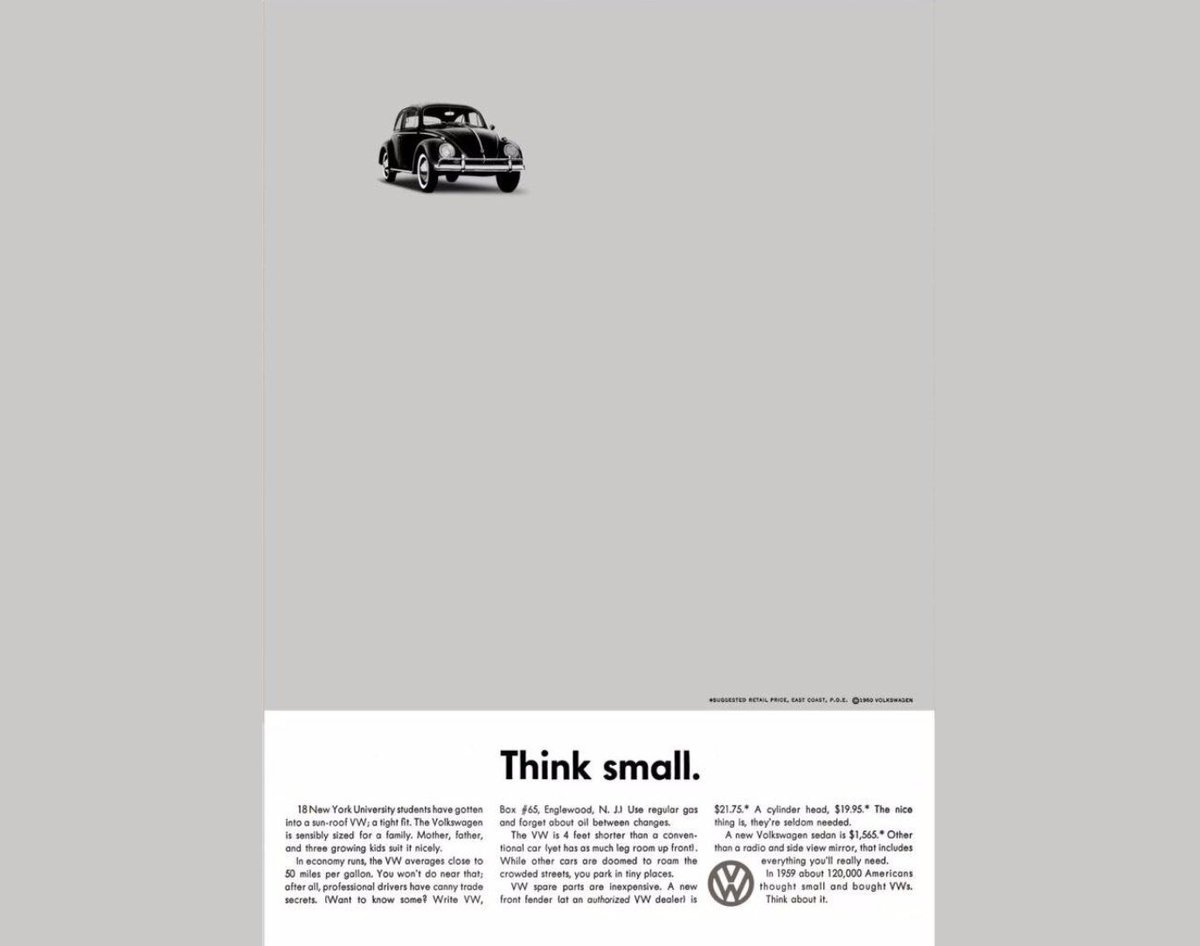
Let's break down why this is a masterpiece.
The context: Post-war America was obsessed with big.
Big cars. Big engines. Every auto brand was selling power and size.
Then Volkswagen showed up with a car the size of a shopping cart and told America to think small.
That took courage.
What makes this ad genius: Most brands run from their weakness.
Volkswagen ran straight at theirs.
Every American looking at that ad was thinking the same thing. "That car is tiny."
So the headline said it first.
The moment you say it before the customer thinks it, you own it. It's no longer a weakness.
The white space: Look at what is not in this ad.
No lifestyle shot, family road trip, or smiling driver.
That white space is doing as much work as the copy.
It forces your eye to the car. It communicates confidence. It says, "We don't need to fill the page to earn your attention."
Most brands are terrified of white space.
The copy underneath: Long form. Honest. Self deprecating.
It talks about how easy the car is to park, cheap to insure and run.
It's simple, it's classic, perfection in my book.

English

I love the "remote work" model.
I want access to the BEST talent in the world. Regardless of their location.
Right now, our team spans 13 countries.
UK. US. Spain. France. Italy. Lebanon. Egypt. UAE . India. Spain. Poland. Portugal. Nepal.
We get great talent, but this also helps us work globally.
Here's what it actually means in practice.
- We helped an AI brand scale across 20 languages and 10 countries, without hesitation.
- Language matters. A Spanish ad written for Spain does not work in Mexico.
- Culture matters. A hook that lands in the US falls flat in Taiwan.
These challenges are not barriers for us.
So grateful for our team.

English

There are only three variables that decide if an ad works.
1. The creative
2. The targeting
3. The product
We can fix the first two.
If the product is wrong, no ad creative on earth will save it.
I've watched companies burn millions trying to outspend a product gap.
No amount of targeting precision or creative brilliance fixes a product people don't want.
English

@oliverwhudson At Multiply we call it the creative debt trap.. brands underproduce for months, see performance slide, then try to fix it with budget instead of volume. The accounts we take over almost always need 3x more creative before anything else moves.
English

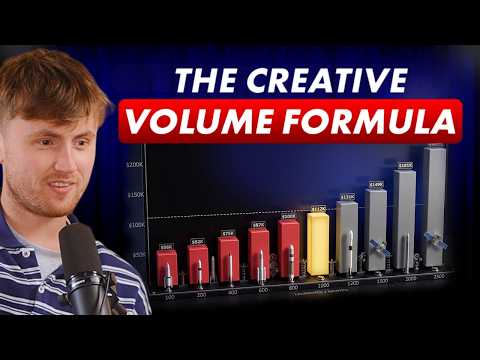
I've just dropped a creative forecasting masterclass on our Youtube channel.....
Most brands have no idea how many ads they actually need to make each month.
After auditing around 30 ad accounts in the last 45 days (brands spending £100K to £5M a month on Meta) I keep seeing the same gap, no system connecting creative production to spend targets.
The problem with that: 30–50% of your winning ads die every single month. The algorithm is replacing your inventory faster than most brands are producing it.
So we built a model that answers one question: how many new creatives do I need to produce each month to hit my spend target?
We've validated it across brands from £100K to £5M a month in Meta spend. And I turned it into a full masterclass on the D2C Diaries youtu.be/hCq-ki8ZDw4

YouTube

English

@northbeam CPCs at 12-month lows and CVRs still falling is a creative diagnosis, not a platform one. The media is cheaper than ever and the brands that can't convert it are losing on the hook, not the bid.
English


@mannybarbas_ Same pattern we see constantly at the £100K-£1M/month level. The brands who treat creative like a production line instead of a project always recover faster. 100 ads launched is a good week, not a special occasion
English

Sometimes all you need to do is get new ads spending
Our performance was struggling for a couple of weeks
Was easy to blame meta... bugs etc
We launched over 100 ads and turned off some of our old 'winners' that were consistently spending
We've since had our best week since we launched this particular brand
Meta will often spend on ads due to engagement or previous history - esp when running cost controls
Refresh your creatives if you're struggling!
English

Creative as targeting is the most important shift in paid social in years and most brands are still treating it like a production line. Volume of genuinely different angles beats polished consistency every time now. The accounts struggling are the ones optimizing for brand safety over creative variety.
English

i've genuinely never made my clients more money on meta than i am right now.
the platform's not broken.
“andromeda killed meta ads” is a psyop.
the rules just changed and hardly anyone's caught up yet.
here's what happened:
the andromeda update rewired how ads get served. your creative is basically your targeting now - you feed meta diverse ads and let it match each one to the right person.
it was never like this before.
so the ones bleeding ad spend are still running the 2023 playbook. a few polished brand-style ads, a couple lookalikes, stacked interests, the whole setup built to control where the budget goes.
that's the exact structure andromeda punishes now. it sits there starving while the algorithm waits for creative variety.
i spent the last few months just feeding it the way it wants to be fed:
25-30 genuinely different creatives per account, not hook variations - actually different angles. founder talking straight to camera with a bold claim in the first second. broad targeting, no hand-holding, let it sort out who sees what.
the rising CPLs and "meta is dead" takes are what running the old playbook into the new algorithm looks like. nothing more than that.
take a real hard look at your creative spread before you blame the platform.
Northbeam@northbeam
If your Meta performance has been falling, you're not alone. Northbeam data shows Meta CPCs hit 12-month lows but CVRs slid right alongside them. Cheaper clicks haven’t meant better performance.
English

Every great ad works because of a principle.
- Scarcity
- Contrast
- Specificity
- Social proof
- Pattern interrupt
We have to ask, "Why does this work?" What's the principle?
It's actually pretty common practice for agencies to ship ads without naming the principle they're using.
If you don't know WHY it worked, you can't replicate it effectively.
When we break down a winning ad, we:
1. Name the principle first.
2. Test variations of the same principle across new hooks and visuals.
That's how you turn one winner into ten.
Great example, this Nike billboard that crosses out "someday" works on the "kill-the-excuse" principle.
I challenge you to peek at an ad today. Why did it work? What's the principle?

English

@Kantrowitz You can build the most transformative technology in history and still lose the narrative. These college kids feel threatened because the story and framing around the tech is not at all positive. Need there to be a hopeful stance to win over the next decade..
English

@elonmusk @AnthropicAI @SpaceX The race for AI compute is the new race for oil fields. Whoever controls the infrastructure controls the industry. SpaceX moving into orbit just changed the ceiling on what's possible.
English

As the recently expanded partnership with @AnthropicAI demonstrates, @SpaceX is offering AI compute as a service at significant scale.
We are in discussions with other companies to do the same.
Over time, especially with orbital data centers, we expect to serve AI at extremely high scale.
English

@bosmeny @ycombinator @sama @dflieb Yuri Milner comparison is solid. The moves that look aggressive in the moment are the ones that look obvious in hindsight.
English

A mic drop moment @ycombinator tonight
@sama just offered $2M in OpenAI tokens to EVERY YC startup in the current batch in exchange for equity
Just like Yuri Milner offering to invest in every startup back when Sam was a YC partner
I can't wait to see what's unlocked when you let the most driven, creative and formidable founders tokenmaxx

English

@shaneparrish The misinformation spreads because the real story hasn't been told compellingly enough. Quoted from Drake himself 'It's not about who did it first, it's about who did it right"
English

Greg Brockman talked about this on The Knowledge Project.
"Our data centers use incredibly little water."
"That's actually misinformation."
"It's less than a household. It's because it's a closed loop."
"Think of it as like a swimming pool of water, and you just circle it around. And so it's a fixed amount of water that's not very large."
And then he goes on to nail what's really happening.
People are scared. They don't know how AI will benefit them.
Naval@naval
The latest IQ test involves data centers and water.
English

@wallstengine Builders and sellers will survive but Measurers are all but done tbh. That's going to reshape every function in every company over the next three years. Advertising included.
English

Cloudflare CEO Prince on how AI changes who gets laid off first:
Two weeks ago I laid off more than 20% of my workforce. I didn’t do it because Cloudflare is struggling. We posted record revenue growth, have strong free cash flow and are adding an unprecedented number of customers around the world. I did it because business is changing, and to win the future, Cloudflare needs to change with it.
We haven’t found another example in U.S. business history of a public company growing at more than 30% that laid off more than 20% of its workforce. Yet what we did is likely going to become the norm over the next year. This is a story about artificial intelligence, but executives and commentators are misunderstanding how it will disrupt business and who will be affected.
AI isn’t coming for builders or sellers, but it is coming for measurers. Tireless, independent, efficient and available, AI systems can now measure an organization with a level of objective detail and precision that was previously impossible even for the best employees.
For Cloudflare, internal audit previously picked a handful of business risk areas to scrutinize each quarter. Now we’re moving to a system in which every business risk is audited continuously. We’re closing our books faster. We’re making fewer mistakes and catching the ones we do more reliably. And, as CEO, I’ve never had better tools to measure exactly how the business is performing, including identifying our rising stars.
The vast majority of those we laid off last week were measurers. We cut middle managers across the organization because AI allows us to have more direct reports per manager while still measuring and mentoring our teams effectively.
We consolidated our operations functions into a single group that can support teams across the business, using AI to gain specific expertise when needed. We significantly reduced our marketing team, which, like in most companies, was teeming with measurers. Across our finance team, we found opportunities to consolidate and automate.
We received almost a million applicants for 1,111 paid internships this summer. The interns we hired are extremely qualified and AI-native. They’re all builders or sellers, and we expect that the majority will get full-time offers.


English

Today, we share a breakthrough on the planar unit distance problem, a famous open question first posed by Paul Erdős in 1946.
For nearly 80 years, mathematicians believed the best possible solutions looked roughly like square grids.
An OpenAI model has now disproved that belief, discovering an entirely new family of constructions that performs better.
This marks the first time AI has autonomously solved a prominent open problem central to a field of mathematics.
English

@higgsfield The barrier to entry just dropped by 99x. Every creative industry is about to feel this the same way filmmaking is feeling it right now.
English

Tomorrow we premiere Hell Grind in Cannes.
It's a first 95-minute AI film, made entirely on Higgsfield.
The budget was under $500K, with $400K going to compute.
The first 25 minutes needed 16,181 generations for 253 shots.
A traditional film would cost from $50M.
Filmmaking is changing.
Amy Wu Martin@amywumartin
The future of AI film just debuted at Cannes. @higgsfield_ai’s first full length demon action flick is 95 min, cost $500k and 14 days of production by 15 professionals. Congrats to @alexmashrabov and the team!
English

@oleksantoniv Nothing wrong with that if the audience is real and the product is good. Distribution built before launch is the most valuable assets a founder can have.
English