Alex Clayton

322 posts

Alex Clayton

Alex Clayton

@afc

Technology investor at Meritech.

Katılım Aralık 2008
758 Takip Edilen9.8K Takipçiler
JJ
JJ@JosephJacks_·
I haven’t seen the cap table. S1 doesn’t list it yet. But the PitchBook data says I am correct contingent on my asterisk *️⃣.. which is that they would have had to do pro rata across the first few subsequent rounds.. and not sell any secondary along the way. Benchmark was the largest check in the A, as far as I know.
JJ tweet media
English
1
0
0
657
JJ
JJ@JosephJacks_·
Benchmark VII still owns > 20% of @cerebras who are > 20X oversold on their IPO. If it trades at even HALF of how Shanghai priced Moore Threads and Cambricon … it will be > $500 billion in < 2 years. This means @ericvishria has a shot to deliver the 🥇 fund in VC history.
English
11
13
285
62.5K
Alex Clayton
Alex Clayton@afc·
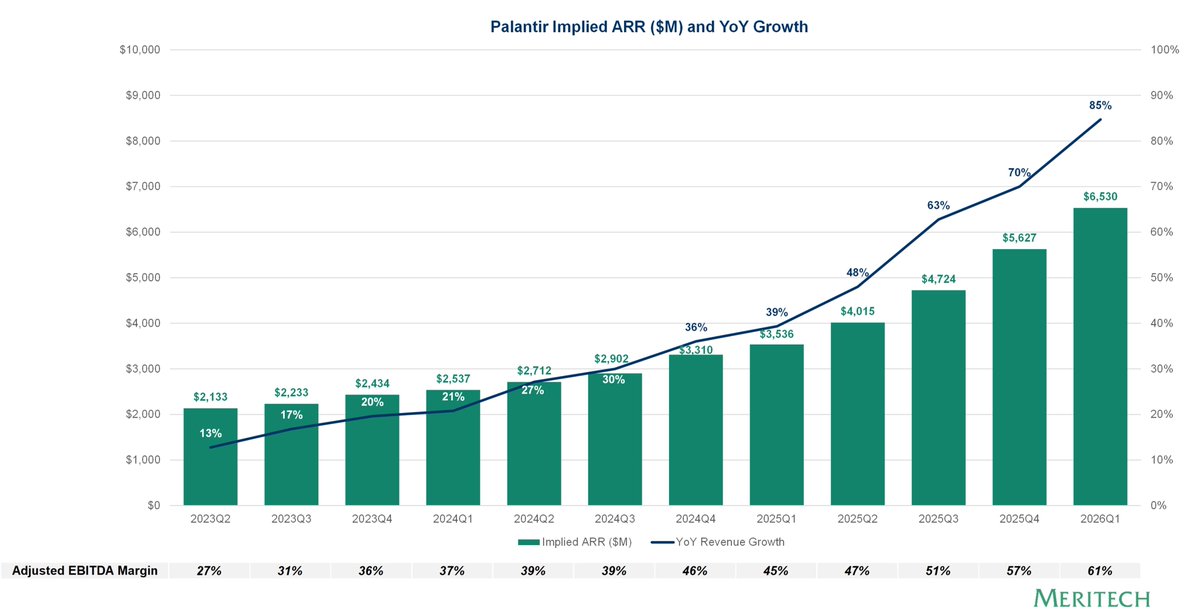
Palantir ($PLTR) has just done what no other technology company has ever done. We track 300+ companies with trading data going back to 1989 (17,000+ reported quarters), and only one company has had an 11-quarter revenue acceleration streak, and that is Palantir ($PLTR). Palantir has gone from $2.1B of ARR, growing 13%, to $6.5B, growing 85%. Adjusted EBITDA margins have also more than doubled to 61% over the past 3 years.
Alex Clayton tweet media
English
3
4
35
4.9K
Alex Clayton
Alex Clayton@afc·
Atlassian's ($TEAM) stock was up 30% today. The company reported revenue growth accelerating to 32% year over year to $7.1B in ARR. Most importantly, they reported credit usage: tokens were growing rapidly. "In AI, we continue to add millions of monthly active users to Rovo and our AI Rovo credit usage is growing more than 20% month-over-month. Customers using Rovo are also growing their ARR at roughly 2x the rate of customers who are not using Rovo, contributing to our strong cloud outperformance and expansion in the quarter...." Every public software company should figure out how to get into the token flow to accelerate growth.
Alex Clayton tweet media
English
5
4
94
15.5K
Alex Clayton
Alex Clayton@afc·
Service businesses need an AI partner for the future...@apurvas96 and @thetysonchen and the whole @getavoca team are building something special.
Apurva Shrivastava@apurvas96

I'm excited to share that @getavoca has raised over $125M across Seed to Series B at a $1B valuation, backed by Kleiner Perkins, Meritech, General Catalyst, Amplify, and more to build AI agents for the services economy. Thank you to @FortuneMagazine for the exclusive cover. fortune.com/2026/04/27/avo…

English
0
0
20
2.8K
Reid Christian
Reid Christian@reidRMC·
Celebrating an exit as a VC is so odd, on one hand it’s job well done, but the actual job was done by the entrepreneur…
English
10
3
51
7K
Alex Clayton
Alex Clayton@afc·
Awesome chart. SaaS budgets aren't going away, but all the growth in software is happening through token spend. SaaS needs to get into the token flow.
COATUE@coatuemgmt

Chart of the Day — Collaboration with @arakharazian and @tryramp AI labs: 74% consumption-based pricing. Traditional SaaS: 96% seat/platform — largely static over the past 11 months. AI reprices software around consumption — SaaS incumbents have not yet transitioned. Source: Ramp, Coatue Analysis as of April 2026

English
1
4
48
20.1K
Alex Clayton
Alex Clayton@afc·
The market perception for public (and even private) SaaS/software is that if you're not in the token flow i.e. selling labor or jobs-to-be-done to your customers, it's akin to being an offline business as the internet took off. 93% of public SaaS co's are still trading under 5x revenue...
Alex Clayton tweet media
English
5
7
62
11.9K
Brad Menezes
Brad Menezes@bradmenezes·
Introducing Superblocks 2.0: AI-generated enterprise apps – finally under IT control. Vibe-coded apps just became the #1 attack vector in the enterprise. Business teams are building on production data, while IT has zero visibility. No reviews. No audits. No permissions. No control. AI hackers are about to get 100x better. Anthropic proved it with Mythos. Superblocks 2.0 is the only platform to take back control: > Business teams build AI-powered apps with permissions baked in. > IT and Security can audit everything and lock down anything, instantly. > Engineering sets the standards. Every app follows them. Instacart, SoFi, and LinkedIn run Superblocks in production today. And larger organizations we can't yet name are too: A Fortune 500 just shut down 2,500 Replit users to standardize on Superblocks, running the platform air-gapped in their AWS environment. A 150,000-employee global services firm replaced Lovable with Superblocks to unlock AI-built apps on restricted internal systems. Every IT leader we’ve demoed to using Replit, Lovable or v0 asked for early access. Today we open access to the world. The genie is out of the bottle on employee vibe coding. Let it run wild, or take back control – superblocks.com
English
193
410
2.2K
4.6M
Sumir Meghani
Sumir Meghani@sumirmeghani·
@afc @bgurley There are two separate points. AI is threatening tenured business models, especially SaaS. Changes to probabilities of terminal value outcomes affects share price. Separately SBC mathematically/directly impacts share price. It’s directly linked and dilutive.
English
1
0
1
196
Alex Clayton
Alex Clayton@afc·
@bgurley we have been doing some analysis on this...I don't agree that SBC is the root cause based on the data. == SBC (stock-based compensation) is not the root cause of the selloff in software — it's slowing revenue growth as AI threatens the core value proposition of sticky, recurring revenue and ever-growing absolute free cash flow. SBC is a derivative of this (to be clear, it should be treated as a cash expense). We looked at 1.5M data points from 10 years of trading data across 141 companies, and there is no discernible correlation between either dilution per year or SBC as a % of revenue and valuation multiples. The Street cares about revenue growth. Each time there is a correction and/or growth slows, as it did in 2022, the SBC comments emerge. That is not to say that dilution is not important, because it is, but high and durable revenue growth matters much more. For example, over the past 10 years, 88% of the time, there is a stronger correlation between revenue growth and valuation multiples than between any SBC, dilution, or free cash flow metric. Moreover, 100% of the time (by quarter) over the past 10 years, reported free cash flow had a higher correlation to valuation than free cash flow less SBC. The market has never, in any single quarter over the past decade, placed more value on SBC-adjusted free cash flow than on reported free cash flow…. A few other notes: we looked at every company that has been continuously in the public software index over the past 10 years (33 companies with full 10-year track records). Dilution explains 12% of return variance; SBC as a % of revenue has essentially zero correlation with returns (r-squared of ~0). Revenue CAGR is the single strongest predictor, explaining 41% of 10-year return variance (r-squared=0.41). The top quartile by share price return over the past ten years (SHOP, AXON, TTD, PANW, NOW, APPF, HUBS, TWLO) diluted a median 47% and returned a median 635%. The bottom quartile of share price returns (RPD, BLKB, OTEX, PRGS, FIVN, BL, SGE, SPSC), which included 4 net share buyers, returned a median of (7)% and had a median cumulative dilution of 4% (basically nothing!). The pattern is clear: the best-performing software companies used equity aggressively to attract top talent and fund growth, while the most capital-conservative companies delivered the weakest returns. Even during the 2022–2023 rate-hike correction — the most hostile environment for growth stocks in a decade — growth metrics only lost to FCF and SBC metrics in 3 consecutive quarters before reasserting dominance. Many public software companies are in a "burn the ships" moment, figuring out how to grow revenue faster, which requires getting into the token flow. It's almost akin to being an offline business in 1997 and needing to go online. Public technology markets care about high, durable revenue growth, and I don't believe that, looking back in 10 years, the companies that didn't make it will be the ones that just limited SBC. It will be the ones that failed to innovate / hire the best people, and failed to achieve high, durable revenue growth. This is clear when looking at this chart over time...the market cares about Rule of X (which is mostly growth).
Alex Clayton tweet media
Bill Gurley@bgurley

x.com/i/article/2042…

English
5
6
71
10.7K
Alex Clayton
Alex Clayton@afc·
Software is now the new PowerPoint...thanks 4.6!
English
2
0
9
1.4K
Alex Clayton
Alex Clayton@afc·
1/ Given the significant growth across the AI ecosystem, we launched a new product -- our AI Ecosystem Index, which covers almost 60 companies across the hyperscalers, semis, memory, neoclouds, and others. Thanks Will Wood and @ausw2000 for building this. The growth in value and returns has dramatically outpaced software over the past few years...indexed returns of 422% for the AI ecosystem index vs. just 64% for software since the launch of ChatGPT. Outcomes are also much larger; the median company is worth $31B vs $4B in software. Product below:
Alex Clayton tweet mediaAlex Clayton tweet media
English
1
3
15
1.9K
Alex Clayton retweetledi
Jake Stauch
Jake Stauch@jakeserval·
Serval is #1 on the Enterprise Tech 30. What a surreal moment. Special to see so many of our customers here like @clay, @vercel, @togethercompute, and many more we'll announce soon. I’m so grateful for the entire @getserval team that powers this rocket ship, especially my cofounder Alex McLeod and COO @TatianaBirgisso, who have assembled unrivaled teams across engineering and GTM. It’s Serval now. newcomer.co/p/mintlify-ser…
English
16
16
53
11K
Alex Clayton
Alex Clayton@afc·
Anthropic, one of the most innovative companies in the world, is using Qualtrics, which was founded in 2002, as its survey tool for Cowork users. Anthropic's core business is building the world's leading models, not survey tools. While they could do it, why spend the time and resources? Hard to imagine a world where companies in-house a significant part of 3rd-party apps, simply because they want to focus on what their business does best.
Alex Clayton tweet media
English
41
8
204
43.4K