ankithooda

263 posts

ankithooda

ankithooda

@ah_code_

Programmer https://t.co/cdgQGzxJZv https://t.co/ItxCoa4yV8

Remote Katılım Haziran 2023
261 Takip Edilen34 Takipçiler
ankithooda retweetledi

Sidu Ponnappa
Sidu Ponnappa@ponnappa·
tl;dr spicy take: most late zirp/COVID vintage junior programmers are mediocre, and will remain so because they are "soft" - and computers otoh are unfeeling and unforgiving, and therefore programming is exacting. this seems to be disproportionately the 2018-2024 cohort (v broadly). not those from before, and not those after (though it's still early for the latter). I'm increasingly convinced this cohort is soft. soft and delulu. computers are not soft. production is unforgiving. good tech leads are tough bosses. there are exceptions of course and these exceptions are self evidently so, demonstrated by their code in prod. but the vast majority all behave like they and their mid skills and mid code make them the same as the elite of their cohort. long take: programming is hard because computers demand (literally) perfect articulation of a plan of execution in (literally) unambiguous grammar. inconsistencies are relentlessly rejected by the machine. consistent but wrong plans will be faithfully executed to a T, and will fail consequently. a programmer's life is one of overcoming endless, continuous failure and rejection in the face of something that you can't externalize your failures onto. the machine never fails. only the programmer does. leading teams of programmers consequently presents rather unique challenges. the craft is exacting and unforgiving. and so the leader has to be also. of course, competent 1st degree leaders of programming teams are hard to mint. and the huge explosion of entrants into the field during zirp has worsened the problem enormously, because the likelihood that a new professional programmer has worked under a competent lead is vanishingly small and dropping each year. agents make this worse - but that's a problem for next year. I'm now seeing early signs (becase I currently operate at a tiny scale) that the vast majority of today's junior programmers are mediocre at best _because_ they have never worked with competent seniors, and especially, competent leads who own the bar on the craft for their team. the ones who demand taste, discipline and ownership. and equally, for some strange reason, this cohort expects their leads to be soft and cuddly? and when they run into a competent lead who holds them accountable, the reaction is to say "nobody understands me. nobody appreciates what I bring to the table. boo hoo". and these are self evidently not 99.99th percentile devs. not even 99.5th. I mean isn't it obvious that if one were that good one would be in Stanford or MIT or core conrtib on Linux/eqiv or on a hardcore GOOG/OpenAI/Anthropic team. I don't think this will end well for this cohort. I hope I'm wrong. I don't think I am.
English

16
9
124
11.7K
ankithooda retweetledi
Joran Dirk Greef
Joran Dirk Greef@jorandirkgreef·
Something we value at TigerBeetle is that we are craftspeople. It’s who we are and what we do, but more, it’s the quality (and trust) we sell: “Each line of TigerBeetle code is handcrafted, and then independently reviewed (and understood) by another engineer.”
English
13
21
263
16.2K
ankithooda retweetledi
Abhinav Upadhyay
Abhinav Upadhyay@abhi9u·
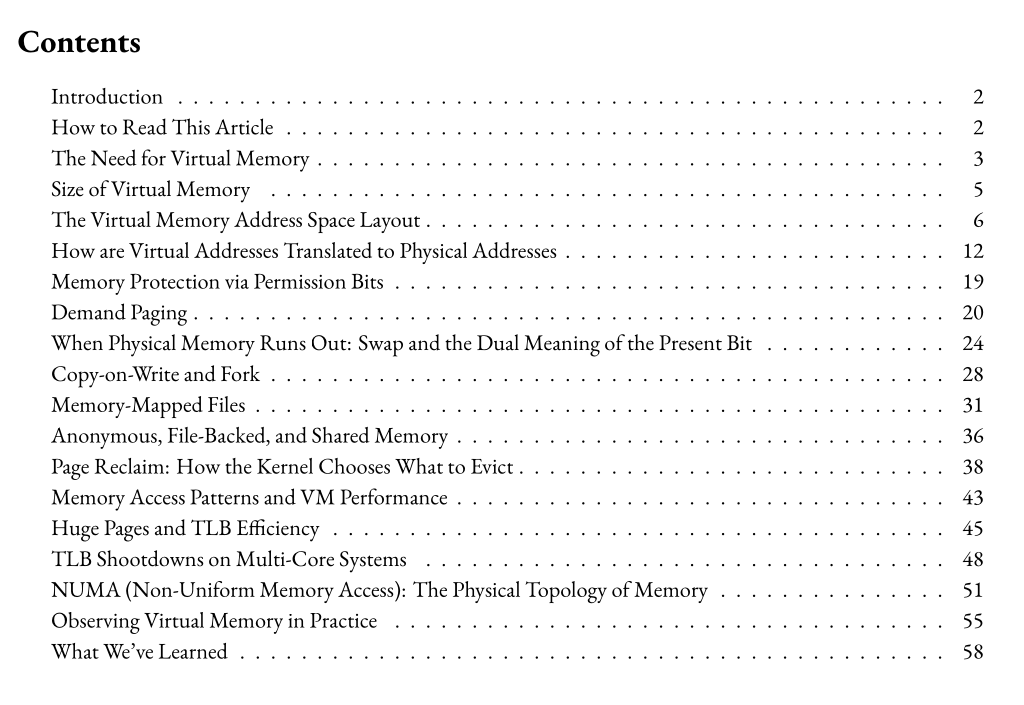
Before jumping into books like DDIA or Database Internals, it helps to understand the systems layer these designs are built on. A lot of the design of such data-intensive systems is based on virtual memory: page tables, page faults, mmap, the page cache, swapping, NUMA placement, TLBs, and the tradeoffs between what the OS wants and what the database wants. My latest article is a ~25,000-word mini-book on virtual memory. It starts from first principles and goes all the way down to advanced topics like NUMA placement and performance debugging with tools like perf and /proc. I also wrote it differently: as a dialogue between a user-space process and the kernel. Most treatments of virtual memory are dry and fact-heavy. I wanted this one to feel more like a story, while still being technically deep. Link below.
Abhinav Upadhyay tweet media
English
25
176
1.5K
113.1K
Ankit Gupta
Ankit Gupta@Ankittt410·
Guys, what’s the most effective way to get rid of ants? I’m honestly running out of options. I’ve already tried all the usual gharelu jugaad - turmeric, chalk lines - but nothing seems to work. They disappear for a day or two and then come right back. This is a newly bought flat, and it's becoming really frustrating to deal with this so frequently. Looking for practical, safe, and actually effective solutions. If something worked for you long-term, please share 🙏
English
1
0
0
217
ankithooda retweetledi
Ravi Mohan
Ravi Mohan@ravi_mohan·
Having a first hand look at the effects of constant LLM use on thinking ability. Anecdotal, obviously, but equal parts horrifying/amusing. Kyle Kingsbury has an excellent article (one of series, all of which are worth reading) which seems relevant aphyr.com/posts/420-the-…
English
0
1
2
173
ankithooda retweetledi
Werner Vogels
Werner Vogels@Werner·
For two decades, S3 has been an object store, but today it's something broader. S3 Files lets you mount any bucket as a filesystem—no copies, no sync scripts, no choosing between file and object. @andywarfield tells the full story, including the "filerectories" that almost made the cut. allthingsdistributed.com/2026/04/s3-fil…
English
26
248
1.3K
321.8K
ankithooda retweetledi
Jim Keller
Jim Keller@jimkxa·
I’ve been thinking about the usual order of problem solving in computers 1) Compute 2) Memory 3) IO Scaling with MPI or similar is often an exercise for the reader @tenstorrent solved it in this order 1) Data placement and movement for Scaling 2) IO 3) Memory 4) Compute Compute is the easiest and best understood so making it last makes sense This was hard, actually, but puts the hard part first. Results are surprisingly good
English
13
31
399
32.4K
ankithooda retweetledi
Max Slinger
Max Slinger@PromptSlinger·
@p_mbanugo @TigerBeetleDB tigerbeetle vendoring everything seemed extreme a year ago. now we're all just hoping some maintainer's npm token didn't get phished last tuesday
English
0
5
32
3.9K
ankithooda retweetledi
Thorsten Ball
Thorsten Ball@thorstenball·
Here's some current Amp meta.
Thorsten Ball tweet media
English
18
14
194
26.9K
ankithooda retweetledi
Antithesis
Antithesis@AntithesisHQ·
Hegel is an open source property-based testing library for every language, based on, and brought to you by @DRMacIver and some of the other folks behind Hypothesis -- the most widely-used, and arguably the best, property-based testing tool in the world today. Hegel-rust is on github today, more coming soon.
English
2
21
96
12.6K
ankithooda retweetledi
Hedgie
Hedgie@HedgieMarkets·
🦔 Researchers at Aikido Security found 151 malicious packages uploaded to GitHub between March 3 and March 9. The packages use Unicode characters that are invisible to humans but execute as code when run. Manual code reviews and static analysis tools see only whitespace or blank lines. The surrounding code looks legitimate, with realistic documentation tweaks, version bumps, and bug fixes. Researchers suspect the attackers are using LLMs to generate convincing packages at scale. Similar packages have been found on NPM and the VS Code marketplace. My Take Supply chain attacks on code repositories aren't new, but this technique is nasty. The malicious payload is encoded in Unicode characters that don't render in any editor, terminal, or review interface. You can stare at the code all day and see nothing. A small decoder extracts the hidden bytes at runtime and passes them to eval(). Unless you're specifically looking for invisible Unicode ranges, you won't catch it. The researchers think AI is writing these packages because 151 bespoke code changes across different projects in a week isn't something a human team could do manually. If that's right, we're watching AI-generated attacks hit AI-assisted development workflows. The vibe coders pulling packages without reading them are the target, and there are a lot of them. The best defense is still carefully inspecting dependencies before adding them, but that's exactly the step people skip when they're moving fast. I don't really know how any of this gets better. The attackers are scaling faster than the defenses. Hedgie🤗 arstechnica.com/security/2026/…
English
123
792
3K
719.7K
ankithooda retweetledi
Joran Dirk Greef
Joran Dirk Greef@jorandirkgreef·
@Steve1885204 Under the hood, TigerBeetle is designed pretty much as just a copy on write filesystem in itself, that can run on raw block devices directly, with a superblock, circular log and then grid of 512 KiB blocks to power an LSM on top.
English
2
4
52
3.8K
ankithooda retweetledi
Kai Lentit (e/xcel)
Kai Lentit (e/xcel)@KaiLentit·
Anti-pattern Architect.
English
30
153
1.8K
126.2K
ankithooda retweetledi
tobi lutke
tobi lutke@tobi·
@sshhafiq @elkelk gotta start with the chart at $0 which is what it was when I wrote the first line of code
English
39
47
2K
101.3K
ankithooda retweetledi
libby
libby@evenstvr·
i love them so bad 😭
English
25
2.2K
25.5K
680.4K
ankithooda retweetledi
TigerBeetle
TigerBeetle@TigerBeetleDB·
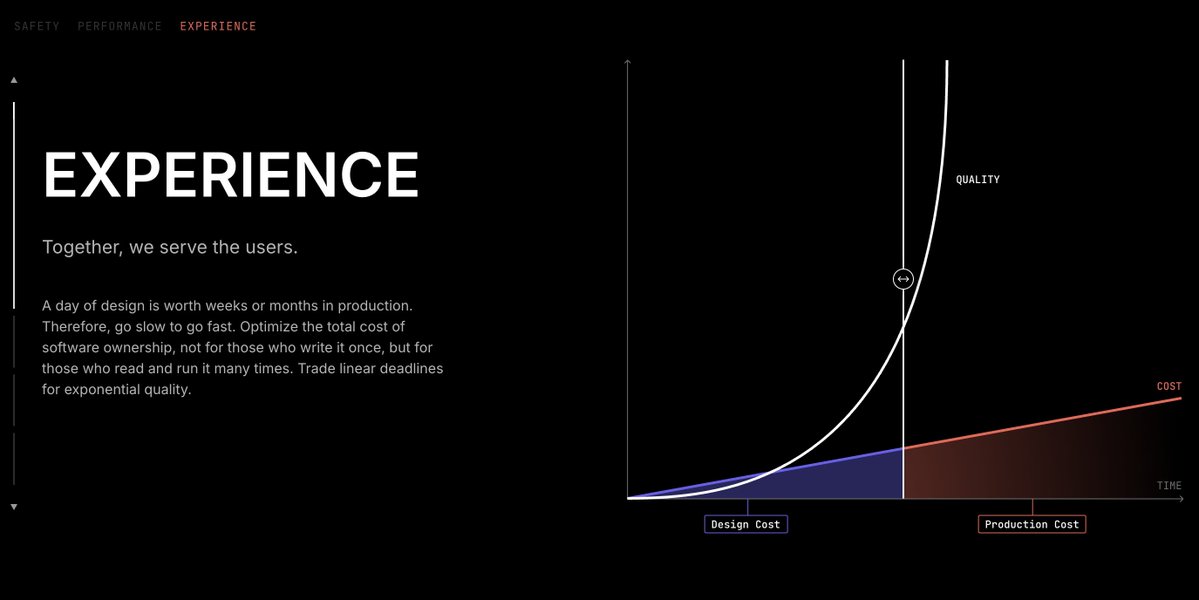
TigerStyle.dev A new, visual home for TigerStyle -- the software engineering methodology developed by TigerBeetle to produce safer, faster software in less time. "Do the hard thing today to make tomorrow easy." "If you want to be remembered, be remarkable."
TigerBeetle tweet mediaTigerBeetle tweet mediaTigerBeetle tweet mediaTigerBeetle tweet media
English
22
93
560
80.7K
Alex Torres
Alex Torres@openprototyper·
@mu_chrinovic What the most fundamental version of an os kernal that one can take on as a project to learn the fundamentals? Or at least get an understanding of how that kernel space works at its core
English
1
0
1
190
Chrinovic Mukanya
Chrinovic Mukanya@mu_chrinovic·
OS kernels are complicated systems
English
12
4
114
7.8K