Ajay Subramanian

424 posts

Ajay Subramanian banner
Ajay Subramanian

Ajay Subramanian

@ajaysub110

PhD candidate studying human and machine vision @nyuniversity

New York, USA Katılım Mart 2018
258 Takip Edilen814 Takipçiler
Ajay Subramanian
Ajay Subramanian@ajaysub110·
Final run: success. After those fixes, the policy learns a much cleaner and more stable kick. The robot is no longer just matching frames; it is executing the motion in a physically consistent way. Code here: github.com/ajaysub110/rl_…
English
0
0
1
65
Ajay Subramanian
Ajay Subramanian@ajaysub110·
The fixes were mostly about getting the control formulation right: -initialize from the correct root body -include the reference motion in observations -predict residual actions instead of absolute joint targets -keep reward scales numerically sane -add balance/smoothness terms
English
1
0
1
34
Ajay Subramanian
Ajay Subramanian@ajaysub110·
As a fun pre-weekend project, I built a small humanoid motion imitation pipeline in Isaac Lab: take a human kick from AMASS (amass.is.tue.mpg.de), retarget it to Unitree H1 with ASAP (agile.human2humanoid.com), then train a PPO policy to reproduce it in simulation.
English
1
0
5
194
Ajay Subramanian retweetledi
Akshay Subramanian
Akshay Subramanian@AkshaySubraman9·
Excited to share two updates: I’ve defended my PhD at MIT, and I’ve moved to SF to join @Latent_Labs as a Member of Technical Staff. If you are in the Bay Area, I'd love to reconnect or meet up.
Akshay Subramanian tweet media
English
17
10
438
16.4K
Ajay Subramanian retweetledi
Quanting Xie
Quanting Xie@DanielXieee·
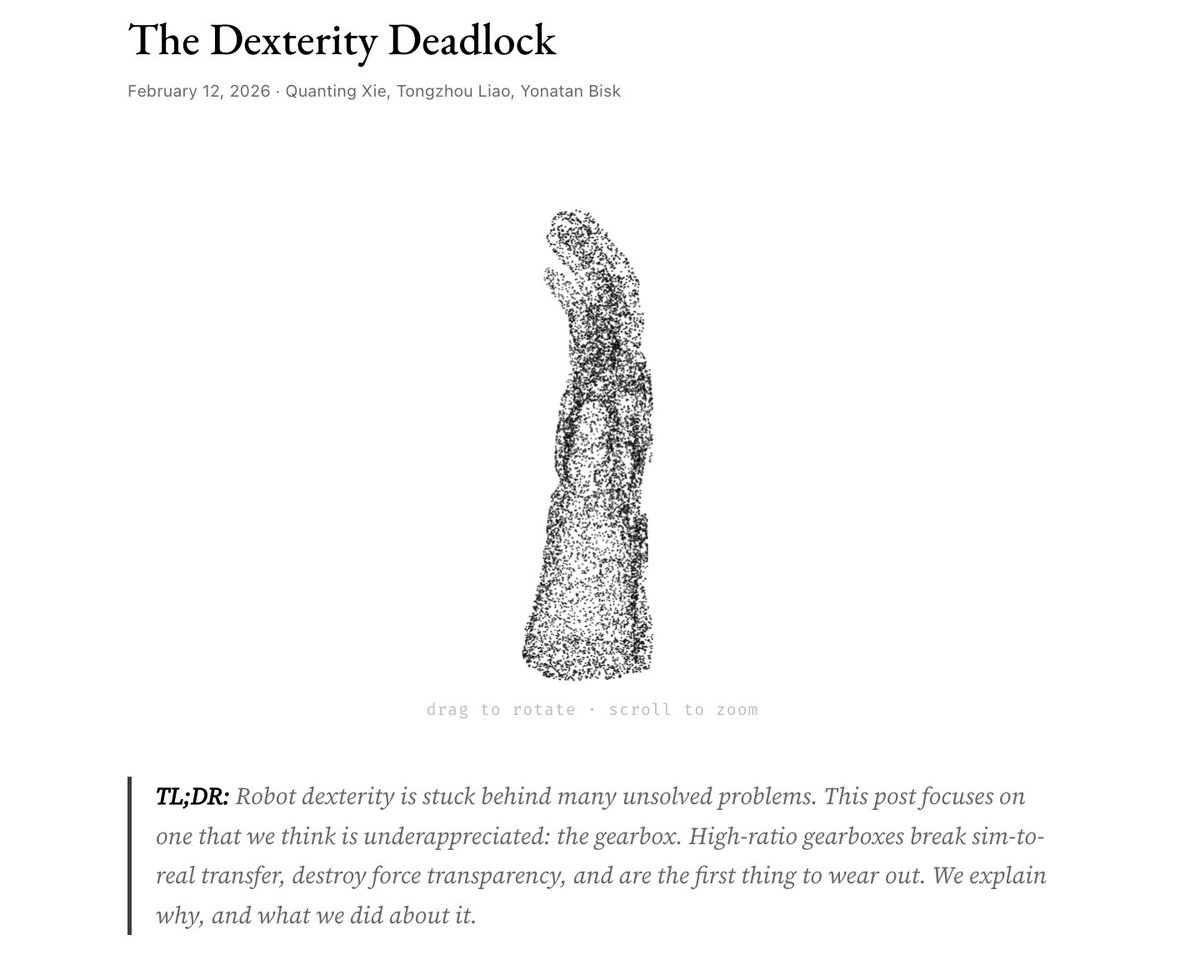
Why does manipulation lag so far behind locomotion? New post on one piece we don't talk about enough: The gearbox. The Gap You've probably seen those dancing humanoid robots from Chinese New Year. Locomotion isn't entirely solved; but clearly it's on a trajectory. But we haven't seen anything close for manipulation. 𝗪𝗵𝘆? When sim-to-real transfer fails, the instinct is to blame the algorithm. Train bigger networks. Crank up domain randomization. Those approaches have made real progress; we don't deny that. But we started wondering: are we treating the symptom or the disease? The Hardware Bottleneck: Fingers are too small for powerful motors. So most hands use massive gearboxes (200:1, 288:1) to get enough torque. But those gearboxes break everything manipulation needs:   • Stiction and backlash are complex to simulate. Policies trained on smooth physics hallucinate when they hit that reality.   • Reflected inertia scales as N². At large gear ratio, the finger hits with sledgehammer momentum.   • Friction blocks force information. The hand becomes blind. And they're the first thing to break. What we are trying to build at Origami, we cut the gear ratio from 288:1 to 15:1 using axial flux motors and thermal optimization. The transmission becomes more transparent: backdrivable, low friction, forces propagate to motor current. Early signs are encouraging. Still running quantitative benchmarks. Why Interactive? I love how Science Center uses interactive devices to explain complex ideas. I want to borrow this concept and help people understand the hard problems in robotics better visually. The post has demos where you can toggle friction, slide gear ratios, watch the sim-to-real gap widen in real-time. What's inside:   • Interactive demos (friction curves, N² scaling, contact patterns)   • Comparison table: 14 robot hands by sim-to-real gap and force transparency   • The math behind why low-ratio matters Read it here: origami-robotics.com/blog/dexterity… We're not claiming we've solved dexterity. The deadlock has many pieces. But we think this one's foundational. Curious what you think.
Quanting Xie tweet media
English
24
100
656
143.2K
Ajay Subramanian retweetledi
Akshay Subramanian
Akshay Subramanian@AkshaySubraman9·
Thrilled to announce the final preprint of my PhD! We introduce PackFlow, a flow matching method for generative molecular crystal structure prediction, and post-trained via reinforcement learning on MLIP energies and forces. Paper: arxiv.org/abs/2602.20140 @RGBLabMIT
English
5
30
183
8.8K
Ajay Subramanian retweetledi
Demis Hassabis
Demis Hassabis@demishassabis·
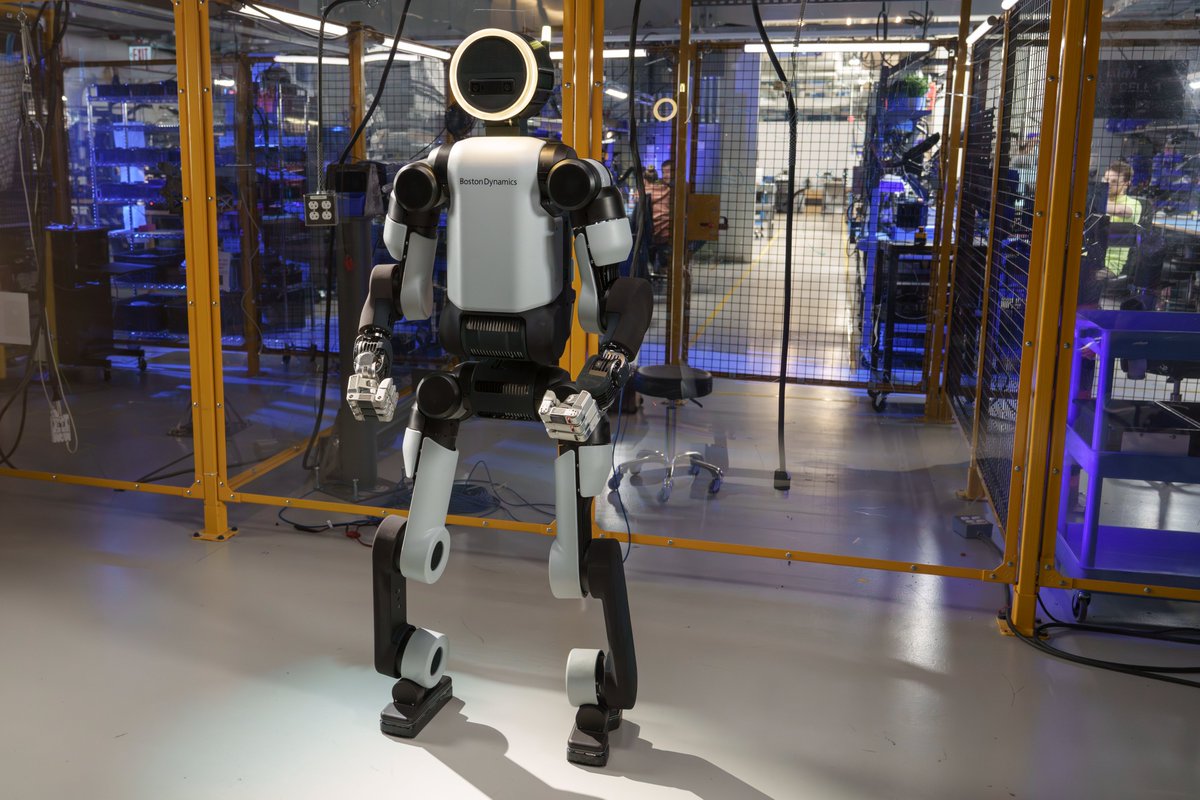
We’re making great progress with our Gemini Robotics work in bringing AI to the physical world - a critical aspect of AGI. As part of our next steps, super excited to announce our partnership with @BostonDynamics, combining our SOTA robotics models with their world-class hardware
Google DeepMind@GoogleDeepMind

Google DeepMind 🤝 @BostonDynamics Our new research partnership will bring together our advancements in Gemini Robotics’s foundational capabilities to their new Atlas® humanoids. 🦾 Find out more → goo.gle/49paguA

English
200
453
4.5K
321.8K
Ajay Subramanian retweetledi
Google DeepMind
Google DeepMind@GoogleDeepMind·
Google DeepMind 🤝 @BostonDynamics Our new research partnership will bring together our advancements in Gemini Robotics’s foundational capabilities to their new Atlas® humanoids. 🦾 Find out more → goo.gle/49paguA
Google DeepMind tweet media
English
221
666
4.7K
941.9K
Ajay Subramanian
Ajay Subramanian@ajaysub110·
@simar_kareer @physical_int Congrats on the great work! The human data you use during finetuning is task-specific. Have you tried using cross-task human data, say as pretraining phase 2? Diverse robot data pretraining -> Diverse human data pretraining -> Task-specific finetuning. Would that help further?
English
0
0
0
101
Simar Kareer
Simar Kareer@simar_kareer·
Some properties of LLMs only emerge with scale, one of which is the ability to effectively generalize from diverse data. During my internship @physical_int, we uncovered an emergent property of VLAs: as we scale up pre-training, VLAs can naturally learn from human video data!
English
7
13
83
9.3K
Ajay Subramanian retweetledi
Vijay Veerabadran
Vijay Veerabadran@simple_cell_·
🚨 Appearing as a #NeurIPS2025 D&B spotlight(~3%) Could VLMs guess your next prompt for a wearable AI agent? We present WAGIBench, the 1st large-scale Goal Inference Benchmark for Wearable Agents w/ audiovisual, digital & longitudinal context! Paper: arxiv.org/abs/2510.22443 1/
English
1
5
14
827
Ajay Subramanian
Ajay Subramanian@ajaysub110·
@ky__zo Because 1) the world is designed for a human form factor, and 2) with current methods that use human demonstration data, robots that don't resemble humans are very hard to train
English
0
0
0
34
kyzo
kyzo@ky__zo·
can someone explain why are we trying to make robots looking like humans? shouldn’t it have a crazy versatile form with 8 hands or legs, being agile and nimble to and light? it feels like closing the dishwasher would be easier if it was done by leg? (I almost always do it with my leg) forcing a robot to squat to close a dishwasher is like deploying a trpc turborepo for a static hello world page
Gavin Purcell@gavinpurcell

From @JoannaStern's great video review of the @1x_tech Neo of today (she makes it clear this isn't what's shipping in 2026). For now, it's all remote operated and it's *still* struggling a little to do basic stuff. This isn't crapping on it, it just that this stuff is HARD.
English
185
20
440
95.8K
Ajay Subramanian retweetledi
Vimal Mollyn
Vimal Mollyn@mollyn_paan·
Excited to present EclipseTouch at UIST today! 3:30 PM in Capri in the Sensing Light, Supporting Touch session. EclipseTouch is an accurate, headset-integrated system for sensing ad hoc touch input on a variety of everyday surfaces. Our system combines a computer-triggered camera with one or more infrared emitters to create structured shadows, which we can use to estimate touch contact and hover distance. Our results show this approach can be accurate, and robust across diverse materials, lighting conditions, and interaction orientations.
English
1
3
14
1.2K
Ajay Subramanian retweetledi
Chris Hayduk
Chris Hayduk@ChrisHayduk·
Everyone posting about the Dwarkesh interview (including Dwarkesh himself!) is missing this subtle point. When LLMs imitate, they imitate the ACTION (ie the token prediction to produce the sequence). When humans imitate, they imitate the OUTPUT but must discover the action
Richard Sutton@RichardSSutton

@eigenrobot Even in birdsong learning in zebra finches the motor actions are not learned by imitation. The auditory result is reproduced, not the actions; in this crucial way it differs from LLM training.

English
68
118
1.5K
333.3K
Ajay Subramanian
Ajay Subramanian@ajaysub110·
@olivia_y_lee Cool paper! Have you tried comparing your work in simulated environments against Eureka-style or RL-VLM-F-style reward functions?
English
1
0
2
175
Olivia Lee
Olivia Lee@olivia_y_lee·
Enabling robots to improve autonomously via RL will be powerful, and dense shaping rewards can greatly facilitate RL. Our #IROS2025 paper presents a method leveraging VLMs to derive dense rewards for efficient autonomous RL. ⚡🦾 #Robotics #ReinforcementLearning 🧵1/5
English
4
12
120
9.7K
Ajay Subramanian
Ajay Subramanian@ajaysub110·
@alopeze99 Cool paper! Have you experimented with using a LLM/VLM to decompose tasks into stages rather than specifying it manually?
English
1
0
1
117