Alex Sharp

23.7K posts

Alex Sharp banner
Alex Sharp

Alex Sharp

@ajsharp

Building autonomous marketing @adfactorai. magellan’s a lot cooler than justin bieber

Katılım Aralık 2008
3.6K Takip Edilen1.9K Takipçiler
Alex Sharp
Alex Sharp@ajsharp·
@noahkagan Yea, this stuff is so frustrating. For what it’s worth they have a domain whitelist setting so you can restrict which domains are valid for hosting your pixel.
English
0
0
3
177
Noah Kagan
Noah Kagan@noahkagan·
Last Saturday night, 2:55 AM started the worst week of the year for me. Facebook restricted our ad account out of nowhere. Fifteen years of running Facebook ads. Over $20M spent cumulatively. I personally helped build Facebook Ads in the early days. And on a random Saturday night, an email landed saying our account was restricted, no reason given. 😞 I figured it would resolve itself. Our ads are straightforward comparison ads for products we promote on AppSumo. I called Facebook (you can actually call them), and the rep said they'd review it and have it cleared in 24 to 48 hours. I looked at the recent ads. Two had been rejected, both AI software ads. Nothing that should take down a whole account. Context: my last startup got permanently banned by Facebook. That ban killed our revenue from $150K a day down to $15K a day overnight. That's a story for another time. But sitting there at 2:55 AM, all of that fear came rushing back. 48 hours later, Monday morning. Still restricted. I called again. They said it looked positive and we'd get an email when it cleared. I started checking email obsessively. Nothing. So I went into Hail Mary mode. I reached out to Naomi, a VP of product. To the COO. To the CTO. To old account managers. To friends who work there. I even found a guy whose entire business is getting people's Facebook accounts unbanned. (Ours wasn't technically banned, just restricted, but yolo.) Every night that week, my family would go to sleep and I'd go upstairs and call Facebook ad support. I was depressed. I was frustrated. The thought running through my head was that 16 years of work was about to get erased because some intern or agency we'd worked with did something stupid I didn't know about. Thursday, 1 AM. I'm in the account again, scrolling through the restriction page, and I notice something I hadn't seen before. A line that says "data sources restricted." I click into it. It says: you're sending traffic from an adult site. WHAT!?! I sat there staring at it. That is not possible. I started digging to figure out wtf. It turns out there's a thing called pixel bombing. Pixels are public. Someone can grab your pixel and intentionally place it on bad sites to get you banned. I didn't know this existed until that moment. Maybe it was this? Then I dug deeper and realized years ago we'd built a product, and someone had taken our AppSumo Facebook tracking pixel and put it on that product. A random user of that product put it on a adult site. Facebook saw traffic from an adult site coming into our pixel and flagged the whole account. I removed the pixel from the product. Blocked the offending sites in Facebook's settings. Submitted a new review request. The next morning, the account was unlocked. Poof. A few lessons for others: - Audit your pixels. Know where they are placed. - Have a separate ad account running as a backup so if something happens you are not dead in the water. - Get an account rep account support set up before you need it. Or find an agency who has direct Facebook contacts. - And if you're a smaller company doing 50% or 75% of your revenue on one channel, build a hedge. The day Facebook decides you don't exist, you don't. One thing that was a quiet positive in the middle of all this: our ads were dark for 48 hours and the revenue impact was smaller than I expected. Facebook ads are 5-10% of our business. Worth knowing what each channel actually contributes when it goes to zero. That was the worst week of my life in the past years! And it came down to a pixel I forgot we had, on a product I forgot we built, on a site I never visited.
English
100
37
840
82.3K
Alex Sharp
Alex Sharp@ajsharp·
@thdxr I’ve always appreciated the extreme honesty of wall st. Never trying to convince anyone they’re in it for any other reason than the money.
English
0
0
1
101
dax
dax@thdxr·
remember how when we were growing up wall street was the bad guy and everyone hated them and every movie had them as the villain that's tech now
English
71
74
1.7K
53.9K
✦ 𝓢𝓱𝓲𝓷𝓮 ✦🪐
I love people with ADHD because they never actually forget anything. You just have to say the right words to activate them like a sleeper cell and then they awaken with all of the knowledge on a very niche subject they studied for 3 months straight 6 years ago.
English
119
4.3K
40.7K
650.9K
Eren Bali
Eren Bali@erenbali·
Who is building an AI agent that can pull permit / zoning rules by address (including city/county/state restrictions) and answer questions. If nobody has done thus it’s a $$$$ opportunity
English
89
6
305
74.9K
Alex Sharp
Alex Sharp@ajsharp·
vibed a little @ElevenLabs text to speech pi extension while driving this morning. now pi can speak text responses w your chosen elevenlabs voice. cannot believe how easy this was, i think largely due to how well pi exposes it's docs to itself. cheers @badlogicgames, pi is absolutely incredible
English
1
1
4
2.1K
Alex Sharp
Alex Sharp@ajsharp·
@LukeGromen How is this a swap in any normal sense? What happens to the swap contract if their currency continues to tank if SOH isn't reopened?
English
0
0
1
999
Luke Gromen
Luke Gromen@LukeGromen·
Sec. Bessent response to UAE after UAE threatened to price oil and gas in CNY if US would not supply USD swap lines a few days ago (bottom): "Yes - we will give you whatever swap lines you want 'to prevent the disorderly sale of US assets'."
Luke Gromen tweet media
Luke Gromen@LukeGromen

UAE to Trump Administration: "You started this war; if we run short of USDs as a result of it, either you will give us USD swap lines, or we will be forced to start transacting oil and gas in CNY and other currencies." -WSJ, just now Via @ces921

English
96
450
1.9K
545.3K
Alex Sharp
Alex Sharp@ajsharp·
The looming end of the subsidized token era of AI is going to create massive opportunities for AI app layer companies. Why? Price positioning and anchoring. Right now you get an insane amount of value from $20/mo from the labs, and it makes it seem crazy to pay $15-20/mo for an app that only does a fraction of what claude/chatgpt goes. Think: voice transcription apps like superwhisper/wisprflow. But the era of $20/mo is coming to an end, Anthropic signaled that this week for enterprise customers. That will create lots of room for app layer companies to raise prices to a more competitive/sustainable level. The opportunity space, especially for lower-priced prosumer ai products is about to explode.
English
2
0
0
42
Alex Lieberman
Alex Lieberman@businessbarista·
Someone is going to build a worldclass “Brain” for enterprises & make a stupid amount of money. Why? As @da_fant said, “coding w ai is solved bc all context is in the git repo. knowledge work is difficult bc context is spread out. an ai system that creates a git repo w all context for a knowledge worker will be able to 100% automate the work.” When companies talk about being data ready for AI, this is what they’re implicitly saying. Engineering has been prepared for this moment for a long time because of the deterministic nature of code, the centralization/versioning of data (read: GitHub), and AI tools that are largely build by engineers for engineers. But for the rest of white collar work, there’s a TON of catching up to do to properly harness the power of the technology. The big challenge here, and why no one has truly cracked the code for "an ai system that creates a git repo w all context for a knowledge worker" is because unlike code, most knowledge is 1) distributed, 2) unstructured, and 3) unverifiable. It's distributed: transcripts live in Granola. Documents in Notion. Customer Data in Hubspot. ERP. Emails. Slack messages. Random spreadsheets. SOP docs. Etc. Etc. Building an ingestion engine that connects to all of your disparate data sources and auto-updates based on the shelf-life of the data is the first, and frankly, easiest step of the process. Next, it's unstructured: let's say I want to create a proposal for a potential client. To nail the proposal, I want it to pull important information from a variety of sources. The specific asks & background from our initial sales call. Previous proposals to anchor ourselves to a proven format. And completed sprint boards from Linear, so the pricing & timeline in the document is grounded in truth. Whether it's a thoughtful filesystem (a la Obsidian) or an OpenClaw-esque memory structure, the brain needs to be great at self-organizing in a thoughtful schema. This is very hard, especially if you want to build a generalizable brain that can be shaped to an array of different enterprises. And finally, most knowledge is unverifiable: writing a function, running a unit test, and seeing if the code works is easy. It works or it doesn't. Using AI to accelerate your content creation process is highly subjective. What is a good/bad idea? Is the content in your voice or not? Does it feel like slop or novel? Answering these questions are both difficult and non-verifiable. That same system described above doesn't just have to be great at organizing & forming coherent relationships, but it also has to be great at self-improving based on feedback from the user. Memory systems (like those introduced by OpenClaw) are great to a point, but as you scale the corpus of data within your company's brain, things like compaction and cleaning become wildly important to avoid the needle in the haystack problem. Someone is going to figure out how to solve this problem, and when they do, not only will they make a shit ton of money, but they'll be robinhood for knowledge workers, enabling non-engineers to enjoy the sort of leverage that only technical folks have felt for the last few years.
English
156
72
916
205.4K
Alex Sharp
Alex Sharp@ajsharp·
@IterIntellectus No it doesn’t. Youre either rage baiting or have no idea what youre talking about. Either way, this sucks.
English
0
0
1
41
vittorio
vittorio@IterIntellectus·
"sleep training" a newborn means letting a defenseless baby scream for its mother in the dark until it's either exhausted or has given up on life. the attachment literature is clear that before 6 months, a baby crying with nobody coming learns exactly one thing, that calling for help doesn't work and you even have parents bragging about how they tortured their kid into an 8h sleep you need to attend to every need of your child. they don't have a prefrontal cortex able to understand what's happening. if you love them and care for them, they'll barely cry, and when they do there's a clear reason you can address right away
English
1.2K
1.9K
28.7K
3.2M
Alex Sharp
Alex Sharp@ajsharp·
@LizAnnSonders Great chart. The stuff you share is consistently unique and extremely poignant and revealing. Much appreciated, thank you.
English
0
0
0
393
Liz Ann Sonders
Liz Ann Sonders@LizAnnSonders·
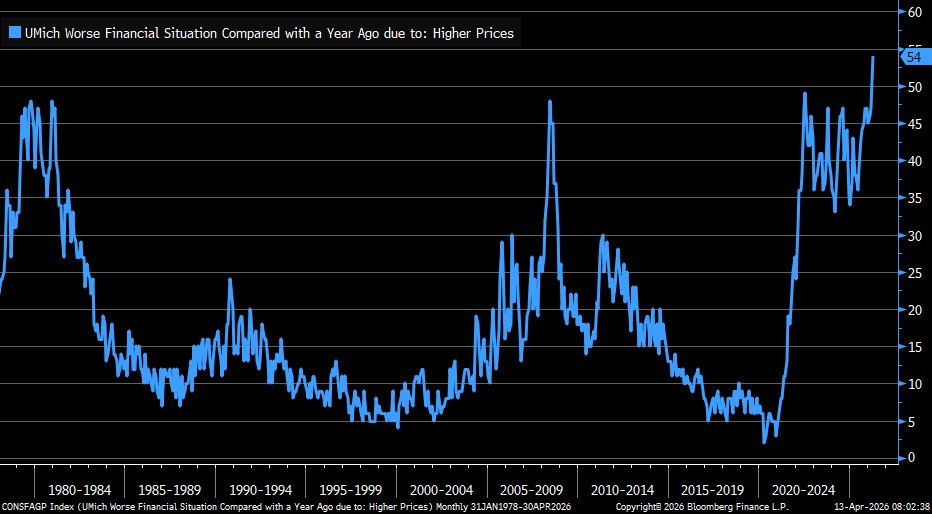
Share of consumers saying their financial situation is worse compared to a year ago due to higher prices jumped to 54% in April vs. 47% in March … now highest on record
Liz Ann Sonders tweet media
English
125
755
2.7K
602.6K
Alex Sharp
Alex Sharp@ajsharp·
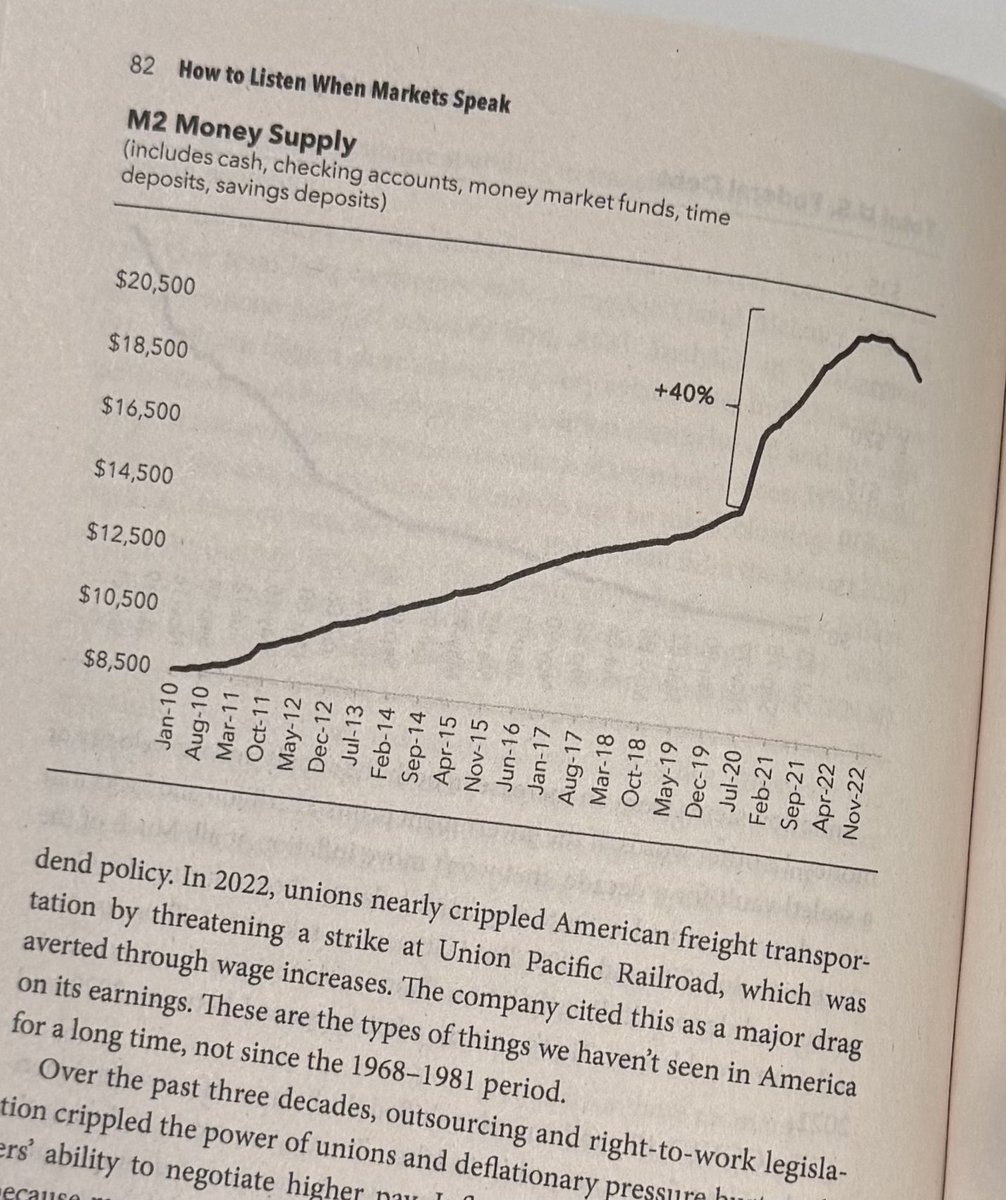
Thank you for posting this. Wild how many supposed experts fundamentally misunderstand the relationship bw money supply and inflation. Nearly everyone I see thinks money supply go up, inflation go up. The real world is highly dynamic/complex, and in crisis, the financial system needs lots of dollars to properly function.
English
1
0
1
12
Steven.N
Steven.N@StevenMacroView·
The 40% figure may seem significant as far as currency inflation goes; but the 40% does not equate to an actual outcome of the debasement. If the USD had been truly debased: - why did the USD perform so well in 2022? - Why did Bitcoin collapse & Gold price stagnate? - Where did all of the "money" printed go? Is there something wrong with how the debasement effects are being transmitted through the economy, or is this just another example of an incomplete story on debasement.
English
6
0
12
1.8K
Lawrence McDonald
Lawrence McDonald@Convertbond·
Never, ever forget. Over 40% of all US dollars ever created were done so in 2020-2022. Yet, central bankers and Wall Street Research lectured against a hard asset portfolio and dramatically downplayed currency debasement.
Lawrence McDonald tweet media
English
62
426
1.9K
113.9K
Alex Sharp
Alex Sharp@ajsharp·
@VivekVRao1 you probably need to determine what extreme is on a per-security basis, right? 5 min candles on some assets would prob trigger on things that would look like errors on another asset. thinking btc for example will often have insane deviations within a 5 min period
English
1
0
2
617
Vivek V Rao
Vivek V Rao@VivekVRao1·
I have spent dozens of hours cleaning Bloomberg historical futures data. Vendors' data may have fewer errors but is not error-free. For price data, compute returns and look for extreme values and unusually high volatility or kurtosis. Also look for very negative ACF(1) of returns, since a junk price between two good prices will lead to big but offsetting consecutive returns. Look for repeated values. If you have good tools for spotting bad data, a higher error rate in free data may be tolerable.
Virat Singh@virattt

Everyone wants free stock market data. But free or cheap data has hidden costs. Cheap data providers have no revenue incentive to fix errors and no QA pipelines to catch them. Worse, your usage data is the actual product being sold to other customers. Hedge funds don't build on free data for the same reason they don't trade on free research. One bad data point and your portfolio is gone.

English
4
13
211
34.6K
Alex Sharp
Alex Sharp@ajsharp·
@joemccann @IBKR Totally. Have been doing this with options data, by far the best "free" option i've found, at least from a brokerage api
English
1
0
3
806
Alex Sharp retweetledi
Andrej Karpathy
Andrej Karpathy@karpathy·
Software horror: litellm PyPI supply chain attack. Simple `pip install litellm` was enough to exfiltrate SSH keys, AWS/GCP/Azure creds, Kubernetes configs, git credentials, env vars (all your API keys), shell history, crypto wallets, SSL private keys, CI/CD secrets, database passwords. LiteLLM itself has 97 million downloads per month which is already terrible, but much worse, the contagion spreads to any project that depends on litellm. For example, if you did `pip install dspy` (which depended on litellm>=1.64.0), you'd also be pwnd. Same for any other large project that depended on litellm. Afaict the poisoned version was up for only less than ~1 hour. The attack had a bug which led to its discovery - Callum McMahon was using an MCP plugin inside Cursor that pulled in litellm as a transitive dependency. When litellm 1.82.8 installed, their machine ran out of RAM and crashed. So if the attacker didn't vibe code this attack it could have been undetected for many days or weeks. Supply chain attacks like this are basically the scariest thing imaginable in modern software. Every time you install any depedency you could be pulling in a poisoned package anywhere deep inside its entire depedency tree. This is especially risky with large projects that might have lots and lots of dependencies. The credentials that do get stolen in each attack can then be used to take over more accounts and compromise more packages. Classical software engineering would have you believe that dependencies are good (we're building pyramids from bricks), but imo this has to be re-evaluated, and it's why I've been so growingly averse to them, preferring to use LLMs to "yoink" functionality when it's simple enough and possible.
Daniel Hnyk@hnykda

LiteLLM HAS BEEN COMPROMISED, DO NOT UPDATE. We just discovered that LiteLLM pypi release 1.82.8. It has been compromised, it contains litellm_init.pth with base64 encoded instructions to send all the credentials it can find to remote server + self-replicate. link below

English
1.4K
5.3K
27.9K
66.6M
Alex Sharp retweetledi
Ben Hunt
Ben Hunt@EpsilonTheory·
While Trump dodged the draft, Robert Mueller volunteered for the Marines after graduating Princeton. He was awarded a Bronze Star with combat V, rescuing a wounded Marine while under fire. He was later shot in the thigh, awarded a Purple Heart, and returned to lead his platoon.
Ben Hunt tweet media
English
325
1.5K
7.9K
283.6K
Demetri Kofinas
Demetri Kofinas@kofinas·
This is excellent.
plur daddy@plur_daddy

Equity bears are at the brink of insanity given resilience in the indices, but odds of a breakdown are increasing now. Equities top slowly as passive flows and rotational dynamics can hold up indices for a long time. There are many structural forces rigged to push them higher, and thus it takes a lot to make them go down. Over the course of an equity bull market, buy-the-dip behavior continually gets reinforced, and the majority of capital will be controlled by adherents to this mantra. In theory, the longer prices remain coiled, the larger the move once they exit the range. This nuke in gold suggests there are liquidity issues brewing under the surface. It feels like a preview of what is going to happen to crowded trades. My theory is the Middle East is selling gold to shore up capital, as they have lost their revenue, and have many expenses around defence. They will also need to rebuild lost energy infra, and eventually, new pipelines to reroute around Hormuz. The buyback window is starting to close, and the sugar rush of higher-than-usual tax refunds is starting to fade. Retail has been a key marginal buyer of equities in these past weeks, and the fading of the tax refund tailwind is critical. The market is gradually coming to terms with the fact that this conflict may last for a long time. On a conventional level, the US and Israel have completely dominated Iran, but Iran has an asymmetric edge when it comes to controlling world oil prices through Hormuz. Trump can still end it, but the issue is that the US cannot simply leave, a ceasefire with Iran must be struck in order to guarantee that Hormuz is reopened. In order to strike a ceasefire, Iran wants to see a guarantee that the US and Israel won't attack them again (at a bare minimum), and it will be difficult for the US to get Israel to agree to that. Trump is used to being able to quickly maneuver according to his whims, as he did with tariffs, but the complex interlocking physical realities of war are different. Oil shocks often contribute to the end of bull markets, since they constrain consumer spending, hit manufacturing, and lower the ability of central banks to offer support. Indeed, the Fed came out slightly hawkish yesterday, and Powell also hinted that he may stay in his Governor seat post his role as Chair ending, which would constrain Trump's plans to unleash liquidity. We have a stronger dollar and long duration bond yields are going up over the world, which tightens liquidity. The Middle East is tight on money now and they were the marginal bidder in many assets. In particular, they were a key funder for AI capex through their investments in the frontier labs. They've been 40-50% of recent big rounds. Remember other deep pockets like Softbank are close to being tapped out. Any dollar that goes into these rounds will have to come out of something else, like liquid stocks (look at my pinned post for this broader thesis). And if we have any signs of risk to AI capex expectations, this will be a major shift that the market needs to contemplate. I've said this before, but puts are a difficult way to express bearish equity views because timing is so uncertain. Equities can hold on for a long time, because they are structurally rigged to go higher. Easier expressions are simply being in cash, or gradually shorting cash stocks over time, which helps avoid getting chopped. This is a very difficult market, stay safe out there.


English
4
5
49
22.4K