Akash Bhate ✨

1.4K posts

Akash Bhate ✨ banner
Akash Bhate ✨

Akash Bhate ✨

@akashbhate

Dad, husband, dog dad to Loki. I write about AI, product, tech & leadership. Views my own. New Mountain Capital, ex Amazon, GE & Koch Industries, Cornell alum

New York, NY Katılım Nisan 2009
1.7K Takip Edilen353 Takipçiler
Sabitlenmiş Tweet
Akash Bhate ✨
Akash Bhate ✨@akashbhate·
Leaders don’t need to code, but must understand retrieval/RAG, agents, evaluation, privacy, and hallucination risks. #ArtificialIntelligence
English
0
0
6
225
Akash Bhate ✨
Akash Bhate ✨@akashbhate·
The winners in AI aren't the ones with the best model — they're the ones who figure out where the leverage actually sits. If McKinsey is mapping 4 distinct agentic roles, it means the build phase is officially underway. Pick one and go deep. 🚀
McKinsey & Company@McKinsey

Agentic AI is changing how tech services create value. We’re starting to see four distinct roles take shape, each with a different set of capabilities, bets and trade-offs. The question isn’t whether to play but where to focus and how to build around it. mck.co/4mP7C7t

English
0
0
0
21
Akash Bhate ✨
Akash Bhate ✨@akashbhate·
@andrewchen running this playbook right now. email automation is live. async AI updates are replacing half my 1:1s. hiring is the hardest one — not because AI can’t do it but because no one wants to own the decision when it goes wrong.
English
0
0
0
74
andrew chen
andrew chen@andrewchen·
everyone's talking about AI replacing middle managers but the real unlock for me would be for AI to: - do my email - replace the need for all my weekly meetings and 1:1s - make hiring loops more efficient 😂
English
105
5
169
18.7K
Akash Bhate ✨
Akash Bhate ✨@akashbhate·
How do you actually apply "don't use AI here"? Simple test I use: Ask — "If this decision is wrong, what's the downside?" If it's recoverable, automate it. If it shapes trust, reputation, or major financial outcomes — keep a human in the loop. AI on the work. Humans on the judgment that matters.
English
1
0
0
15
Akash Bhate ✨
Akash Bhate ✨@akashbhate·
@SahilBloom Great read, thanks for posting. Truth is always in the middle, the Industrial Revolution destroyed jobs but created millions more. The question isn't 'will jobs disappear' ... it's 'what new jobs will emerge that we can't yet imagine?
English
0
0
0
24
Akash Bhate ✨
Akash Bhate ✨@akashbhate·
@balajis AI and ZK will converge. Defense becomes embedded in offense capabilities.
English
0
0
0
26
Balaji
Balaji@balajis·
From AI to ZK. Artificial intelligence is the attack. Zero knowledge is the defense. AI takes advantage of the slightest slip. ZK does not let anything slip. AI decodes all the data. ZK encrypts all the data. AI is the surveillance state. ZK is the sovereign individual.
English
384
519
3.5K
455.6K
Akash Bhate ✨ retweetledi
fabian
fabian@fabianstelzer·
Documentary: non-technical founder discovers Claude Code
English
211
930
9.6K
947K
Akash Bhate ✨
Akash Bhate ✨@akashbhate·
@yishan Directionally true and agree. Without data moat startups face existential pressure.
English
0
0
0
4
Yishan
Yishan@yishan·
My AI investment thesis is that every AI application startup is likely to be crushed by rapid expansion of the foundational model providers. App functionality will be added to the foundational models' offerings, because the big players aren't slow incumbents (it is wrong to apply the analogy of "fast startup, slow incumbent" here), they are just big. Far more so than with any other prior new technology, there is a massive and fast-moving wave that obsoletes every new app almost as fast as it can be invented. There is almost no time to build a company and scale it. There are two ways AI application startup founders can make money: - Make a flash-in-the-pan app that generates a ton of cash and bank the cash (my estimate is that you have about 12-18 months cashflow generation) - Make a good enough app that you get acquired by one of the big players for sufficient equity The situation is highly unstable - we don't know if it's going to crash or go to the moon but both scenarios make it very unlikely that any AI application startup will independently become a generational supercompany (baseline odds are low to begin with). The best odds are finding an application niche in a highly specialized field with extremely unique and specific data barriers, ideally ones relating to real atoms (hardware or world-related) data and not software/finance.
English
1K
1.5K
13.4K
20.7M
Akash Bhate ✨
Akash Bhate ✨@akashbhate·
@gregisenberg 100K laid off will be replaced by 150K new roles we haven't invented yet. Cos have to embed AI in workflows → Competitive moat
English
0
0
0
69
GREG ISENBERG
GREG ISENBERG@gregisenberg·
what's about to happen: > saas stocks see a massive correction > pressure to boost profits > saas companies see BIG productivity gains from AI > saas companies lay OFF 100,000+ workers in 2026 :( > hiring slows down > laid off workers can't find jobs > many become founders out of necessity > build software companies with AI > most struggle with distribution, not code > new SaaS model emerges > tons of new AI-first companies > fewer employees, more automation > most don't raise money > they sell early, reinvest cash, and stay independent > glad they got fired > 10x the amount of entrepreneurs > fewer unicorns, more "real' businesses > boom in 1-10 person businesses > becomes the dream thx old boss :)
GREG ISENBERG tweet media
English
324
218
3K
412.3K
Akash Bhate ✨
Akash Bhate ✨@akashbhate·
Just sayin…. Most of us are still running “AI transformation initiatives”: new platforms, new model, training sessions, change management programs. The ones winning? They’re quietly eliminating administrative tax while their people work exactly like they always have. The best AI implementations are the ones people don’t even realize they’re using.
English
0
0
0
34
Akash Bhate ✨
Akash Bhate ✨@akashbhate·
Your people are already generating insights in emails, Slack, meeting notes. The AI opportunity isn’t making them work differently. It’s capturing the value they’re already creating but losing to administrative friction.
English
0
0
1
54
Scott Adams
Scott Adams@ScottAdamsSays·
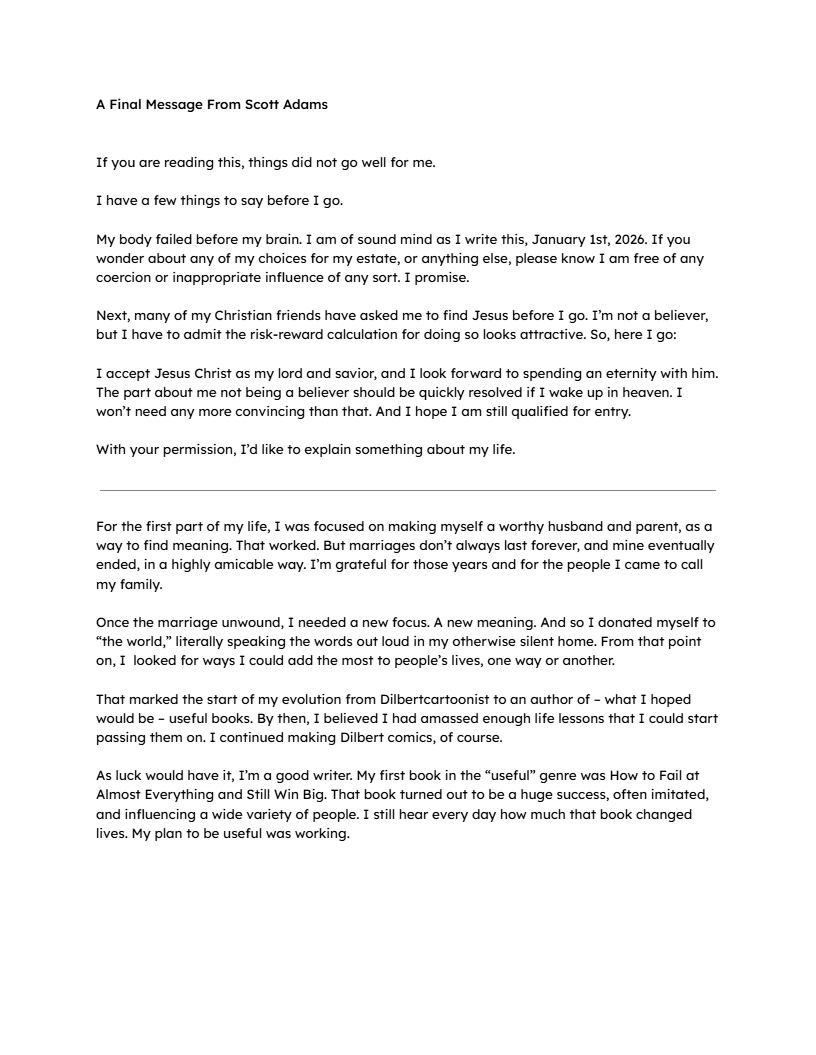
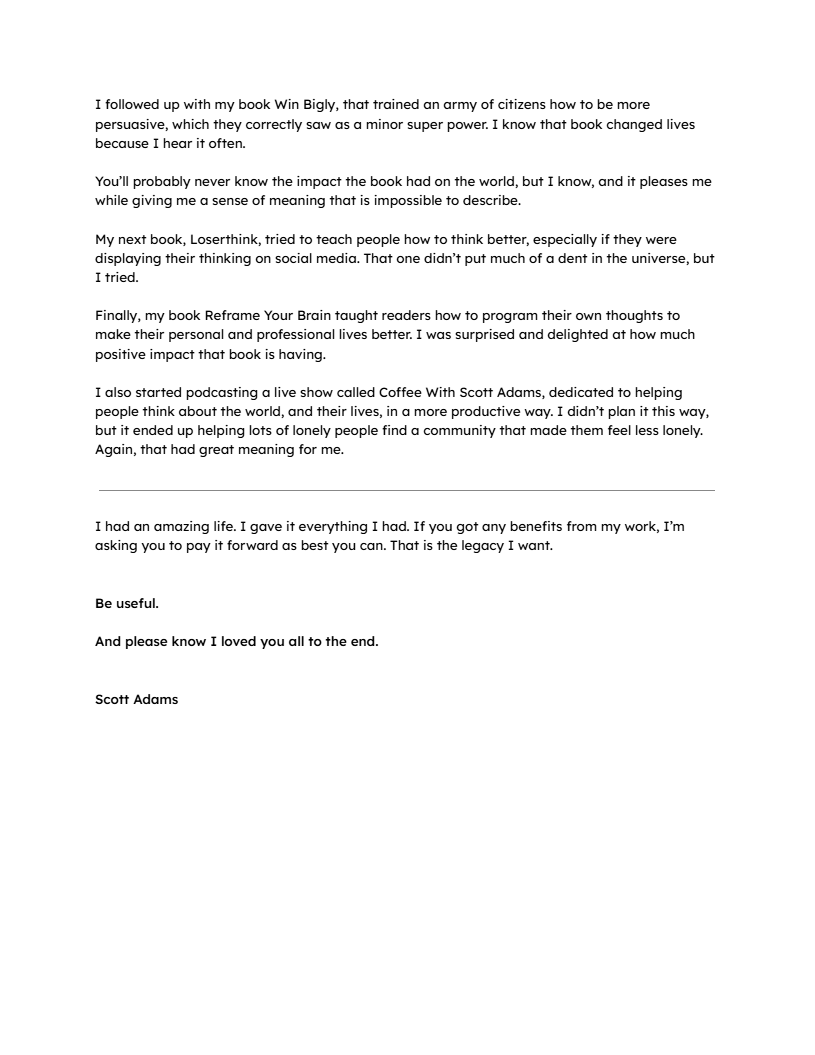
A Final Message From Scott Adams
Scott Adams tweet mediaScott Adams tweet media
English
13.1K
31.9K
191.3K
43.1M
Akash Bhate ✨
Akash Bhate ✨@akashbhate·
@karpathy: “I had this wrong for decades. Agency > Intelligence.” This changes everything. High agency: “I’ll figure it out” → actually does Low agency: Waits for luck, permission, perfect conditions. AI makes intelligence free. But it can’t make you DO anything. Agency is the new scarce resource. Are you acting like you have 10X more agency than you think you do? That’s the question.
English
0
0
0
15
Akash Bhate ✨
Akash Bhate ✨@akashbhate·
@karpathy: “I had this wrong for decades. Agency > Intelligence.” This changes everything. High agency: “I’ll figure it out” → actually does Low agency: Waits for luck, permission, perfect conditions. AI makes intelligence free. But it can’t make you DO anything. Agency is the new scarce resource. Are you acting like you have 10X more agency than you think you do? That’s the question.
English
0
0
0
10
Akash Bhate ✨
Akash Bhate ✨@akashbhate·
@karpathy: “I had this wrong for decades. Agency > Intelligence.” This changes everything. High agency: “I’ll figure it out” → actually does Low agency: Waits for luck, permission, perfect conditions. AI makes intelligence free. But it can’t make you DO anything. Agency is the new scarce resource. Are you acting like you have 10X more agency than you think you do? That’s the question.
English
0
0
0
11
Akash Bhate ✨
Akash Bhate ✨@akashbhate·
@balajis Yeah, moving in that direction. The scarcest resource I see isn’t compute, tech or capital, it’s organizational trust, and people. Until technologists learn to build inside existing systems, capital still decides velocity.
English
0
0
1
16
Balaji
Balaji@balajis·
The technologist is the capitalist of the 21st century.
English
238
323
3K
141.4K
Akash Bhate ✨
Akash Bhate ✨@akashbhate·
Great list, broadly agree w/direction: 2026 is less about AI capability leaps and more about friction, cost scrutiny, reliability, observability, power, and governance. The winners won’t be shiny or smartest agents, but ones that make AI boring, accountable, and economically obvious.
English
2
0
4
1.4K
Tomasz Tunguz
Tomasz Tunguz@ttunguz·
11 Predictions for 2026 Every year I make a list of predictions & score last year’s predictions. 2025 was a good year : I scored 7.85 out of 10. Here are my predictions for 2026 : 1. Businesses pay more for AI agents than people for the first time. This has already happened with consumers. Waymo rides cost 31% more than Uber on average, yet demand keeps growing. 1 Riders prefer the safety & reliability of autonomous vehicles. For rote business tasks, agents will command a similar premium as companies factor in onboarding, recruiting, training, & management costs. 2. 2026 becomes a record year for liquidity. SpaceX, OpenAI, Anthropic, Stripe, & Databricks IPO, with SpaceX & OpenAI ranking among the ten largest offerings ever. The pent-up demand from 4+ years of drought finally breaks. Fear of disruption by fast-growing AI systems drives defensive acquisitions exceeding $25b as incumbents buy rather than build. 3. Vector databases resurge as essential infrastructure in the AI stack. Multimodal models & world/state-space models demand new data architectures. Vector databases grow revenue explosively as they become the connective tissue between foundation models & enterprise data. 4. AI models execute tasks autonomously for longer than a workday. According to METR, AI task duration doubles every 7 months. 2 Current frontier models reliably complete tasks taking people about an hour. Extrapolating this trend, by late 2026, AI agents will autonomously execute 8+ hour workstreams, fundamentally changing how companies staff projects. 5. AI budgets receive scrutiny for the first time. Buying committees & boards push back on AI spend. Small language models & open-source alternatives rise in popularity as research labs determine how to specialize them for particular tasks, achieving state-of-the-art performance at a fraction of the cost. Developers prefer them for 10x cost reductions. 6. Google distances itself from competitors via breadth in AI. No other company achieves breakthroughs across as many domains : frontier models, on-device inference, video generation, open-source weights, & search integration. Google sets the pace, forcing OpenAI, Anthropic, & xAI to specialize in response. The era of every lab competing on every frontier ends. 7. Agent observability becomes the most competitive layer of the inference stack. Engineering observability, security observability, & data observability fuse into a single discipline. Agents require unified visibility across code execution, threat detection, & data lineage. This marks the beginning of the confluence I predicted in 2025 : the three observability spaces finally converge. 8. 30% of international payments are issued via stablecoin by December. The efficiency gains in cross-border settlement are too large to ignore. As regulatory clarity improves in major markets, stablecoins move from the periphery of crypto to the core of global trade finance, displacing traditional SWIFT rails for a significant portion of B2B volume. 9. Agent data access patterns stress & break existing databases. Agents issue at least an order of magnitude more queries to databases & data lakes than people ever did. This surge in concurrency & throughput requirements forces a redesign of the overall architecture for both transactional & analytical databases to handle the relentless demand of autonomous systems. 10. The data center buildout reaches 3.5% of US GDP in 2026. The scale of investment mirrors the historical expansion of the railroads. The only factor that slows overall building is perceived risk within the credit market, particularly in the private credit market. The massive growth in that asset class suddenly shows strains of increasing default rates, creating a potential bottleneck for the most capital-intensive infrastructure projects. 11. The web flips to agent-first design. Most developer documentation & many websites become agent-first rather than people-first. This shift occurs because many purchasing decisions are now informed first through agentic research. Consequently, the front door needs to be designed for robots, while the side door caters to people.
GIF
English
132
348
2.1K
526.8K
Akash Bhate ✨
Akash Bhate ✨@akashbhate·
Memory & Judgment The most useful thing AI can do isn’t predict the future. It’s remind you how similar situations turned out last time.
English
0
0
2
23