Alexander Witpas

2K posts

Alexander Witpas banner
Alexander Witpas

Alexander Witpas

@alexanderwitpas

Criminologist, sexologist, working in public health policy, with a particular interest in boys and men. All views my own. Retweet is not endorsement.

Antwerp, Belgium Katılım Nisan 2009
697 Takip Edilen167 Takipçiler
Alexander Witpas retweetledi
Jesús Fernández-Villaverde
Jesús Fernández-Villaverde@JesusFerna7026·
Smartphones are not the explanation for the recent decline in fertility. Instead, they are an accelerator of deeper forces already at work. Let’s start with the facts. Fertility is falling almost everywhere: in rich, middle-income, and poor countries; in secular and religious countries; and in countries with high and low levels of gender equality. The decline accelerated around 2014. So, no country-specific explanation will work unless you are willing to believe that 200 distinct country-specific explanations arrived at roughly the same time. Smartphones look like the obvious candidate: the first iPhone was released in 2007, and global adoption has been astonishingly fast. Economists understand the first major decline in fertility in advanced economies, from 6 or 7 children per woman throughout most of human history to about 1.8, that occurred between the early 1800s and roughly 1970, well before smartphones. The main drivers were a sharp fall in child mortality (effective fertility was rarely above 3 and often close to 2) and the shift from a low-skill, rural agrarian economy to a high-skill, urban industrial one. We have quantitative models that fit these facts well. Country-specific factors mattered too, of course. Proximity to low-fertility neighbors accelerated Hungary’s decline, while fragmented landowning structures accelerated France’s. But these were second-order mechanisms. This is also why most economists long considered Paul Ehrlich’s doom scenarios implausible. We forecast that fertility in middle- and low-income economies would follow the same path as in the rich, probably faster, because reductions in child mortality reached India or Africa at lower income levels (medical technology is nearly universal, and most gains come from handwashing and cheap antibiotics, not Mayo Clinic-level care). Much of what we see in Africa or parts of Latin America today is still that old story. But in the 1980s, a new pattern appeared. Japan and Italy fell below 1.8, the level we had thought was the new floor. By 1990, Japan was at 1.54 and Italy at 1.36. This second fertility decline began in Japan and Italy earlier than elsewhere, driven by country-specific factors, but the underlying dynamics were widespread: secularization, an education arms race, expensive housing, the dissolution of old social networks, and the shift to a service economy in which women’s bargaining power within the household is higher. The U.S. lagged because secularization came later, suburban housing remained relatively cheap, and African American fertility was still high. U.S. demographic patterns are exceptional and skew how academics (most of whom are in the U.S.) and the New York Times see the world. My best guess is that, without smartphones, Italy’s 2025 fertility rate would be about 1.24 rather than 1.14. I doubt anyone will document an effect larger than 0.1-0.2. Italy was at 1.19 in 1995, not far from today’s 1.14. The TFR is cyclical due to tempo effects, so I do not read too much into the rise between 1995 and 2007 or the decline from 1.27 in 2019 to 1.14 today. The direct effect of smartphones is not zero, but it is not, by itself, that large. Where social media, in general, and smartphones, in particular, matter is in the diffusion of social norms. What would have taken 25 years now happens in 10. Social media are not the cause of fertility decline; modernity is. But they are a very fast accelerator. That is why social media are a major part of the story behind Guatemala (yes, Guatemala) going from 3.8 children per woman in 2005 to 1.9 in 2025. Without them, Guatemala would also have reached 1.9, just 20 years later. Modernity, in its current form, is incompatible with replacement-level fertility. By modernity, I do not mean capitalism: fertility fell earlier and faster in socialist economies than in market economies. Socialist Hungary fell below replacement in 1960, and socialist Czechoslovakia in 1966 (both experienced small, short-lived baby booms in the mid-1970s). By modernity, I mean a society organized around rational, large-scale systems and formalized knowledge. Countries will not converge to the same fertility rate. East Asia is likely stuck near 1, possibly below, given its unbalanced gender norms and toxic education systems. Latin America faces the same gender problem plus weak growth prospects, so I expect something around 1.2. Northern Europe has more egalitarian family structures and might hold near 1.5. The very religious societies are probably the only ones that will sustain 1.8. All of this could change with AI or changes in population composition. We will see. But on the current evidence, deep sub-replacement fertility is the “new new normal.” Unless we reorganize our societies, better learn to handle it as best we can.
Jesús Fernández-Villaverde tweet media
English
160
714
2.8K
573.1K
Alexander Witpas retweetledi
Steven Pinker
Steven Pinker@sapinker·
Speaking Truth to Power Is bad for truth, notes philosopher Dan Williams @danwilliamsphil. "Intellectual courage is extremely important. But without first carefully establishing what’s true, it’s either pointless or harmful. So intellectuals’ primary responsibility is simply to seek and speak the truth, full stop. This job description is less heroic, but it’s more intellectually and socially useful, and it’s less vulnerable to self-deception precisely because it’s less heroic." open.substack.com/pub/conspicuou…
English
0
89
359
25.7K
Alexander Witpas retweetledi
John McDermott
John McDermott@mcdermott·
There's an entire genre of journalism now that writes about tensions between men and women without even trying to get the male perspective. Aside from being bad journalistic practice, this is bad societally — it furthers the resentment and widens the gender divide.
Foundational White Janissary@White_Janissary

We really need to address the true scourge of modern media: the unchecked proliferation of the “I interviewed 5 random middle class women and an adjunct professor at a mid-sized university and found out men are the problem” genre of femslop article.

English
54
194
1.7K
59K
Alexander Witpas retweetledi
Benedict Janssen
Benedict Janssen@BenedictJansse2·
Jarl over Loosdrecht en Jarl over de UvA rellen.
Benedict Janssen tweet mediaBenedict Janssen tweet media
Nederlands
75
410
1.6K
63.8K
Alexander Witpas retweetledi
TheTinMen
TheTinMen@TheTinMenBlog·
Most shocking was the biggest disparity in unilateral violence was in middle/high school samples, where girls were 2.5 TIMES (!) more likely to be unilaterally violent than boys. This surely shines new light on why BOTH girls and boys should be taught about the dangers of IPV?
TheTinMen tweet mediaTheTinMen tweet mediaTheTinMen tweet media
English
2
26
111
3.1K
Alexander Witpas retweetledi
James L. Nuzzo, PhD
James L. Nuzzo, PhD@JamesLNuzzo·
In my latest essay at The Nuzzo Letter, I show how the United Nations suppressed data that it collected from male research participants.
James L. Nuzzo, PhD tweet media
English
0
29
133
8.3K
Alexander Witpas retweetledi
Dr John Barry
Dr John Barry@MalePsychology·
Interesting, but spare us the BS about how "we don't know about sex differences because A: Historically, medical studies have primarily focused on men". In reality, sex differences research was considered sexist and widely discouraged neurosciencenews.com/sex-dependent-… via @neurosciencenew
English
2
9
60
6K
Alexander Witpas retweetledi
Dr John Barry
Dr John Barry@MalePsychology·
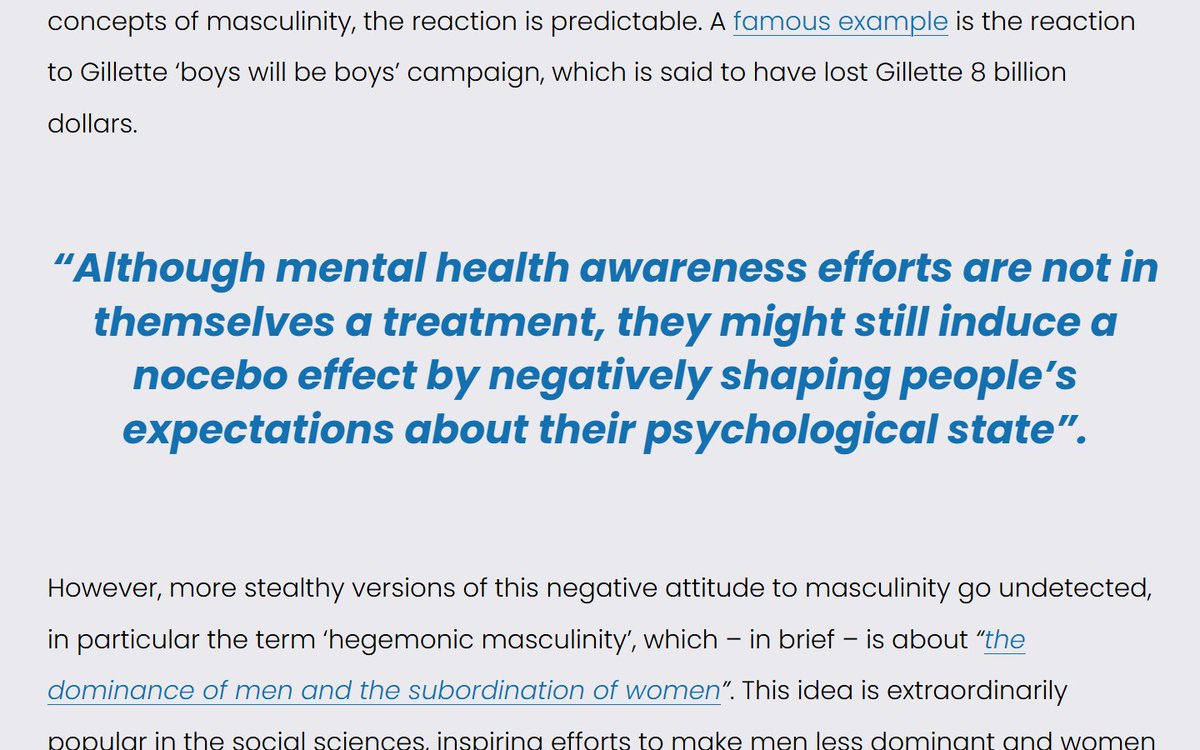
"Inaccurate concepts based on ideology, such as patriarchy theory, should not be considered part of mental health awareness". “Blaming his behaviour on masculinity or patriarchy might misunderstand his situation, and he might end up feeling worse". centreformalepsychology.com/male-psycholog…
Dr John Barry tweet media
English
1
14
47
1.5K
Alexander Witpas retweetledi
Richard V. Reeves
Richard V. Reeves@RichardvReeves·
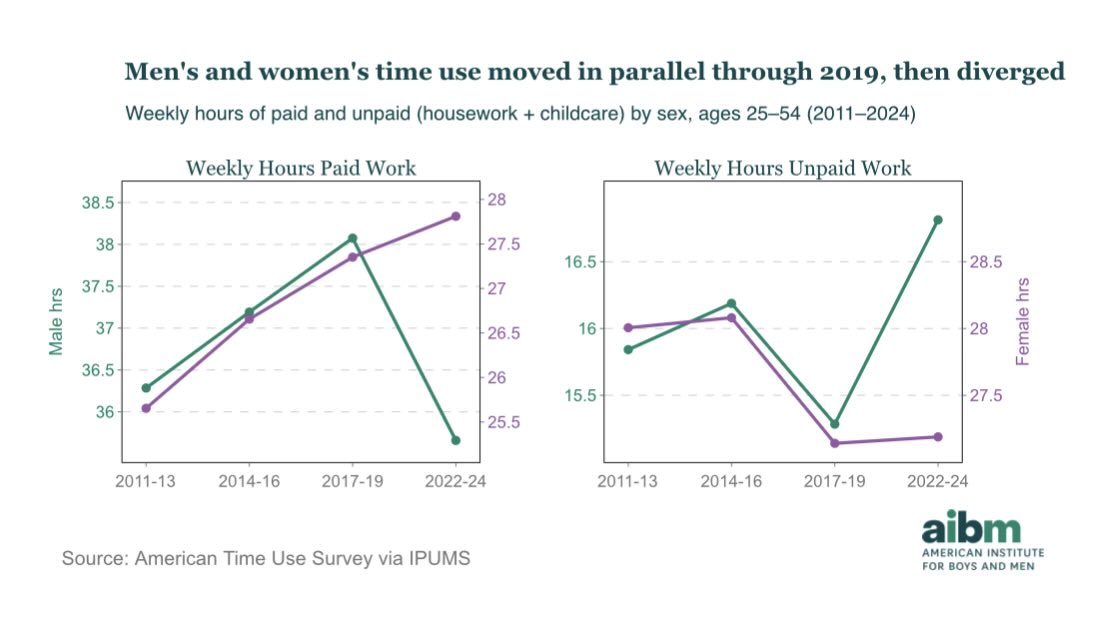
Meanwhile. far from the frontlines of the culture wars, an astonishing shift has taken place in fatherhood. The gender gap in both paid AND unpaid has closed by 4 hours just since 2019. New research at @aibm_org by Ari Binder: aibm.org/research/the-g…
Richard V. Reeves tweet media
English
6
18
59
25.6K
Alexander Witpas retweetledi
Dr John Barry
Dr John Barry@MalePsychology·
This is an important finding - therapy works less well for men than women for self-harm. Great to see the @BPSOfficial guidance cited as identifying likely improvements. It was authored by myself and @SeagerMJ, but with a huge amount of useful input from the BPS membership 🙏
Centre for Male Psychology@CentreMalePsych

New @TheLancet review finds therapy (e.g. CBT) for self-harm is "more effective for females than for males" sciencedirect.com/science/articl… When suggesting future directions for research and policy, the review cites the @BPSOfficial guidance on therapy for men cms.bps.org.uk/sites/default/…

English
2
19
62
7.3K
Alexander Witpas retweetledi
Rob Henderson
Rob Henderson@robkhenderson·
One possible effect of MeToo is that now you see plenty of perfectly normal guys who are genuinely afraid of being accused of something—harassment, coercion, intimidation, whatever it may be. I think people misunderstood what young men are actually like and overinterpreted the problem. Yes, there’s always some small percentage of genuine predators out there—people who are basically immune to laws, shame, or stigma. They’re going to be predators no matter what barriers you put in front of them. But the average guy is not like that. The average young guy, when he’s repeatedly told about toxic masculinity, that men are the problem, “the future is female,” and that he constantly needs to prove he respects women, starts to internalize something different. He thinks, I should just hang back. I shouldn’t do anything. I don’t want to make anyone uncomfortable. So he ends up walking on eggshells. When I think back to high school, the average guy already needed basically every condition to be perfect just to make a move. In some ways, it’s amazing anyone ever pairs up at all. I think about my best friend in high school—I lived with him our senior year. He had a crush on this girl in our class for ages. She liked him too; we knew from her friends. It was the classic setup where everyone knew, everyone was talking, and everyone was rooting for them. His friends told her friends. Her friends told him. I told my friend. The entire social machinery was working overtime to make this happen. And still, it felt impossible. Finally, he walks up to her, and I’m standing maybe ten feet away pretending not to listen. He says, “Hey, our friends have been talking, and I guess I should tell you I like you…” He was terrified. He even said, “I can’t believe how hard this is for me.” She was encouraging him: “It’s okay. You can ask.” He says, “I want to ask you something.” She says, “It’s okay. You can ask.” And he says, “I don’t know if I can.” That’s your typical 17-year-old boy. All the nerves, all the emotional energy, all the fear of asking a girl out for the first time. Finally, after all of that, he asks: “Will you go out with me?” She says yes. This is with mutual attraction, friend approval, social permission—basically a green light from the universe. And he was still terrified. Now imagine that same boy growing up hearing over and over: don’t bother women, leave them alone, don’t approach, don’t be creepy, don’t be a toxic male. At some point, the average guy doesn’t become more respectful—he just becomes more passive.
English
21
124
1.1K
83.6K
Alexander Witpas retweetledi
TheTinMen
TheTinMen@TheTinMenBlog·
The world loves telling suicidal men to “talk”. As if saying that four letter word to a man in distress, is the complete solution to all his problems. But what if research was showing us that the majority of men who died by suicide, did talk, but ended up taking their lives none-the-less? When does it become time to ask: maybe we’re not listening in the way men want to be heard? Maybe we cannot hear, what men are already telling us? Well, as politicians and policy makers drag their feet in asking such questions, an entire industry of ‘social prescription’ organisations has exploded onto the UK mens health scene, to create the spaces men have been crying out for. And they’re not clinical one-to-one therapy sessions in the traditional way. They’re DIY workshops, or hiking societys, they’re breakfast clubs, footie games, and talking circles; they’re deep in the wilderness, atop mountains, doing laps of your neighborhood park, and in the backroom of the local pub. Men are already “doing the work”, building the spaces our politicians have failed to provide. So here’s a massive shout out to the life saving work of these budding organisations, that so many men call home… @andysmanclubuk @manvfat @talkclubcharity @StrongmenOrgUk @UKMensSheds @BlokesClub @MandemMeetup @SShaljean ~ Research – Why men drop out of therapy pubmed.ncbi.nlm.nih.gov/34041980/ Suicide of middle aged men sites.manchester.ac.uk/ncish/reports/…
English
14
48
257
4.1K
Alexander Witpas retweetledi
Daniel Friedman
Daniel Friedman@DanFriedman81·
In the 2000s, Esquire and GQ had large subscriber-bases among men and magazines like Maxim and Details were also very popular with nearly entirely male audiences, in addition to numerous print magazines focusing on gaming, cars, and various male-dominated hobbies. Men were a large segment among readers of literary fiction, and there were male editors acquiring books that were of interest to male audiences. Now the entire print media, online media and publishing ecosystem is female dominated and female serving. This audience is still there. Half the population is still men. What happened? Did all this stuff get usurped by YouTube? Or did they just abandon their audience?
John McDermott@mcdermott

My pitch for a The Cut for men.

English
38
32
533
113.3K
Alexander Witpas
Alexander Witpas@alexanderwitpas·
@jenteach13 Also: let parents remove teachers who are clearly unfit to teach, and let them remove teaching materials that are disorganized, incorrect, or simply stupid.
English
0
0
0
22
Jen
Jen@jenteach13·
You want to fix education? Let teachers remove kids who make it impossible for everyone else to learn.
English
404
577
10.3K
229.8K
Alexander Witpas retweetledi
TheTinMen
TheTinMen@TheTinMenBlog·
Men are always the yard stick from which we measure women. Women’s health, women’s salary, women’s education, women’s life expectency, and happiness; you name it, one way or another, I am sure it has been measured many times, against men...
TheTinMen tweet media
English
3
7
112
2.4K
Alexander Witpas retweetledi
Lisa Britton
Lisa Britton@LisaBritton·
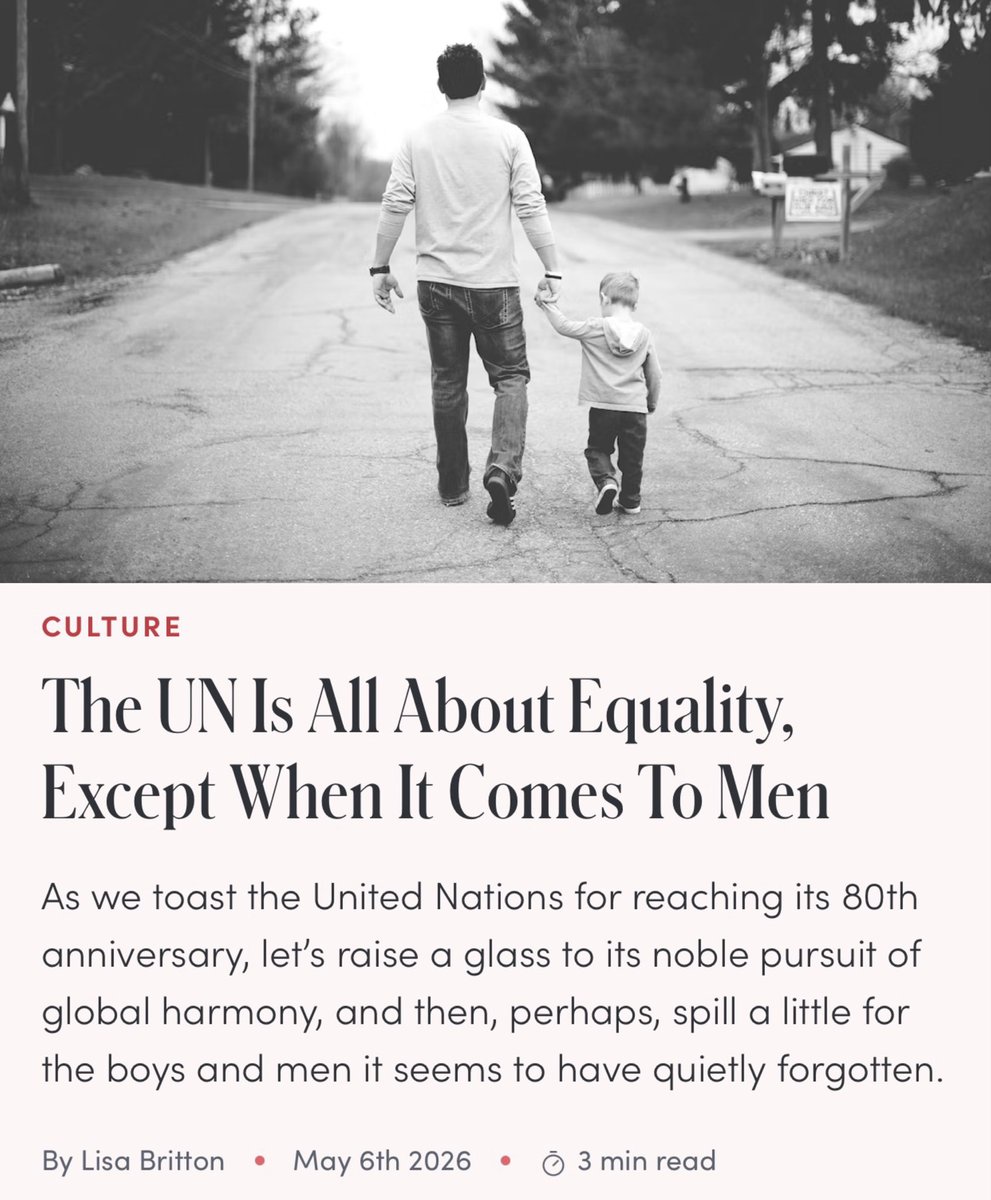
I spoke with two senior UN officials in New York City, in town for the UN General Assembly in September, who revealed a troubling reality: the UN’s obsession with one-sided gender equality has morphed into systemic discrimination—against men. Within the organization, hiring and promotion decisions right up to the top are increasingly driven by identity rather than merit. If you're a young man today hoping to secure a job in the UN, there's no doubt that it will be difficult. Gender parity has already been reached and maintained since 2018 (50% women) in senior-level roles, and 60% of field staff are women today. Yet when there’s a selection process, those hiring must indicate that women have received due consideration and, in the case that a man is preferred, 𝘦𝘹𝘱𝘭𝘢𝘪𝘯 𝘸𝘩𝘺. As a woman myself, I find this infantilizing. It suggests that women need a handicap to compete, undermining the very equality the UN claims to champion. Ignoring men’s issues while mandating justifications for hiring them isn’t equality. That's bias and sexism dressed up in progressive jargon. Read more: eviemagazine.com/post/the-un-is…
Lisa Britton tweet media
English
46
189
795
15.6K
Jill Filipovic
Jill Filipovic@JillFilipovic·
I have rarely met a woman whose standards were too high and very often met women whose standards were far too low.
English
24
76
1K
30.2K