Alfredo De la Fuente
2.8K posts

Alfredo De la Fuente
@alfo_512
swe @Google | prev @Meta


New blackboard lecture w @ericjang11 He walks through how to build AlphaGo from scratch, but with modern AI tools. Sometimes you understand the future better by stepping backward. AlphaGo is still the cleanest worked example of the primitives of intelligence: search, learning from experience, and self-play. You have to go back to 2017 to get insight into how the more general AIs of the future might learn. Once he explained how AlphaGo works, it gave us the context to have a discussion about how RL works in LLMs and how it could work better – naive policy gradient RL has to figure out which of the 100k+ tokens in your trajectory actually got you the right answer, while AlphaGo’s MCTS suggests a strictly better action every single move, giving you a training target that sidesteps the credit assignment problem. The way humans learn is surely closer to the second. Eric also kickstarted an Autoresearch loop on his project. And it was very interesting to discuss which parts of AI research LLMs can already automate pretty well (implementing and running experiments, optimizing hyperparameters) and which they still struggle with (choosing the right question to investigate next, escaping research dead ends). Informative to all the recent discussion about when we should expect an intelligence explosion, and what it would look like from the inside. Timestamps: 0:00:00 – Basics of Go 0:08:06 – Monte Carlo Tree Search 0:31:53 – What the neural network does 1:00:22 – Self-play 1:25:27 – Alternative RL approaches 1:45:36 – Why doesn’t MCTS work for LLMs 2:00:58 – Off-policy training 2:11:51 – RL is even more information inefficient than you thought 2:22:05 – Automated AI researchers


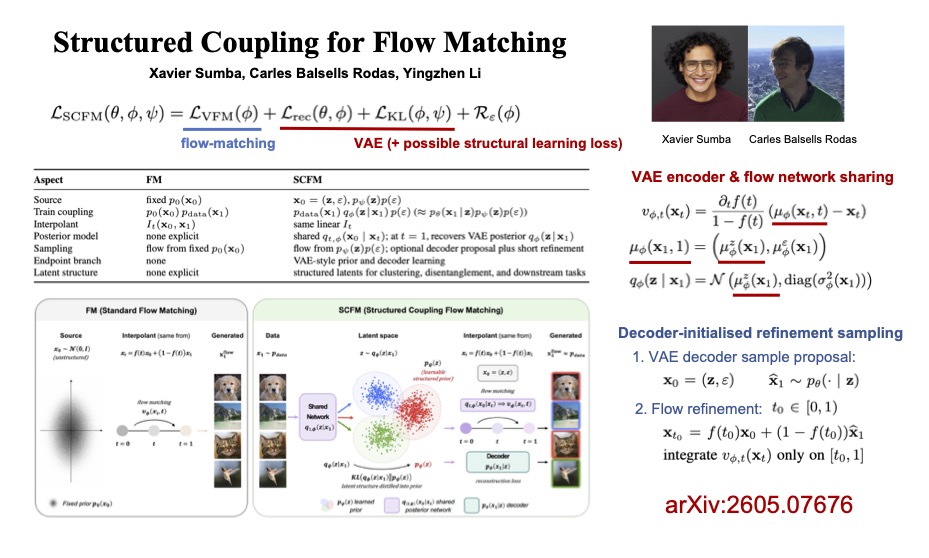
Tons of papers re diffusion/flow matching at ML confs these days, but to my surprise very few of them consider learning the prior🤔 Am I missing any important work here? 🙏 for suggestions


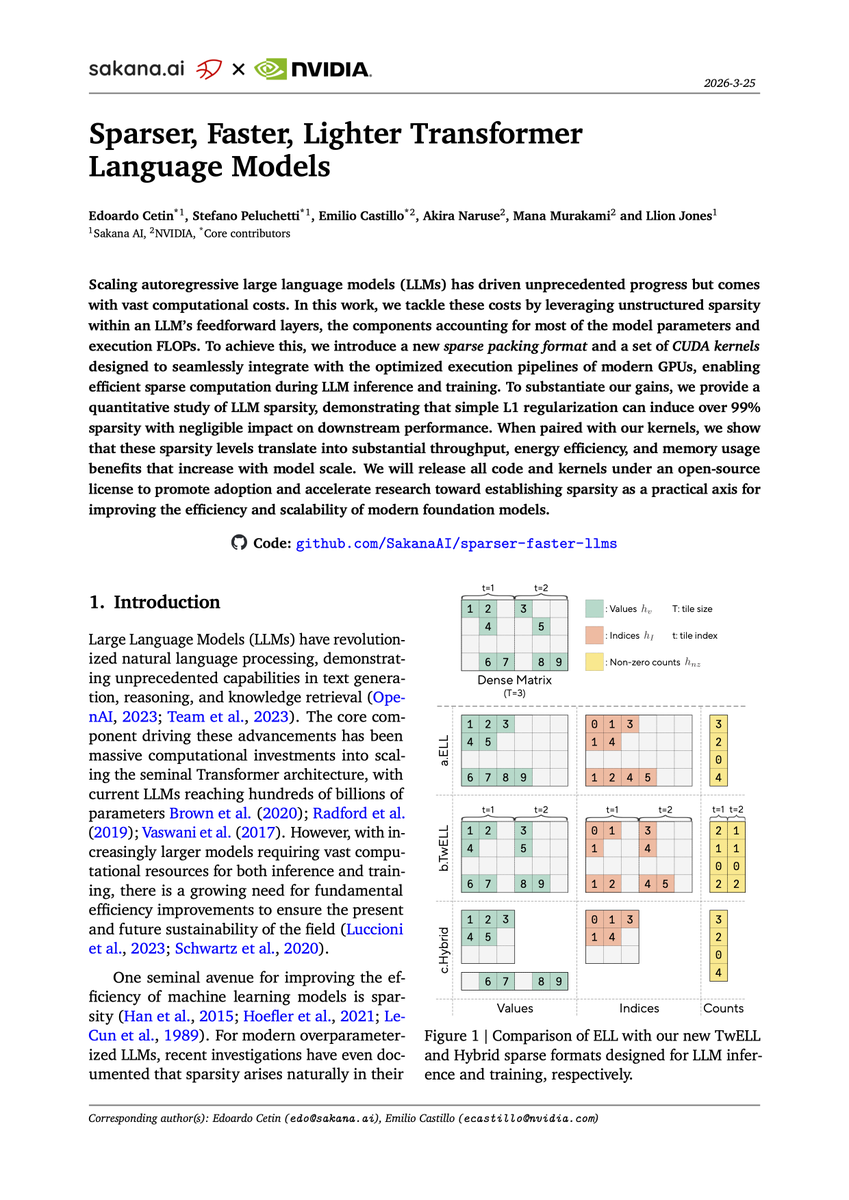
How do we make LLMs faster and lighter? Don’t force the GPU to adapt to sparsity. Reshape the sparsity to fit the GPU! ⚡️ Excited to share our new #ICML2026 paper in collaboration with @NVIDIA: "Sparser, Faster, Lighter Transformer Language Models". This work introduces new open-source GPU kernels and data formats for faster inference and training of sparse transformer language models: Paper: arxiv.org/abs/2603.23198 Blog: pub.sakana.ai/sparser-faster… Code: github.com/SakanaAI/spars… While LLMs are undoubtedly powerful, they are increasingly expensive to train and deploy, with a large part of this cost coming from their feedforward layers. Yet, an interesting phenomenon occurs inside these layers: For any given token, only a small fraction of the hidden activations actually matter. The rest approximate zero, wasting computation. With ReLU and very mild L1 regularization, this sparsity can exceed 95% with little to no impact on downstream performance. So, can we leverage this sparsity to make LLMs faster? The challenge is hardware. Modern GPUs are optimized for dense matrix multiplications. Traditional sparse formats introduce irregular memory access and overheads that cancel out their theoretical savings for GEMM operations. Our contribution is twofold: 1/ We introduce TwELL (Tile-wise ELLPACK), a new sparse packing format designed to integrate directly in the same optimized tiled matmul kernels without disrupting execution. 2/ We develop custom CUDA kernels that fuse multiple sparse matmuls to maximize throughput and compress TwELL to a hybrid representation that minimizes activation sizes. We used our kernels to train and benchmark sparse LLMs at billion-parameter scales, demonstrating >20% speedups and even higher savings in peak memory and energy. This work will be presented at #ICML2026. Please check out our blog and technical paper for a deep dive!


you can outsource your thinking but you cannot outsource your understanding


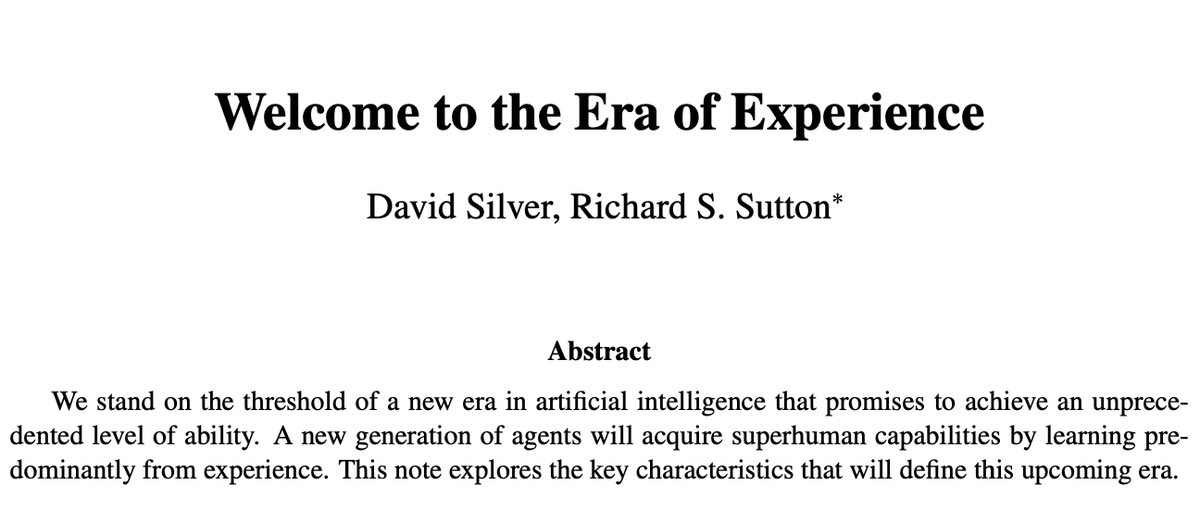
Introducing Ineffable Intelligence. Led by David Silver, we're assembling the best engineers and researchers in the world to make first contact with superintelligence. We’ll be solving the hardest problems in AI on the way. Come join us. ineffable.ai