Alexander Graef

5.7K posts

Alexander Graef banner
Alexander Graef

Alexander Graef

@alxgraef

Senior Policy Fellow @theELN | Russia-West | Security | Strategy | @YGLNtweets member | fmr ACONA Fellow | fmr @IFSHHamburg | bluesky: https://t.co/XTK5Y3BjlU

Hamburg, Deutschland Katılım Ocak 2015
2K Takip Edilen6.7K Takipçiler
Sabitlenmiş Tweet
Alexander Graef
Alexander Graef@alxgraef·
New report: The confrontation between Russia and other European states is not a temporary crisis but a long-term condition that must be managed. In this new policy report I suggest three interdependent elements for a European strategy. 1/4 europeanleadershipnetwork.org/report/managin…
English
1
3
12
1.2K
Alexander Graef
Alexander Graef@alxgraef·
@Wright_T_J True. Experts adapt in diff ways but they do so similarly when pol pluralism is limited. When your relevance/position ties you to service for either state or society, wiggle room is narrow. In Russia, current alternatives are exit (silence/irrelevance), exile or imprisonment.
English
0
0
0
20
Timothy Wright
Timothy Wright@Wright_T_J·
@alxgraef His positions are more extreme now than they were pre February 2022. Just an observation
English
1
0
0
47
Alexander Graef
Alexander Graef@alxgraef·
Trenin as the new RIAC President — an interesting choice. A long-standing figure in #Russia’s expert community, yes, but unlike Ivanov he lacks recent within-system experience and political weight. Ivanov was a career diplomat, Foreign Minister, and Security Council Secretary 1/3
Andrey Baklitskiy@baklitskiy

Dmitry Trenin, formerly Director of Carnegie Moscow and now with Higher School of Economics and IMEMO, was elected to be the next President of the @Russian_Council instead of the former foreign minister Igor Ivanov

English
2
1
14
3.3K
Alexander Graef
Alexander Graef@alxgraef·
3/3 Still, both Trenin and Ivanov have good and personal ties to the policy expert community. Ivanov was exceptional in this regard, bridging bureaucracy and academia since the 1970s. I once asked Karaganov, whose views he valued most, he named only two people - one was Trenin.
English
3
0
3
737
Alexander Graef
Alexander Graef@alxgraef·
2/3 This difference matters — it reflects a broader shift in Russia’s expert community (more in forthcoming publications). Earlier, experts often had real political experience from 1980s and 1990s. Trenin, as a former GRU officer, will be in many ways a transitionalfigure.
English
1
0
3
463
Alexander Graef
Alexander Graef@alxgraef·
Both Putin and Trump illustrate how ego and dysfunctional administrations can produce bad strategic decisions. Yet the U.S., like any dominant power, enjoys wider margins for error; Russia less so. Power may conceal the costs of such decisions, but it doesn’t make them sound.
English
0
1
10
698
Alexander Graef
Alexander Graef@alxgraef·
4/4 The central task going forward is to shape rivalry more deliberately - preserving political control, managing escalation risks, and sustaining European unity over time.
English
1
0
1
250
Alexander Graef
Alexander Graef@alxgraef·
New report: The confrontation between Russia and other European states is not a temporary crisis but a long-term condition that must be managed. In this new policy report I suggest three interdependent elements for a European strategy. 1/4 europeanleadershipnetwork.org/report/managin…
English
1
3
12
1.2K
Alexander Graef
Alexander Graef@alxgraef·
Reality check: there will be no EUropean army or joint nuclear deterrent anytime soon. The pol preconditions simply don’t exist. Let’s stop chasing illusions and focus on what works: practical, multispeed cooperation among willing states, but coordinated through EU mechanisms.
English
3
9
74
9.5K
Alexander Graef retweetledi
European Leadership Network (ELN)
President #Trump’s comments on #Greenland have prompted renewed debate about Arctic security, transatlantic relations and #NATO cohesion. With Danish and Greenlandic foreign ministers meeting Vance and Rubio this week, attention is turning to how coherent and credible European responses have been, and what this reveals about Europe’s ability to act on its security. Find out what @theELN members had to say in the latest Network Reflections 👉 ow.ly/rZwB50XWCIF
English
3
7
13
2.4K
Seva
Seva@SevaUT·
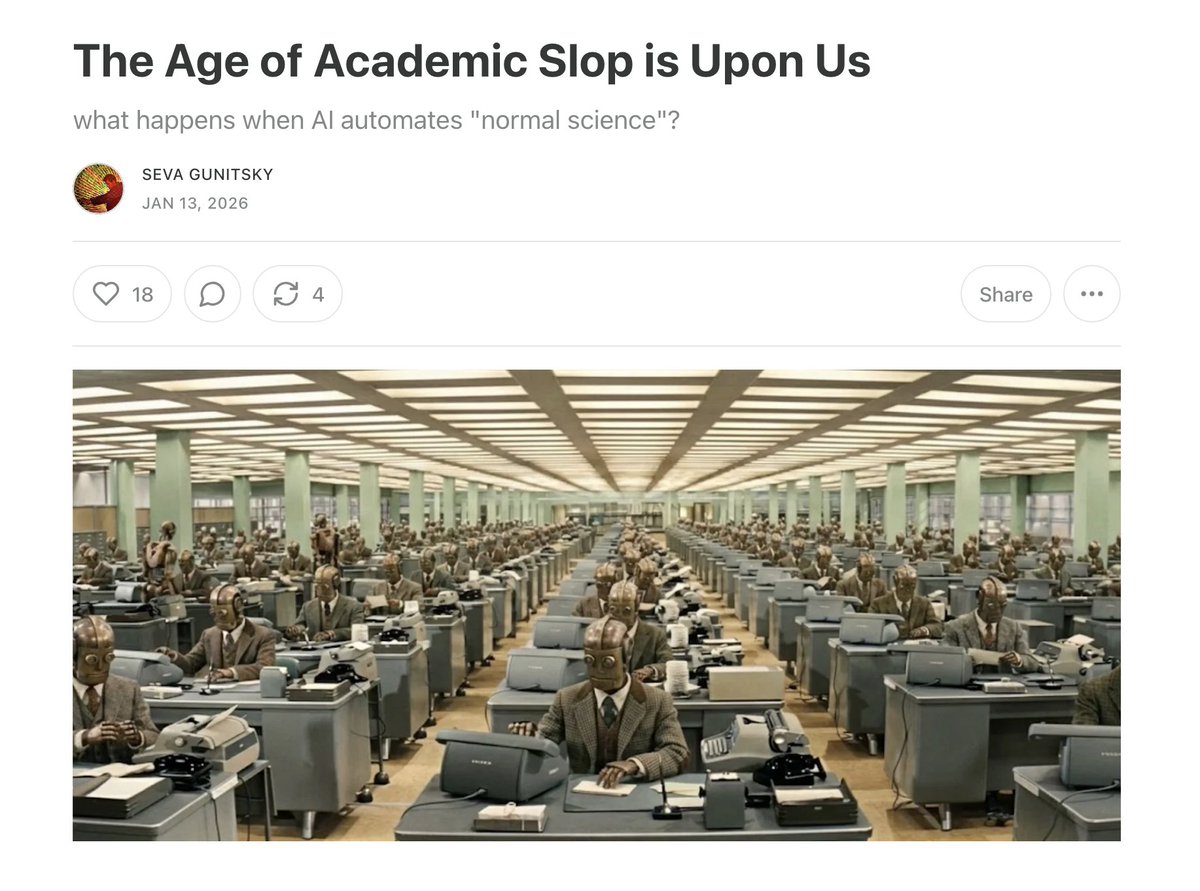
I just finished a three-year term as an editor at an international relations journal. I began at the start of the LLM era but ended right in the middle of it. Our volume of submissions tripled and our desk reject rate rose to 75%. I have some thoughts. link below
Seva tweet media
English
42
388
2.6K
190.6K
Alexander Graef
Alexander Graef@alxgraef·
"I suspect the value of original or elegant theory will become more important. Good quant work is becoming cheap and plentiful; good theory remains hard. Perhaps ethnographic work will become more valuable, and original data collection that AI still cannot do."
Seva@SevaUT

I just finished a three-year term as an editor at an international relations journal. I began at the start of the LLM era but ended right in the middle of it. Our volume of submissions tripled and our desk reject rate rose to 75%. I have some thoughts. link below

English
0
2
7
948
Alexander Graef retweetledi
Sabine Hossenfelder
Sabine Hossenfelder@skdh·
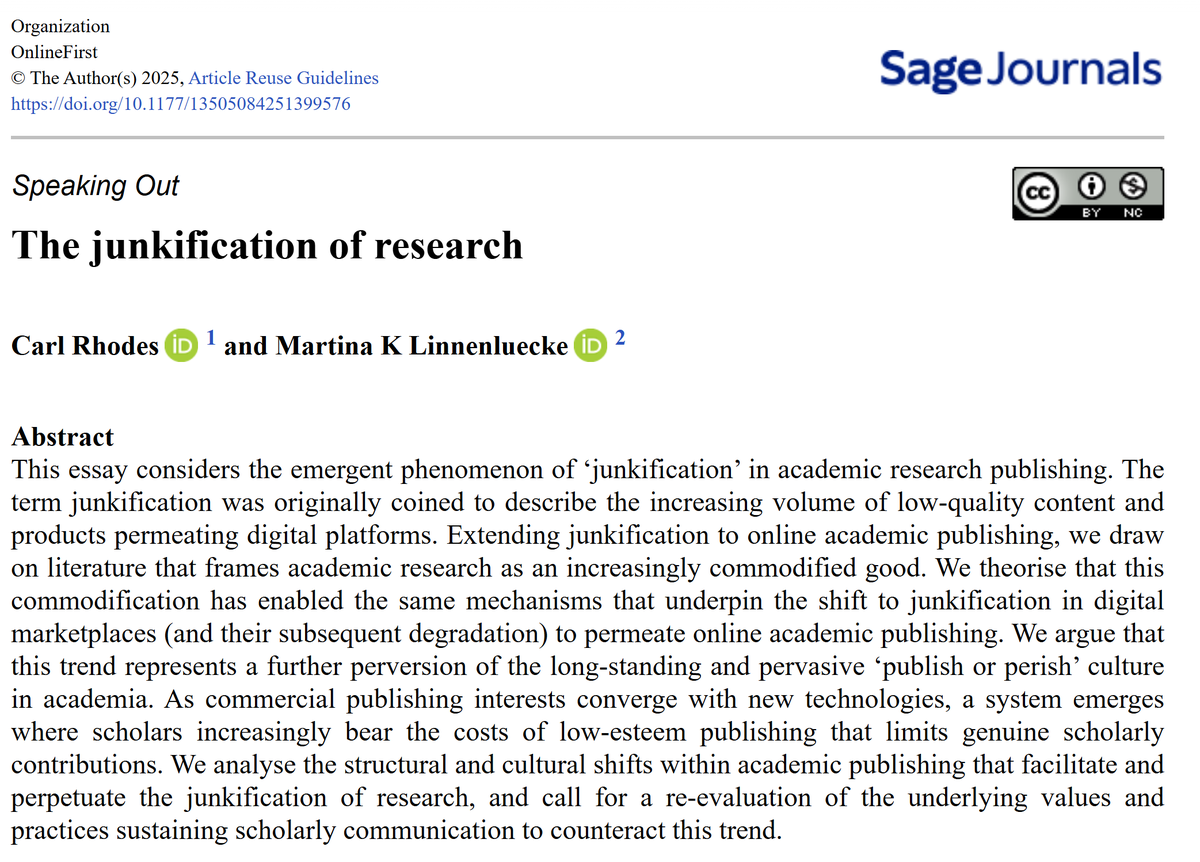
Two business school professors from the University of Technology in Sydney have sounded the alarm on the declining quality of academic literature in a new publication titled “The junkification of research”. Drawing parallels to the “enshittification” of online platforms, they argue that similar forces are now overwhelming scholarly publishing. The key drivers are threefold: 1) relentless “publish or perish” pressures in academia, 2) scientific publisher’s incentive to publish more to make more money, and 3) AI making paper production faster and easier. Taken together, they say, these drivers are a recipe for disaster. The authors call for a shift to not-for-profit models of scientific publishing and better evaluation systems. I strongly doubt either is going to happen. The problem is of course not new, and you all know that I have been drawing attention to this trend for more than a decade. It is interesting to see, however, that the awareness for the issue is increasing. Paper: Rhodes, C., & Linnenluecke, M. K., “The junkification of research” Organization (2025).
Sabine Hossenfelder tweet media
English
172
1.4K
5K
319.6K
Alexander Graef retweetledi
Franz-Stefan Gady
Franz-Stefan Gady@HoansSolo·
The preponderance of conventional military power around precision strikes (including raids) creates a strategic culture that favors quick tactical fixes—ostensibly low-cost but inherently very high-risk—over long-term strategic planning and execution. This institutional bias has been further amplified by the maturation of the precision strike regime, with the US still the leading power in this domain. What emerges is a “strike-as-strategy” paradox that continues to infuse US military culture: the substitution of episodic kinetic action for comprehensive strategic design, now reinforced by a political culture under the Trump administration that favors—indeed demands—televised displays of quick tactical fixes and precision strike capabilities. All of this creates a critical trade-off, however: while the recent US military action against Venezuela represents an awesome display of military prowess unmatched by any peer competitor, this very dominance could have the paradoxical consequence of making the US less ready for sustained, large-scale conventional war. Large-scale conventional warfare demands strategic depth—robust industrial mobilization, sustainable logistics, force regeneration capabilities, and the political resilience to absorb costs over extended periods, above all a coherent theory of success at the operational level linking it to a favorable political outcome at the strategic level—capacities that atrophy when military and strategic cultures become excessively oriented toward technologically sophisticated but strategically limited strike/raid operations.
English
7
77
268
32K
Alexander Graef
Alexander Graef@alxgraef·
@WegMitPutin This was the entire idea behind the Eurasian Economic Union. It did not work out as planned though. Do not forget that the Russian market is (still) very signifcant for many CIS members.
English
1
0
0
36
Alexander Graef
Alexander Graef@alxgraef·
The pursuit of spheres of influence is hardly new. What is changing is the animating ideology (civilizationism rather than neoliberalism), the primary instruments (military coercion over economic inducement), and the tolerance for external actors operating within those spheres.
English
1
1
7
752
Alexander Graef
Alexander Graef@alxgraef·
@WegMitPutin It's mostly true for Russia as well. Don't know enough about China to make the call.
English
1
0
0
29
Alexander Graef
Alexander Graef@alxgraef·
@SevaUT Agree, at least when compared to the resources they invest. For example, the simple fact that Medvedev (or rather, accounts operating under his name) continues to successfully troll Western media, making headlines not only on Twitter but elsewhere as well, is flabbergasting.
English
0
0
3
106
Seva
Seva@SevaUT·
@alxgraef blaming russia is a convenient excuse for people in the west to ignore internal grievances but also Russia is pretty effective at amplifying those pre-existing grievances or using them to nudge certain politicians into its orbit
English
1
0
2
169
Seva
Seva@SevaUT·
The best objection I’ve seen to the tripartite “sphere of influence” thesis is “What influence? Russia is too weak to control Ukraine, let alone Europe!” I agree that Russia is weak, but that doesn’t mean Putin isn’t trying to establish a sphere of influence. Quick thread 1/5
English
21
48
585
91.7K