Amanda Geiser

162 posts

Amanda Geiser

Amanda Geiser

@amandaegeiser

PhD student at @BerkeleyHaas studying decision making and consumer behavior

Berkeley, CA Katılım Ekim 2014
1K Takip Edilen831 Takipçiler
Sabitlenmiş Tweet
Amanda Geiser
Amanda Geiser@amandaegeiser·
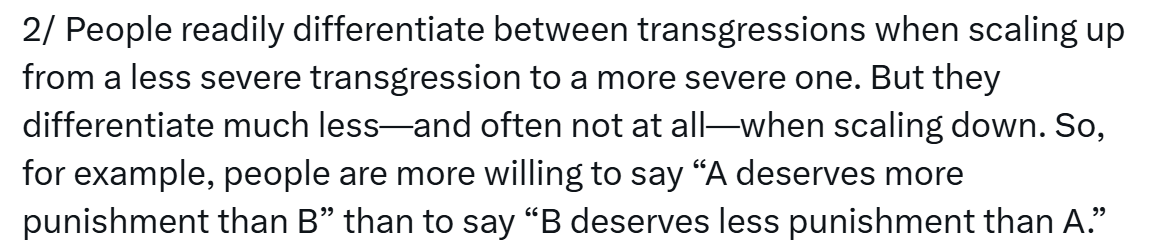
New paper with @IkeMDSilver1 and @deborahasmall just out at Psychological Science: People often compare bad acts to other bad acts. Is it worse to kill two people than to kill one? Should someone who assaulted an adult be punished less than someone who did the same to a child? We find that when making these kinds of judgments, the direction of comparison matters.
Amanda Geiser tweet media
English
4
27
143
31.3K
Amanda Geiser
Amanda Geiser@amandaegeiser·
5/ It's not totally clear why we failed to replicate the original results, in part because we don't have access to the data from the original studies. Nevertheless, in the paper we walk through several possible explanations for the discrepancies.
English
1
0
3
223
Amanda Geiser
Amanda Geiser@amandaegeiser·
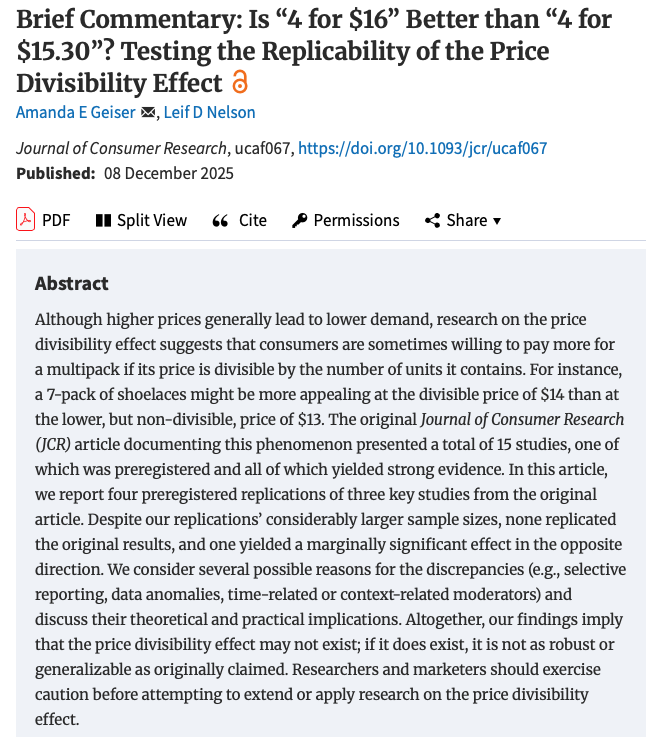
New commentary with Leif Nelson out at JCR. We attempted to replicate the "price divisibility effect": the idea that consumers prefer divisible prices (e.g., "4 for $16") over non-divisible ones (e.g., "4 for $15.30"). Across 4 preregistered replications -- using the exact same materials/measures as the original studies, and much larger sample sizes -- we found no evidence for such an effect.
Amanda Geiser tweet media
English
1
4
23
1.7K
Amanda Geiser retweetledi
Brian Guay
Brian Guay@BrianMGuay·
🚨Out today in PNAS @PNASNews🚨 pnas.org/doi/10.1073/pn… Why do people overestimate the size of politically relevant groups (immigrant, LGBTQ, Jewish) and quantities (% of budget spent on foreign aid, % of refugees that are criminals)? We analyze 100k estimates to find out🧵👇
Brian Guay tweet media
English
8
95
349
52.9K
Amanda Geiser
Amanda Geiser@amandaegeiser·
@StefanFSchubert @IkeMDSilver1 @deborahasmall not in the paper, but we've discussed it! We'd predict a similar asymmetry to arise in cases where it seems immoral to express insufficient praise (though I wouldn't be surprised if this is rarer for praiseworthy acts than blameworthy ones).
English
0
0
4
66
Stefan Schubert
Stefan Schubert@StefanFSchubert·
@amandaegeiser @IkeMDSilver1 @deborahasmall Nice. Btw did you look at whether there is a similar asymmetry in appraisals of morally praiseworthy acts? I could see that people treat them differently from transgressions in this regard.
English
1
0
3
92
Amanda Geiser
Amanda Geiser@amandaegeiser·
New paper with @IkeMDSilver1 and @deborahasmall just out at Psychological Science: People often compare bad acts to other bad acts. Is it worse to kill two people than to kill one? Should someone who assaulted an adult be punished less than someone who did the same to a child? We find that when making these kinds of judgments, the direction of comparison matters.
Amanda Geiser tweet media
English
4
27
143
31.3K
Amanda Geiser
Amanda Geiser@amandaegeiser·
@StefanFSchubert @IkeMDSilver1 @deborahasmall thanks, that's a great example. It reminds me of how people sometimes use the scale of one tragedy to evaluate another, e.g., "this earthquake had twice as many fatalities as 9/11". Framing it as "9/11 had half as many fatalities as this earthquake" seems more like downplaying.
English
1
1
10
174
Stefan Schubert
Stefan Schubert@StefanFSchubert·
@amandaegeiser @IkeMDSilver1 @deborahasmall This is interesting. I wonder if it's related to exchanges where A says or implies that "X is as bad as the Holocaust", and B responds with outrage "are you saying the Holocaust was no worse than X!?" Seems like there's an upscale-downscale asymmetry there, too.
English
1
1
6
224
Amanda Geiser
Amanda Geiser@amandaegeiser·
@StefanFSchubert yes! @yorl and @squig have a cool paper that makes a related point (which we cite). They find that when people see the claim "B is worse than A", they draw much stronger (negative) inferences about B (vs. A) than they do from the claim "A is better than B".
English
1
0
4
135
Stefan Schubert
Stefan Schubert@StefanFSchubert·
Interesting - intuitive yet non-obvious Might relate to how people conflate relative claims (B is not as bad as A) and absolute claims (B is not bad).
Stefan Schubert tweet media
Amanda Geiser@amandaegeiser

New paper with @IkeMDSilver1 and @deborahasmall just out at Psychological Science: People often compare bad acts to other bad acts. Is it worse to kill two people than to kill one? Should someone who assaulted an adult be punished less than someone who did the same to a child? We find that when making these kinds of judgments, the direction of comparison matters.

English
1
0
21
1.9K
Amanda Geiser
Amanda Geiser@amandaegeiser·
6/ We think this psychology may have broader implications for how people respond to wrongdoings. For example, maybe people are reluctant to scale down relative to *any* reference point, in which case they might also adjust asymmetrically relative to *other people's* judgments.
English
1
1
16
776
Amanda Geiser retweetledi
Spencer Greenberg 🔍
Spencer Greenberg 🔍@SpencrGreenberg·
The Dunning-Kruger Effect is one of the most famous psychology findings. It's the idea that people of low competence/ability overestimate their ability. But is it REAL? At Clearer Thinking, we investigated (with surprising twists and turns): 🧵
Spencer Greenberg 🔍 tweet media
English
14
46
309
44K
Amanda Geiser
Amanda Geiser@amandaegeiser·
@atcarterallen where/how have you noticed this? I have not, but curious to hear examples
English
0
0
1
49
Carter Allen
Carter Allen@atcarterallen·
an intuitive take i have is that success is hugely biased in favor of people (esp. men) who hit puberty really early; i feel like i notice it constantly and am shocked people seem to never talk about it!
English
1
0
0
132