Shanaka Anslem Perera ⚡@shanaka86
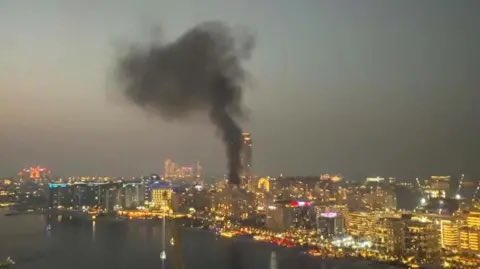
JUST IN: A drone just hit a fuel tank at the busiest airport in the Middle East. The Dubai Media Office confirmed it 23 minutes ago.
“A drone incident in the vicinity of Dubai International Airport (DXB) affected one of the fuel tanks. Dubai Civil Defence teams are currently working to bring the fire under control. No injuries have been reported so far.”
That is the official statement from @DXBMediaOffice, posted in English and Arabic, with thousands of views in the first half hour. The fuel tank is burning. Civil Defence is on scene. The airport that processed 87 million passengers last year, the global hub that connects 260 destinations across six continents, the physical embodiment of everything Dubai built over three decades, has a fuel tank on fire because a drone that costs less than a business-class seat through Terminal 3 reached the aviation fuel supply that keeps the hub operational.
This is the third confirmed drone incident at or near DXB since the war began. On 11 March, two drones struck near the airport, injuring four people. On 1 March, drones hit AWS data centres in the same corridor. Today, the target was not a server farm or a residential tower. It was aviation fuel. The escalation is vertical: from data to shelter to the liquid that makes the airport function.
Fuel tanks at international airports are not incidental targets. They are the circulatory system of aviation. DXB operates on jet fuel stored in tank farms adjacent to the runways. A sustained fire in a fuel tank does not merely delay flights. It grounds the refuelling infrastructure that determines whether aircraft depart at all. Civil Defence is containing this fire. The question is not whether this fire is contained. The question is whether the next drone reaches the next tank, and whether the insurance market, the airline route planners, and the 87 million annual passengers calculate that a 94% interception rate over an airport fuel farm is sufficient assurance to book the ticket.
The cumulative toll on the UAE since 28 February: 294 ballistic missiles, 15 cruise missiles, over 1,600 drones. Six dead. 141 injured. AWS data centres struck. Creek Harbour and 23 Marina towers burning from debris. The Burj Al Arab facade hit. Jebel Ali Port targeted. Fujairah oil zone fires. The Iranian Hospital closed. Five schools shuttered. Twenty-one people charged for filming. And now a fuel tank at the airport that defines the city burning while Civil Defence teams work to contain what the air defence system intercepted everywhere except here.
The $600 million daily regional tourism loss was calculated before a fuel tank at DXB caught fire. The DFM Real Estate Index was down 21.4% before a fuel tank at DXB caught fire. The $20 billion DFC insurance facility had zero confirmed takers before a fuel tank at DXB caught fire. Every metric of economic damage that existed this morning is now being recalculated against a new data point: the airport itself is no longer outside the target set.
Dubai built the busiest airport in the Middle East to prove the Gulf was open for business. Iran just proved it is open for drones. The fuel tank is burning. Civil Defence is responding. No injuries reported. And somewhere in the Gulf, a Shahed that cost $20,000 to $35,000 just imposed a repricing event on an aviation hub worth hundreds of billions by reaching the one target that converts a “drone incident” from a security event into an infrastructure crisis: the fuel that keeps the planes flying.
Full analysis!
open.substack.com/pub/shanakaans…