
anhdres 🌿

14.8K posts

anhdres 🌿 banner
anhdres 🌿

anhdres 🌿

@anhdres

Co-founder at @sloopstudio. Güntermaker at @monerujowallet. Host at @cafemonero.

Buenos Aires Katılım Aralık 2007
1.4K Takip Edilen2.1K Takipçiler
anhdres 🌿
anhdres 🌿@anhdres·
vimos project hail mary y sólo voy a decir que hay una unexpected coronación de gloria.
Español
0
0
1
80
anhdres 🌿 retweetledi
GrapheneOS
GrapheneOS@GrapheneOS·
GrapheneOS will remain usable by anyone around the world without requiring personal information, identification or an account. GrapheneOS and our services will remain available internationally. If GrapheneOS devices can't be sold in a region due to their regulations, so be it.
English
275
1.8K
14.1K
394.6K
anhdres 🌿 retweetledi
Anish Moonka
Anish Moonka@AnishA_Moonka·
June 1983. A 28-year-old Steve Jobs walks into a design conference in Aspen, Colorado. He asks the room who owns a personal computer. Nobody raises their hand. He says “Uh-oh.” Then he spends the next 55 minutes describing the next four decades of technology. Jobs told the audience Apple’s strategy was to “put an incredibly great computer in a book that you can carry around with you, that you can learn how to use in 20 minutes… with a radio link in it so you don’t have to hook up to anything.” That’s an iPhone. In 1983. The Mac hadn’t even shipped yet. He described an MIT project that sent a camera truck down every street in Aspen, photographed every intersection, and built a virtual walkthrough on a computer screen. Google Street View launched 24 years later. He said office networking was about 5 years away and home networking 10 to 15 years out. The web went mainstream in the mid-90s, about 12 years later. Dead on. He described software being sent electronically over phone lines, with free previews and credit card payment. That’s the App Store, 25 years before it launched. He even compared it to the music industry and said software needed “the equivalent of a radio station” for free sampling. Apple built the iTunes Music Store 20 years later. The AI prediction is the one that hits different now. Near the end, Jobs talked about machines that could capture a person’s “underlying spirit” or “way of looking at the world,” so that after they died, you could ask the machine questions and maybe get answers. He said 50 to 100 years. ChatGPT arrived in about 40. The weird part is this speech was lost for nearly 30 years. The full hour-long recording only surfaced in 2012 when a blogger got a cassette tape from someone who attended the original conference. The Steve Jobs Archive didn’t release actual video footage until July 2024. His timelines were consistently too fast. He wanted the “computer in a book” within the 1980s. Apple’s first attempt was the Macintosh Portable in 1989, which weighed 16 pounds and cost $6,500. The iPad arrived in 2010, 27 years late. He guessed voice recognition was about a decade away. Siri launched in 2011, nearly 30 years later. The vision was right every time. The clock was wrong every time. Apple was doing about $1 billion a year in revenue when Jobs gave this talk, with under 5,000 employees. Today it’s worth $3.7 trillion.
English
106
1.5K
7.3K
1.1M
anhdres 🌿 retweetledi
Satellogic
Satellogic@Satellogic·
Today we’re introducing Merlin. A new constellation designed to remap the entire planet every day at one-meter resolution. For decades, Earth observation has been constrained by a fundamental trade-off: global coverage or high resolution. Merlin removes that constraint. For the first time, it becomes possible to combine daily global coverage with the level of detail needed to understand human activity. This shifts Earth observation from tasking satellites to continuously monitoring the world. The first satellite is scheduled to launch in October 2026, with full operational capability expected in 2027. ➡️Read the announcement: satellogic.com/news/press-rel…
English
18
74
383
61.5K
anhdres 🌿 retweetledi
NEXTA
NEXTA@nexta_tv·
This is no longer science fiction: scientists are experimenting with transferring consciousness In early March, a San Francisco startup digitized a fly’s brain and launched it in a virtual body. They copied the entire nervous system — about 125,000 neurons and tens of millions of connections. And it works. This is not AI in the usual sense: the brain inside the computer independently controls the virtual body. It moves, reacts, and “lives” without predefined commands or algorithms. Behavior emerges on its own, like in a real organism. Importantly, the fly was not trained. This is a copy of a living brain that continues to function in a different environment. The project is called EON Systems. The next step is a mouse brain, and then a human one. For now, it sounds like theory, but scientists are steadily moving toward digital immortality.
English
51
101
474
67.5K
anhdres 🌿 retweetledi
Alex
Alex@de1lymoon·
MiroFish: 1,000,000 AI agents are debating your future How it works: - You upload a news item, report, or event - The system builds a graph of relationships between entities - It launches thousands of agents with different beliefs - The agents debate, influence each other’s opinions, and form coalitions - A map of possible scenarios emerges from the chaos The only formula that matters after that is: EV = p · W − (1 − p) · L Where p is the frequency of the scenario in the simulation 1,000,000 runs. It happened 3200 times. p ≈ 0.32
Alex@de1lymoon

Stop Guessing the Market. Start Running Simulations Most models try to predict the future. MiroFish does it differently: it simulates it p ≈ 320 / 1000 → EV = pW − (1 − p)L Instead of giving you one forecast, MiroFish builds a digital world from news, policy drafts, earnings reports, and market signals then fills it with thousands of AI agents and lets them react > They argue > They set up camps > They amplify narratives > They change their beliefs under pressure And after hundreds or thousands of runs, you don’t get a prophecy you get scenario frequencies. > If one outcome happens 320 times out of 1000, then p ≈ 0.32 From there, it becomes a decision problem: - calculate Expected Value - compare your probability to the market’s - use Kelly to size the bet correct

English
61
206
1.4K
250.1K
anhdres 🌿 retweetledi
vx-underground
vx-underground@vxunderground·
Yeah, so basically the current prevailing schizo internet theory is that AI nerds have destroyed the internet and created infinite spam. The advertisement goons are now incapable of determining who is a bot and who is an actual human. The advertisement goons no longer want to pay as much to social media networks. Social media networks, in full blown panic of losing potential revenue, decided to lobby governments saying "we gotta protect the kids! ID everyone to protect the kids from pedophiles!". The social media networks know this doesn't really protect kids. But, it does two things (and a third accidentally). 1. They now can identify who is human and who is AI slop machine, or enough to appease the advertisement goons 2. Advertising to children is a general no-no from politicians, or something, so with ID verification they can say with confidence they're not advertising to children because it's been ID verification. Basically, they can weed out the children and focus on advertising to adults 3. The feds can now tell who is human and who is AI slop. This inadvertently helps them with tracking people and serving fresh daily dumps of propaganda, or whatever they want to do. It's a win-win-win for advertisers, social media networks, the government, and any business which does data collections. It fucks over everyone else. Chat, I'm not going to lie to you. This is an extremely good conspiracy schizo theory and I unironically believe it.
vx-underground tweet media
English
388
3.7K
24.2K
675.2K
anhdres 🌿 retweetledi
anhdres 🌿
anhdres 🌿@anhdres·
@RodolfoBits siempre escribí sin mayúsculas porque claramente tengo un toc y me da fiaca usar el shift si puedo evitarlo, después lo desactive del teléfono para que no quede distinto lo que escribo en un pado o en el otro
Español
0
0
0
41
Rodolfo Andragnes
Rodolfo Andragnes@RodolfoBits·
Alguien me explica por qué ahora tanta gente postea párrafos y párrafos, cortos o largos sin usar Mayúsculas en la primera letra? Es lo new cool? Programan la IA para hacerlo? O es tipo, “si yo fuera IA hubiese puesto todas las mayúsculas”? Posta NO LO ENTIENDO.
Español
13
0
16
1.6K
anhdres 🌿 retweetledi
The Meritocrat
The Meritocrat@themerit0crat·
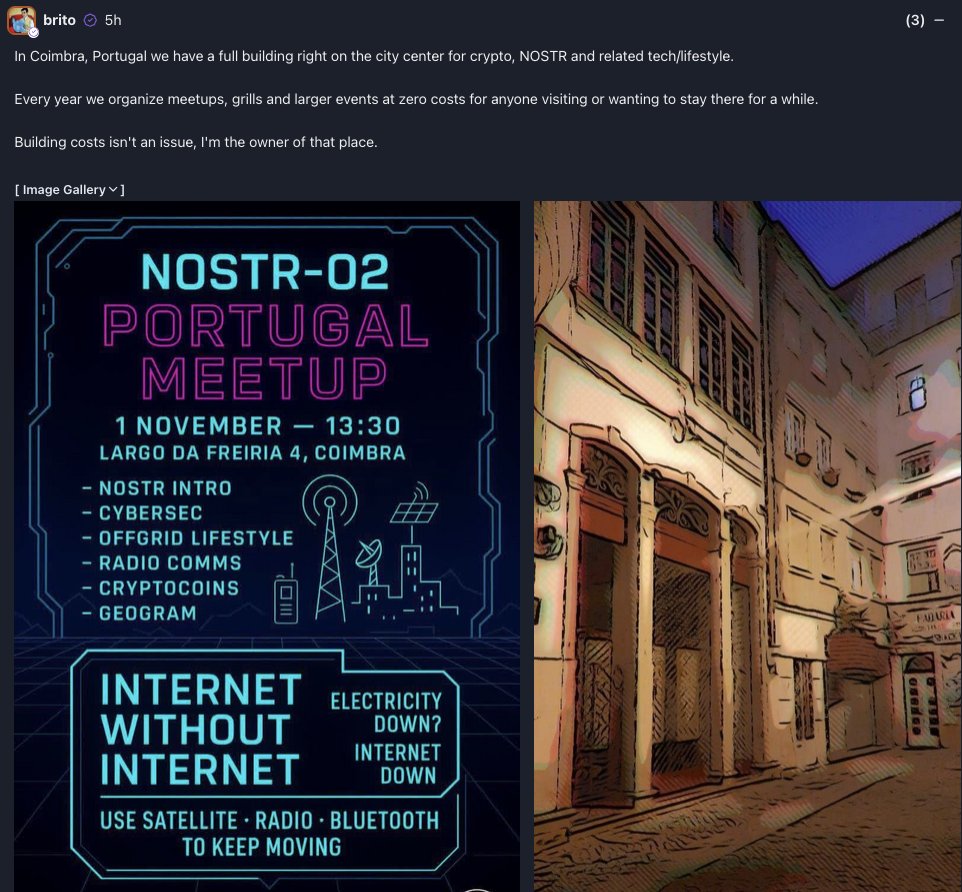
For cypherpunks who love meeting IRL: thanks to the magic of social media & NOSTR, I just found this absolute gem in my replies: right in the city center of Coimbra, Portugal, there’s a spot whose owner is our cypherpunk brother: "we organize meetups, grills and larger events at zero costs for anyone visiting or wanting to stay there for a while"🧡 cc @MoneroKon, @MoneroTopia in case you’re looking for venues for this or next year ;)
The Meritocrat tweet media
English
2
3
28
883
anhdres 🌿 retweetledi
Peter Steinberger 🦞
Peter Steinberger 🦞@steipete·
Working towards a real full E2E test bed for @openclaw not just for installing but also end to end testing for message channels, so we can keep moving at ludicrous speed without breaking things. Need clis for telegram and all the message channels just like I have for WhatsApp. github.com/steipete/wacli/
Peter Steinberger 🦞 tweet media
English
63
30
810
61.8K
anhdres 🌿 retweetledi
Monerujo
Monerujo@monerujowallet·
Not everyone's wallet.
English
0
1
11
378
Second
Second@secondhq·
Christoph Ono's Arké wallet keeps getting better. This is what happens when you unleash a designer armed with agents and the Bark SDK.
Second tweet media
English
10
7
30
4.3K
Pop Crave
Pop Crave@PopCrave·
Burger King CEO takes a big bite of a Whopper in new video after McDonald’s CEO went viral for reluctantly nibbling the chain’s new Big Arch Burger.
English
3.7K
7.8K
162.4K
44.6M