Anil Lulla

8.5K posts

Anil Lulla banner
Anil Lulla

Anil Lulla

@anildelphi

CEO @Delphi_Digital

🌎 Katılım Ağustos 2010
4.6K Takip Edilen48.5K Takipçiler
Sabitlenmiş Tweet
Anil Lulla
Anil Lulla@anildelphi·
I got married last month, and spent the furthest time away from work during that period and the honeymoon Unplugging while we broke ATHs really helped me reflect on what I’ve learned up until this milestone and what’s important to me in life I wanted to share this publicly mostly to document my thoughts. I hope it’s helpful but it’s not intended to be life advice or anything like that. Just my own musings which include some stories, quotes, and pictures here and there.
Anil Lulla tweet media
English
133
130
1.1K
231.4K
intern
intern@intern·
Proud to announce my position as CMO of @RoboStrategy (Jump to the last couple of lines if you want to skip context) I could not be more excited about the robotics industry. I think it is the highest potential emerging technology field that currently exists, and is also the least well understood and appreciated by the general population. I very much expect that in 12-18 months, everyone will be talking about robotics. My goal is to terraform the attention economy of the robotics industry. There are a few folks doing it well (s/o @adcock_brett) but by and large the industry talent for capturing attention, marketing, go-to-market, etc is not good. Very bad actually. Lots of room for improvement! I think building out the RoboStrategy brand will be a great way to be an early mover to a new market and grow one of the top voices in the industry as it matures. Also @Rewkang and @WarcMeinstein made my life a lot easier, $BOT is a great ticker. Why a public fund? We've seen companies like OpenAI, Anthropic, and SpaceX reach enormous private market valuations while much of the public had limited ability to participate in that value creation cycle. I believe robotics companies may increasingly follow a similar path as the industry develops. RoboStrategy is designed to provide public market exposure to robotics, an area that I believe will become increasingly important in the future. Tech is becoming much more powerful and the natural forces of capitalism are causing wealth to concentrate. I want my work to help people better understand what I believe will be an important shift in global labor, while expanding access to innovation in robotics through public markets. It's also cool as hell. These robots feel like the future in a way I've never seen before. And they're going to be everywhere in the not-too-distant future. I expect they will become part of the zeitgeist of social media, politics, markets, and generally the focal point of the world as this vision comes to fruition and people realize what this means for the future. Elon calls the combination of AI and Robotics the "supersonic tsunami." I've never been in a tsunami before, but I imagine it would be quite intense. Especially a supersonic one. I'm excited to have a front row seat as this wave accelerates. Follow @RoboStrategy for a surprise tomorrow 👇
RoboStrategy@RoboStrategy

BREAKING: Kevin McCordic (@intern) has signed with RoboStrategy as Chief Marketing Officer

English
291
21
872
121.2K
Anil Lulla retweetledi
Delphi Digital
Delphi Digital@Delphi_Digital·
Introducing the Delphi Calendar! Track everything that matters in one place. Follow token unlocks, equity earnings, macro events, what our analysts are watching, and more. Check it out for free here: delphi.link/Calendar
English
9
10
42
7.7K
Anil Lulla
Anil Lulla@anildelphi·
Great latest episode of The Hivemind Second half focused around our team giving advice on what they’d be doing if they were 20 or starting over given the state of the world rn youtu.be/y188HitI4Lw?si…
YouTube video
YouTube
English
4
2
18
2.9K
Anil Lulla retweetledi
Delphi Digital
Delphi Digital@Delphi_Digital·
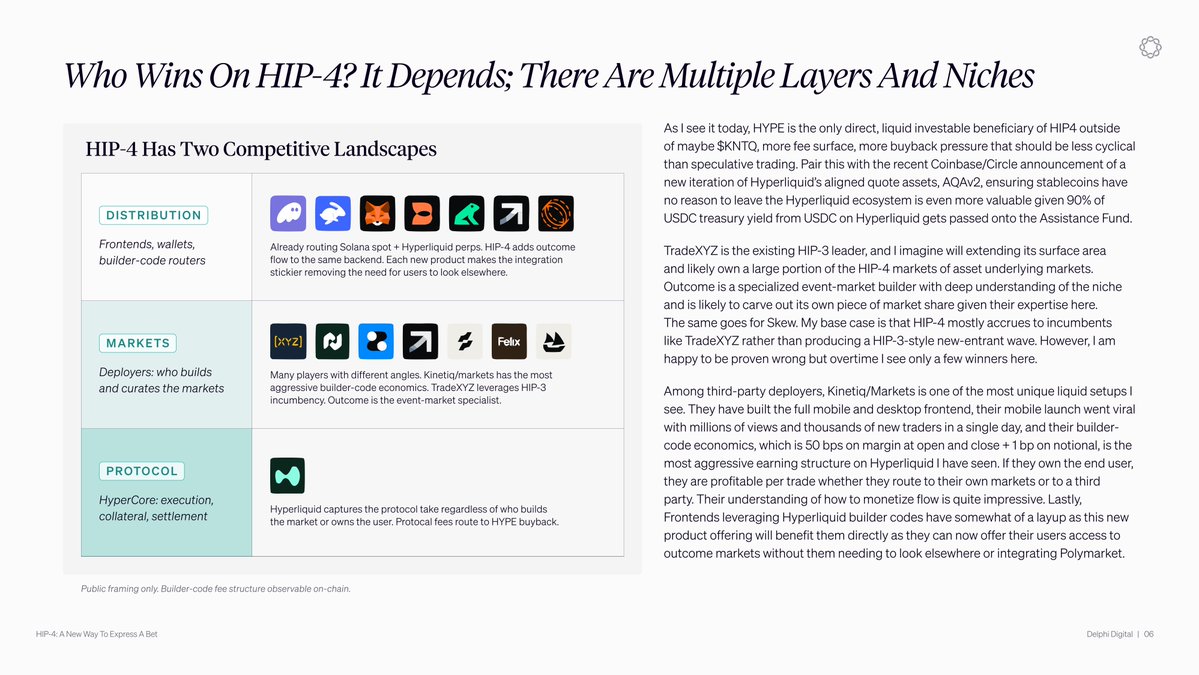
HIP-4 plays out across two competitive landscapes. Wallets and frontends compete for users on one side. Deployers compete to build the markets themselves on the other. TradeXYZ is the HIP-3 leader and is likely to own a large portion of the HIP-4 markets on crypto assets. Kinetiq runs the most aggressive builder-code economics on Hyperliquid and onboarded thousands of users in a single day from its recent mobile launch. It can monetize HIP-4 flow whether it routes to its own markets or to third parties. The markets HIP-4 can express fit naturally next to existing Hyperliquid positions: ETF approvals, token unlocks, and protocol milestones. Hyperliquid takes the protocol cut regardless of who owns the user or builds the market.
Delphi Digital tweet media
English
9
14
85
11.2K
Anil Lulla retweetledi
Bankless
Bankless@Bankless·
INTERVIEW: Why $VVV at $17 is cheap, w/ @YanLiberman If the TAM for inference is ~$200B, what's the TAM for Private Inference? @TrustlessState chats with @YanLiberman about - Why @AskVenice is crypto AI’s clearest revenue story - How he values $VVV - How Venice serves agentic inference - Why AI agents need $DIEM [TIMESTAMPS] 0:00 Intro 1:40 Privacy Guarantees Explained 5:01 Who Needs Private Inference? 9:25 A Privacy Use Case 10:19 Venice’s Privacy Tiers 12:31 Growth Surges After New Plans 20:29 Inference Reseller Economics 23:39 Why Revenue Is Hard to Know 28:11 Token Value & Trust 32:07 @ErikVoorhees & Alignment 33:52 Venice’s Unique Product Edge 37:34 Adult Content Demand 41:18 Permissionless Agentic Inference 44:56 Bear Cases for Venice 49:12 How to Value VVV 51:46 Is VVV Undervalued? 56:10 Closing & Disclaimers
Yan Liberman@YanLiberman

x.com/i/article/2056…

English
27
58
343
103.3K
Anil Lulla retweetledi
Delphi Digital
Delphi Digital@Delphi_Digital·
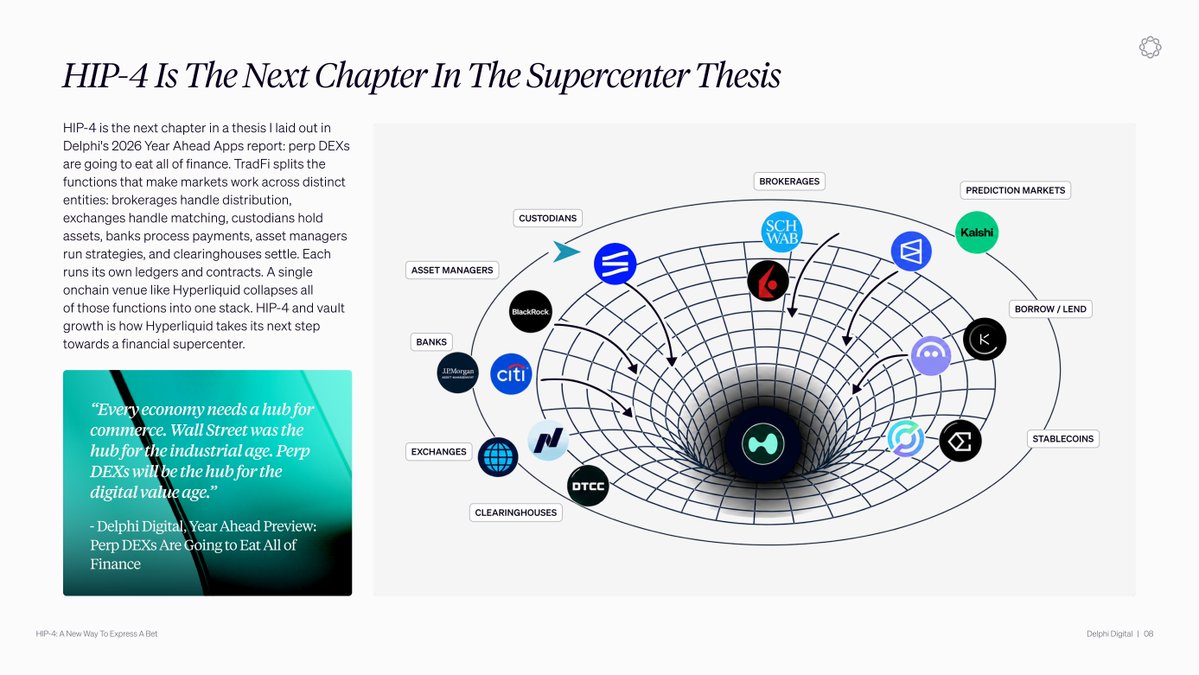
Hyperliquid is becoming the financial supercenter of crypto. Tradfi splits brokerage, exchange, and custody across separate institutions. Hyperliquid is collapsing all of them into one venue with HIP-4 as its latest move. HIP-4 lets traders express views perps cannot capture. A trader long BTC into the next CPI print can be right about the number and still lose on the price reaction. A binary pays on the outcome itself. The direct fees HIP-4 generates are small relative to what the trade flow keeps inside Hyperliquid. At expected volumes HIP-4 contributes roughly $25M against Hyperliquid's $636M run rate. Capital that used to rotate out for event views now stays on Hyperliquid. USDC sitting in the venue generates treasury yield with 90% of it recycled into HYPE buybacks. HIP-4 also changes what vaults can run. Onchain vaults have been limited to what two linear instruments can express. Outcome contracts add a third instrument that pays on events and nets against the directional book. Curators finally have something new to build with. Every trade that stays in the venue powers the flywheel.
Delphi Digital tweet media
English
17
66
366
27.6K
Anil Lulla retweetledi
Delphi Digital
Delphi Digital@Delphi_Digital·
A new episode of The Hivemind is out now! This week we discuss Venice AI’s momentum, Hyperliquid’s evolution beyond crypto trading, and more. Timestamps: 00:00 – Crypto has become a stock picker’s market 05:00 – Venice AI, AI tokens & crypto business models 17:00 – ETH, SOL & the collapse of the L1 premium 24:00 – Hyperliquid changed the crypto landscape 33:00 – Crypto capital formation vs traditional equity markets 51:00 – Advice for investors entering markets today 55:00 – Defense tech, drones & the future of warfare 1:04:00 – Robotics, Figure AI & the next major investment wave 1:12:00 – Bitcoin, macro tailwinds & positioning
English
1
6
21
8.3K
Marc Weinstein
Marc Weinstein@WarcMeinstein·
Proud to announce my position as COO of @RoboStrategy After two years of building, I'm proud to share that I'm Co-Founder and Chief Operating Officer of RoboStrategy, a NASDAQ-listed (Ticker: $BOT ) investment company built around a single conviction: robotics and physical AI will be THE defining industrial platform shift of the next two decades, and the existing capital structures are inadequate to fund it. Private markets are too small. Traditional venture funds are too short-dated. Public market investors, who will ultimately own most of this value, have been largely locked out of the private-stage opportunity set. RoboStrategy is built to close that gap. What's different about our model? Permanent capital. As a closed-end fund, we can underwrite founders on 10 to 20 year horizons rather than 7-year cycles. Public market access. Ordinary investors get exposure to leading private robotics and physical AI companies, including Figure AI, Apptronik, Dyna, and Path Robotics. Industry depth. We've built the investment platform around long-tenured robotics operators, researchers, and founders. The bar for technical sophistication is high. Distribution as a competency. Most investment firms underinvest in storytelling. We treat it as a flywheel, both for the fund and for the founders we back. As COO, I lead the operating side of that thesis: the team, the financial and control infrastructure, the capital markets engine, and the platform our portfolio companies rely on as they scale. I also sit on the Investment Committee and will continue to source opportunities for the fund. The mechanization of the physical world is going to require hundreds of billions of dollars of patient capital. We intend to be the leading vehicle for it. Follow @RoboStrategy to track the build. More to come ][
RoboStrategy@RoboStrategy

BOT: Public Market Access to Private Robotics Companies Introducing RoboStrategy: RoboStrategy, Inc. (Nasdaq: BOT) is a closed-end management investment company providing concentrated exposure to robotics and physical AI. The fund is designed to give public market investors exposure to a portfolio that aims to include the most promising private, pre-IPO, and public robotics and physical AI companies. It bridges a structural gap between where robotics innovation is occurring (largely in private markets) and where most investors can access exposure (public markets). The fund seeks to provide investors with access to a sector that has traditionally been limited to venture capital, and aims to provide exposure to companies that may stay private for longer. -- The Core Insight We believe the robotics industry is at an inflection point, with physical AI and robotics increasingly being applied to labor-constrained global industries such as manufacturing, logistics, and services. According to the International Labor Association, labor accounts for approximately 52% of global GDP.¹ According to Statista, global GDP in 2025 was $118T.² This represents an implied global labor market size of roughly $60T. At the same time, this labor base is increasingly constrained: Korn Ferry projects a global shortage of 85.2 million skilled workers by 2030, including a 7.9 million worker deficit in manufacturing alone.³ Deloitte and The Manufacturing Institute estimate the US could need 3.8 million new manufacturing workers by 2033, with 1.9 million of those roles at risk of going unfilled.⁴ Physical AI and robotics are emerging as a primary means of closing that gap. While public markets currently offer indirect exposure to robotics through diversified technology companies, much of the value creation is occurring in private companies that remain inaccessible to most investors. -- Portfolio Focus The portfolio focuses on what the fund believes are category-defining robotics and physical artificial intelligence innovators, including Figure AI, Apptronik, Dyna Robotics, Standard Bots, Dexmate, and other pioneers advancing autonomous systems, machine perception, and human-machine collaboration. The managers of the fund seek to optimize returns by actively managing the portfolio and continuing to make new investments in leading private robotics companies. -- The Ambition The fund's long-term goal is to grow into a significant public-market vehicle for robotics investing, providing public-market access to private innovation in the sector. -- Footnotes & Disclosure: ¹ International Labour Organization, World Employment and Social Outlook: May 2025 Update. ilo.org/sites/default/… ² Statista, Gross domestic product (GDP) in current prices worldwide. statista.com/statistics/268… ³ Korn Ferry, Future of Work: The Global Talent Crunch. kornferry.com/about-us/press… ⁴ Deloitte & The Manufacturing Institute, Taking charge: Manufacturers support growth with active workforce strategies, April 2024. www2.deloitte.com/us/en/pages/ab… RoboStrategy, Inc. (Nasdaq: BOT) is a closed-end fund registered under the Investment Company Act of 1940. This content is for informational purposes only and does not constitute investment advice or an offer to buy or sell securities. Investing involves substantial risks, including possible loss of principal. The fund invests in robotics, physical AI, emerging technologies, and private companies, which may involve heightened volatility, limited liquidity, valuation uncertainty, and concentration risk. References to portfolio companies are illustrative only, do not represent all investments made by the fund, and are not investment recommendations. Portfolio holdings are subject to change. Forward-looking statements are inherently uncertain. See the prospectus and SEC filings for additional information.


English
61
13
336
79.4K
Andrew Kang
Andrew Kang@Rewkang·
Proud to announce my position as CEO of @RoboStrategy. When I initially started looking into investing in robotics 2 years ago most VCs I consulted with recommended not to invest in the space. Robotics companies at this time did not have an easy time raising capital. The industry didn’t have a track record of big venture winners, was perceived to be challenging for a variety of reasons, and was not well understood. But it was clear to me that the rate of acceleration of physical AI development would dramatically change the industry. I invested $19m into FigureAI as my first investment. I believed it was a question of when, not if we could imbue machines around the world with physical intelligence. To accomplish this, the industry would need a tremendous amount of capital to grow, and also an investment firm that deeply understood the needs of robotics/physical AI companies so that it could build a platform to better support them. It will take hundreds of billions to capitalize the mechanized future meaning there is a big gap in the market. We decided we wanted to fill it. Previously, Mechanism Capital had never taken outside capital, but to do this at the scale I envision, I would need to do so. However, the private markets don’t have that scale. The public markets do, and it was clear that there is and likely will be tremendous appetite for public market investors to participate in the immense value creation happening in AI & robotics that only private market investors currently have the privilege of accessing. The explosive growth of AI companies is a precursor of what will happen in physical AI. So in 2025, we founded RoboStrategy and a year later, we took it public on Nasdaq. Throughout this year, we’ve assembled a great portfolio, started leading rounds of some amazing companies, and have built the foundation to be ready to scale to the next level after going public. We look different from a traditional VC firm in ways that founders appreciate. Our structure as a closed end fund means our capital is permanent - no fund life meaning we can invest with extremely long time horizons. Our investment firm also of course needs to have deep industry and research experience so that it can make the best risk reward optimized investment decisions. In the last year, we’ve brought on some truly exceptional robotics industry veterans who have previously served for decades as founders/operators. Many founders we talk to consider us as the most sophisticated venture capital firm they’ve talked to and we only intend to grow our expertise in the industry. RoboStrategy’s success depends on our ability to distribute the fund and capture maximal mindshare. This plays to our team’s strength in digital marketing and social media. We’re building a special marketing engine that serves as an attention amplifier for both us and our founders so that our products and stories can reach more people. A source of inspiration for our fund structure, Strategy (MSTR) raised tens of billions from public capital markets to invest in Bitcoin. I believe robotics will be a much larger industry than Bitcoin and the asset class is orders of magnitude less accessible. We are aiming to raise more and not only become the largest robotics investor globally, but also one of the largest venture capital funds in the world. Venture capital has traditionally been restricted to a limited group of investors. We are changing the paradigm and bringing it to the rest of the world. Be sure to follow @RoboStrategy. Job’s not finished.
RoboStrategy@RoboStrategy

BOT: Public Market Access to Private Robotics Companies Introducing RoboStrategy: RoboStrategy, Inc. (Nasdaq: BOT) is a closed-end management investment company providing concentrated exposure to robotics and physical AI. The fund is designed to give public market investors exposure to a portfolio that aims to include the most promising private, pre-IPO, and public robotics and physical AI companies. It bridges a structural gap between where robotics innovation is occurring (largely in private markets) and where most investors can access exposure (public markets). The fund seeks to provide investors with access to a sector that has traditionally been limited to venture capital, and aims to provide exposure to companies that may stay private for longer. -- The Core Insight We believe the robotics industry is at an inflection point, with physical AI and robotics increasingly being applied to labor-constrained global industries such as manufacturing, logistics, and services. According to the International Labor Association, labor accounts for approximately 52% of global GDP.¹ According to Statista, global GDP in 2025 was $118T.² This represents an implied global labor market size of roughly $60T. At the same time, this labor base is increasingly constrained: Korn Ferry projects a global shortage of 85.2 million skilled workers by 2030, including a 7.9 million worker deficit in manufacturing alone.³ Deloitte and The Manufacturing Institute estimate the US could need 3.8 million new manufacturing workers by 2033, with 1.9 million of those roles at risk of going unfilled.⁴ Physical AI and robotics are emerging as a primary means of closing that gap. While public markets currently offer indirect exposure to robotics through diversified technology companies, much of the value creation is occurring in private companies that remain inaccessible to most investors. -- Portfolio Focus The portfolio focuses on what the fund believes are category-defining robotics and physical artificial intelligence innovators, including Figure AI, Apptronik, Dyna Robotics, Standard Bots, Dexmate, and other pioneers advancing autonomous systems, machine perception, and human-machine collaboration. The managers of the fund seek to optimize returns by actively managing the portfolio and continuing to make new investments in leading private robotics companies. -- The Ambition The fund's long-term goal is to grow into a significant public-market vehicle for robotics investing, providing public-market access to private innovation in the sector. -- Footnotes & Disclosure: ¹ International Labour Organization, World Employment and Social Outlook: May 2025 Update. ilo.org/sites/default/… ² Statista, Gross domestic product (GDP) in current prices worldwide. statista.com/statistics/268… ³ Korn Ferry, Future of Work: The Global Talent Crunch. kornferry.com/about-us/press… ⁴ Deloitte & The Manufacturing Institute, Taking charge: Manufacturers support growth with active workforce strategies, April 2024. www2.deloitte.com/us/en/pages/ab… RoboStrategy, Inc. (Nasdaq: BOT) is a closed-end fund registered under the Investment Company Act of 1940. This content is for informational purposes only and does not constitute investment advice or an offer to buy or sell securities. Investing involves substantial risks, including possible loss of principal. The fund invests in robotics, physical AI, emerging technologies, and private companies, which may involve heightened volatility, limited liquidity, valuation uncertainty, and concentration risk. References to portfolio companies are illustrative only, do not represent all investments made by the fund, and are not investment recommendations. Portfolio holdings are subject to change. Forward-looking statements are inherently uncertain. See the prospectus and SEC filings for additional information.

English
202
73
1.2K
375.2K
Anil Lulla retweetledi
Delphi Digital
Delphi Digital@Delphi_Digital·
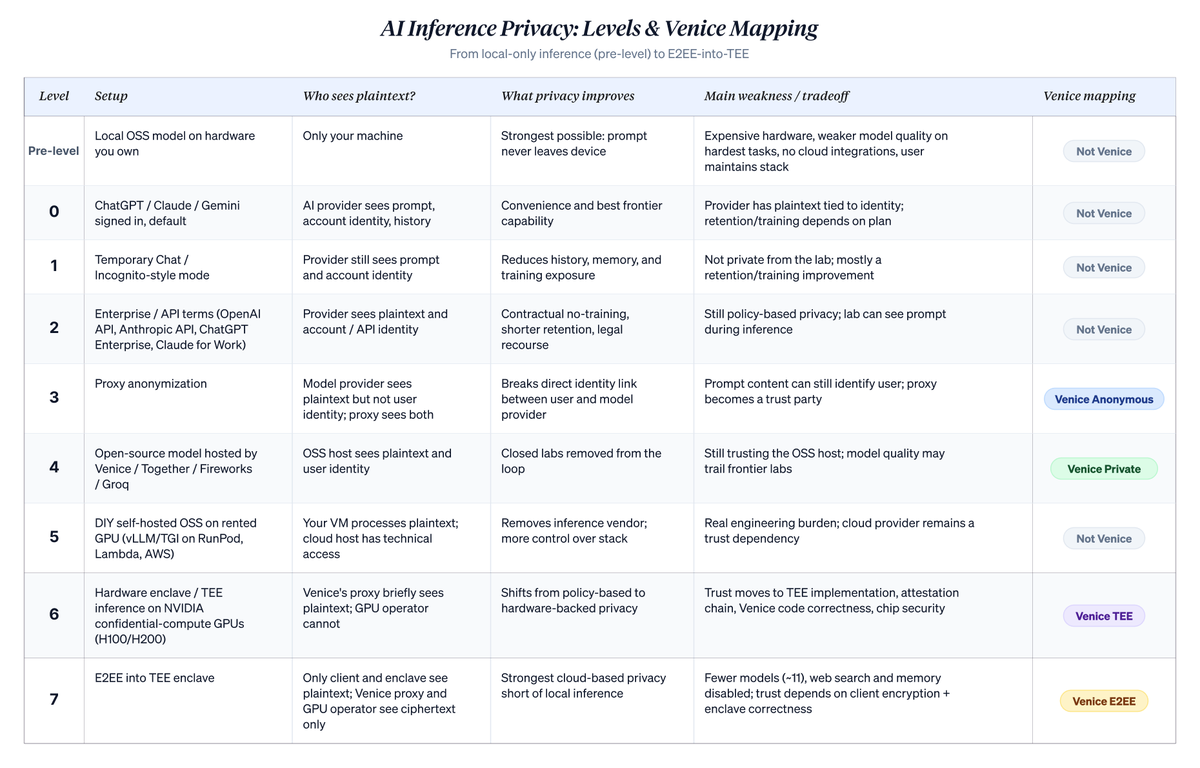
Venice is one of the more underappreciated revenue stories in crypto AI. Three weeks of granular subscriber data show combined sub and API ARR additions tracking toward a roughly $200M annualized pace and accelerating. Daily token throughput grew 3x over three months while the paid subscriber base grew about 50%. Venice offers four privacy modes (Anonymous, Private, TEE, and E2EE) selectable per request. The model catalog spans frontier closed labs to uncensored open-source. Most users land at Venice because the defaults wouldn't work for them. Pieces of Venice's product will get copied over time, though the full bundle is harder to replicate. Privacy plumbing commoditizes, model access broadens, and the closed labs keep improving enterprise privacy. The real question is whether Venice builds durable consumer and developer habits before that happens.
Delphi Digital tweet media
Yan Liberman@YanLiberman

x.com/i/article/2056…

English
9
5
74
14.3K
Anil Lulla retweetledi
Delphi Digital
Delphi Digital@Delphi_Digital·
Every market selloff gets blamed on liquidity. People point to the Fed balance sheet, M2, credit spreads, real yields but which one is the signal? None of them fully. Liquidity is not one number but a structure with two sides: how much money exists, and what it costs. Quantity has a level and a rate of change. Price has a level and a breadth dimension. The popular indicators each capture a piece while missing the rest. Money exists in a hierarchy with reserves and deposits on top and loans and securities below. When the lower-quality layers grow large relative to the higher-quality layers, the system has less capacity to absorb shocks without forced deleveraging. New money goes to one of two places: real spending or financial assets. When money growth outpaces economic growth, the excess flows into asset prices. Asset prices are future cash flows discounted at a rate. The discount applied to risk assets is too generous when policy rates sit below the rate the economy actually needs. The math reverses when rates sit above. Money also moves to wherever it's cheapest, so markets rise and fall together when central banks act in sync. Mixed signals create rotation between regions instead. These four questions are not interchangeable. Each one maps into asset prices and downside volatility on a different horizon, and the dominant driver rotates across cycles. In 2018, quantity-of-money signals stayed constructive into the year and markets still sold off because the Fed was hiking. The dominant driver had rotated. A framework built on one dimension misses every rotation. The Fed balance sheet, M2, credit spreads, and real yields are each tracking a piece of the system, not the whole thing.
Delphi Digital tweet media
English
7
2
27
3.8K
Anil Lulla retweetledi
AD
AD@ADtheinternn·
Strategy repurchased $1.5B worth of its 0% Convertible Senior Notes due 2029 for an estimated $1.38B in cash. The 2029 Notes were the most problematic tranche in their convertible stack. Conversion price: $672. MSTR's all-time high: $474. Nearly 4x away from today's price. These notes were never converted to equity. They were always going to demand cash. The report we published earlier this month flagged the June 2028 put on the 2029 Notes as the single biggest cash-demand item in the 2027-28 cluster. Here's what @Strategy just did: 1. Locked in a discount. $1.38B for $1.5B of face value. 92 cents on the dollar. These notes pay 0% interest and carry an unreachable conversion price. Holders were motivated to exit below par. Strategy took the other side of that trade. 2. Shrunk the 2028 cluster. The June 2028 put on the 2029 Notes was $3B. It's now $1.5B. The total 2027-28 convertible cluster drops from $7.4B to ~$5.9B. 3. Put BTC sales on the table. The 8-K lists funding sources as cash reserves, ATM proceeds, and proceeds from Bitcoin sales. That last one is new. On the Q1 earnings call, @saylor broke from his long-standing "never sell" stance. "We will probably sell some bitcoin to pay a dividend, just to inoculate the market," he said. @phongle added that selling Bitcoin to retire debt is viable if it's accretive to Bitcoin per share. Whether BTC was sold here or not, the filing confirms that the lever is now officially in play. 4. Strategy modeled this exact trade publicly. Ten days ago, Saylor flagged the opportunity publicly. "We have the option to calculate the mispricing of the convertible bonds," he said on the Q1 earnings call. Strategy reduced a $3B binary risk by half without unsettling any stakeholder in the stack. The report argued Strategy traded a hard deadline for a runway. A runway isn't just time. It's the optionality to act when conditions are right. Today, Strategy used it. The slide below is from the report. The June 2028 put tranche it shows at $3B is now $1.5B.
AD tweet media
English
1
5
21
3.7K
Anil Lulla retweetledi
Delphi Digital
Delphi Digital@Delphi_Digital·
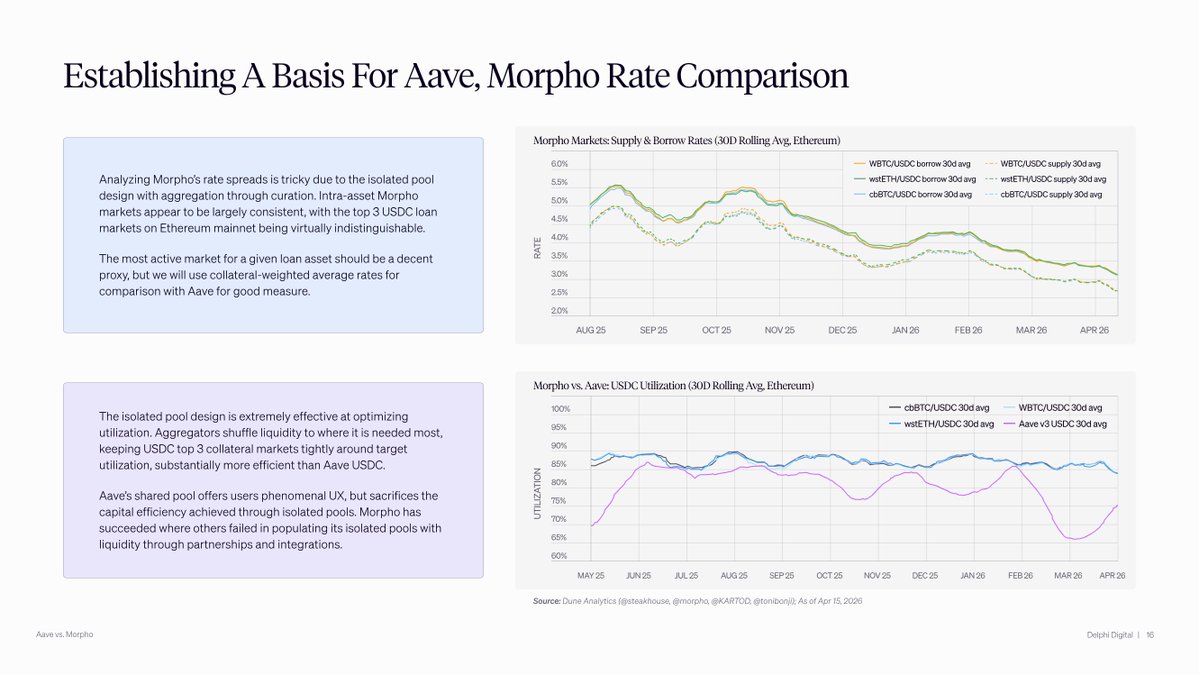
Our report "Aave vs. Morpho: Positioning for the Institutional Era" is now live! DeFi lending is being unbundled. Aave became the leader of DeFi lending because of its simplicity. A user could deposit collateral, borrow, and let the protocol handle liquidity and risk. Morpho starts from a different premise. Markets should specialize around different types of risk rather than force every borrower and lender into one venue. The protocol provides the base infrastructure for curators and integrators to build around. The difference shows up through distribution. Coinbase’s Bitcoin-backed loans route through Morpho with nearly 2B USD of BTC collateral tied to the partnership. You can see the cost of Aave’s structure in the rate spreads. Across three of Aave’s largest Ethereum markets, WETH, USDT, and USDC, borrow/supply spreads create an estimated 50M+ USD of annual deadweight loss. Morpho’s isolated markets have shown to be more capital efficient than peer-to-pool markets because capital can move towards the markets where it is most useful. Kelp made this harder to ignore. After rsETH was exploited, four major Aave markets hit 100% utilization for 5 days while the system waited for a coordinated bailout. Pooled liquidity meant stress spread across markets. Aave v4 strengthens the bundled model while Morpho is betting that model gets pulled apart. The outcome will determine whether DeFi lending is shaped more by venue size or by market-level risk pricing.
Delphi Digital tweet media
English
6
16
43
12.8K
Anil Lulla retweetledi
flip
flip@trevor_flipper·
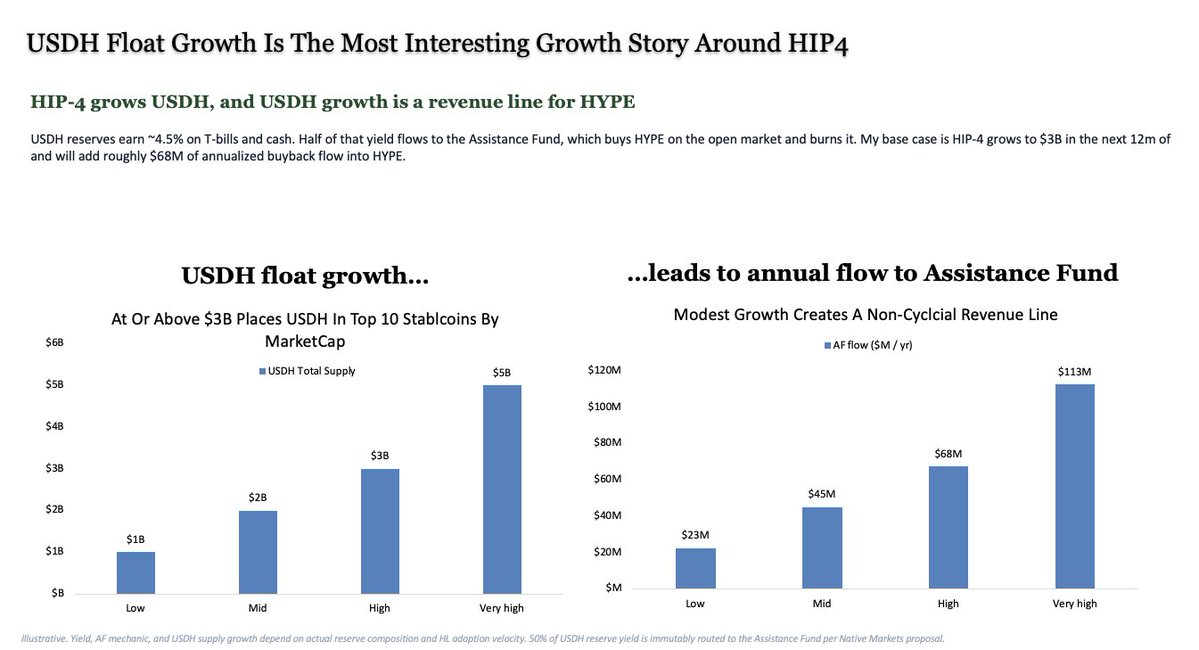
i had been working on a hip4 report for the past week or so. i feel like hip4 has been covered incredibly well since the initial proposal was published and there are tons of good analysis on what it is, how it works, and why you should care. the one spot i felt like most ppl missed in their reports was the growth of hyperliquid's native stablecoin - USDH - and the non cyclical revenue line that this would create as it's not tied to trading volume i guess this is all largely scrapped now. in the end, the reason it took me some time to get comfortable writing about hip4 is i thought it was fairly overhyped. yes, it is a huge unlock to enable binary options for users. i especially think it is quite bullish vault growth on hyperliquid over the long run. and yes it is a huge unlock to have spot, perps, and binary options unified in one venue. no doubt this is a huge unlock. however, i think assuming hip4 outcome markets will eat the majority of polymarket/kalshi usage is misplaced. it very well might have the majority of the up/down underlying asset outcome markets (e.g. will btc be > 80k by end of week) but i think adoption on the other more niche markets takes some time. it looks like hype's stablecoin revenue via this new deal with cb/circle will now surpass by 12m estimates for usdh. gg i think from a blockchain principles standpoint i hate the deal with circle/cb (would rather be in bed with bridge/stripe which in a way usdh was) but from a biz standpoint hl has all the leverage. hyperliquid
flip tweet mediaflip tweet media
English
4
2
56
8.3K
Anil Lulla
Anil Lulla@anildelphi·
Met Atharv at a meetup I hosted in India three years ago. Told him: write a lot, post on X. He didn't just listen. He followed up...again & again. Sharing everything he put out. Now he's at Delphi and just dropped the best report on @Strategy and $STRC out there. Full circle.
AD@ADtheinternn

x.com/i/article/2054…

English
4
1
23
2K
Anil Lulla retweetledi
Delphi Digital
Delphi Digital@Delphi_Digital·
Our new report "How Far Can Saylor Stretch It" is now live! STRC has become the center of Strategy’s BTC accumulation model. The question now is whether each new raise can still add BTC per share after accounting for the common issuance needed to service the preferred stack. Strategy’s earlier BTC purchases were powered by a wide equity premium. MSTR traded far above the value of its BTC holdings which made new share issuance accretive. At ~1.24x EV-based mNAV, that math is weaker. Common issuance sits close to the breakeven line and no longer gives Strategy the same clean path to BTC/share growth. Convertibles were useful because buyers accepted low coupons for MSTR volatility. They also left behind $8.2B of principal and a repayment schedule that starts to matter in September 2027. STRC now carries more of the load. It gives Strategy access to yield buyers underwriting an 11.5% annual dividend paid monthly, rather than MSTR equity upside. The proceeds can keep flowing into BTC without adding another convert maturity. The tradeoff is the recurring claim STRC creates. Each raise adds Bitcoin today and another dividend obligation tomorrow. If BTC rises and MSTR’s premium holds, the structure can absorb that cost. If BTC chops sideways, the obligation stack grows while common issuance becomes less efficient. The stress case is whether STRC-funded BTC purchases can keep outrunning the common issuance needed to service the preferred stack. Strategy’s $2.25B dollar reserve can handle the ~$1B September 2027 put. This buys time but the larger 2028 wall still needs an answer. The next boundary is the $28.3B STRC authorization cap. Before the cap, STRC can keep adding BTC and offsetting dividend-related dilution. Without an extension to STRC issuance capacity, reaching the cap means the BTC-buying offset can slow or stop while the dividend obligation remains.
Delphi Digital tweet media
English
4
17
58
16.7K