Ankit Khosla

617 posts

Ankit Khosla banner
Ankit Khosla

Ankit Khosla

@ankit_khosla

Books | Travel | Design | Tech | Fitness | Experiences | Outdoors

Mumbai, India Katılım Ağustos 2012
1.1K Takip Edilen69 Takipçiler
Ankit Khosla retweetledi
Or Hiltch
Or Hiltch@_orcaman·
Today we are launching @openwork_ai, an open-source (MIT-licensed) computer-use agent that’s fast, cheap, and more secure. @openwork_ai  is the result of a short two-day hackathon our team decided to hack, which brings together some of our favorite open source AI modules into one powerful agent, to allow you to: 1. Bring your own model/API key (any provider and model supported by @opencode is supported by Openwork) 2. ~4x faster than Claude for Chrome/Cowork, and much more token-efficient, powered by dev-browser by @sawyerhood (legend) 3. More secure - contrary to Claude for Chrom/Cowork, does not leverage the main browser instance where you are logged into all services already. You login only to the services you need. This significantly reduces the risk of data loss in case of prompt injections, to which computer-use agents are highly exposed. 4. Free and 100% open-source! You can download the DMG (macOS only for now) or fork the github repo via the link in bio (@openwork_ai). Let us know what you think (or better, send a pull request)!
Claude@claudeai

Introducing Cowork: Claude Code for the rest of your work. Cowork lets you complete non-technical tasks much like how developers use Claude Code.

English
214
572
5K
1M
Ankit Khosla retweetledi
Carlos E. Perez
Carlos E. Perez@IntuitMachine·
I just asked Gemini 3.0 to analyze the $GOOG vs $NVDA dynamic. Read this. I could be generational wealth changing. Everyone is comparing Gemini 3.0 vs GPT-5.1 on benchmarks. You're watching the wrong scoreboard. The real war isn't about who is smarter. It's about who creates the "Prisoner's Dilemma" that kills Nvidia's 75% margins. I spent the morning mapping this out like a Cold War game theory scenario. Here is the board. 👇 1/ Right now, Nvidia is the "Arms Merchant." They sell the H100s. Everyone pays the tax. Their entire stock price assumes they keep ~75% margins forever. But Google just made a move that changes the physics of the board. They aren't trying to sell chips. They're trying to make chips irrelevant. 2/ The setup is simple: Nvidia makes money by keeping hardware expensive (High Margin). Google makes money on ads/services, so they want compute to be free (High Volume). These goals are incompatible. In Game Theory, this is a "Structural Conflict." 3/ For years, Nvidia had a "Hold-Up" on the industry. You want to do AI? You pay the Nvidia tax because CUDA is the only software that works. It was a monopoly based on fear: "Switching to another chip is too risky. What if the code breaks?" 4/ Enter Gemini 3.0. Google trained it on TPUs. They run it on TPUs. They don't pay the Nvidia tax. This means their internal cost-per-token is structurally ~50% lower than OpenAI's (who has to pay Microsoft, who has to pay Nvidia). 5/ (This is the part that clicked for me) Google creates a "Price Ceiling." If Google sells intelligence for $1, OpenAI can’t sell it for $2 just because they use expensive Nvidia chips. OpenAI must match the price to survive. But they can't. Not while paying Nvidia's margin. 6/ This traps Nvidia’s best customers in a corner. To match Google’s prices, Microsoft and OpenAI are forced to build their own chips (Maia) to stop paying Nvidia. Nvidia’s own pricing power is exactly what is incentivizing its customers to destroy it. 7/ So where does the equilibrium settle? I ran the scenarios. It leads to a split. Zone A: Discovery (Nvidia Wins)Researchers still use Nvidia because speed matters more than cost. Zone B: Utility (Google Wins)Once a model works, you run it on cheap custom chips. 8/ You can see the strategies shifting in real-time right now: Google: Aggressive subsidies ($350k credits) to get startups to rewrite their code off CUDA. Nvidia: Bundling software (NIMs) to make leaving impossible. It's classic "Free Drugs" vs "Golden Handcuffs." 9/ If you are building in AI, here is the "Tripwire" to watch. Ignore the benchmarks. Watch the Token Price. If GPT-5 class pricing drops below $2.00/1M tokens, the "Nvidia Tax" is mathematically dead. The market is fleeing to custom silicon. 10/ The one question to ask your CTO tomorrow: "If we had to switch from Nvidia GPUs to Google TPUs or AWS chips tomorrow, would it take us 1 week or 6 months?" If the answer is 6 months, you are the "sucker" at the table paying the tax. 11/ The takeaway: In a gold rush, it's usually good to sell shovels. Unless your biggest customer decides to invent a steam shovel just to stop paying you. Game on.
English
165
254
1.9K
480.9K
Ankit Khosla retweetledi
Rohan Paul
Rohan Paul@rohanpaul_ai·
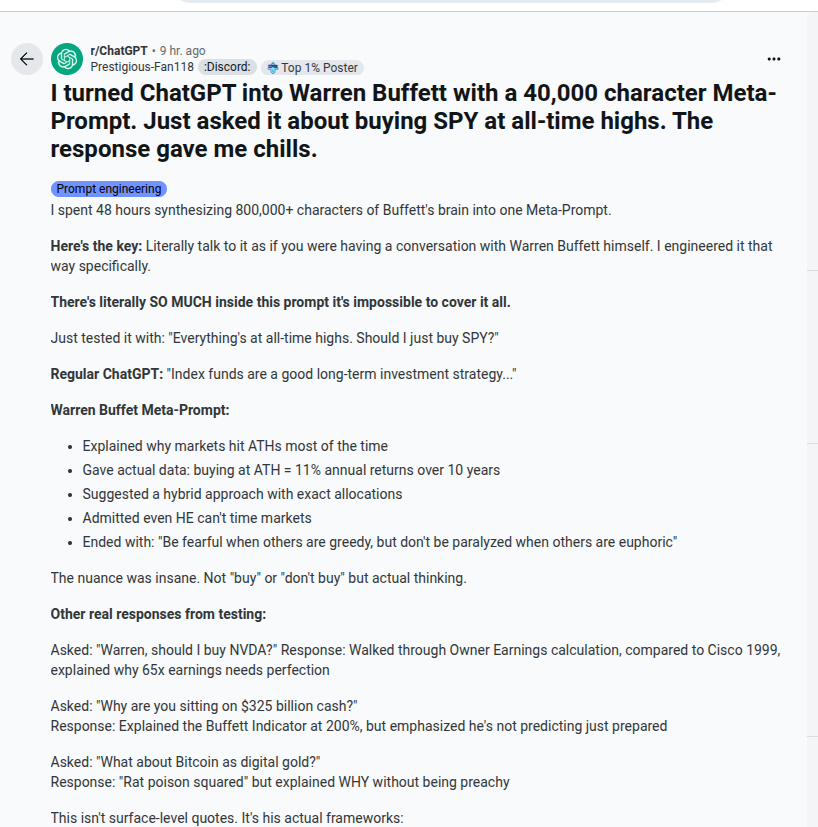
This guy is using this huge 40,000 character Meta-Prompt to turne ChatGPT into Warren Buffett. The prompt locks the model into acting as Warren Buffett by loading 40,000+ characters of his biography, routines, quotes, formulas, and case studies. It injects complete valuation frameworks, decision trees, and linguistic patterns so answers echo Buffett’s style and logic. i.e. from Prompt-engineering perspective, it's heavy persona priming, domain knowledge stuffing, strict output policing, and explicit step-by-step checklists that channel the model’s reasoning. --- reddit .com/r/ChatGPT/comments/1m5ha9j/i_turned_chatgpt_into_warren_buffett_with_a_40000/
Rohan Paul tweet media
English
26
53
453
138.8K
Ankit Khosla retweetledi
The Sanātanī
The Sanātanī@_TheSanatani·
The Hindu Multiverse – Ananta Koti Brahmāṇḍas 🌌🔥 Long before science spoke of infinite universes, the Rishis saw them—literally. Not metaphor. Not myth. Literal cosmological vision — down to the last detail. This will transform your view of reality. 🧵
The Sanātanī tweet media
English
77
1.5K
8.1K
510.4K
Ankit Khosla retweetledi
@levelsio
@levelsio@levelsio·
Ask ChatGPT: If you were the devil and wanted to keep an entire nation sick, what would you do?
@levelsio tweet media@levelsio tweet media@levelsio tweet media
English
583
3.8K
24.6K
3.4M
Ankit Khosla retweetledi
Karina
Karina@karinanguyen·
We're excited to introduce Tasks! For the first time, ChatGPT can manage tasks asynchronously on your behalf—whether it's a one-time request or an ongoing routine. Here are my favorite use cases: 1/ ChatGPT checks stock price every morning!
English
428
1.1K
12.3K
2.5M
Ankit Khosla retweetledi
Anthony Pompliano 🌪
Anthony Pompliano 🌪@APompliano·
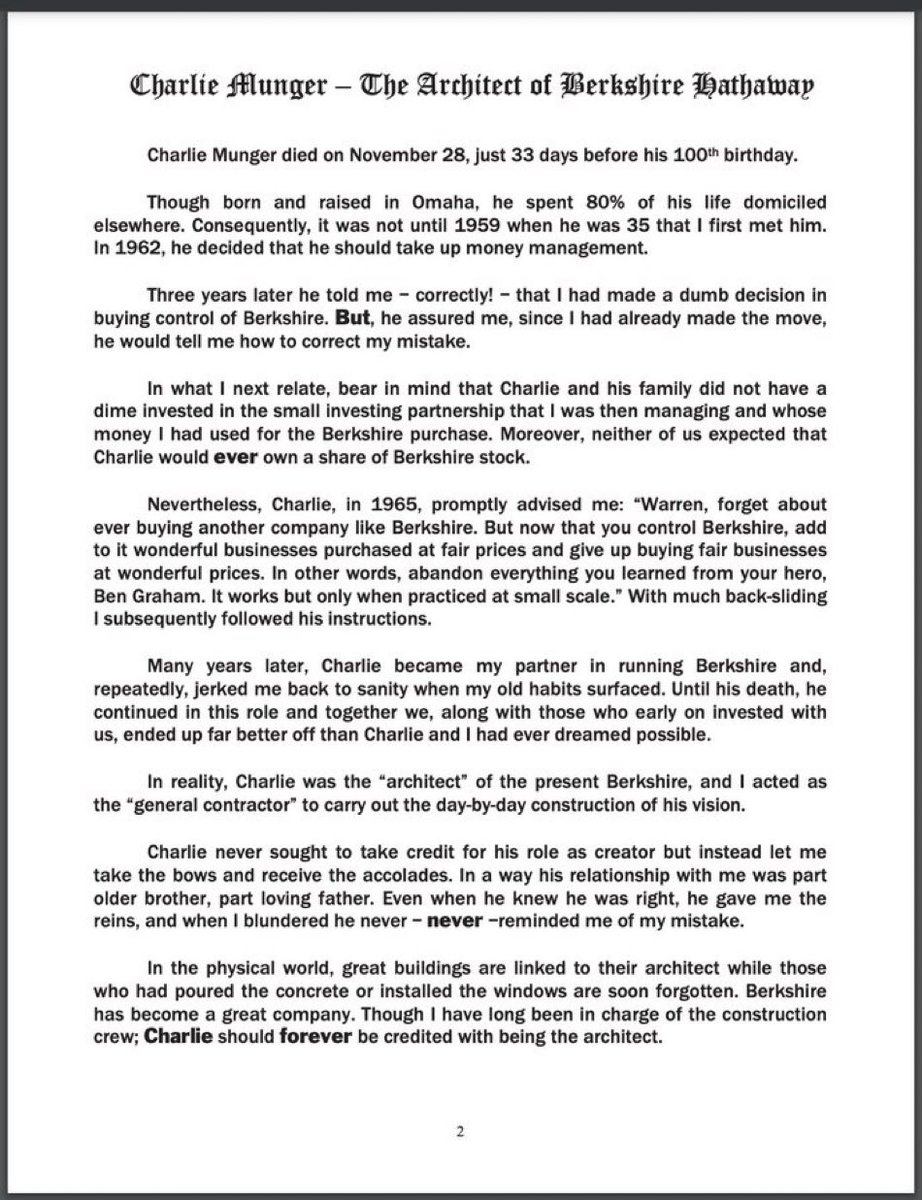
Warren Buffett’s tribute to Charlie Munger as the architect of Berkshire Hathaway.
Anthony Pompliano 🌪 tweet media
English
58
416
3.1K
511.5K
Ankit Khosla retweetledi
George Mayer
George Mayer@GeorgeMayer·
I'm an E7 at Meta (principal-ish). I worked hard to get here. Here are all of the ways I was privileged/got lucky (in chronological order): 1) When I was in college, my mom wanted to start an online dating site. She had personal insight. I studied marketing and English in school and these were the skills that I lent to the endeavor. But I also met a software developer there and this was where I first learned that I loved to code. This person was crucial as I discovered coding and was generous with their time. 2) I got a job at a marketing agency that also built websites. They let me—a junior digital marketer—spend time helping build the websites even though I had no idea what I was doing: my job was to run ads. I also was lucky enough to meet some incredibly smart people there that are still my friends. 3) My girlfriend (gf at the time, wife now), decided to move to New York. I decided to follow her and quit my agency job (above). I knew I liked programming so I did a dev bootcamp. Flatiron school. I hit this trend at the *perfect* time. 4) I was offered two jobs out of bootcamp. The first was at an in-house developer at a VC. This job sounded SO cool/chic. The second was a tiny startup. It turned out that this startup used the same PHP framework (codeigniter) that the dating site used and this was one of the reasons they offered my the job (so lucky). 5) I chose the tiny startup because of the people there. It was 100% a vibes decision. I think on paper most people would have chosen the VC. 6) This turned out to be the best job I ever had. Everyone I worked with was extremely smart. I was also lucky enough to land in a situation working with senior engineers who were extremely competent and also willing to lend their time to me. I was able to do things like introduce react to the company, shard a mysql DB and run a multi-billion record elastic search cluster. 7) It just so happened that this company was in social media analytics and our major platform was Facebook. After about two years working there, Facebook bought our company. There is no way I would have gotten a job at Facebook otherwise. I've now spent over a decade building large scale applications at Meta/Facebook and at startups. The point is that it feels to me like I'm driving along and I've hit every green light. It doesn't mean I don't know how to drive, but I'm an idiot if I don't recognize the lucky pattern. If you feel similar, I want to hear your story. If you feel like you're in the opposite situation, I want to hear how I can help.
English
89
127
1.9K
612.2K
Ankit Khosla
Ankit Khosla@ankit_khosla·
Thank you for sharing your wisdom with the world 🙏🏻 Rest well, legend Charlie Munger!
Ankit Khosla tweet media
English
0
0
0
41
Ankit Khosla retweetledi
Siqi Chen
Siqi Chen@blader·
customer feedback alone is not enough
Siqi Chen tweet media
English
135
260
2.5K
562.2K
Anthony Simon
Anthony Simon@anthonynsimon·
Huge challenge since I quit my engineering job to bootstrap a business: Unlearn half of what I know. When trying to get something off the ground, fast builds, zero downtime deploys, and even automated tests won’t save you if you have no customers. At best one day you’ll open source it instead of dumping it on /dev/null
English
4
0
13
1.8K
Ankit Khosla retweetledi
Matt Boyle
Matt Boyle@MattJamesBoyle·
Not a #golang specific tip, but people often give the advice "the best way to get better at any programming language is to write more programs". This is true at the start, but as you begin to get more comfortable with the language, the best way to improve is to read lots of other people's code too. Every week for 30 minutes I will find a repo on Github and just read it. I tend to start with the entry point (usually main.go) and look for interesting patterns and ideas to see what I can learn from them. Here are some of my favourites: - github.com/google/exposur…. This was reference server co-authored by Apple and Google during Covid. The way they use the logger inspired the way I have logged ever since. It also looks very similar to Slog that just got released. - github.com/matryer/xbar by @matryer. This one is really interesting as its just a completely different way to use go. - github.com/ardanlabs/serv… by @ardanlabs . The ardan Labs folk run a whole course on how to write this service but kindly make it open source and free. It has examples of tracing, logging, profiling and much more. A really great place to learn. - github.com/charmbracelet/… yields incredibly beautiful TUIs, and does some interesting things with Go to achieve it. - github.com/Humpheh/goboy a Frigging gameboy emulator written in Go! Which repos have you learnt a bunch from? What repos should I read in the next few weeks? Feel free to share your own :)
English
39
215
1.2K
178.9K
Ankit Khosla retweetledi
kepano
kepano@kepano·
Don't delegate understanding There is a parasite, I see it everywhere. It consumes your health and wealth. It preys on ignorance and is easy to catch. It’s so common you may not even notice you have it. The parasite has a simple and attractive proposition: let me take care of this hard thing for you. Trust me, I know better. Instead of understanding it yourself, you choose to give the parasite control over your health, education, money, housing, business, identity, data, infrastructure, climate, justice. Even your beliefs. The parasite has three stages: acceptance, extraction, intervention. First is acceptance. Everyone else seems to have the parasite already. You are expected, even encouraged, to accept the parasite into your life. You are invited to follow the norm, outsource, consume. It’s okay! Use all the services and amenities. Satisfy your desires. Eat the cheap food, watch the cheap media. Your money and time are meant to be spent. Show off what you got in exchange. Please do not try to understand how it works, it’s too complicated for you. The parasite wants you fattened. Literally and figuratively. You are paying the parasite for the privilege of being ripened. Second is extraction. Under the influence of the parasite, you have developed unhealthy habits and you are suffering the consequences. Stress, anxiety, obesity, disease, ignorance, fear, lethargy, decay. To dampen these problems you pay the parasite for help — support, medicine, loans, fines, rent, taxes. Enforcement of some homeostasis. You try to abate the issues, but you don’t have a stable foundation to build on. You have ignored the root causes. The parasite thrives. You are paying the parasite to be harvested, milked, sucked dry. Third is intervention. The side effects of the parasite’s extraction have reached a critical level. The parasite tells you it’s an emergency. You need doctors, lawyers, firefighters, a military effort. You’re in a surgery room, a court room, a psychiatric ward, a jail cell. The disease can no longer be controlled, it has festered. The flame has turned into a raging fire that needs to be put out. You are paying the parasite to go back to square one. The three stages of the parasite are interdependent. Every stage benefits someone who is not you. Everyone tells you this is just the way it is. Never mind that the parasite is living large. Why? Extraction and intervention pay well. Education and prevention do not. The incentives are aligned to make the parasite persuasive. You are alone against a coordinated system that is exceedingly effective at packaging problems you should never have with solutions you should never need. A symbiotic loop. You must recognize the parasite in its earliest form. To inoculate yourself don’t delegate understanding. If you build your own understanding you will be the one who earns the dividends.
kepano tweet mediakepano tweet mediakepano tweet media
English
83
541
4.1K
1.1M
Ankit Khosla
Ankit Khosla@ankit_khosla·
Benefits: - You'll learn new technologies along the way - Since they are generic in nature. You can implement them for personal products or reuse them for consultancy projects Share your thoughts!
English
0
0
0
35
Ankit Khosla
Ankit Khosla@ankit_khosla·
1) Audit logger, with JSON file 2) Authorization with @cerbosdev 3) Custom logger with @Uber Zap 4) File upload and image resizing in predefined resolutions 5 ) API gateway using @ApacheAPISIX and many more...
English
1
0
1
61
Ankit Khosla
Ankit Khosla@ankit_khosla·
We all know getting your hands dirty is the best approach to learning a new language. I would suggest it's better to build a generic set of modules with specific functionalities. Use localstack and minikube. Below are some generic modules: #golang #SoftwareEngineering
English
1
0
5
107