Anthony Sexton

4.2K posts

Anthony Sexton banner
Anthony Sexton

Anthony Sexton

@anthonysexton

Love solving problems with great software and a little bit of #fintech

Australia Katılım Mart 2009
1.2K Takip Edilen950 Takipçiler
Anthony Sexton
Anthony Sexton@anthonysexton·
The team plan on @claudeai gets none of the fun stuff like Dispatch. It means the team ask to use their company card to setup their own subscriptions just so they can keep up with what's new. Come on!
English
0
0
0
12
Anthony Sexton retweetledi
vogel
vogel@ryanvogel·
everyone is trying to build async agents that work when they sleep but all they really need are Australians
English
88
113
1.7K
89.8K
Anthony Sexton retweetledi
PGA TOUR
PGA TOUR@PGATOUR·
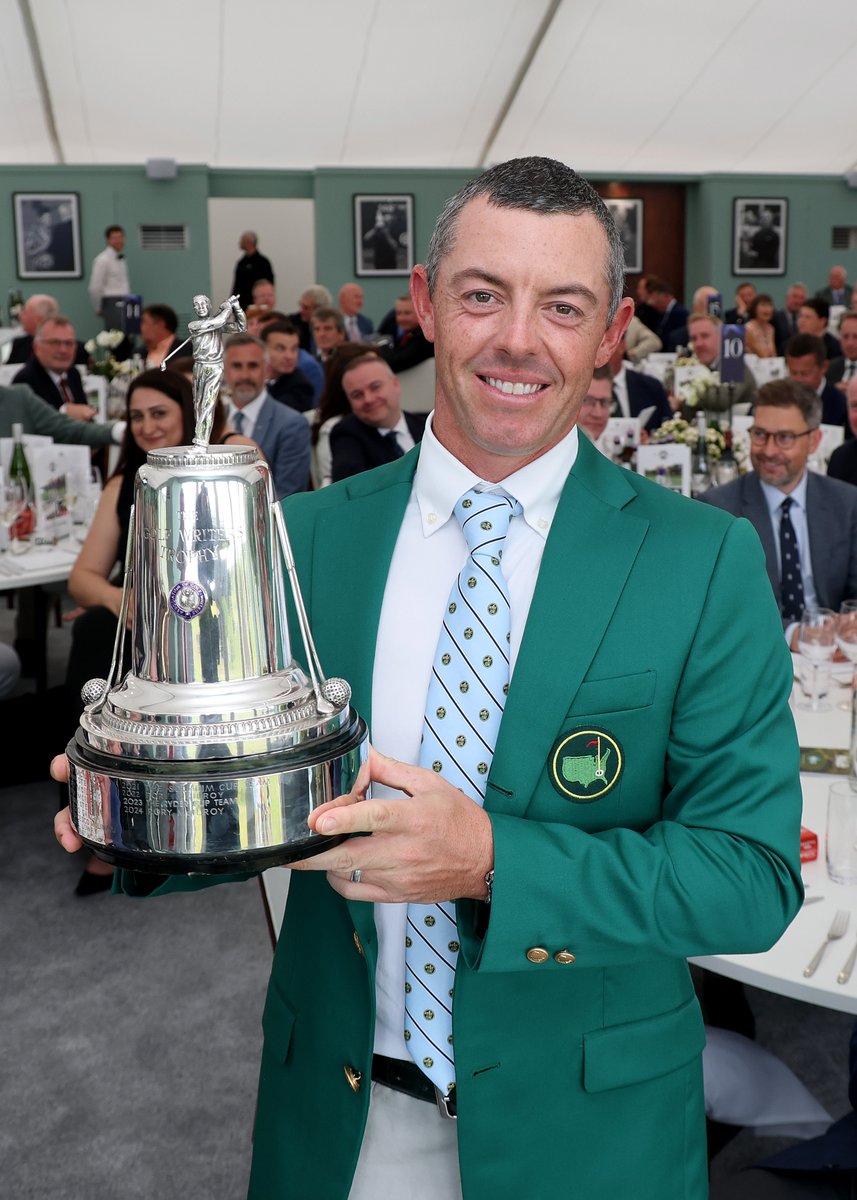
Rory McIlroy explains why he made each selection for his 2026 Masters Champions Dinner menu: 𝗣𝗲𝗮𝗰𝗵 & 𝗥𝗶𝗰𝗼𝘁𝘁𝗮 𝗙𝗹𝗮𝘁𝗯𝗿𝗲𝗮𝗱 “I wanted to try to bring a little bit of the local ingredients in. So I'm doing a Georgia peach and ricotta flatbread with hot honey. So hopefully that will go down well with the drinks.” 𝗥𝗼𝗰𝗸 𝗦𝗵𝗿𝗶𝗺𝗽 𝗧𝗲𝗺𝗽𝘂𝗿𝗮 “I think everyone likes rock shrimp tempura, so sort of a crowd pleaser with that one.” 𝗕𝗮𝗰𝗼𝗻-𝗪𝗿𝗮𝗽𝗽𝗲𝗱 𝗗𝗮𝘁𝗲𝘀 “My mum does these really, really nice dates stuffed with goat cheese, wrapped in bacon … Thanks to Rosie for that one.” 𝗚𝗿𝗶𝗹𝗹𝗲𝗱 𝗘𝗹𝗸 𝗦𝗹𝗶𝗱𝗲𝗿𝘀 “In the buildup to the Masters last year, I was eating a lot of elk ... I didn't want elk to be the main course because I didn't know if everyone would like that … So I'm doing grilled elk sliders which I think is fun.” 𝗬𝗲𝗹𝗹𝗼𝘄𝗳𝗶𝗻 𝗧𝘂𝗻𝗮 𝗖𝗮𝗿𝗽𝗮𝗰𝗰𝗶𝗼 “My wife, Erica and I, our favorite restaurant, or one of our favorite right now is in New York. It's called Le Bernardin. Eric Ripert is the chef there, and this is a dish from that restaurant. It's a yellowfin tuna carpaccio. It's a really thin slice of French baguette with a really thin slight of foie gras on top of that … So that's a fun one that the club worked with me on as well. They went up to the restaurant and worked with the chefs, and made sure; that they obviously wanted to get it right for the night, so that's really cool.” 𝗪𝗮𝗴𝘆𝘂 𝗙𝗶𝗹𝗲𝘁 𝗠𝗶𝗴𝗻𝗼𝗻 𝗼𝗿 𝗦𝗲𝗮𝗿𝗲𝗱 𝗦𝗮𝗹𝗺𝗼𝗻 “It's an amazing honor to be able to host it, but at the same time, I want everyone to enjoy it. I went for two different options for the main course, a wagyu filet mignon for people that want red meat, or a fillet of seared salmon; so depending on what you want.” 𝗦𝗶𝗱𝗲𝘀 “When I was a kid, I used to eat (Irish) champ by the bowlful … Some sauteed brussels sprouts. Glazed carrots with brown butter. And then trying to bring a little bit of that local flavor back in, some crispy Vidalia onion rings. Vidalia is not too far away from Augusta, about a two, two-and-a-half-hour drive.” 𝗦𝘁𝗶𝗰𝗸𝘆 𝗧𝗼𝗳𝗳𝗲𝗲 𝗣𝘂𝗱𝗱𝗶𝗻𝗴 “I think very much a crowd-pleaser, sticky toffee pudding with vanilla ice cream on warm toffee sauce.” 𝗪𝗶𝗻𝗲𝘀 "My favorite part of the menu is you obviously get access to the wonderful wine cellar at Augusta National. We're starting off with a 2015 Salon Brut champagne. And then followed by a 2022. Domaine Leflaive Batard Montrachet. It's the first-ever white wine that I actually liked ... And then for the red wine we're receiving a 1990 Chateau Lafite Rothschild from Pauillac in Bordeaux. That is the wine that I drank the night that I won the Masters, so obviously brings back some great memories. Shane Lowry had a little bit to do with getting that wine, so I want to shout him out for that, too ... To finish off, we're going with a 1989 Chateau D'Yquem dessert wine from Sauternes in Bordeaux, as well. Obviously '89, my birth year, and I think every great meal deserved to be finished off with Chateau D'Yquem. It is like liquid gold. I wanted to be really intentional with the wines. It's something that I'm really into and passionate about and started to collect wine, probably over the past decade."
PGA TOUR tweet media
English
295
510
10.7K
2.8M
Anthony Sexton
Anthony Sexton@anthonysexton·
@petergyang @meetgranola He might be, but their sales team had very much the same opinion when we enquired about API access and SSO. It shouldn’t matter what our team size is, especially in relation to those capabilities…
English
0
0
0
36
Peter Yang
Peter Yang@petergyang·
Chris is one of the most customer obsessed CEOs I know. The idea that @meetgranola is becoming closed as a platform is simply BS. Can't wait for more APIs / CLIs from my favorite AI meeting app.
Chris Pedregal@cjpedregal

There are some tweets out there saying that Granola is trying to lock down access to your data. Tldr; we are actually trying to become more open, not closed. We’re launching a public API next week to complement our MCP. Read on for context. A couple months ago, we noticed that some folks had reversed engineered our local cache so they could access their meeting data. Our cache was not built for this (it can change at any point), so we launched our MCP to serve this need. The MCP gives full access to your notes and transcripts (all time for paid users, time restricted for free users). MCP usage has exploded since launch, so we felt good about it. A week ago, we updated how we store data in our cache and broke the workarounds. This is on us. Stupidly, we thought we had solved these use cases well enough with our MCP. We’ve now learned that while MCPs are great for connecting to tools like Claude or chatGPT, they don’t meet your needs for agents running locally or for data export / pipeline work. So we’re going to fix this for you ASAP. First, we’ll launch a public API next week to make it easier for you to pull your data. Second, we’ll figure out how to make Granola work better for agents running locally. Whether that’s expanding our MCP, launching a CLI, a local API, etc. The industry is moving quickly here, so we’d appreciate your suggestions. We want Granola data to be accessible and useful wherever you need it. Stay tuned.

English
4
3
59
17.2K
Luke Pierce
Luke Pierce@lukepierceops·
Automation consultants charge $15K for what Claude Code now does in 2 hours. I know because we're the ones who used to charge it. Here's the exact process: Step 1: Discovery (20 min) → Paste your org chart, tool stack, and top 3 bottlenecks → Claude interviews you with clarifying questions → Outputs a full process inventory ranked by time cost Step 2: Workflow Mapping (15 min) → Describe any department's daily operations in plain English → Claude builds a complete process map → Every manual handoff, redundant step, and automation trigger flagged Step 3: Opportunity Audit (10 min) → Feed it the workflow map output → Returns your top 10 automation opportunities → Ranked by ROI, complexity, and build time Step 4: Architecture Design (20 min) → Claude designs the full system architecture → Which tools connect where, what the data flow looks like → Agents for complex logic, linear flows for the repetitive stuff Step 5: Build (ongoing) → Claude writes the actual workflow JSON → Self-documents everything as it builds Step 6: The output. A live dashboard your whole team can work from. → Clickable process maps for every department → Automation opportunities ranked by ROI → Implementation progress by phase → KPIs updated in real time → One link you share with clients, freelancers, or your team to execute This is what we hand every client at the end of discovery. The .md file is what makes all of it possible. Without it, Claude guesses. With it, Claude builds like a $15K consultant. Like this post, RT and comment "BLUEPRINT" and I'll send you the full prompt stack and the .md file we use internally. (Must be following so I can DM you) 🎁 Bonus: The first 100 people get a real Precision AI Blueprint — an actual sample audit doc from a client engagement so you can see exactly what the output looks like.
Luke Pierce tweet media
English
1.1K
525
1.5K
150.9K
Nathan Clark
Nathan Clark@nathanclark_·
I'm assuming the "sell" to saas vendors from @lennysan is that Product Pass users will convert to paid…
Nathan Clark tweet media
English
2
0
0
193
Anthony Sexton
Anthony Sexton@anthonysexton·
@Jackkk @Qantas good luck not replying to me the last time I asked about this. Looks like your future travellers may have an issue with the wifi/internet pathway you’ve gone down. Good luck!
English
1
0
3
417
Jack
Jack@Jackkk·
MrBeast reveals once enough airlines start using Starlink, he’ll only book flights that have it “Oh this flight has an extra hour layover? I don’t care, there’s Starlink. I’ll sit in the back of the plane if it gives me Starlink. I really don’t care, Starlink is amazing” “Most people listening probably haven’t used it but for reference when I filmed in Antarctica the only way to get any signal was Starlink. We had this four hour drive in the middle of Africa, you put Starlink on top of the car and you get perfect signal the entire ride” “And I think what Elon Musk is accomplishing with SpaceX, there’s no doubt it’s going to fundamentally progress humanity in unfathomable ways. In our lifetime, someone’s going to go to Mars thanks to SpaceX, I really do believe that”
English
1.1K
2.1K
36.9K
36.9M
Anthony Sexton
Anthony Sexton@anthonysexton·
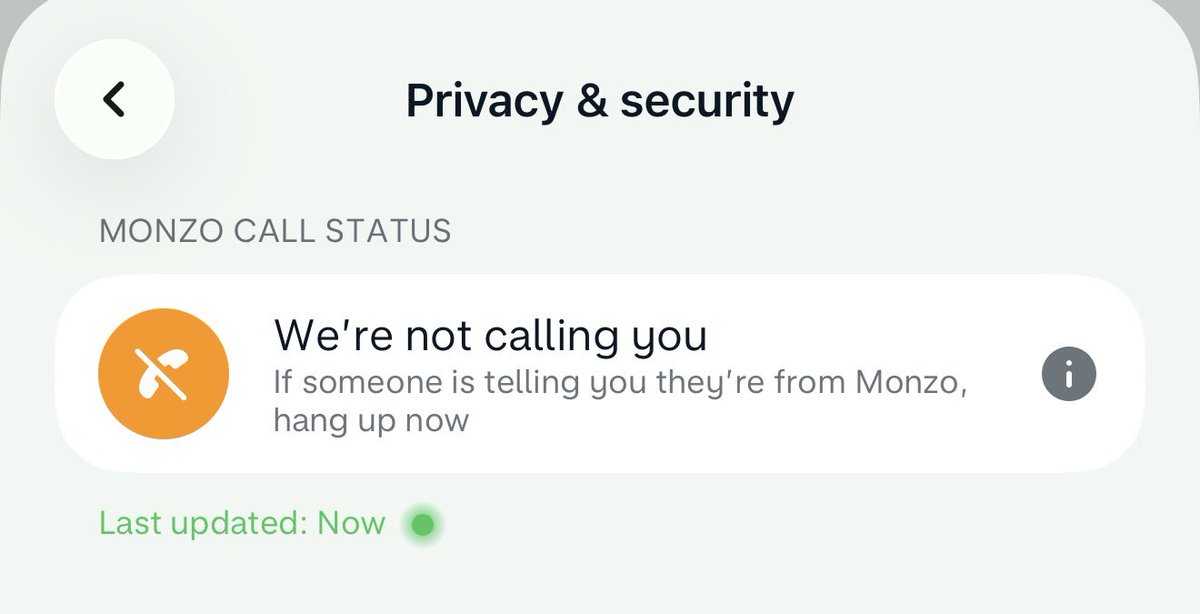
This should be a no-brainer security feature for anyone that has an app. The ability to highlight when you are, or more importantly, aren’t calling someone would be super valuable. Congratulations @monzo! (I know this has been there for a while)
Anthony Sexton tweet media
English
0
0
0
41
Anthony Sexton retweetledi
Gaia ☀︎︎︎
Gaia ☀︎︎︎@GaiaSerenity·
my version of touching grass is watching the ocean sparkle
English
68
11.2K
54.6K
742.1K
Anthony Sexton
Anthony Sexton@anthonysexton·
@awilkinson This is a lot of information for me to be sharing if you can find out all of this. Interested to try it, but I am not sure I want you knowing all of that!
English
0
0
0
175
Andrew Wilkinson
Andrew Wilkinson@awilkinson·
I’ll buy a Mac Studio + Pro Display for whoever gets the most likes/RTs on a post or thread about my insane new personality test, Deep Personality. It screens for: • Ideal job • Relationship fit • Life satisfaction • Anxiety / depression / PTSD / autism • And a lot more Go.
English
36
5
113
38.6K
Akshay Kothari
Akshay Kothari@akothari·
For the past few months, a small crew got together to overhaul @NotionHQ sidebar / navigation. We called the project "Slippery Slope" :) For anyone who's worked on a similar project knows how hard it is to make any changes to navigation, because it directly impacts how millions of people use your product every single day. To my surprise and delight, the team was able to ship something remarkably better in a matter of weeks. We've been using it internally for some time now, and I cannot imagine going back. We start ramping to users tomorrow, but feel free to reply here, and I'll try my best to turn on early access!
English
236
33
730
210.3K
Michael Grinich
Michael Grinich@grinich·
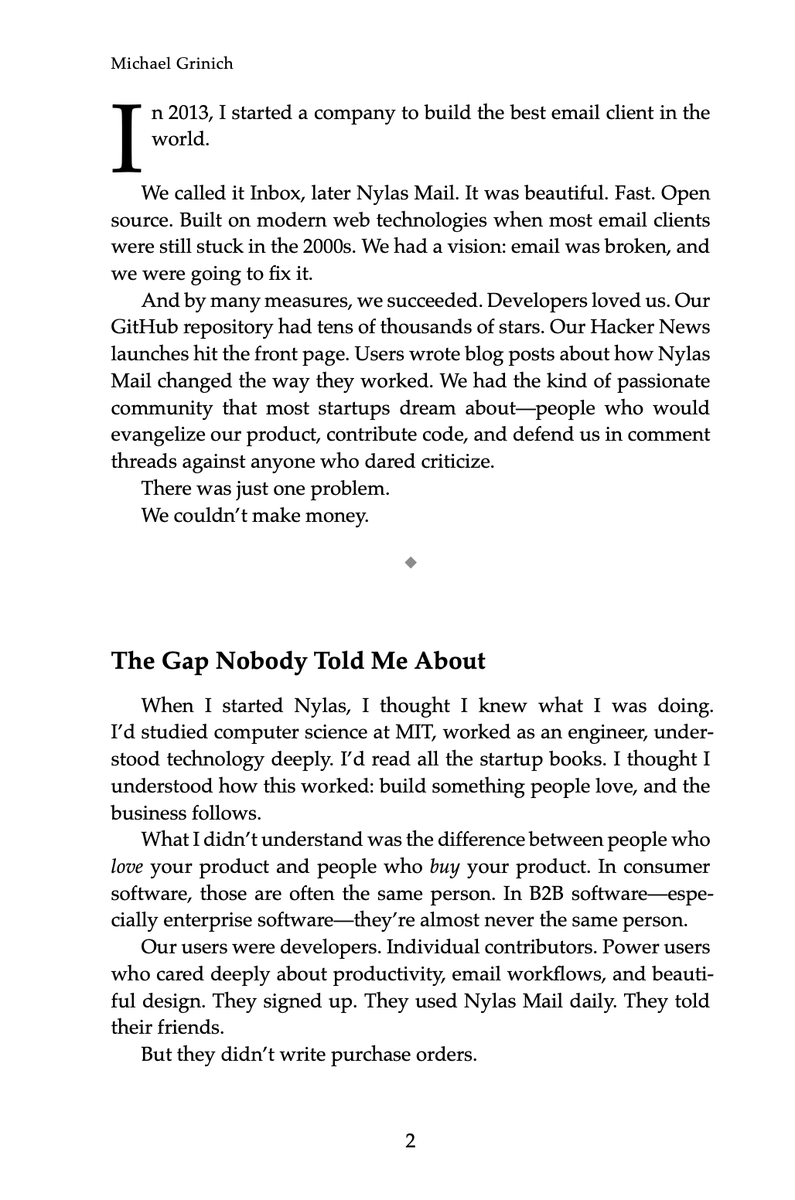
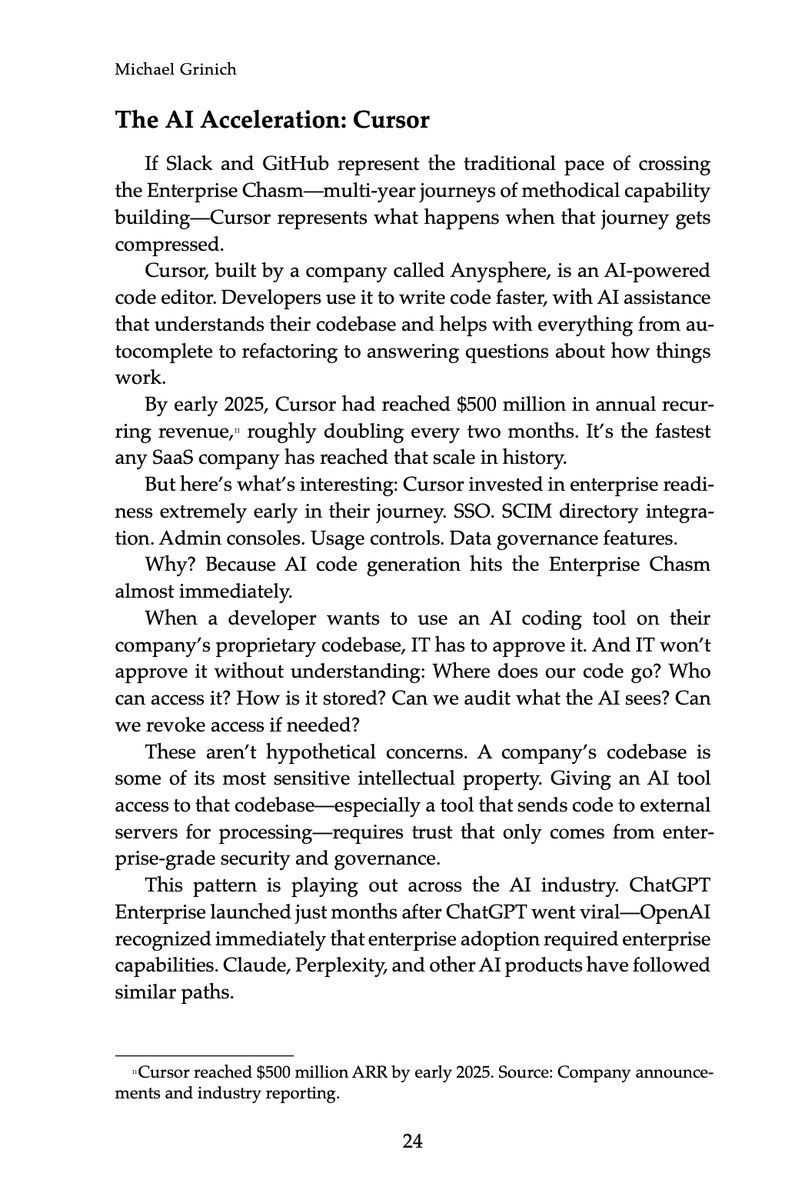
I wrote the book I always wanted. 📖 A complete, practical guide to enterprise readiness — how to go from “users love us” to “enterprises buy from us.” 275 pages. 18 chapters. The missing manual for founders going upmarket. Limited print run. Want a copy?
Michael Grinich tweet mediaMichael Grinich tweet mediaMichael Grinich tweet mediaMichael Grinich tweet media
English
80
6
193
11.3K
Anthony Sexton retweetledi
Karri Saarinen
Karri Saarinen@karrisaarinen·
What it feels like to run a software company in the AI era
Karri Saarinen tweet media
English
52
28
769
36K
Anthony Sexton retweetledi
BuccoCapital Bloke
BuccoCapital Bloke@buccocapital·
Here’s an incredibly simple bull case for the incumbent systems of record, or at least, a simple rebuttal of the seat loss + shrinking customer LTV bear case: 1. AI has actually expanded their TAM, which is now the opportunity to displace labor by charging for outcomes instead of seats 2. If a business currently spends $20-50 to close a support ticket, they are thrilled to pay 50 cents for AI to solve it, and potentially also have to hire fewer support reps. Similar dynamic with leads and business development reps 3. No company actively wants to use another vendor. It is so so so so so much easier to just use your existing relationship and infrastructure 4. Therefore, literally every customer just wants Salesforce or HubSpot or ServiceNow to just figure this out. They are rooting for them 5. Even if they are testing other point solutions, they will absolutely switch if the SoR solution becomes good enough 6. They just have to become good enough in the next 12-18 months. They probably will figure it out
English
36
20
520
90.2K
Anthony Sexton retweetledi
Tomasz Łakomy
Tomasz Łakomy@tlakomy·
European engineers after 4:30pm on Friday (prod is down)
English
99
384
6.5K
395.7K
Anthony Sexton retweetledi
Fusilier
Fusilier@firstfusilier·
He’s not fucken wrong, so why is no one in the Australian Government listening?
English
482
2.1K
8.6K
184.8K
Anthony Sexton
Anthony Sexton@anthonysexton·
@CJHandmer They absolutely do fly on their own aircraft/experience the product. The disconnect is they aren’t paying what we do for it. As a result, I can only assume they think it’s great value!!
English
0
0
0
275
Anthony Sexton retweetledi
Aakash Gupta
Aakash Gupta@aakashgupta·
The entire robotics industry is about to compress a decade of progress into 18 months, and nobody’s pricing it in. The hardware has been ready for years. Boston Dynamics had Atlas doing backflips in 2018. The bottleneck was never motors or actuators. It was that every robot behavior had to be hand-coded. Pick up a box? That’s one program. Pick up a bottle? Different program. Move the box from shelf A to shelf B in a warehouse with slightly different lighting? Start over. Foundation models broke this completely. Before VLAs, teaching a robot one skill gave you exactly one skill. Zero compounding. Zero transfer. A robot trained to fold shirts couldn’t fold towels without starting from scratch. The labor intensity of data generation meant robotics datasets stayed narrow, robots overfit, and small variations like object weight or table height caused failures. Now a single Gemini Robotics model handles tasks it has never seen in training. Google’s On-Device model learns new behaviors with 50-100 demonstrations. Not 50,000. Fifty. That’s a 1000x reduction in the data requirement for new capabilities. The speed implications cascade through everything. First order: deployment timelines collapse. What took robotics teams 6-12 months of custom programming now takes days of fine-tuning. Second order: the addressable market explodes. Tasks that were never economical to automate suddenly are, because the integration cost dropped by orders of magnitude. Third order: the data flywheel accelerates. Every robot running Gemini Robotics feeds learning back into the foundation model. More deployments means faster improvement means more deployments. Physical Intelligence raised at $2.4B because investors finally understood this. Boston Dynamics partnered with Toyota Research Institute to bolt Large Behavior Models onto Atlas. Every humanoid company is scrambling to either build or license the intelligence layer they don’t have. The market is still valuing robotics companies on their hardware differentiation. But hardware is commoditizing. Boston Dynamics spent a decade perfecting locomotion, and now that’s table stakes. The value is migrating entirely to whoever owns the foundation model that generalizes across embodiments. Google trained Gemini on the largest multimodal corpus ever assembled. Then they added physical actions as an output modality. That’s not a robotics company bolting on AI. That’s an AI company whose models now output motor commands. The companies pricing this correctly are building around foundation model access, not around proprietary hardware. The companies pricing this wrong are still acting like the moat is in the mechanical engineering. AGI moving into the physical world isn’t a 10-year prediction. Gemini Robotics shipped in March. The 1.5 version with chain-of-thought reasoning shipped in September. They’re iterating on a 6-month release cycle while hardware companies iterate on 3-year cycles. The gap between software intelligence timelines and hardware development timelines is the entire trade.
Jon Hernandez@JonhernandezIA

📁 Demis Hassabis, CEO of DeepMind, says robotics didnt fail because of hardware. It failed because intelligence was missing. Gemini level models finally give robots the software brain they needed. When intelligence works, hardware follows. AGI doesnt live behind a screen. It moves.

English
244
948
6.4K
1.3M
Anthony Sexton retweetledi
DHH
DHH@dhh·
Microservices is the software industry’s most successful confidence scam. It convinces small teams that they are “thinking big” while systematically destroying their ability to move at all. It flatters ambition by weaponizing insecurity: if you’re not running a constellation of services, are you even a real company? Never mind that this architecture was invented to cope with organizational dysfunction at planetary scale. Now it’s being prescribed to teams that still share a Slack channel and a lunch table. Small teams run on shared context. That is their superpower. Everyone can reason end-to-end. Everyone can change anything. Microservices vaporize that advantage on contact. They replace shared understanding with distributed ignorance. No one owns the whole anymore. Everyone owns a shard. The system becomes something that merely happens to the team, rather than something the team actively understands. This isn’t sophistication. It’s abdication. Then comes the operational farce. Each service demands its own pipeline, secrets, alerts, metrics, dashboards, permissions, backups, and rituals of appeasement. You don’t “deploy” anymore—you synchronize a fleet. One bug now requires a multi-service autopsy. A feature release becomes a coordination exercise across artificial borders you invented for no reason. You didn’t simplify your system. You shattered it and called the debris “architecture.” Microservices also lock incompetence in amber. You are forced to define APIs before you understand your own business. Guesses become contracts. Bad ideas become permanent dependencies. Every early mistake metastasizes through the network. In a monolith, wrong thinking is corrected with a refactor. In microservices, wrong thinking becomes infrastructure. You don’t just regret it—you host it, version it, and monitor it. The claim that monoliths don’t scale is one of the dumbest lies in modern engineering folklore. What doesn’t scale is chaos. What doesn’t scale is process cosplay. What doesn’t scale is pretending you’re Netflix while shipping a glorified CRUD app. Monoliths scale just fine when teams have discipline, tests, and restraint. But restraint isn’t fashionable, and boring doesn’t make conference talks. Microservices for small teams is not a technical mistake—it is a philosophical failure. It announces, loudly, that the team does not trust itself to understand its own system. It replaces accountability with protocol and momentum with middleware. You don’t get “future proofing.” You get permanent drag. And by the time you finally earn the scale that might justify this circus, your speed, your clarity, and your product instincts will already be gone.
English
181
1.2K
8.3K
990.4K