

Anthony Pierri
128 posts

Anthony Pierri
@apierriPMM
Product Marketing for Early Stage B2B Horizontal Startups | Elder Emo
Katılım Haziran 2023
109 Takip Edilen1.1K Takipçiler





maybe the real AI agents were the friends we made along the way
English
Anthony Pierri retweetledi

“Most founders try to do too much and spread themselves thin. You can’t win in 10 markets at once—dominate a tiny niche first, then expand.”
@robwalling and @apierriPMM chat about SaaS positioning and more in episode 772👇
startupsfortherestofus.com/episodes/episo…
English

This one piece of advice by @apierriPMM saved me from completely screwing up last week... 😨
In a recent YouTube video, Anthony shared one of the best hacks for homepage copywriting that I've ever heard. 👇
'Blur out all subtext and show only the H1 and section headers.
Then, see if you still understand what the tool does.'
This tip is so simple, it's almost silly.
But it reveals a lot about the clarity of your messaging.
And I was way too close to completely messing up the homepage of our new SaaS before stumbling upon this video... 😅
Below is an example of what GREAT looks like in terms of clear copywriting, written by the PLG homepage 🐐 himself:

English
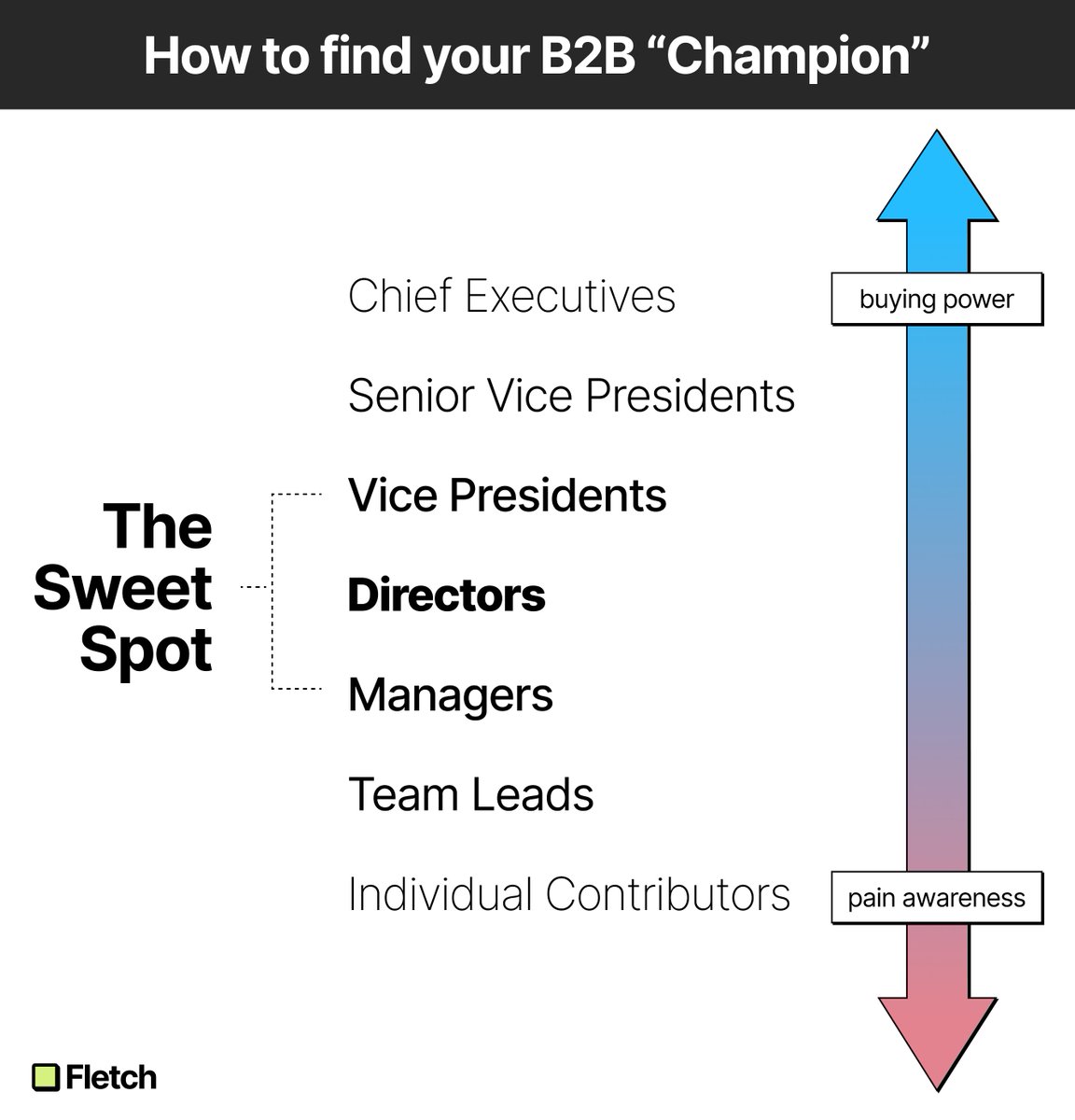
The two biggest homepage mistakes B2B marketers make:
1) writing for the c-suite
2) writing for the end user
When we advocate that startups should NOT write for the c-suite on their homepage, I'll always get asked this question:
"So should I write for the end user? They don't have any buying power!"
...and completely forget there are at least SIX degrees of separation between those two levels.
The trick to finding your buying "champion" is to focus on someone who is close enough to understand the problem that they'll want to be involved in the uncovering/purchasing of a PRODUCT to solve it.
The CFO is going to be so far removed from the problem, they will have no urgency to get the purchase over the finish line.
A lower level employee will see the problem day in and day out — and will be HIGHLY motivated to get it solved.
BUT!
They also must have the level of cred in the org to set up meetings with other stakeholders (i.e. "we NEED to get this solution.")
If you're selling sales tools that will primarily help SDRs in their day to day job...
it's unlikely the 18 year old that was just hired out of high school will have the sway to intro you to the CFO to get that final signature of approval.
If you're selling mid-priced B2B software, your most likely champion is somewhere in the middle...
(think senior managers, directors, or VPs)
Some obvious exceptions:
→ there are truly some products that are meant to be used by the c-suite
(Clari comes to mind).
A big part of their value prop according to Devin Reed was that they would be actively used in the board room.
→ if you're using a PLG strategy, the end user really IS your champion (you want to speak directly to them, as they'll be adopting the product via freemium or a free trial).
#productmarketing #saas #b2b #startups
English

@apierriPMM @apierriPMM -- good one. but even with Cognism's messaging, there are plenty other competitors who follow simple messaging like theirs.
How does a Cognism then differentiate itself?
English
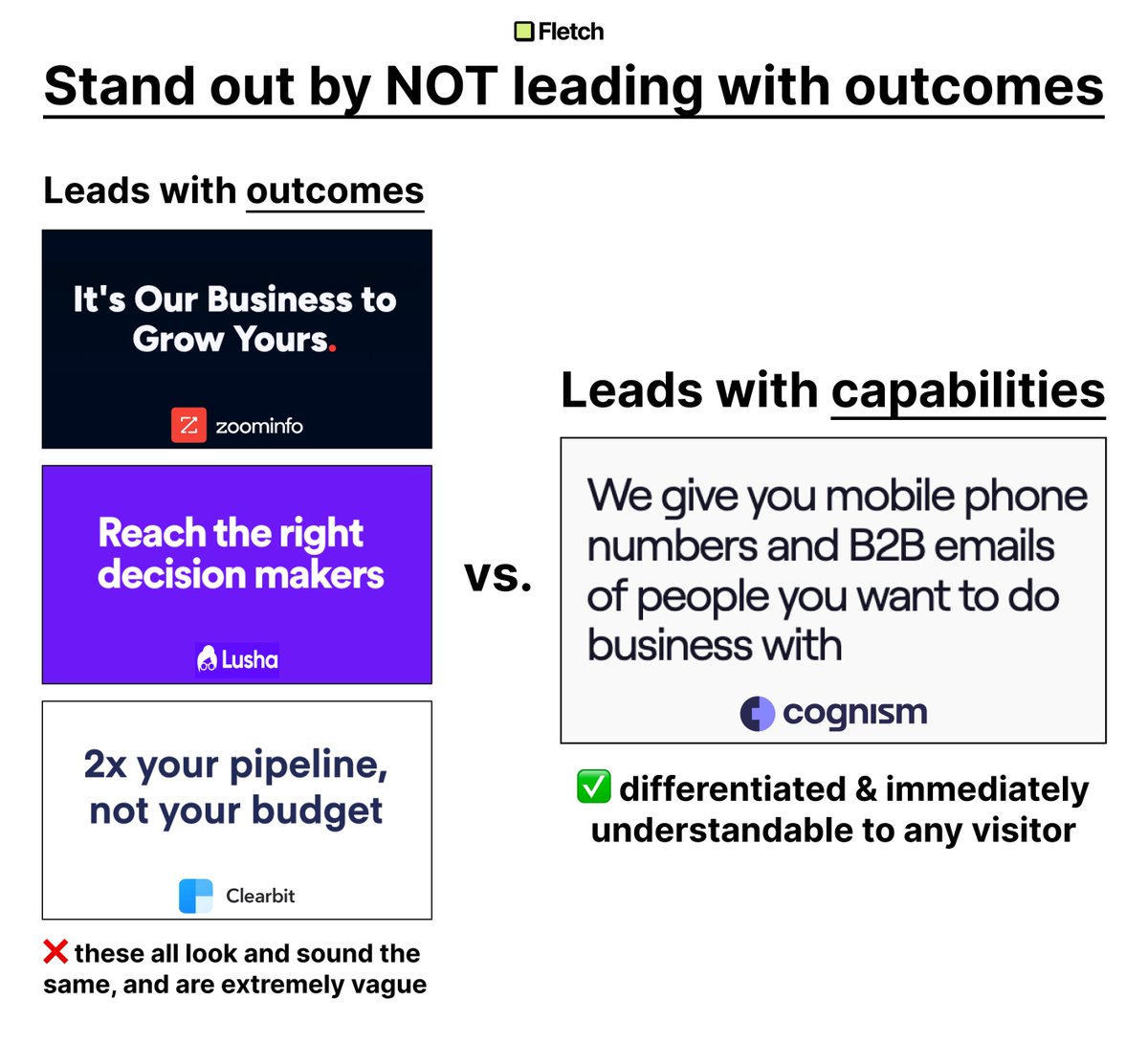
Want to IMMEDIATELY stand out from the crowd in B2B?
Just say what you f*cking do.
Verche Karafiloska had me as a guest on Cognism's podcast "The Loop" back in February while she was still leading product marketing at the company.
In the episode, she shared that they had pivoted from an outcome-focused hero message (something like "improve your bottom line") to what they say today...
...and they saw their conversion rate increase 40%.
40%!!!!!
But when you think about it... it makes sense.
B2B buyers are TIRED.
Tired of reading endless claims of ROI (that they know are absolute BS).
Tired of scrolling homepages without a single mention of your product.
Tired of needing to sign up for a demo to find out ANYTHING.
Tired of wishing that you'll just be honest about what you're selling
(without the used car salesman sales tactics).
She told me they used a message testing app (I can only assume it was Wynter) and the consistent question website visitors had was: "what am I actually buying?"
Sometimes, it pays MORE to not blindly follow "best practices,"
but instead LISTEN TO YOUR PROSPECTS.
When everyone zigs, you should zag.
English
My 10 most controversial takes:
1. Value-based pricing is a scam.
2. If your impressions are down, it’s your fault.
3. Almost all ROI claims are made up.
4. Most SaaS companies should charge LESS, not more.
5. Sales-led, enterprise-focused companies should message like they’re PLG.
6. VC-backed startups should pretend they’re bootstrapped.
7. You (the founder) are the source of 98% of your company’s problems.
8. Most marketing execs do rebrands to solidify their legacy (not to help the company).
9. If you think “nobody cares about features,” you should fire your PM team.
10. “Data-driven decisions” are almost always opinion-driven decisions in disguise.
English
@nurijanian Thanks so much for sharing this!! It might have come from @heyrobk originally (I'm like 99% sure)
English
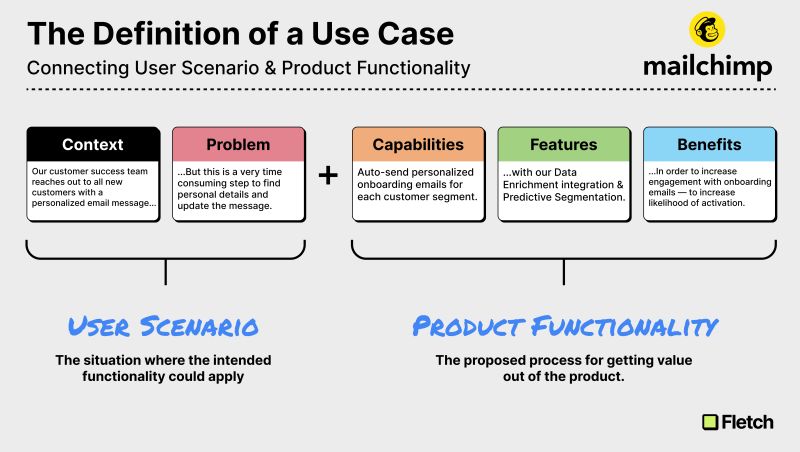
I keep hearing people say "use case" about literally anything
This is a good way to frame it (h/t @apierriPMM)
English
There are two levers an early stage founder can pull to grow their startup:
→ deliver the same use case for more segments
→ expand the use cases your product can deliver
(either for one segment or multiple segments)
@Calendly is a rare example of a growth stage startup that has remained remarkably focused on one use primary use case:
→ scheduling meetings online
Over time, they have used their incredible distribution to reach more and more segments and industries that have this specific need.
They've become the "Kleenex" of scheduling tools and are the default even as large incumbents add scheduling tools to their much broader product suites.
@clickup has taken almost the exact opposite approach.
They have expanded what use cases their product can deliver in effort to be the all-in-one solution for the entire business.
The difficulty of pulling off this second strategy (for an early stage startup specifically) should become obvious when you look at the arrows.
When taking the second growth strategy, the product and GTM teams are immediately pulled in multiple directions.
In the first strategy, the entire business is rowing in the same direction.
Each strategy has its pros and cons — and both of these companies are KILLING it.
But when figuring out YOUR growth strategy, try to be honest about what your (likely very small) team can handle... and what they can't.

English

Sometimes... you really can just build a better mouse trap.
There's a popular ethos around "creating a category" that has captured the minds of many in the startup world.
Anyone starting in an existing category must not really be innovating...
...right?
WRONG.
Here are three contemporary examples of startups that launched in existing categories and have become wildly successful in terms of funding, valuation, and devoted user bases.
1️⃣ @figma
Figma launched in the existing category of interaction design tools and was able to beat out incumbents like Adobe XD, Sketch, and InVision.
2️⃣ @linear
Linear launched in the issue tracking category, and has been able to carve away a massive segment of users who are extremely unhappy with Jira.
3️⃣ @arcinternet
Arc Browser is... you guessed it... a web browser. They are taking on GOOGLE directly, and have been able to build a devoted base of users.
The CRAZIEST part?
These companies differentiated mainly on...
...features 🤯
Figma allowed multiple designers to edit the same file at the same time.
Linear uses a modern UX along with real-time collaboration, keyboard shortcuts, quick navigation, and rapid issue creation.
Arc Browser has auto-closing tabs, dedicated spaces, split view, focus mode, and a host of other experience-improving features that make Chrome feel sluggish and old.
Just remember...
...nothing everything has to be super weird and convoluted.
Sometimes, you really can just make a better product and capture demand from an underserved segment of a very large market.

English
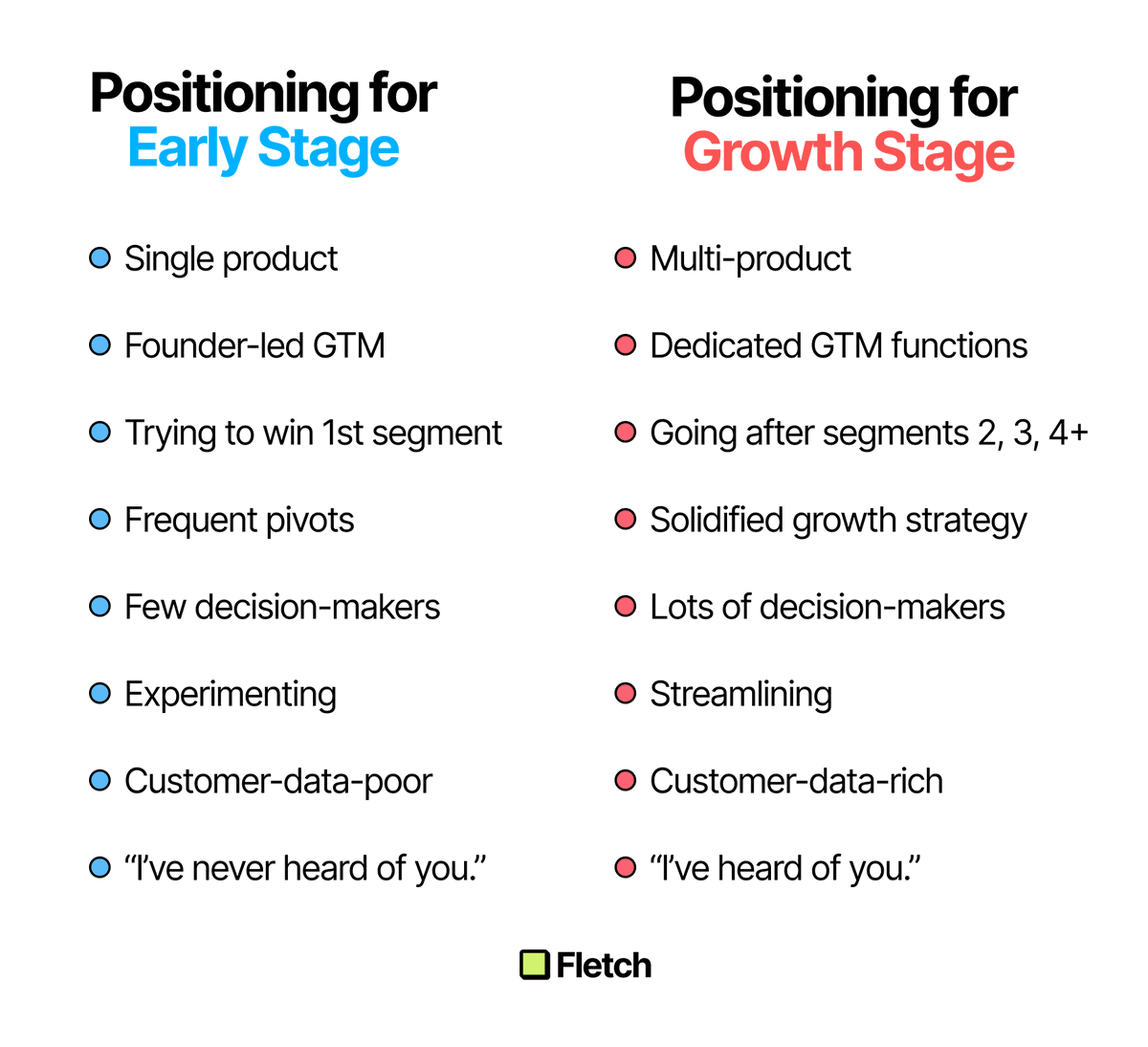
Positioning for early stage and growth stage are different in five major ways:
1️⃣ Market Difference
ES: exploring multiple segments... hoping to conquer ONE of them
GS: have fit with one (or more) segments... deepening penetration
2️⃣ Product Difference
ES: half-built, partially-functioning MVP
GS: one or more products in market and loved by customers
3️⃣ Team Difference
ES: tight group of original founders making decisions in lockstep
GS: multiple VP-level stakeholders (with potentially different opinions)
4️⃣ Brand Difference
ES: nobody has heard of you
GS: you have recognition (and ideally some clout)
5️⃣ Execution Difference
ES: exploring growth strategies
GS: exploiting working growth strategies
Key:
ES = Early Stage
GS = Growth Stage
#productmarketing #saas #startups
English

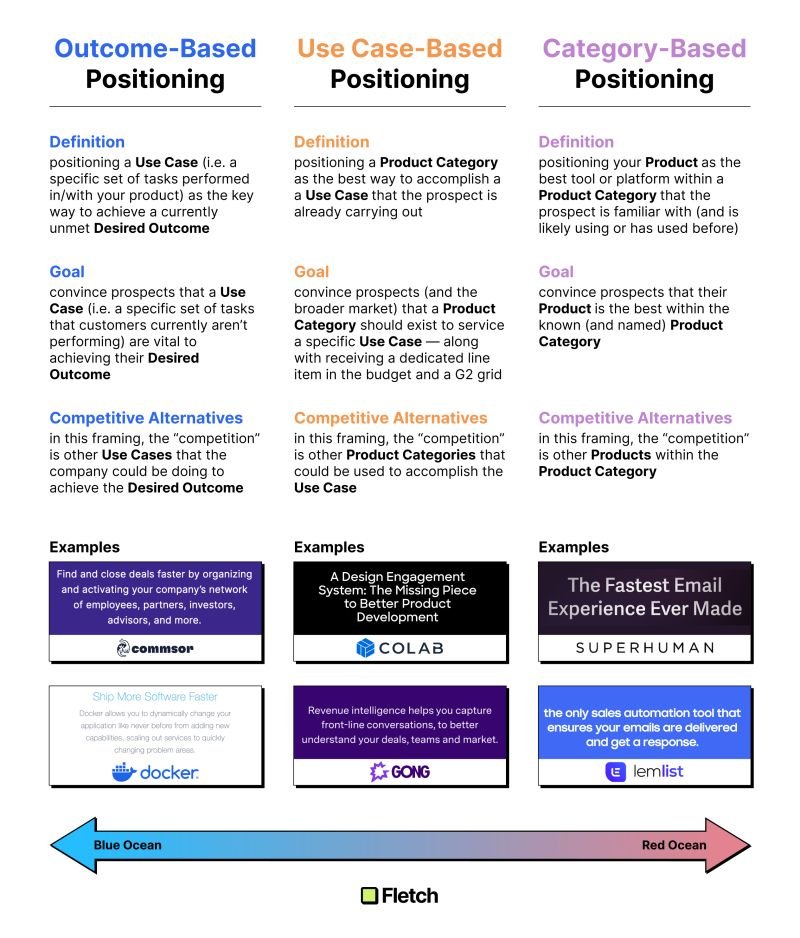
Amazing breakdown with tactical examples of the three ways to position your product
English

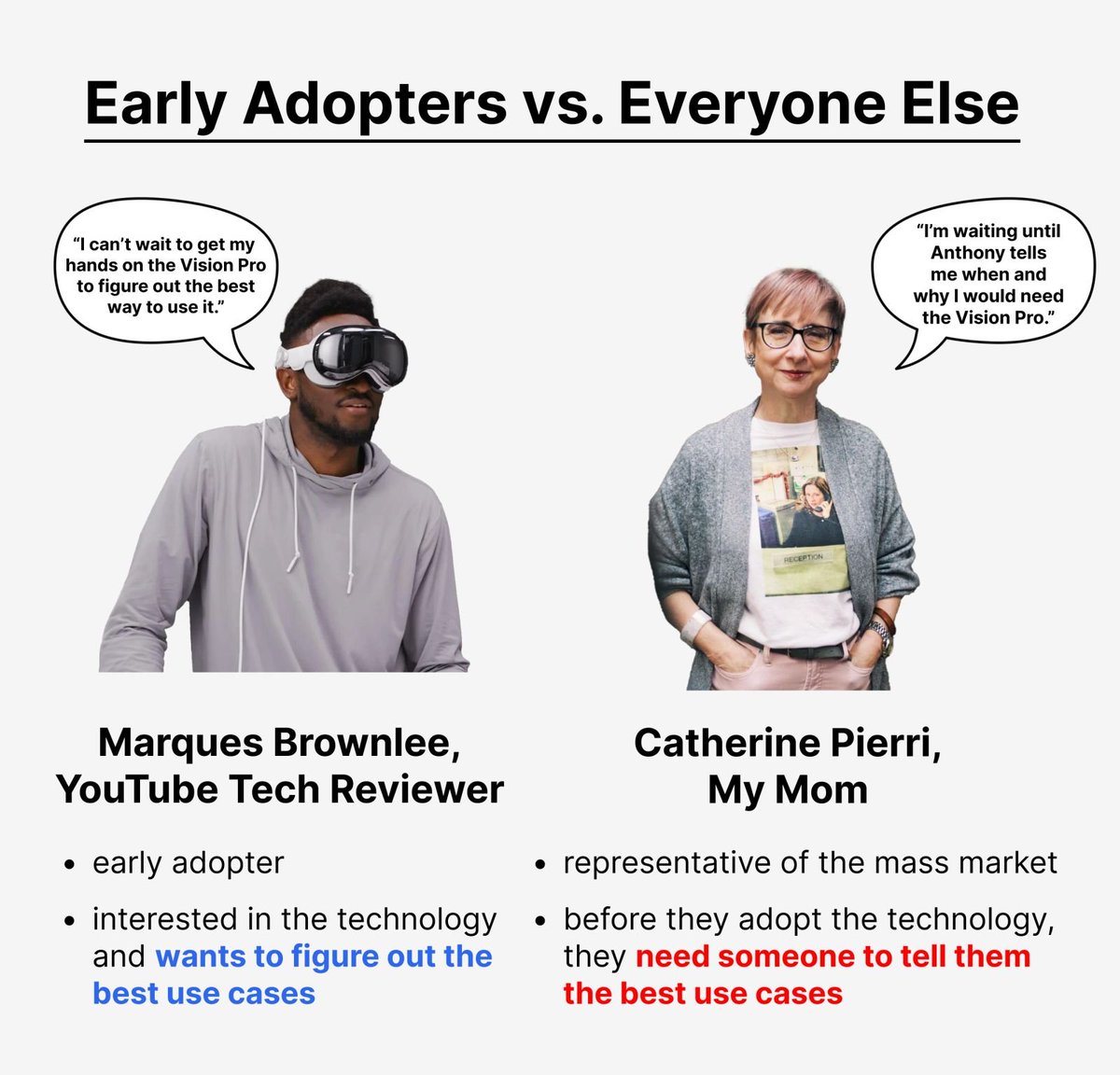
Everyone marketing AI products need to post-it-note this on their laptops:
"The majority of your future customers need YOU to tell them when/how they should use your product."—@apierriPMM
English

The purpose of your Homepage
👇🏼👇🏼👇🏼
Drive Potential Customers to take an Action.
It’s not a company wiki!
Thanks for this @aakashgupta @apierriPMM
#product #growth
English

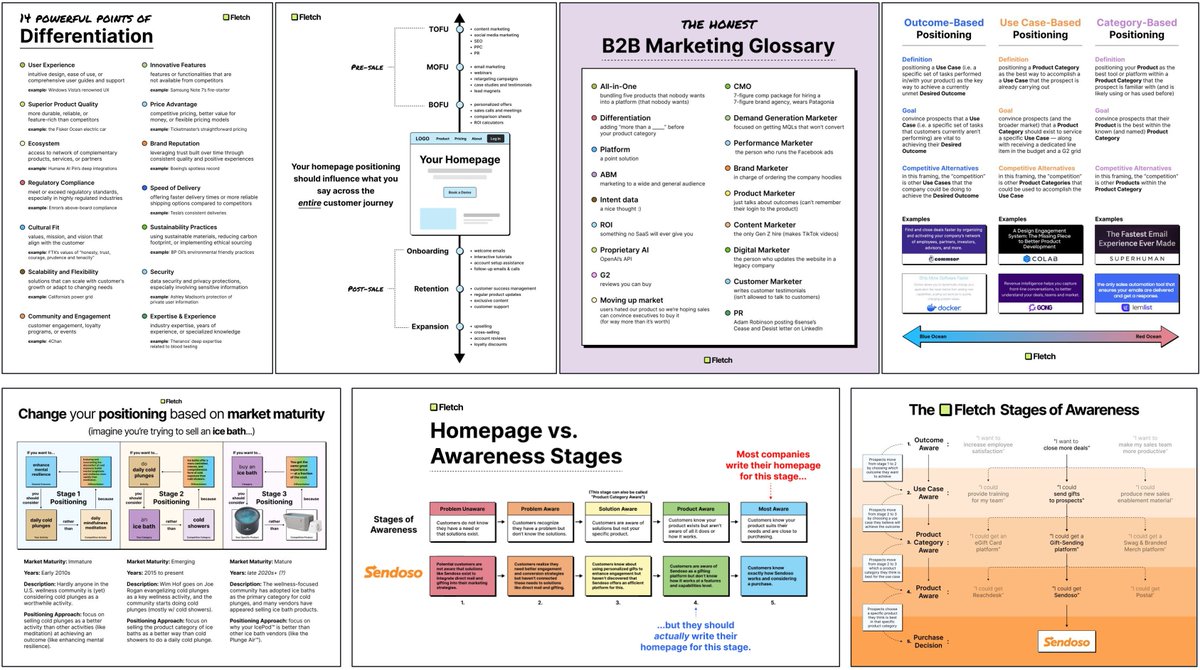
Shoutout to @apierriPMM and @heyrobk who build a great startup with FletchPMM.
They share so much knowledge and incredible easy to read and understand visuals on product positioning and product messaging.
Great job!
English

Building value propositions requires understanding:
(1) What they are trying to do (Use Case)
(2) How they are doing it (Current Way)
(3) Limitation of Current Way
(4) Problem (Blocker of Progress)

English

@apierriPMM Flagship features vs ancillary features is a nice way to think about it I never heard of such exact terms
English
"We need customers to see all our features or else they won't be interested!!"
I hate to burst a founder's bubble — but abundance doesn't equate value.
80% of software features go unused.
Go back and listen to some inbound sales call.
Most likely, people were shopping for a few key capabilities.
If you accept this reality, you have two options for homepage:
❌ show them every single feature
✅ show them just what they're interested in
Because if they aren't interested in your flagship feature...
...it's unlikely your ancillary features will get them over the hump.

English