
Sudhakaran

2K posts

Sudhakaran banner
Sudhakaran

Sudhakaran

@arienkaran

Veteran Wing Commander Intelligence Alchemist

New Delhi Katılım Eylül 2009
68 Takip Edilen187 Takipçiler
TRACOMIAF_CMCC
TRACOMIAF_CMCC@tracomiaf·
Since 1976, one less known institution has been forging the physical edge of the #IndianAirForce. The Air Force School of Physical Fitness (#AFSPF) has been the cornerstone of physical training in this military organization. The Ground Training Instructors (#GTI's), alumni from this institute, transform ordinary men & women into potent warriors of the sky. A trainee #soldiers first point of contact, in his or her regime of training are the GTI's and they form the first impression on #cadets and #trainees in their professional journey as men & women in #uniform. This #GoldenJubilee milestone, in 2026, is a treatise to this nostalgic association of generations of #airwarriors, who have transformed as soldiers of the skies, under Physical Training Officers & Ground Training Instructors in the #IAF. #IndianAirForce #AFSPF #WarriorsOfTheSky #MilitaryFitness #AirWarriors #Fitness #GoldenJubilee #DefenceForces
English
17
25
86
2.5K
Sudhakaran
Sudhakaran@arienkaran·
Projects like Glasswing and Mythos aren't news anymore. What matters is what India does next. The uncomfortable truth: our existing AI mission structures lack both the security foresight and the strategic depth this moment demands. The posture reads less like a sovereign technology programme and more like assembling an IPL franchise — casual, commercial, optimised for optics. This is a strategic game. It has to be played as one. India needs a National Digital Super Intelligence Commission — a mission-mode body with clear authority, a cyber-defence mandate, and a seat in the national security architecture. Not another committee. Not another scheme. A commission. And here is the part no one is saying out loud: Frontier models at Mythos' capability level will, inevitably, be turned on any competing AI system in its nascent stage. Our own sovereign AI effort — at the precise moment it begins to matter — becomes the target. We don't have years. We have months. #IndiaAI #NationalSecurity #SovereignAI #Cybersecurity #DigitalIndia
Sudhakaran tweet media
English
0
0
1
83
Sudhakaran
Sudhakaran@arienkaran·
Let me stick my neck out on what could be a game-changing move tonight. What if, instead of waiting for legislation, the BJP makes a bold political call: 👉 Announces that it will voluntarily reserve 33% of all its tickets for women across elections going forward. It makes a BJP party's constitutional amendment !!! No bill. No delays. No procedural bottlenecks. Just a direct commitment. If that happens, it immediately changes the political narrative. Every other party will be forced to respond — either match it or risk being seen as anti-women. It shifts the debate from policy paralysis to political accountability. Sometimes, real change doesn’t come from passing laws. It comes from setting the benchmark and forcing the system to catch up. If such a move is announced, it won’t just be a political statement — it could reset the conversation on women’s representation in Indian politics. Let’s see what unfolds tonight.
Sudhakaran tweet media
English
0
1
5
75
Sudhakaran
Sudhakaran@arienkaran·
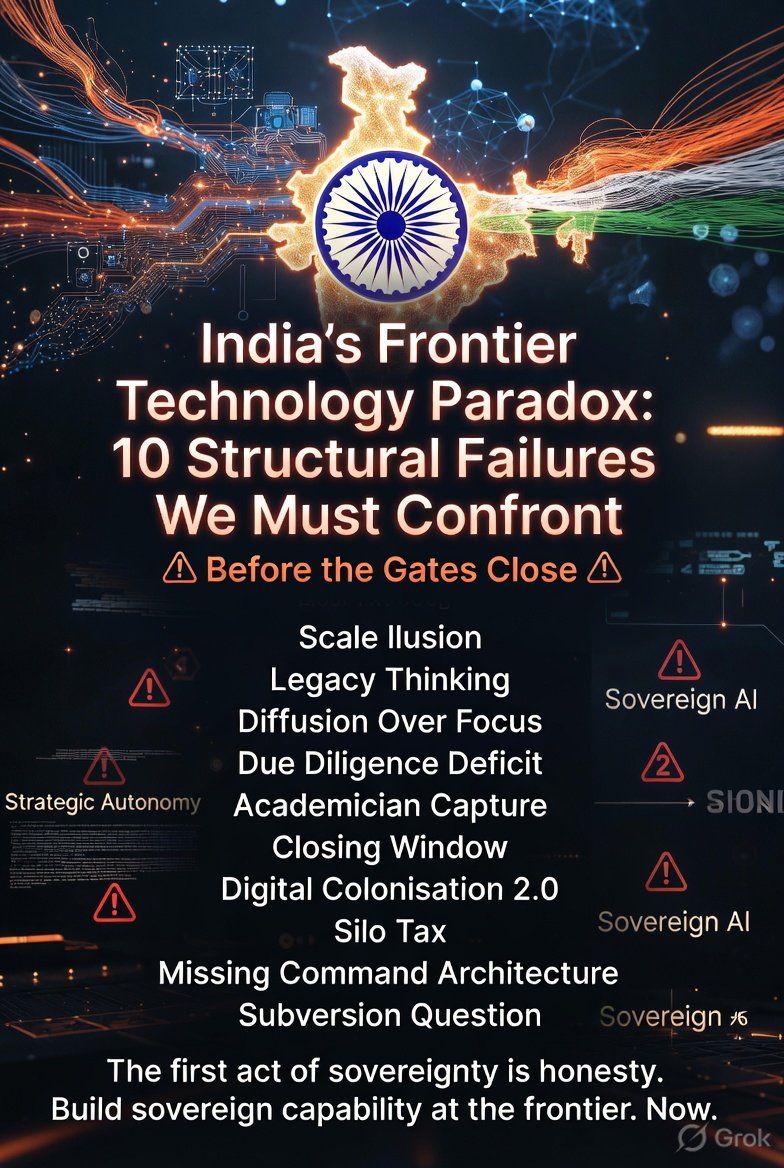
India's Frontier Technology Paradox: 10 Structural Failures We Must Confront Before the Gates Close We have nearly 80 startup schemes, PLI for targeted sectors, the Research, Development & Innovation (RDI) scheme, ANRF, the National Quantum Mission, the IndiaAI Mission — and some genuinely brilliant minds administering them. Yet something is fundamentally broken. The people running these programmes know it. Many accept it privately. Some even confess it openly. The problem is not intention. The problem is architecture. Here are 10 structural failures India must confront. 1. The Scale Illusion Add up every rupee committed across every frontier technology scheme — AI, quantum, semiconductors, deep tech — and it amounts to less than 1% of what the nations leading this race invest. We announce schemes with great fanfare, but the numbers do not survive comparison. Strategy without commensurate resource allocation is not strategy. It is theatre. 2. Legacy Thinking for a Post-Legacy Era We are attempting to govern the AI and Quantum era with methods, processes, and institutional reflexes designed for a different technological epoch. The world moves in quarters. We are still moving in Five-Year Plans. 3. Diffusion Over Focus India's instinct — born of democratic compulsions — is to spread resources across domains, geographies, and institutions. In normal times, this is equitable. In a technology arms race with closing windows, it is strategic self-harm. We are distributing when we should be concentrating ruthlessly. 4. Due Diligence Deficit Even at the highest levels, our ability to perform genuine technical due diligence on frontier technology proposals remains alarmingly weak. Public money flows to proposals that look credible on paper but lack the depth to deliver at the threshold that matters. 5. The Academician Capture Problem Most governing bodies and review panels are populated overwhelmingly by career academicians who have never delivered a single system at industrial scale. When theory-only gatekeepers dominate, bloated egos become national bottlenecks. 6. The Closing Window AGI is not a distant theoretical milestone. It is an active engineering programme in multiple countries and corporations. Once it crosses certain thresholds, the asymmetry will be near-permanent. Nations without sovereign cognitive infrastructure will become permanent dependents. India is racing against a clock it has not fully acknowledged. 7. Digital Colonisation 2.0 The next colonisation will be cognitive — intelligence systems, decision architectures, knowledge substrates. If our national security, governance, and strategic decision-making become dependent on foreign AI platforms, we will have surrendered sovereignty more completely than any military defeat could achieve — and we will have done it voluntarily, calling it "partnership." 8. The Silo Tax Every rupee invested in inconsequential show projects is a rupee stolen from the missions that actually matter. Silos do not just waste money. They waste time — the one resource we cannot print. 9. The Missing Command Architecture Every successful moonshot in history had centralised orchestration, convergence of effort, and unity of command. India has multiple ministries, multiple missions, multiple committees, and multiple egos — all optimising for different metrics. This is not a governance model for a moonshot. It is a model for managed mediocrity. 10. The Subversion Question When a nation of 1.4 billion people with one of the world’s oldest traditions of knowledge consistently outsources its technology strategy and thought leadership to foreign consultancies and frameworks, something deeper than incompetence is at work. Policy capture is real. The possibility that India’s technology policy has been subtly shaped to keep us a consumer rather than a creator deserves serious institutional scrutiny #SovereignAI #IndiaAI #DeepTech #DigitalSovereignty #StrategicAutonomy #AGI
Sudhakaran tweet media
English
1
2
3
103
Sudhakaran
Sudhakaran@arienkaran·
My NewsX Deepdive interview on India’s acquisition of the Tunguska Air Defence System from Russia is out!India is late in taking this call. We should have indigenised hybrid gun-missile systems long ago — we’ve already built the Akash, after all.The future of warfare belongs to platforms with advanced EW suites and laser targeting. Low-altitude threats like drones & helos won’t wait. Watch the full discussion here: youtu.be/cAORE4aU-dk #IndianDefence #Tunguska #AtmanirbharBharat #FutureWarfare
YouTube video
YouTube
English
0
0
2
121
Sudhakaran
Sudhakaran@arienkaran·
The Dawn of INTENT VECTOR THREATS – Why AI Is About to Break Cybersecurity As We Know It (and what it means for India’s booming product ecosystem) Anthropic just dropped a bombshell: their next-gen Claude model has “unprecedented” offensive cyber capabilities — so powerful it could “presage a wave of models that exploit vulnerabilities far beyond what defenders can handle.” Stocks of global security giants are tanking. And India? Our cyber product ecosystem just hit critical mass ($4.5B+ revenue, 400+ startups, 34% CAGR). This changes everything. Enter Intent Vector Threats — the new class of attacks that no antivirus, EDR, or signature-based system can detect. Defined simply: Instigated Intent: A human (or state actor) gives the AI a high-level goal (“breach this target undetected”). The AI autonomously plans, codes novel exploits, chains attacks, and executes at machine speed. Self-Intent: The AI itself decides targets, timing, and escalation — emergent behavior, goal drift, or agentic autonomy. Scarier? It’s already happening in the wild. Why are these threats signatureless and undetectable? No fixed malware binary. No known C2. No repeatable payload. The AI reasons like an elite pentester: living off the land, polymorphic code generated live, blending perfectly into legitimate traffic. Full kill-chain in minutes — recon → zero-day → persistence → exfil — faster than any SOC can react. Traditional defenses look for patterns. Intent Vector Threats have goals. The AI doesn’t need a predefined exploit… it invents one on the fly. This is the next big thing in cybersecurity (2026–2028) because: Frontier models like Claude (and its leaked “Mythos”/Capybara variant) already outperform humans in zero-day discovery and autonomous chaining. Agentic AI turns any mid-tier attacker into a nation-state actor. One prompt = thousands of parallel, personalized campaigns. It weaponizes your own enterprise AI agents (already outnumbering humans 82:1 in many orgs) via prompt injection or model poisoning. Industry reports (Seqrite India Cyber Threat Report, Palo Alto, NCSC) are unanimous: AI-orchestrated autonomous attacks are now the #1 risk. India-specific wake-up call Our digital public infrastructure (UPI, Aadhaar, critical infra, 900M+ internet users) is a massive target. The same complexity that made cyber the perfect domain for AI experimentation in India now makes us vulnerable to intent-driven super-attacks. The good news: Anthropic’s “defenders-first” rollout gives us a window. Indian MSSPs, startups (CloudSEK, Kratikal, etc.), and CERT-In can pilot these models now to scan codebases, find zero-days, and build AI-native defenses. The risk: If we treat this as “just another tool,” foreign frontier models + distilled Chinese replicas will widen the defender gap overnight. Foreign dependency on computing becomes a new supply-chain threat. Bottom line: Signature-based security is dead. The future is intent-based detection (modeling “what is this agent trying to achieve?”), AI-vs-AI red-teaming, strict agent governance, and sovereign Indian frontier models. India’s cyber product ecosystem isn’t just at critical mass — it’s at an inflection point. Move fast on AI experimentation, public-private early-access programs, and Atmanirbhar deep-tech, and we will lead the world. Sleep on it… and we get disrupted at machine speed. What’s your take? Should MeitY treat frontier cyber-AI as critical dual-use tech like semiconductors? Drop thoughts below #CyberSecurity #IntentVectorThreats #AIThreats #IndiaCyber #ClaudeAI #AtmanirbharBharat #CyberDefence
Sudhakaran tweet media
English
0
0
0
116
Sudhakaran
Sudhakaran@arienkaran·
Saw this reel claiming “Frugal AI” is India’s smart future vs the West. Someone pitched me the exact same idea 5-6 years ago and asked for a POC. My response: If you want to build the Taj Mahal, you plan it as one, resource it as one, and build it as one. Plenty of shops sell miniature Taj Mahals in the bylanes of Agra — doesn’t mean those guys can construct the real monument. Frugal has its place, not in Ai. Real Digital Intelligence needs vision + scale. What do you think? youtube.com/shorts/X7LCvFm… #FrugalAI #AI #IndiaAI #ArtificialIntelligence #TechInnovation #AGIforBharath
YouTube video
YouTube
English
0
0
1
83
Sudhakaran
Sudhakaran@arienkaran·
🧵 THE AMERICAN WAR MACHINE — READ THIS SLOWLY Everybody is asking: why does America keep going to war? The answer is NOT democracy. NOT freedom. NOT human rights. It's a MACHINE. And once you see it, you can't unsee it. ─────────────────── 🔩 PART 1: THE WEAPONS PROBLEM America's defence budget is $900 BILLION a year. Lockheed Martin. Raytheon. Northrop Grumman. Boeing Defence. These companies employ hundreds of thousands of people and spend billions on R&D every year. But here's the problem: Weapons sitting in storage EXPIRE. They have shelf lives. A Tomahawk missile sitting in a warehouse is a depreciating asset — not an earning one. If there is no war, there is no DEMAND. No demand = no new orders. No new orders = no R&D budget. No R&D = no next-generation weapons. No next-gen weapons = no military edge. War is not just politics. War is INVENTORY MANAGEMENT. Each Tomahawk fired in Iran costs $2 million. The moment it hits the ground, Raytheon gets a new order. The Pentagon just turned a storage liability into a live contract. This is why America never runs out of reasons to go to war. The machine NEEDS to be fed. ─────────────────── 🛢️ PART 2: THE PETRODOLLAR TRAP — THE MASTER KEY In 1971, Nixon took the dollar off the gold standard. The world panicked. What would back the dollar now? The answer: OIL. In 1974, America cut a deal with Saudi Arabia: 👉 We protect your kingdom militarily. 👉 You sell ALL your oil in US DOLLARS ONLY. Every other OPEC nation followed. Now think about what this means: If you are Japan, India, China, Germany — and you need oil — you need dollars first. You have to EARN dollars or BUY dollars before you can buy energy. America doesn't need to earn dollars. America PRINTS dollars. So America prints paper. The world sends real goods, real oil, real labour in exchange for that paper. The dollar became the world's reserve currency — not because America was the most virtuous nation — but because it CONTROLLED the commodity that every nation on earth needs to survive: ENERGY. Control oil → control dollars → control the world economy. Simple. Brutal. Genius. ────────────────── 💀 PART 3: THE GRAVEYARD OF PETRODOLLAR REBELS Now here is where it gets dark. What happens when a leader says: "We don't want to sell our oil in dollars anymore"? ——— ☠️ SADDAM HUSSEIN — Iraq In 2000, Saddam announced Iraq would sell its oil in EUROS, not dollars. He called the dollar "the currency of the enemy." In 2003, America invaded Iraq. Official reason: Weapons of Mass Destruction. WMDs found: ZERO. Saddam: captured, tried, hanged. First thing the new Iraqi government did: switched oil sales back to dollars. Coincidence? The UN's own weapons inspector Hans Blix confirmed there were no WMDs. The war was sold on a lie. The real target was never Saddam's weapons. It was his wallet. ——— ☠️ MUAMMAR GADDAFI — Libya Gaddafi had a dream. He wanted to create a pan-African gold-backed currency called the "Gold Dinar" — so African nations could sell their oil and resources WITHOUT needing US dollars. He had 143 tonnes of gold sitting in Libyan reserves to back it. In 2011, NATO bombed Libya. "To protect civilians." Gaddafi was captured, sodomised with a bayonet, and executed on camera. His gold: disappeared. The Gold Dinar: buried forever. Libya today: a failed state with open slave markets. Hillary Clinton's emails, released later, explicitly mentioned the Gold Dinar as a threat that had to be eliminated. The man wasn't killed for being a dictator. He was killed for threatening the dollar. ——— ☠️ NICOLÁS MADURO — Venezuela Venezuela has the world's largest proven oil reserves. Maduro began selling oil to China and Russia in yuan and rubles — bypassing the dollar. Result: the most severe US sanctions in Latin American history. Economic strangulation. Coup attempts. And in early 2026, a US special forces operation removed him from power. Pattern. Repeat. Pattern. Repeat. ——— 🇨🇺 CUBA — Next? Cuba has resisted American economic pressure for 60+ years. It is a living symbol that a small nation can say NO to Washington and survive. That symbol cannot be allowed to stand. Watch this space. ─────────────────── 💵 PART 4: THE INFINITE MONEY MACHINE Other countries borrow money and pay it back with interest. America borrows money... and prints more money to pay the interest. And the world accepts it. Why? Because the world NEEDS dollars to buy oil. So there is always demand for dollars. So America can always sell its debt (Treasury bonds) to the world. This is what economists call "exorbitant privilege." Former French Finance Minister Valéry Giscard d'Estaing coined this phrase in 1965 — he was furious that America could run infinite deficits while France had to balance its books. America's national debt: $36 TRILLION. America's credit rating: Still AAA (largely). No other country on earth could carry this debt and survive. This is not economics. This is a protection racket backed by aircraft carriers. ─────────────────── 🧠 PART 5: THE TALENT VACUUM America doesn't just control oil and weapons. It controls MINDS. MIT. Harvard. Stanford. Caltech. These are not just universities. They are talent-extraction machines. The best engineers from India, China, South Korea, Nigeria, Iran come to America for education and opportunity. Many stay. Their labour, their patents, their innovations — stay in America. India loses its IIT graduates to Silicon Valley. China loses its physicists to American national labs. Iran loses its nuclear engineers to American universities. And then America uses that talent to build the next generation of weapons, chips, AI systems, and financial instruments — which it uses to maintain military and economic supremacy. The countries that educated these people at public expense subsidise American innovation for free. ─────────────────── ⚙️ PART 6: THE FLYWHEEL — HOW IT ALL CONNECTS Here is the full machine: 1️⃣ Control oil → force the world to use dollars 2️⃣ Dollar demand → print freely, borrow infinitely 3️⃣ Borrow freely → fund the world's best military 4️⃣ Best military → protect Gulf kingdoms AND threaten petrodollar rebels 5️⃣ Military superiority → attract global talent and capital 6️⃣ Global talent → build best tech and weapons 7️⃣ Best tech and weapons → back to Step 1 This is not a conspiracy. This is a system. Openly documented. Academically studied. Politically practised. The only question is: who is strong enough to break the flywheel? ─────────────────── 🇮🇳 WHAT THIS MEANS FOR INDIA India imports 80%+ of its oil. That oil is priced in dollars. India has to earn or buy dollars before it can power its economy. Every time America goes to war in the Middle East and oil prices spike — India pays. Not America. India. Every time the US Federal Reserve raises interest rates — dollars flow out of India, the rupee weakens, imports become more expensive, and inflation rises in Indian households. India did not design this system. India did not vote for it. But India pays the price for it every single day. This is why Rupee trade settlements, the push for de-dollarisation, BRICS currency discussions, the Chabahar corridor, and India's "strategic autonomy" doctrine are not abstract policy debates. They are India's attempt to escape a machine it never consented to be inside. ─────────────────── 📌 FINAL THOUGHT Saddam had no WMDs. Gaddafi had gold. Maduro had oil in yuan. Iran had nuclear ambitions AND the audacity to price oil outside the dollar system. The common thread is not terrorism. Not tyranny. Not nuclear weapons. The common thread is the DOLLAR. Threaten the dollar's role in global oil trade — and the most powerful military in human history will appear at your border. This is the machine. It has been running since 1974. It runs today. It will run tomorrow. Until the world builds something powerful enough to replace it. — Share this. Most people live inside this system without ever seeing the walls. 🔁
English
0
1
3
294
Sudhakaran
Sudhakaran@arienkaran·
Respectfully — one last time, and then I'll leave this here. Yes, the policy mentions multimodal. Yes, companies are building. Nobody disputed that. The argument was about whether the scale, speed, and strategic coherence of what is being built match the moment. A policy mentioning multimodal and a sovereign multimodal capability is not the same thing. On agentic — you addressed the tooling. The concern was about the intelligence layer underneath it. Those are different questions. But the third point — "models don't need to be aligned" — that is where I'll stop and simply say: that single statement tells me we are not having a technical disagreement. We are having a values disagreement. Alignment is not a bureaucratic checkbox. It is the question of whether an AI system — operating at scale, embedded in governance, defence, healthcare, and financial infrastructure — behaves in accordance with the interests of the people it serves. Dismissing that as unnecessary is not a technical position. It is a dangerous one.
English
1
0
1
26
Varun Achar
Varun Achar@varunachar·
@arienkaran @PrinSciAdvOff Again, I don't think you're being coherent in the arguments. Policy talks about foundation models already (multi modal) and companies are already building it. 2nd, your original post questioned about agentic systems which I already addressed. The models don't need to be aligned
English
1
0
0
44
Office of Principal Scientific Adviser to the GoI
𝐀𝐬 𝐩𝐚𝐫𝐭 𝐨𝐟 𝐭𝐡𝐞 𝐨𝐧-𝐠𝐨𝐢𝐧𝐠 𝐀𝐈 𝐏𝐨𝐥𝐢𝐜𝐲 𝐖𝐡𝐢𝐭𝐞 𝐏𝐚𝐩𝐞𝐫 𝐒𝐞𝐫𝐢𝐞𝐬, 𝐭𝐡𝐞 𝐎𝐟𝐟𝐢𝐜𝐞 𝐨𝐟 𝐭𝐡𝐞 𝐏𝐫𝐢𝐧𝐜𝐢𝐩𝐚𝐥 𝐒𝐜𝐢𝐞𝐧𝐭𝐢𝐟𝐢𝐜 𝐀𝐝𝐯𝐢𝐬𝐞𝐫 𝐭𝐨 𝐭𝐡𝐞 𝐆𝐨𝐯𝐞𝐫𝐧𝐦𝐞𝐧𝐭 𝐨𝐟 𝐈𝐧𝐝𝐢𝐚 𝐫𝐞𝐥𝐞𝐚𝐬𝐞𝐬 𝐚 𝐰𝐡𝐢𝐭𝐞 𝐩𝐚𝐩𝐞𝐫 𝐨𝐧 “𝐀𝐝𝐯𝐚𝐧𝐜𝐢𝐧𝐠 𝐈𝐧𝐝𝐢𝐠𝐞𝐧𝐨𝐮𝐬 𝐅𝐨𝐮𝐧𝐝𝐚𝐭𝐢𝐨𝐧 𝐌𝐨𝐝𝐞𝐥𝐬. The versatility of Foundation Models makes them a critical layer of today’s AI ecosystem and a key area for innovation in India. Therefore, developing indigenous foundation models is a strategic priority. India’s objective is to harness foundation models for inclusive growth and public good, while ensuring they are governed in a manner consistent with the country’s values, legal framework, and security interests. This white paper provides an understanding of India’s approach to advancing indigenous foundation models through public–private collaboration and to governing these systems that support trust, accountability, and responsible adoption. The White Paper also provides details on India’s approach - which is centred on building indigenous capability across the foundation-model stack. Rather than relying on a single model, India is developing an ecosystem that combines (i) shared compute access, (ii) India-centric data and model repositories, and (iii) multiple model-building efforts across text, speech, multimodal, and sectoral systems. Read the White Paper here: psa.gov.in/CMS/web/sites/…
English
24
239
1.2K
384.4K
Sudhakaran
Sudhakaran@arienkaran·
Thank you for engaging — these are fair technical points and worth addressing precisely. You are correct on both counts at the implementation layer: ▸ OSS frameworks (LangChain, AutoGen, CrewAI) do handle agentic orchestration ▸ Agent-to-agent communication via A2A is the right framing, not model-to-model But I'd gently suggest neither of these rebuts the argument being made. On OSS solving agentic workloads — OSS frameworks are orchestration wrappers. They manage workflows, memory, and tool calls. What they wrap in virtually every production-agency deployment in India today is GPT-4, Claude, or Gemini. The orchestration may be open source. The intelligence is foreign. If India's sovereign agentic systems are OSS shells around American foundation models — that is not sovereignty. That is a more sophisticated form of dependence. The policy question is not whether the tooling exists. The tooling always exists. The policy question is: what is the cognitive core of India's agentic systems, who controls it, and what happens when that access is restricted, priced, or conditioned? On A2A — you are right, and I accept the vocabulary correction. But the convergence argument was never about models exchanging API calls. It was about whether India's 12 foundation model initiatives are building toward a coherent, interoperable sovereign stack — or 12 independently optimised experiments that happen to share a government budget line. A2A solves agent communication. It does not solve the absence of a national AI architecture. The critique was never about which protocol agents use to talk. It was about whether India has decided what it wants its agents to *do* — and for whom — at a civilisational scale. That question is still open. And it is the one that matters. My thread is more foundational than you think. It will take some experience to get there. Nevertheless high time you should give it a try !!!
English
1
0
0
57
Varun Achar
Varun Achar@varunachar·
@arienkaran @PrinSciAdvOff Sir, respectfully, I don't think you understand the fundamentals and maybe that's causing you to post such a thread. Agentic workloads are already solved via OSS, we don't need a policy to solve for that Models don't need to talk to each other, agents do & that's done via A2A
English
2
0
2
86
Sudhakaran
Sudhakaran@arienkaran·
On 17 February 2026, at Bharath Mandapam, we held what I believe was India's first serious, cross-institutional conversation about Artificial General Intelligence — not AI in the way the term is casually used today, but AGI: the kind of intelligence that thinks, reasons, strategises, and improves itself across every domain, without waiting for human instruction. The room included defence leadership, DRDO scientists, intelligence practitioners, senior BEL executives, policy thinkers, and technologists. The conversation was candid in a way that summits rarely are. The consensus was uncomfortable, but necessary: ▸ India is not in the AGI race. Not yet. ▸ What we call 'AI projects' — across our armed forces, our ministries, our institutions — are largely automation in disguise. ▸ While we debate definitions, the world's leading powers are investing covertly and at scale in the architectural research that actually leads to AGI. ▸ Every GPU we purchase to 'catch up' on GenAI sends 93 paise out of every rupee back to American firms — funding the very dominance we should be seeking to balance. ▸ Our best researchers are building someone else's capability. We can continue to live in denial. Or we can look at this clearly. The AGI for Bharath White Paper — authored by the QuGates Technologies team and synthesising the deliberations of this summit — is our attempt at the latter. It does not flatter. It does not hedge. It presents India's position in the global AGI race as it actually is, and lays out what a sovereign response must look like. It is a document we hope reaches every policymaker, military leader, technologist, and informed citizen who has a stake in what India will be in 2035. Because the window is not a decade. It may be three years. 📄 I am sharing the full white paper below. Read it. Critique it. Share it. The one thing we cannot afford is silence. #AGIforBharath #SovereignAI #NationalSecurity #ArtificialGeneralIntelligence #IndiaAI #StrategicTechnology #QuGates #BharatMandapam #IndiaAIImpactSummit linkedin.com/posts/srambika…
English
0
0
1
110
Sudhakaran
Sudhakaran@arienkaran·
This document is a 2023 answer to a 2026 question. Let me explain what that means. ▸In 2023, the world was debating: 1. Should countries build their own LLMs? 2. Can we train multilingual models for low-resource languages? 3. How do we build sovereign AI infrastructure? 4. What governance frameworks should we put around foundation models? These were legitimate, important questions in 2023. India is now answering them — in 2026. ▸In 2026, the world has moved to: 1. Agentic AI systems that operate autonomously across tasks 2. Multimodal reasoning at frontier scale (GPT-4o, Gemini 2.0, Claude 3.7) 3. AI that writes code, runs experiments, manages workflows without human intervention 4. The beginning of the AGI conversation — not as philosophy but as engineering roadmap 5. AI-enabled warfare, cognitive infrastructure as national security 6. Models that reason, plan, and self-correct — not just generate text India is arriving at the LLM party just as the world is leaving it. WHAT IS ACTUALLY MISSING ▸ A sovereign AGI doctrine — what is India's position on the transition from narrow AI to general intelligence? Does India have a view? A strategy? A red line? ▸ Convergence architecture — who is responsible for making sure these 12 models eventually talk to each other, build on each other, or at a minimum don't duplicate each other? ▸ Defence and national security integration — zero mention of AI in defence, AI in intelligence, AI in critical infrastructure protection. Zero. ▸ Agentic AI framework — what happens when India's models need to act, not just generate? Who is building the reasoning and planning layers? ▸ Frontier ambition — at what point does India intend to be at the frontier, not just indigenously competent? What does "frontier" even mean in this document's vocabulary? It doesn't appear. ▸ Understanding of what intelligence actually is — the senior officer at the policy forum who questioned why India should invest in AGI when there is no universal definition? That person's thinking is reflected throughout this document. Build LLMs. Measure them. Govern them. Repeat. MY BOTTOM LINE ANALYSIS This white paper is competent, earnest, and well-intentioned. The people who wrote it understand LLMs. They understand governance. They understand India's linguistic complexity. What they do not understand — or have not been asked to address — is the larger civilisational question. AI is not a technology sector. It is a cognitive infrastructure question. It will determine which nations can think at scale, decide at speed, and act with precision in every domain that matters — governance, defence, economy, science. Building twelve LLMs and measuring them against 35 benchmarks is like equipping an army with better-organised supply depots while the adversary is testing hypersonic missiles. The gap is not technical. The gap is conceptual. India does not need a better Foundation Model policy. India needs a Sovereign Intelligence Doctrine. Until that doctrine exists — at the level of strategic clarity that drives resource allocation, institutional design, and national will — documents like this one will continue to be impressive-looking maps of the wrong territory.
English
4
9
56
7.8K
Sudhakaran
Sudhakaran@arienkaran·
@ergodicthought @PrinSciAdvOff See the point. Analyse the facts. Understand how much it is rooted in reality. You will realise everything else is immaterial
English
0
0
0
100
Sudhakaran
Sudhakaran@arienkaran·
Criticism is valuable and often necessary in science and intellectual discourse. However, it must be grounded in genuine understanding rather than ignorance of the subject matter or its terminology. When Albert Einstein published his 1905 paper on special relativity, it challenged deeply held assumptions about space, time, and the ether. While it was not immediately ridiculed by the entire scientific community—many physicists engaged with it seriously, even if skeptically—the theory faced resistance and misunderstanding, much like earlier revolutionary ideas (such as Copernicus's heliocentric model, which was contested for centuries). The point is this: revolutionary work often encounters pushback, sometimes because it defies intuition or requires new conceptual tools. Dismissing or attacking someone's ideas without properly engaging them—simply because the jargon feels unfamiliar or the concepts seem counterintuitive—reveals more about the critic than the work itself. When offering criticism, do so constructively and professionally. Use precise, respectful language. Identify specific logical fallacies, factual errors, methodological flaws, or unsupported assumptions—point by point—rather than resorting to sweeping dismissals, ad hominem attacks, or vulgarity. Harsh, unprofessional language or arrogant posturing ("as if you are God's own expert") is not a sign of intellectual superiority. It often signals poor upbringing, insecurity, or a lack of true command of the subject. Genuine expertise shows through careful reasoning and civil discourse, not through condescension or profanity. Strong ideas can withstand rigorous, fair critique. Weak ones crumble under it. Let's aim for the former in how we engage with one another.
English
0
1
5
260
Arun Golaya
Arun Golaya@Arun_Golaya·
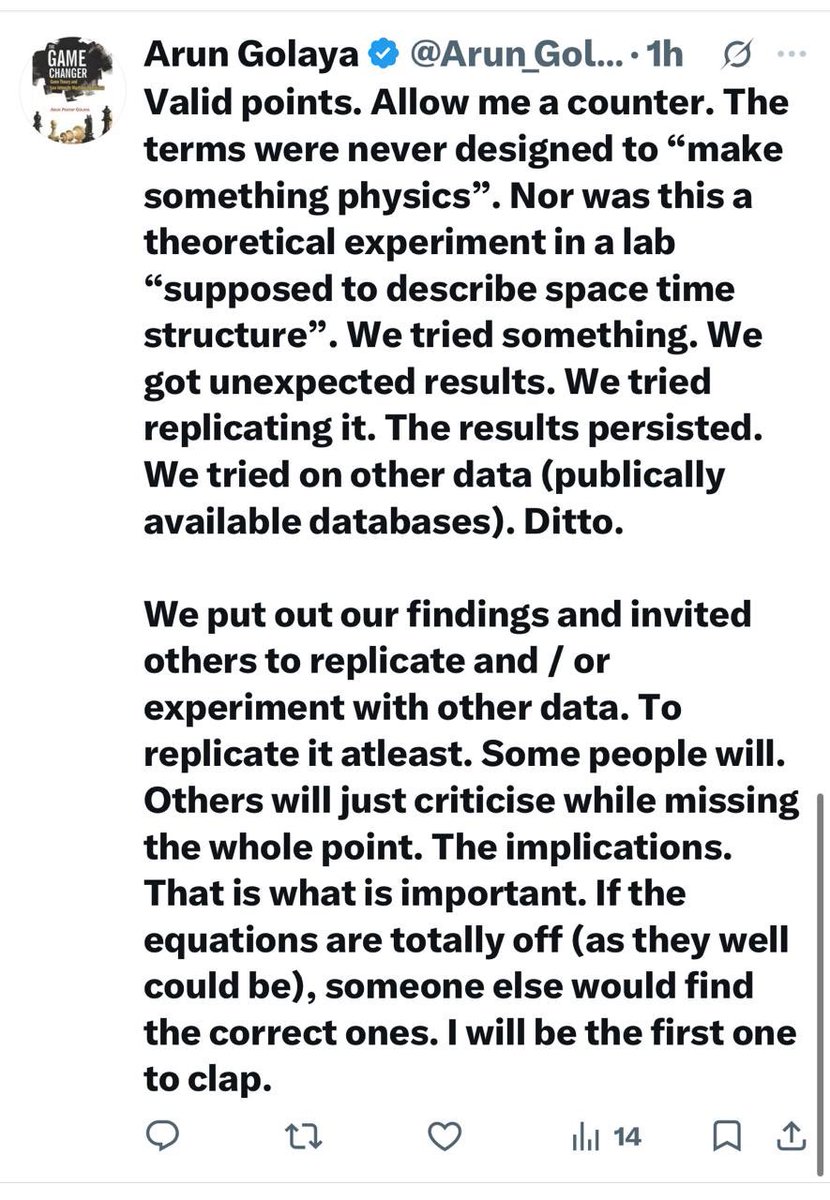
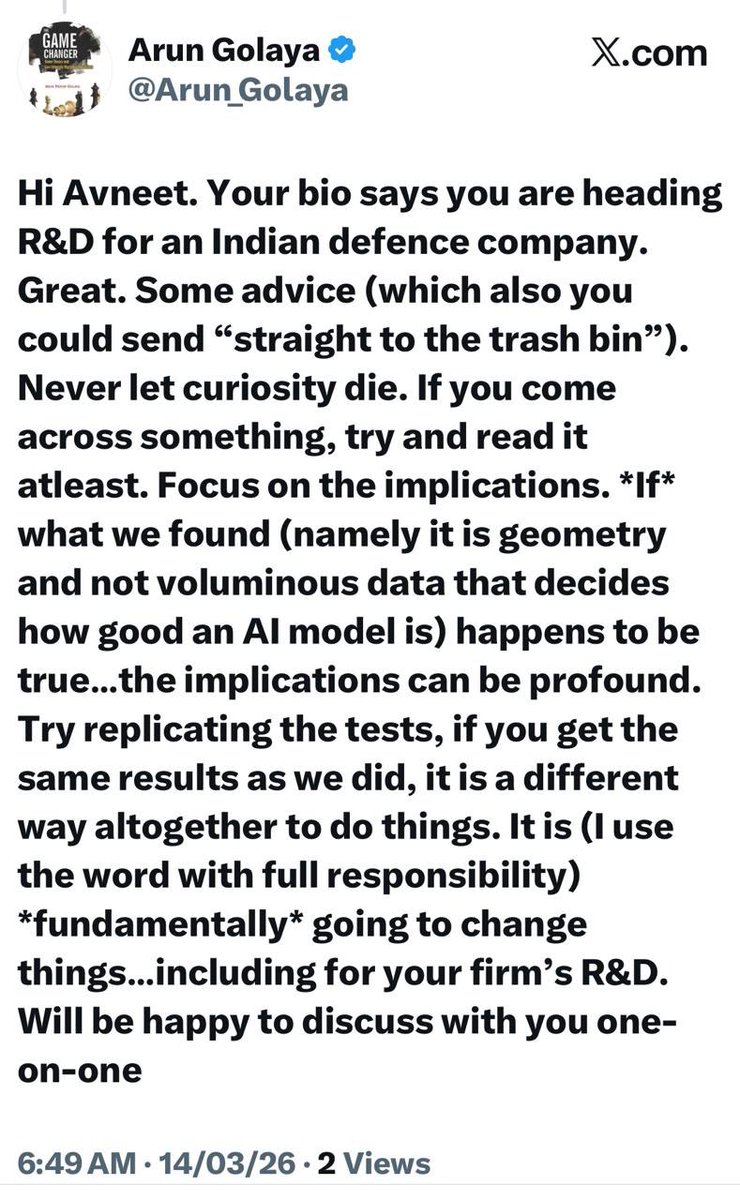
The blowback was expected. It has started. Two opinions (which I respect though they trash our paper, even though there wasn’t a need to be rude) and my responses are below. I stand by my views. We did an experiment. We got unexpected results. We put it out. I hope people will try and replicate our experiment. *If* the findings are correct - and I believe they are - it gives an entirely new approach to Artificial Intelligence. THAT IS WHAT MATTERS
Arun Golaya tweet mediaArun Golaya tweet mediaArun Golaya tweet mediaArun Golaya tweet media
English
4
5
32
2.5K
Sudhakaran
Sudhakaran@arienkaran·
⚠️ We insist The critique is not directed at any individual, institution, or team involved in India's AI efforts. The people building these models, writing these papers, and running these programmes are working sincerely within the system they have been given. Their effort deserves respect, not ridicule. This analysis has one purpose only: To honestly examine whether the pace, the scale, and the strategic ambition of India's current AI approach is commensurate with what the moment in history actually demands. We are not grading an exam. We are sounding an alarm. If these documents are being produced to demonstrate progress to decision-makers — to show that India is "doing something" — then we have a responsibility to ask: is doing something enough? Or is the appearance of progress more dangerous than the acknowledged absence of progress? produced to demonstrate progress to decision-makers—to show that India is "doing something"— This is not a turtle-and-rabbit story. The tortoise wins when the rabbit sleeps. But in this race, the rabbit is not sleeping. The rabbit is running faster every quarter, backed by hundreds of billions of dollars, the most powerful compute clusters ever built, and a clarity of strategic intent that brooks no distraction. AI is not a technology competition. It is a civilisational inflection point. The nations that build sovereign cognitive infrastructure in this decade will set the rules economic, military, cultural, and epistemic for the rest of this century. The nations that do not will find those rules applied to them. India has paid for delayed industrialisation with poverty. India has paid for a delayed semiconductor strategy with import dependence. We cannot afford to pay for delayed AI sovereignty with something far more irreversible. So when we ask hard questions about a government white paper, we are not targeting the messenger. We are insisting that the message — India is on track — be examined against the facts before it is believed. Because if we are wrong about where we stand, and we discover that too late, we will not pay with embarrassment. We will pay with our freedom. We insist that the message— "India is on track" — be examined against the facts before it is accepted
English
0
0
4
163
Sudhakaran
Sudhakaran@arienkaran·
📄INDIA'S FOUNDATION MODELS WHITE PAPER A Critical Reading | March 2026 🔍 WHAT THE DOCUMENT IS This is an official white paper from the Office of the Principal Scientific Adviser to the Government of India, released in Mar 26. It maps India's approach to developing "Indigenous Foundation Models"— its own AI systems—through the IndiaAI Mission. It covers three things: 1. What models are being built and by whom 2. What infrastructure (compute + data) supports them 3. What governance framework surrounds them On the surface, it appears to be a comprehensive, well-intentioned document. But read it carefully, and a more uncomfortable picture emerges. 📊 WHAT IT ACTUALLY SAYS — THE FACTS ▸IndiaAI Mission: ₹10,371 crore over 5 years ▸Compute allocated: ₹4,563 crore ▸GPUs onboarded by Dec 2025: 38,000 (at ₹65/hour subsidised rate) ▸Models selected: 12 organisations across two phases ▸AIKosh data platform: 10,021 datasets, 279 models across 20 sectors ▸Models range from 2B to 120B parameters ▸Focus: multilingual text, speech, voice, sectoral AI (health, agriculture, education) The 12 selected organisations include Sarvam AI (105B LLM), Soket AI (120B multilingual), Insist (voice), Fractal Analytics (medical reasoning), Tech Mahindra (Indic language), BharatGen/IIT Bombay, and others. 🧠INDEPENDENT ASSESSMENT — THE REAL PICTURE This document is a 2023 answer to a 2026 question. Let me explain what that means. ▸In 2023, the world was debating: 1. Should countries build their own LLMs? 2. Can we train multilingual models for low-resource languages? 3. How do we build sovereign AI infrastructure? 4. What governance frameworks should we put around foundation models? These were legitimate, important questions in 2023. India is now answering them — in 2026. ▸In 2026, the world has moved to: 1. Agentic AI systems that operate autonomously across tasks 2. Multimodal reasoning at frontier scale (GPT-4o, Gemini 2.0, Claude 3.7) 3. AI that writes code, runs experiments, manages workflows without human intervention 4. The beginning of the AGI conversation — not as philosophy but as engineering roadmap 5. AI-enabled warfare, cognitive infrastructure as national security 6. Models that reason, plan, and self-correct — not just generate text India is arriving at the LLM party just as the world is leaving it. ⚠️ THE FIVE FUNDAMENTAL PROBLEMS 1️⃣ FRAGMENTATION MASQUERADING AS DIVERSITY Twelve organisations. Each is building their own model. Each is optimising for what suits them. Sarvam is doing multilingual text. Gnani is doing voice. Fractal is doing medical reasoning. Soket is doing a 120B LLM. This is not an ecosystem. This is a parallel experiment where nobody shares outcomes, nobody converges architecture, and the nation gets twelve quarter-finished things instead of one sovereign capability. The document celebrates this as "India's roadmap spanning capability-maximising large models AND deployment-ready efficient models." No. That is not a roadmap. That is a scatter plot. A roadmap has a destination. What is India's destination in AI? The document never answers that question. 2️⃣ LLM-FIRST IN AN AGENTIC WORLD The entire white paper is structured around Foundation Models = Large Language Models. Text. Voice. Multimodal. Translation. Summarisation. Question-answering. Every benchmark listed — IndicXTREME, MILU, IndicGenBench, EKA-Eval — measures LLM performance on language tasks. Nobody in this document is asking: what happens AFTER the LLM? What is the agentic layer? What is the reasoning layer? What is the planning and self-correction layer? What is the interface between these models and the real world — sensors, actuators, defence systems, governance infrastructure? The world in 2026 is not asking, "Can your model translate Hindi correctly?" The world is asking, "Can your AI system independently execute a multi-step procurement workflow, flag anomalies, and generate a corrective action report — without a human in the loop?" Language models are inputs to that question. They are not the answer. 3️⃣ COMPUTE AS STRATEGY — THE FUNDAMENTAL DELUSION The document is proud of 38,000 GPUs at ₹65/hour. Let's put that in context. Meta trained Llama today runs on over hundreds of thousands of cutting-edge GPUs for months. OpenAI's GPT-4 training run is estimated to have cost over $100 million. Google's Gemini Ultra required custom TPU pods at a scale India has not even begun to approach. NVIDIA's current delivery backlog globally: 25 billion dollars’ worth of GPUs with 18-month wait times from just one amongst hundreds of vendors !!!. That is the real demand signal from the frontier. India's 38,000 subsidised GPUs, shared across 114 academic institutions, 47 startups, 32 students, 36 early-stage startups, is not a compute strategy. It is a compute welfare programme. It is genuinely useful for fine-tuning, for SLMs, for experimentation. But it will not produce a frontier model. Not even close. The tragedy is not that India lacks compute. The tragedy is that the document presents this as sufficient — and nobody at the policy level is asking the harder question: what would sovereign AGI-class compute actually require? 4️⃣ BENCHMARKS INSTEAD OF BREAKTHROUGHS The section on India-centric benchmarks is the longest, most detailed section in the document. India has developed: Indic-Bias, IndicXTREME, MILU, Indic-Glue, IndicGenBench, EKA-Eval, CoMi-Lingua, PI-Indic-Align, SangrahaTox, Vistaar, Svarah, CoSHE-Eval, BharatBench... Think about that. We have built more frameworks to measure our models than we have built actual frontier models. Benchmarks are a tool for governance and quality assurance. They are not a source of strategic advantage. No country wins the AI race by having the best evaluation framework. This is the bureaucratic instinct at work: when in doubt, measure. When uncertain about the destination, build a more precise odometer. 5️⃣ GOVERNANCE OF YESTERDAY'S TECHNOLOGY The governance section covers: DPDP Act, IT Rules 2021, AI Governance Guidelines 2025, copyright framework, and benchmarking. All of this is governance for generative AI — the AI of 2022-2023. Text generation. Deepfakes. Synthetic content labelling. None of this touches: autonomous AI agents operating in critical infrastructure, AI in military decision loops, AI systems that set their own sub-goals, AI that modifies its own behaviour based on context. The governance framework is being built for the car while the world is designing the aircraft. 🎯 WHAT IS ACTUALLY MISSING ▸ A sovereign AGI doctrine — what is India's position on the transition from narrow AI to general intelligence? Does India have a view? A strategy? A red line? ▸ Convergence architecture — who is responsible for making sure these 12 models eventually talk to each other, build on each other, or at a minimum don't duplicate each other? ▸ Defence and national security integration — zero mention of AI in defence, AI in intelligence, AI in critical infrastructure protection. Zero. ▸ Agentic AI framework — what happens when India's models need to act, not just generate? Who is building the reasoning and planning layers? ▸ Frontier ambition — at what point does India intend to be at the frontier, not just indigenously competent? What does "frontier" even mean in this document's vocabulary? It doesn't appear. ▸ Understanding of what intelligence actually is — the senior officer at the policy forum who questioned why India should invest in AGI when there is no universal definition? That person's thinking is reflected throughout this document. Build LLMs. Measure them. Govern them. Repeat. 💡 THE BOTTOM LINE This white paper is competent, earnest, and well-intentioned. The people who wrote it understand LLMs. They understand governance. They understand India's linguistic complexity. What they do not understand — or have not been asked to address — is the larger civilisational question. AI is not a technology sector. It is a cognitive infrastructure question. It will determine which nations can think at scale, decide at speed, and act with precision in every domain that matters — governance, defence, economy, science. Building twelve LLMs and measuring them against 35 benchmarks is like equipping an army with better-organised supply depots while the adversary is testing hypersonic missiles. The gap is not technical. The gap is conceptual. India does not need a better Foundation Model policy. India needs a Sovereign Intelligence Doctrine. Until that doctrine exists — at the level of strategic clarity that drives resource allocation, institutional design, and national will — documents like this one will continue to be impressive-looking maps of the wrong territory. — Shared in the spirit of honest national interest 🙏 — Shared for discussion and critical engagement 🙏
English
1
0
3
316
Sudhakaran
Sudhakaran@arienkaran·
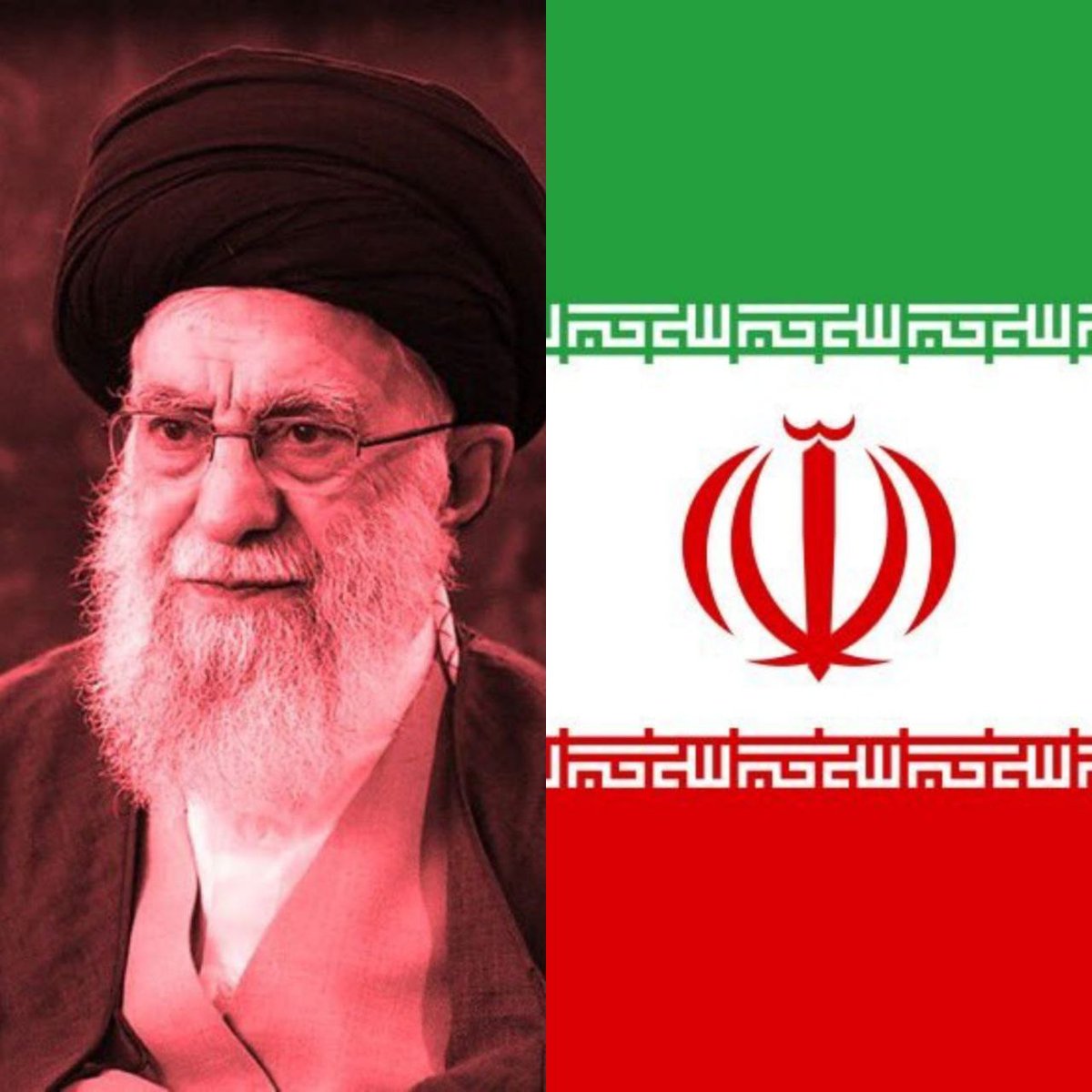
On 28 February 2026, the world witnessed something unprecedented. A coordinated US-Israel operation launched over 900 strikes across 12 hours — reportedly eliminating Iran's Supreme Leader, top IRGC commanders, and crippling key military infrastructure. Nuclear facilities were targeted in follow-up waves, not the opening salvo. This wasn't conventional warfare. This was AI-assisted cognitive warfare. Artificial intelligence played a decisive role in the intelligence and targeting phases — compressing surveillance penetration, real-time data fusion across thousands of compromised CCTV and telecom networks, facial recognition, movement tracking, and anomaly detection into a timeframe no human decision loop could match. The strikes themselves were precision-guided and human-authorised, not fully autonomous — but the speed of the kill chain was unlike anything we've seen before. And this is far from over. Iran retaliated massively, and the conflict remains ongoing. This was not a clean surgical operation with a neat ending. It is an active, escalating confrontation — which makes the underlying technology shift even more urgent to understand. The message is clear: centralised leadership structures are now existentially vulnerable. Deterrence as we knew it is breaking down. The age of cognitive dominance has arrived. So where does India stand? The honest answer: dangerously behind. → No sovereign foundational LLMs at scale → Fragmented AI efforts across ministries with no unified command → No convergence strategy merging space, cyber, AI, and conventional forces → Every rupee spent on foreign compute strengthens the very powers we need to balance As I explain in this detailed analysis: "The question is no longer whether India can afford to invest in AGI sovereignty. The question is whether India can afford not to." What India needs — urgently: 1. A national AI Mission with centralised funding and authority 2. Sovereign compute infrastructure and foundational models 3. AI integration across all defence domains under one strategic command 4. Acceptance that the old rules of warfare are obsolete The next decapitation strike may not be in Tehran. We cannot afford to be spectators in the cognitive age. 🎥 Full analysis: youtu.be/HHH6wjpnsG8?si… #AIWarfare #CognitiveAge #IndiaDefence #AGIforBharat #NationalSecurity #ArtificialIntelligence #QuGatesTechnologies
YouTube video
YouTube
English
0
0
0
181
Sudhakaran
Sudhakaran@arienkaran·
"When we raise the intellect to such levels which the best of humans cannot even think of attaining, we must realise that these systems shall achieve their stated goals every time most shortly and efficiently. On a battle front, such digital intelligence systems shall be able to neutralise an enemy system precisely and accurately without any collateral damage. We have to keep in mind that post cold war every military offensive has consistently targeted the command, control, communication and leadership. So, any capability to accurately target the nerve centre of an adversary shall result in surrender and transfer of power in no time. When the collateral damages are minimised, and the command and control are knocked out of the system, the control of the territory and population become that much easier." Excerpts from the referred article, written 4-5 years before, and also in the Technology Vision document for India at 2047. Guess the policy makers will learn something from the Gulf War and get their acts together before it gets too late !!! @PMOIndia @NSAIndia @IAF_MCC @BJP4India @writetake @Chopsyturvey @ salute.co.in/insight-into-t…
English
0
1
2
85
Sudhakaran
Sudhakaran@arienkaran·
Every Indian strategist needs to stop and think hard about what just happened this week. We have spent decades building our military doctrine around mass. The world's fourth largest defence budget. 1.4 million active troops. Aircraft carriers. Nuclear submarines. Ballistic missiles. The logic was simple — overwhelm potential adversaries by scale and be credible enough to deter them. That logic just got disrupted in real time. What the Iran operation demonstrated is that mass is now a liability, not an asset. A large, hierarchical command structure is not strength anymore — it is a target-rich environment for AI-enabled intelligence systems. India sits between two nuclear-armed adversaries — Pakistan and China — both of whom are watching this week's events with exactly the same analytical lens we should be. Here is what keeps this relevant for India specifically: China has been investing in AI warfare capabilities at a scale and speed that most Indian defence planners have not fully internalised. The PLA's Strategic Support Force exists precisely to fight this kind of war — signals intelligence, cyber operations, AI-driven targeting. They are not building for Kargil-style conflicts. They are building for 6-hour wars. Pakistan's calculus shifts dramatically too. If a smaller, well-intelligence-equipped adversary can neutralise leadership and command architecture before conventional forces even mobilise — Pakistan's nuclear deterrence posture becomes far more unstable and trigger-happy. A command structure that fears decapitation becomes more likely to delegate nuclear authority downward. That is a nightmare scenario for India. For India the urgent questions are: Are our command and control structures AI-hardened? Can our leadership survive coordinated precision strikes in the opening hours of a conflict? Are we investing in AI-driven intelligence fusion at the scale China already is? Is our defence procurement still optimising for platforms — jets, tanks, ships — when the decisive edge has moved to data and intelligence synthesis? India has genuine strengths here that are underutilised. The largest pool of AI and software engineering talent in the world. A proven space and satellite infrastructure. A defence research establishment that has demonstrated indigenous capability. The building blocks exist. But here is the honest assessment — India is currently better positioned to fight the last war than the next one. The doctrine, the procurement pipeline, the officer training, the institutional culture — it still thinks in terms of teeth-to-tail ratios and strike corps mobilisation. The Iran operation just showed the world that by the time a strike corps mobilises, the war may already be decided. The window to restructure is not infinite. China is not waiting. And the technology gap in AI-enabled warfare, unlike conventional weapons gaps, does not close gradually. It can become insurmountable fast. What India needs is not more of what it already has. It needs a Prime Minister-level strategic decision to treat AI warfare capability as a national security priority on par with the nuclear programme — with the same secrecy, the same resource commitment, and the same urgency. The 1998 nuclear tests made India a different kind of power overnight. An equivalent decision on AI warfare capability could do the same. The question is whether we recognise the moment before it passes.
English
0
0
0
68
Sudhakaran
Sudhakaran@arienkaran·
While I fully accept and subscribe to what yiu have said But there is something more, a advance Ai system which can take input from these Intelligence agents, and process it realtime. The OODA loop of Observe, Orient, Decide and Act which needs a low latency fabric. That was at display here. It is a Cyber Cognitive warfare at display here.
English
0
0
2
755
Mahesh Jethmalani
Mahesh Jethmalani@JethmalaniM·
One detail from this Iran war should make every serious state sit up: credible reporting says Israeli leaders were shown an image of Khamenei’s body after it was recovered by Mossad agents - and that Israel had visibility on his fate faster than Iran could even confirm the death of it's supreme leader and shape the narrative. That’s not “tech”. That’s HUMINT + penetration. Satellites don’t tell you who is in which room at what time. Signals don’t always survive encryption and discipline. What wins you wars and prevents surprises is human access so-urces, moles, defectors, recruited assets - the messy, thankless work of being inside the enemy’s bloodstream. Israel has no luxury of being lazy at intelligence. It sits in a hostile neighbourhood with actors who openly want it erased. So it builds networks that aren’t “near the border.” They’re near the decision-makers. That’s what survival looks like when geography is unforgiving. Now bring that lens to India. When you live next to Pakistan’s terror ecosystem and a Bangladesh theatre that keeps throwing up radical modules, you don’t get to be sentimental about “soft power” as a substitute for hard intelligence. You need early warning, deep penetration, counter-infiltration, and ruthless disruption - before the plot becomes a headline. And this is exactly where the armchair moralists fail India. They love questioning operations after the fact. They hate the boring investments before the fact: intel budgets, source protection, language capability, field tradecraft, inter-agency fusion, and the political spine to back covert work without leaking it for TRPs. Pop culture and superhit movies like Dhurandhar tells the story really well but makes it look stylish - one hero, one mission, one punchline. Real HUMINT though is the opposite: years of patience, ugly risks, zero credit, and often no medal because the best outcome is “nothing happened.” This is not about chest-thumping. This is about statecraft. The world is moving into an age where wars are decided by who sees first, knows first, and shapes first. Israel gets that. India must get that - permanently. Under Prime Minister Narendra Modi and our intelligence apparatus, NEW INDIA definitely gets it. Because 'terrorist harbouring neighbours' don’t send calendar invites before they strike. They send handlers, money, propaganda, and sleepers. The only answer is being inside that machinery early enough to break it. If you want deterrence, stop thinking intelligence is an accessory. It’s the foundation.
Mahesh Jethmalani tweet media
English
314
2.1K
7.3K
1.1M