Armaan | AI Systems

292 posts

Armaan | AI Systems banner
Armaan | AI Systems

Armaan | AI Systems

@armaxnpuri

Helping people use AI to work smarter, create faster and build profitable systems. Sharing tools, workflows and practical AI strategies.

Worldwide Katılım Temmuz 2026
55 Takip Edilen15 Takipçiler
Armaan | AI Systems
Armaan | AI Systems@armaxnpuri·
Charging per deliverable is how you accidentally cap your own income. 5 social posts = $150. 10 posts = $300. The math feels fair until you realize the client with the messiest process and the most revisions is paying the same as the one who approves everything first try. You're not selling output. You're selling a solved problem. Price the problem.
English

0
0
0
0
Armaan | AI Systems
Armaan | AI Systems@armaxnpuri·
𝗬𝗼𝘂 𝗱𝗼𝗻'𝘁 𝗻𝗲𝗲𝗱 𝘁𝗲𝗻 𝗰𝗹𝗶𝗲𝗻𝘁𝘀. 𝗬𝗼𝘂 𝗻𝗲𝗲𝗱 𝘁𝗵𝗿𝗲𝗲 𝗴𝗼𝗼𝗱 𝗼𝗻𝗲𝘀 𝘄𝗵𝗼 𝗽𝗮𝘆 𝗼𝗻 𝘁𝗶𝗺𝗲 𝗮𝗻𝗱 𝗱𝗼𝗻'𝘁 𝗮𝗿𝗴𝘂𝗲 𝗮𝗯𝗼𝘂𝘁 𝘀𝗰𝗼𝗽𝗲. Chasing volume is how operators burn out in month four. A roster of three clients at $600/month each with clean, well-documented briefs is a calmer and often more profitable business than eight clients at $200/month who each demand daily check-ins. The instinct to say yes to every lead is understandable when you're starting out. It's also how you end up managing chaos instead of running a business. Better a small roster you can serve excellently than a large one you're constantly apologizing to. Would you rather have three great clients or eight mediocre ones? No wrong answer, just curious where people land.
English
0
0
0
0
Armaan | AI Systems
Armaan | AI Systems@armaxnpuri·
𝗧𝗵𝗲 𝗯𝘂𝘀𝗶𝗻𝗲𝘀𝘀𝗲𝘀 𝘁𝗵𝗮𝘁 𝗴𝗲𝘁 𝘁𝗵𝗲 𝗺𝗼𝘀𝘁 𝗼𝘂𝘁 𝗼𝗳 𝗔𝗜 𝗮𝘂𝘁𝗼𝗺𝗮𝘁𝗶𝗼𝗻 𝗮𝗿𝗲𝗻'𝘁 𝘁𝗵𝗲 𝗺𝗼𝘀𝘁 𝘁𝗲𝗰𝗵-𝘀𝗮𝘃𝘃𝘆. 𝗧𝗵𝗲𝘆'𝗿𝗲 𝘁𝗵𝗲 𝗺𝗼𝘀𝘁 𝗵𝗼𝗻𝗲𝘀𝘁 𝗮𝗯𝗼𝘂𝘁 𝘄𝗵𝗲𝗿𝗲 𝘁𝗵𝗲𝘆'𝗿𝗲 𝘄𝗮𝘀𝘁𝗶𝗻𝗴 𝘁𝗶𝗺𝗲. The owner who says 'we lose about 3 hours a week chasing invoice approvals' is easier to help than the one who says 'we want to be more efficient.' Vague pain produces vague solutions. Specific pain produces systems that actually get used.
English
0
0
0
1
Armaan | AI Systems
Armaan | AI Systems@armaxnpuri·
The detail worth flagging in that comparison is "takes things super literally" as a trade-off for correctness, that's actually the more valuable trait for anything you're shipping to a client or a paying user. Cleverness looks impressive in a demo, but literal, thorough execution is what keeps an automation from silently breaking on an edge case nobody tested. If you're picking a model for something that needs to run unattended and be trusted, boring and correct beats clever and fragile every time.
English
0
0
0
0
Theo - t3.gg
Theo - t3.gg@theo·
So far, Opus 5 feels like a strange but useful in-between of gpt-5.6-sol and Fable 5 It has a lot of Fable's taste, but also comes with gpt-5.6's thoroughness and, well, "autism" (it takes things super literally). It writes code that is slightly worse to look at than Fable, but more likely to be correct. It regularly is catching things that Fable missed. So far, feels like a good compromise compared to 5.6's messy code and Fable's habit of being too clever to be correct. I think I'm gonna like this model a lot.
English
117
69
3.3K
190.1K
Armaan | AI Systems
Armaan | AI Systems@armaxnpuri·
The line that actually matters for anyone building an income system isn't "100% of tasks done by agents," it's "no more prompting" — that's a real shift from writing instructions in natural language to designing structure (nodes, states, checks) that constrains the agent's behavior. Prompting gets you a demo, graphs get you something that runs unattended without drifting off track after step three. If you're offering AI automation as a service, that's the actual upgrade to make: stop selling "I wrote a good prompt," start selling "I built a system that doesn't need babysitting."
English
0
0
0
0
Movez
Movez@0xMovez·
Andrew Ng: "100% of my tasks are done by AI agents - hype has exceeded my expectations. Graphs are the next step. In 3-6 months, everyone will be building Graphs for our multi-agent systems. No more prompting." In 15-minute talk at dev conf, Andrew Ng reveals how to build self-learning agents from scratch. Worth more than a $500 agentic course.W Watch it today, then read how hedge funds are using graph engineering in the article below.
Roan@RohOnChain

x.com/i/article/2079…

English
24
35
278
35.4K
Armaan | AI Systems
Armaan | AI Systems@armaxnpuri·
The direct version of that for anyone building income right now: platforms, agencies, marketplaces all take a cut because they sit between you and the buyer. AI collapses a lot of that gap, you can build the thing, market it, and deliver it yourself without needing a platform's audience or a middleman's distribution. The people winning right now aren't necessarily more skilled, they've just cut out more steps between doing the work and getting paid for it directly.
English
0
0
0
1
Justin Welsh
Justin Welsh@thejustinwelsh·
How to make more money: Remove the middleman between your skills and the people willing to pay for them.
English
118
48
758
27.7K
Armaan | AI Systems
Armaan | AI Systems@armaxnpuri·
𝗖𝗼𝘂𝗿𝘁𝗻𝗲𝘆 𝗕𝗹𝗮𝗸𝗲 𝘀𝘁𝗲𝗽𝗽𝗲𝗱 𝗮𝘄𝗮𝘆 𝗳𝗿𝗼𝗺 𝗮 𝗺𝗮𝗿𝗸𝗲𝘁𝗶𝗻𝗴 𝗷𝗼𝗯 𝗳𝗼𝗿 𝗳𝗼𝘂𝗿 𝘆𝗲𝗮𝗿𝘀 𝘁𝗼 𝗿𝗮𝗶𝘀𝗲 𝗵𝗲𝗿 𝗸𝗶𝗱𝘀 𝗶𝗻 𝗗𝗲𝘀 𝗠𝗼𝗶𝗻𝗲𝘀. 𝗚𝗲𝘁𝘁𝗶𝗻𝗴 𝗯𝗮𝗰𝗸 𝗶𝗻𝘁𝗼 𝗮𝗻𝘆𝘁𝗵𝗶𝗻𝗴 𝗳𝘂𝗹𝗹-𝘁𝗶𝗺𝗲 𝗳𝗲𝗹𝘁 𝗶𝗺𝗽𝗼𝘀𝘀𝗶𝗯𝗹𝗲 𝗼𝗻 𝗵𝗲𝗿 𝘀𝗰𝗵𝗲𝗱𝘂𝗹𝗲. Her old marketing background made "content" an obvious lane, but every job posting she found wanted full-time hours she couldn't give. A friend running a small therapy practice mentioned needing "literally anything" on social media, since word-of-mouth referrals had slowed down. Courtney's pitch was blunt: "I have three hours a day while my kids are at school. That's enough for four posts a week if you're specific about what you want said." The therapist said yes on the spot, mostly relieved someone understood mental-health content couldn't be generic. The brief took real care — therapy content has real sensitivity around tone, claims, and privacy. Courtney spent the first week almost entirely on the reference document before writing a single post. $500/month to start. Three months in, two more small practices in the same professional network reached out directly, having seen the first client's posts. $1,450/month combined, all inside her three-hour school-day window. What she told me: "I was worried four years out of the industry made me behind. It turned out understanding a nervous new client's actual worries mattered more than being current on trends." Has time away from an industry ever made you better at understanding a client's actual fears, instead of worse? If a schedule like hers sounds like what you need, comment AI and I'll send you the playbook that shows exactly how to structure it.
English
0
0
0
0
Armaan | AI Systems
Armaan | AI Systems@armaxnpuri·
The number worth paying attention to isn't the $56K/month, it's "20 hours per month" — that's the actual proof the system compounds instead of scaling with his time. Most people building an app or a tool stay stuck trading hours for output because they never automated support, updates, or acquisition, so revenue growth just means more work. The real milestone isn't the first dollar, it's the point where the thing keeps earning while your hours on it shrink. That's the difference between a side hustle and an actual asset.
English
0
0
0
1
Starter Story
Starter Story@starter_story·
Timo built a $50K/month AI app with his brother, and he says: mobile apps were the breakthrough that let them finally quit their 9-to-5 jobs... "Before I started this app, I was working a nine-to-five as a software engineer at a big car brand in Germany. So I started this whole thing with my brother, and we both always wanted to start a business and tried a lot of different businesses. But mobile apps were the first thing that really worked out and allowed us to quit our jobs and pursue this full-time." "That allowed me to quit my job after only six months. And currently, I'm traveling the world, and I'm only working 20 hours per month on this app." "We went from zero to more than $90K in downloads and more than $260,000 in revenue in just over a year. Now, we're making $56,000 per month with Chart Detector AI."
English
16
11
160
12.5K
Armaan | AI Systems
Armaan | AI Systems@armaxnpuri·
The mechanism worth stealing here isn't the ad tool, it's "clone the structure, only swap the variable" as a workflow, same hands, same cuts, same lighting, just a different product plugged in. That's the fastest way to test creative right now, you're not reinventing what already works, you're isolating the one thing you're actually testing (the product) while holding everything else constant. Most people building content burn time reinventing format when the format was never the variable that needed testing in the first place.
English
0
0
0
1
Romain Torres
Romain Torres@rom1trs·
I built a Claude skill that swaps your product into any winning ad > paste a viral ad + your product photos > it clones the ad frame by frame: same hands, cuts, lighting > only the product changes Everything runs in Claude through the Arcads MCP Comment "CLONE" and I'll send you the skill
English
542
75
667
56.2K
Armaan | AI Systems
Armaan | AI Systems@armaxnpuri·
The real unlock in that setup isn't the AI, it's turning "saved for later" into "actually retrievable," which is where most people's saved content permanently dies. Everyone has thousands of saved videos and links they'll never look at again because search inside saved posts is basically nonexistent. An agent that watches, tags, and vaults that content turns a graveyard of good ideas into something you can actually query on demand. That's a repeatable pattern worth stealing for any content-heavy workflow, not just trip planning, sourcing, research, competitor tracking, anywhere information gets saved and never revisited.
English
0
0
0
0
Charlie Kerr
Charlie Kerr@charliekerr·
My girlfriend has thousands of TikTok’s saved- day trips, vacation ideas, restaurants, gifts, etc. I couldn’t keep track of it. Now she texts the videos to Hermes, it watches them + stores in a vault, I text the agent to pull from her lists and plan. Magic.
Charlie Kerr tweet mediaCharlie Kerr tweet media
English
128
163
4.9K
317.7K
Armaan | AI Systems
Armaan | AI Systems@armaxnpuri·
The genuinely smart piece of that whole system isn't the AI writing the site, it's "pulls the owner's name from review replies" — that one detail is what makes a cold outreach feel personal instead of spammy, and it's exactly the kind of small automation step that separates a tool people ignore from one that gets a reply. Most people skip that layer because it's harder to build than the flashy part. The unglamorous data-matching step is usually where the actual conversion rate lives, not the AI-generated deliverable itself.
English
0
0
0
0
Chris
Chris@everestchris6·
kimi k3 + hermes finds local businesses with ugly or zero websites, builds them a real one and sends the owner a loom-style video of it i sold my first website on literally my first dm, just off a loom video the system you can run as a one-person agency: - it scrapes one niche off google maps and flags everyone without a site - it keeps only rated, reviewed, still-alive businesses - pulls the owner's name from review replies - kimi k3 writes each site from their real reviews, nothing invented - a face-cam walkthrough plays over the new site - the owner clicks, sees their business look professional, claims the site every step from sourcing to outreach is fully automated reply "SITE" + RT and i'll send you a free guide so you can build this too (must be following so i can DM you)
English
846
454
1K
83K
Armaan | AI Systems
Armaan | AI Systems@armaxnpuri·
The math is directionally right but slightly off on the framing, human intelligence isn't priced by raw compute cost, it's priced by scarcity and judgment, which is exactly why the gap matters for anyone building income right now. As raw intelligence gets commoditized to $200/month, the value shifts entirely to whoever can direct it well, ask it the right questions, structure the right workflow, catch what it gets wrong. Cheap intelligence doesn't remove the need for skill, it just changes what skill means, from knowing facts to knowing how to steer a system that already knows everything.
English
0
0
0
0
Raoul Pal
Raoul Pal@RaoulGMI·
People say AI is expensive. Let me break it down. I pay $200 a month for Claude and get PhD-level intelligence on every subject known to humanity. Now price a human. Globally, on average, maybe $10,000 a year in food to run one brain. Plus the twenty odd years it takes to grow it first. So it's $10,000 a year for human-level compute, versus $200 a month for intelligence that clears any human on any topic. That's why it's scaling this fast. The price of human intelligence is just uneconomical compared to machines.
English
192
117
1.5K
164.2K
Armaan | AI Systems
Armaan | AI Systems@armaxnpuri·
Same logic applies harder to AI tools right now, a clean, memorable name matters more than usual because half your discovery comes from word of mouth or someone screenshotting your tool into a group chat. A weird domain or a name with a dash is friction someone has to overcome every time they try to recommend you. If you're launching any small automation or tool, spend the extra hour on a name people can say out loud and remember without looking it up, that's cheap now and expensive to fix after you have users.
English
0
0
0
0
Nick Huber
Nick Huber@sweatystartup·
Never, ever build a business around a .co, .io, .net etc. And never have a dash in the middle or a misspelled word. Or over 12 characters. The best way for nobody to take you seriously, stunt your own growth, and have an expensive rebranding problem later.
English
55
5
133
38.4K
Armaan | AI Systems
Armaan | AI Systems@armaxnpuri·
The honest gap "60 minutes, $10K/month" glosses over is that the tool part is genuinely fast now, building something functional in an hour is real. The part that actually takes time is distribution, getting it in front of people who'll pay, which is exactly what building an audience is for. Skipping that step is why most people who build the tool this weekend still make $0 next month. The money isn't in the build speed, it's in already having somewhere to put the thing once it's built.
English
0
0
0
3
Rahul
Rahul@sairahul1·
Sam Altman: "We're going to see 10-person billion-dollar companies pretty soon." "If I were 22 right now, I'd feel like the luckiest kid in history." Most people will read this, feel inspired for 3 minutes, and go back to what they were doing. The ones who act will build a money making machine this weekend. One tool. 60 minutes. $10K/month. This is the how ↓
Rahul@sairahul1

x.com/i/article/2080…

English
37
114
1K
440.6K
Armaan | AI Systems
Armaan | AI Systems@armaxnpuri·
Hello! Worth noting the deeper trend behind this, "prove you're human" is quietly becoming one of the most valuable layers of the internet, verification, authenticity signals, provenance. As bots get better at mimicking real engagement, the accounts and tools that can reliably prove "a real person made this" start carrying a premium that pure content volume can't touch anymore. If you're building anything online right now, standing for something real and consistent, not just posting more, is what will actually separate you from the noise flooding every platform.
English
0
0
0
0
Bindu Reddy
Bindu Reddy@bindureddy·
X has purged all the AI reply bots The probability tha you will be interacting with another human on here has gone up exponentially Say HELLO if you are a human 🔥
English
549
26
1.1K
43.5K
Armaan | AI Systems
Armaan | AI Systems@armaxnpuri·
This is exactly the "agent vs agent" arms race quietly reshaping every application layer right now, both sides of hiring are now automated, so the actual bottleneck shifts from volume to verification. If you're building anything AI-adjacent for income, this is the opportunity hiding in the complaint, tools that filter, rank, and verify signal out of noise are becoming genuinely valuable because raw output is now free and worthless. Whoever builds the filter gets paid, not whoever generates more applications, more content, or more leads.
English
0
0
0
0
Alex Lieberman
Alex Lieberman@businessbarista·
I posted about jobs yesterday and got 3,000 applicants. 90% of them were complete garbage because candidates are using AI to auto-apply to hundreds of jobs a day. It's totally fucking with a company's ability to find legit applicants and the problem is only going to get worse. Just one example of how "fight fire with fire" (read: agents fighting agents) is going to be the answer to bad AI actors in every part of the economy.
English
106
8
262
38.1K
Armaan | AI Systems
Armaan | AI Systems@armaxnpuri·
Those stats are true for what most people call entrepreneurship, launching a company that needs funding, a team, and years of runway before profitability. But that's not the same category as building one small AI automation for a client and getting paid this month, or running a side income stream that lives alongside a job until it doesn't need to anymore. The "quit your job all in" framing skips the actual smart move: start small, prove it works while employed, only go full-time once the income already exists. Building on nights and weekends isn't a compromise, it's just better risk management than the framing gives it credit for.
English
0
0
0
0
Codie Sanchez
Codie Sanchez@Codie_Sanchez·
Hard truth: Quitting your job to go all in on entrepreneurship is in most cases dumb. • 50% of startups don't make money for the first 3 to 5 years • 34% of entrepreneurs make less than $50k a year • Only 9% of businesses hit $1M in revenue It's perfectly fine to work for someone else and be an entrepreneur on the weekend.
English
132
71
821
76.6K
Armaan | AI Systems
Armaan | AI Systems@armaxnpuri·
Real answer: Anthropic doesn't publish exact separation, but the pattern with dual-tier releases is usually capability parity with different guardrails or deployment constraints, not a quality gap. The confusion is fair though, and it points to a bigger lesson for anyone building on these models: chasing "which model is best" is a distraction, the compounding edge comes from your workflow, prompts, and how well you've wired the model into a repeatable system, not from picking the marginally newer one every time a new name drops.
English
0
0
0
18
Adam Lyttle
Adam Lyttle@adamlyttleapps·
I’m confused by Anthropic’s new models So Opus is just as good as Fable? Then why Fable? What’s the point Why is there 2 frontier models at the same time? What one should I be using?
English
342
17
1.9K
533.2K
Armaan | AI Systems
Armaan | AI Systems@armaxnpuri·
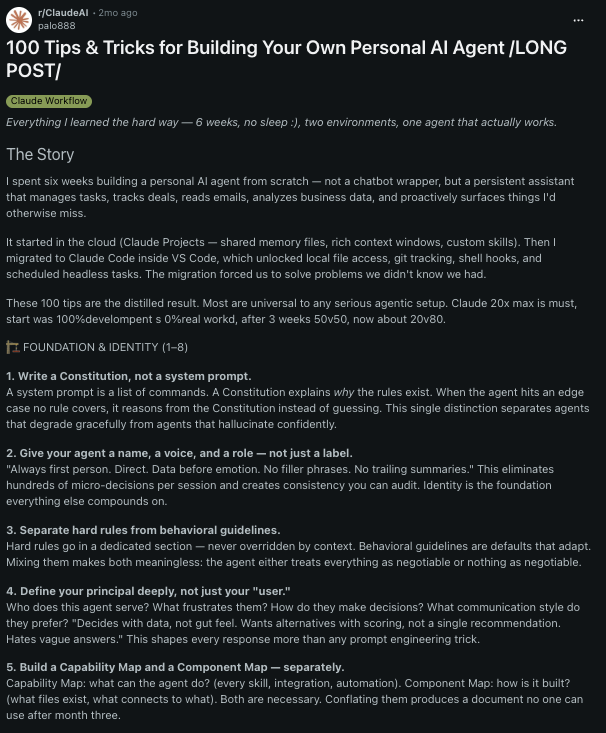
The distinction that actually matters in that list is "Constitution, not a system prompt" — most people building agents write one big instruction block and wonder why it drifts after a few steps. Separating hard rules (things it must never do) from behavioral guidelines (how it should generally act) is what keeps an agent stable over long sessions instead of slowly reinterpreting its own instructions into something looser. That one structural choice is the difference between an agent you can trust unattended and one you have to babysit every few messages.
English
0
0
0
0
Hamza Khalid
Hamza Khalid@humzaakhalid·
this is f*cking gold a guy spent 6 weeks with no sleep building a personal AI agent from scratch, then wrote down all 100 things he learned not a chatbot wrapper. an assistant that manages tasks, tracks deals, reads emails, and flags things before you even ask. if I had this before I built my first agent, I would've skipped a month of trial and error in the right hands, this changes everything: → write a Constitution, not a system prompt → give your agent a name, a voice, a role → separate hard rules from behavioral guidelines → build a Capability and a Component Map separately And that's tip 5 out of 100. (All tips are dropped in the comments below) then read how to use claude as your company OS below: ↓
Hamza Khalid tweet media
Hamza Khalid@humzaakhalid

x.com/i/article/2078…

English
23
96
825
116.1K
Armaan | AI Systems
Armaan | AI Systems@armaxnpuri·
The subscription model exists because it's genuinely a better business for the seller, recurring revenue is predictable, one-time sales aren't, but that same shift is a massive opportunity if you flip to the other side of it. Building something small that saves someone time every month (an automation, a workflow, a bot) and charging a recurring fee for it is the exact same model everyone's annoyed about, just pointed at a problem you solved instead of one Microsoft solved. The frustration people feel paying subscriptions is the same reason subscriptions are one of the most durable ways to get paid once you're the one offering the service.
English
0
0
0
0
Jum
Jum@JesterJum·
You know what really bugs me? We cant own anything. Everything is a subscription....like literally everything. You cant buy Microsoft Office. You have to purchase a subscription for a year. You literally have to pay for everything FOREVER Isn't anyone else bothered by this.
English
2.8K
1.1K
9.4K
263.5K