Abdul Basit

14.2K posts

Abdul Basit banner
Abdul Basit

Abdul Basit

@basitresearcher

Senior Associate Fellow @RSIS_NTU| Violent Extremism| South Asia| Views Personal| Likes/Retweets ≠Endorsement

Katılım Ekim 2011
4.3K Takip Edilen4.1K Takipçiler
Sabitlenmiş Tweet
Abdul Basit
Abdul Basit@basitresearcher·
1. My working paper for @tabadlab arguing for an indigenous CT discourse in Pak following the US withdrawal from Afg. To sustain CT efforts in Pak against an ever-evolving & expanding threat landscape creating a public buy-in is extremely necessary. 1/n tabadlab.com/time-for-an-in…
English
13
20
83
0
Abdul Basit retweetledi
Barak Ravid
Barak Ravid@BarakRavid·
🚨A U.S. official briefed on the negotiations told me the Trump administration and Iran are close to a deal for ending the war and noted remaining gaps focus on "wording" of several points
Barak Ravid@BarakRavid

🚨🚨🚨Scoop: President Trump tells me he's "solid 50/50" on Iran deal or bombing. Trump said he will meet senior advisers today to discuss latest draft agreement and may make a decision by tomorrow. My story on @axios axios.com/2026/05/23/tru…

English
176
210
923
727.3K
Abdul Basit retweetledi
Lucas Webber
Lucas Webber@LucasADWebber·
A leaked EU threat assessment seen by RFE/RL warns about: • Possible Iranian proxy or "sleeper cell" attacks • ISIS-K online recruitment efforts • Radicalization of minors via Telegram and TikTok • Russian ex-convict fighters from the Ukraine war rferl.org/a/leaked-eu-re…
English
1
41
70
5.4K
Abdul Basit retweetledi
Hamidreza Azizi
Hamidreza Azizi@HamidRezaAz·
A non-aggression pact between #Iran and Saudi Arabia? 🔹The Financial Times report on Saudi Arabia’s proposal for a regional “non-aggression pact” between Iran and neighboring states is not merely a temporary diplomatic initiative. Rather, it signals Riyadh’s attempt to redefine the Middle East’s security architecture in the aftermath of the U.S./Israeli war on Iran. 🔹The significance of this idea lies less in the pact itself – after all, this is not the first time such an idea is being discussed – than in the strategic logic behind it. Saudi Arabia appears to have concluded that the perpetual cycle of deterrence, limited strikes, and proxy warfare can no longer be managed solely through reliance on the American security umbrella. 🔹The Saudis’ reference to the 1970s “Helsinki process” is also far from accidental. That model was designed precisely to manage competition between hostile blocs, not to fully resolve ideological and geopolitical disputes. In other words, the objective is not to eliminate tensions, but to contain them. 🔹In effect, Riyadh now seems to be moving toward a form of implicit acceptance of a new regional balance of power, in which Iran, despite the heavy costs of the recent war, remains an indispensable actor in the region’s security equations. 🔹This shift also reflects a broader change in the Saudi conception of “stability.” For years, many Arab states defined regional security in terms of containing or weakening Iran’s regional influence. Now, however, the primary priority appears to be preventing Iran-Israel conflict from escalating into a permanent regional war. 🔹From this perspective, the proposal for a non-aggression pact should be understood as part of the broader trend toward the “regionalization” of Persian Gulf security. This process began with the China-mediated Iran-Saudi rapprochement in 2023 and may now enter a more complex phase, i.e., the establishment of rules of conduct for crisis management. 🔹At the same time, comparisons between the Middle East and Cold War-era Europe have serious limitations. Unlike Europe, the region lacks durable institutional structures, clear deterrence lines, and even a minimal consensus over the foundations of a regional security order. Moreover, the role of non-state actors and multilayered conflicts makes the equation far more complex. 🔹More importantly, any such initiative would remain inherently fragile without some degree of mutual understanding between Iran and Israel regarding the acceptable limits of escalation. Any new direct confrontation could easily destroy the entire process of regional de-escalation. 🔹At the same time, the proposal itself demonstrates that the Arab states of the Persian Gulf are increasingly concerned about the spillover of Iran-Israel rivalry into their energy infrastructure, trade corridors, and economic development projects. This concern has now become a major driver of regional policy. 🔹For this reason, even if the idea of a “non-aggression pact” never materializes into a formal agreement, the very fact that it has been proposed carries an important message, that a significant part of the Arab world is no longer seeking to exclude Iran from the region’s security equations, but rather to make patterns of interaction with Tehran more predictable.
English
0
134
409
133.4K
Abdul Basit retweetledi
Global Peace Index
Global Peace Index@GlobPeaceIndex·
Understanding why some wars escalate, while others do not, is essential for designing early interventions and effective peacebuilding strategies, writes IEP Research Fellow Dr Sascha Nanlohy. visionofhumanity.org/why-conflicts-…
English
0
3
6
455
Abdul Basit retweetledi
Institute for National Strategic Studies
AI-enabled irregular warfare is reshaping the cognitive battlespace. "Irregular Warfare, Part Two" examines how adversaries use AI-driven influence operations to target perception, trust, morale, & decision-making below the threshold of kinetic conflict. inss.ndu.edu/news/Article/4…
English
0
6
12
966
Abdul Basit
Abdul Basit@basitresearcher·
Balochistan, Sindh, Punjab and in G-B. To fault a particular province or ethnicity for TTP’s problem will be truly unfortunate. It’s a national security issue and the ppl who have suffered the most from terrorism are Pashtuns from KP. TTP tries to exploit such fault-liens. Ends
English
0
0
2
63
Abdul Basit
Abdul Basit@basitresearcher·
Why Fazlullah suffered as TTP chief and the group splintered under him and unified efficiently under Nur Wali “Mehsud”, again intra-tribal dynamics provide answers. But there are non-Pashtuns in TTP both at the commander and fighter levels. TTP has expanded network in…2/2
English
1
0
1
65
Abdul Basit
Abdul Basit@basitresearcher·
Not just Pashtun domination of TTP is a critical variable while conducting ethnographic analysis or these groups’ composition but within that domain it is a group whose back bone is former by some hailing from Mehsud tribe. Why Gul Bahadur refused to become part of TTP..1/2
Tariq Parvez@TariqParvezTP

TTP was formed in 2007, as a result of about 40 militant groups, all belonging to FATA/KP. It would be interesting to know how many of the TTP top leaders, today, are non Pakhtuns.

English
1
0
4
586
Abdul Basit retweetledi
Hassan I. Hassan
Hassan I. Hassan@hxhassan·
Former Qatari PM Hamad bin Jassim and former Saudi intel chief Turki al-Faisal have both gone public in recent days on Iran, Israel & the Gulf. Their views are proxies for the thinking behind the curtain. New, sharp by @kshaheen in @newlinesmag. newlinesmag.com/running-notes/…
English
2
97
328
46K
Abdul Basit retweetledi
Chris Meder
Chris Meder@EVCurveFuturist·
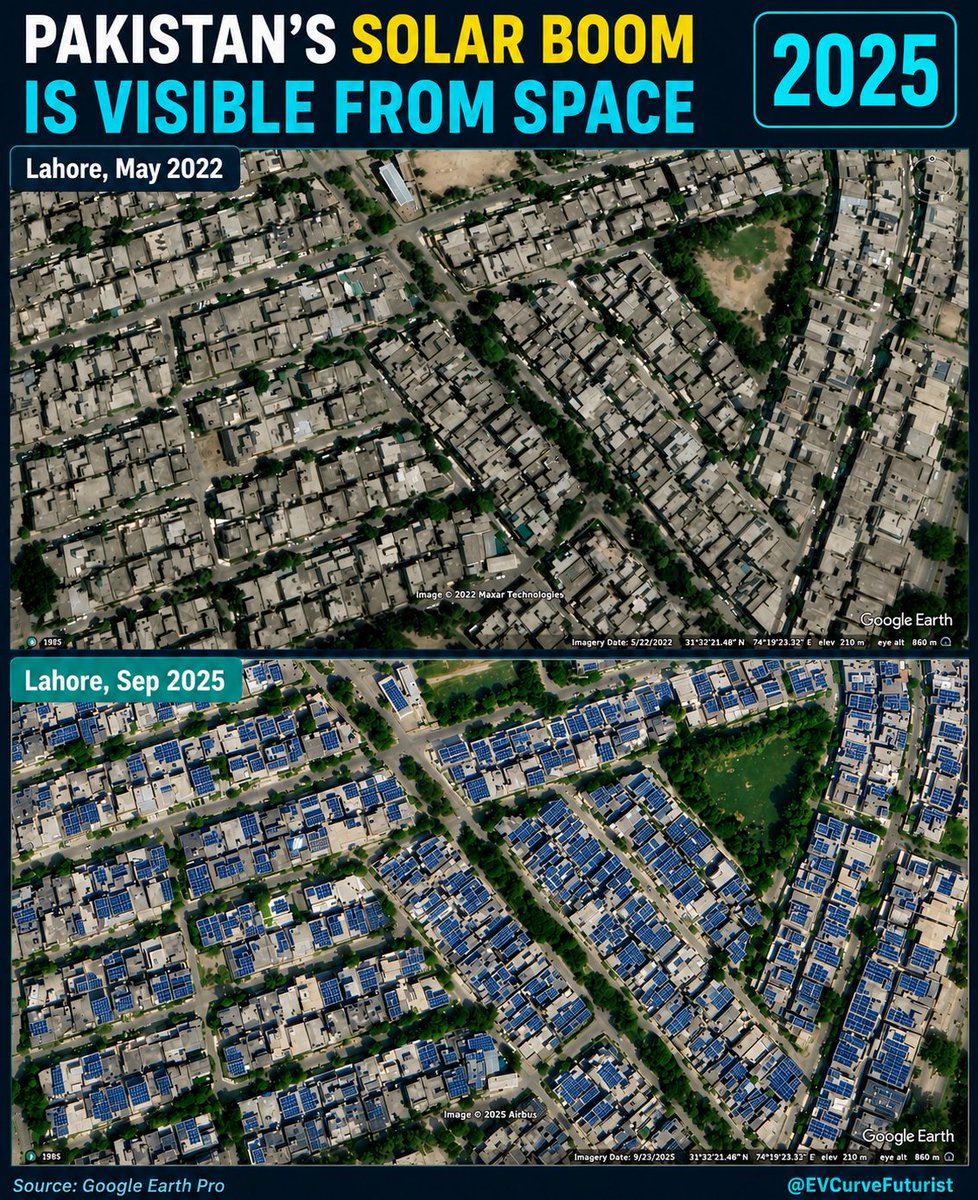
Pakistan may be accidentally building one of the world’s first decentralised #solar economies. The craziest part? Real scale barely shows in official stats. Imported 51.5 GW solar panels by late 2025—nearly = entire grid. Yet registered net-metered rooftop solar just 5.3–6.8 GW. What makes this story so extraordinary is the speed. In only a few years, Pakistan appears to have gone from a relatively minor solar market to potentially sourcing around a quarter of its electricity from solar once distributed generation is included. 👉 ~16.6–17 GW solar imports in 2024 👉 ~18 GW solar imports in 2025 👉 ~51.5 GW cumulative imports by late 2025 👉 Rooftop solar: ~1.3 GW → 4.1 GW in 2024 👉 ~5.3–6.8 GW registered rooftop solar in 2025 👉 24+ GW estimated behind-the-meter/off-grid 👉 Solar potentially ~25% of actual electricity use The massive gap between imported panels and officially registered systems strongly suggests tens of gigawatts are now operating quietly on homes, farms, factories and businesses across the country. This increasingly looks less like a normal energy transition and more like large-scale consumer-led grid defection. And economics is driving nearly all of it. Electricity tariffs surged. Diesel prices climbed. Blackouts remained common. Meanwhile ultra-cheap Chinese solar panels and falling battery prices made self-generation economically irresistible. So millions effectively made the same calculation: Generate your own power, or remain trapped inside an expensive and unstable system. Once solar becomes cheaper than the grid itself, adoption can move faster than governments, utilities and even official statistics can keep up with. This isn’t gradual transition by any stretch. It may ultimately become a blueprint for how energy-poor nations break free from legacy old-world energy systems dominated by fossil fuels and increasingly expensive centralised power. It’s decentralisation at escape velocity. This is #Bettrification.
Chris Meder tweet media
English
235
1.4K
4.7K
398.9K
Abdul Basit retweetledi
Ihsanullah Tipu Mehsud
Ihsanullah Tipu Mehsud@IhsanTipu·
A Case of alleged recruitment of Pakistani youths for Russia-Ukraine war has surfaced with claims that a human-trafficking network is luring young men to Russia through promises of high-paying jobs & forcing them into war-related activities against Ukraine share.google/UCFBEsTMx2qNaw…
English
7
51
157
13.3K
Abdul Basit retweetledi
Vali Nasr
Vali Nasr@vali_nasr·
This article by Robert Kagan is worth reading. It is a searing assessment of the catastrophic failure of the Israel-U.S. war on Iran, calling it a defeat. It is also perhaps best captures how Iran sees things and why it is not submitting to Trump’s demands in the talks 👇🏼 “There will be no return to the status quo ante, no ultimate American triumph that will undo or overcome the harm done. The Strait of Hormuz will not be “open,” as it once was. With control of the strait, Iran emerges as the key player in the region and one of the key players in the world. The roles of China and Russia, as Iran’s allies, are strengthened; the role of the United States, substantially diminished. Far from demonstrating American prowess, as supporters of the war have repeatedly claimed, the conflict has revealed an America that is unreliable and incapable of finishing what it started. That is going to set off a chain reaction around the world as friends and foes adjust to America’s failure. President Trump likes to talk about who has “the cards,” but whether he has any good ones left to play is not clear. The United States and Israel pounded Iran with devastating effectiveness for 37 days, killing much of the country’s leadership and destroying the bulk of its military, yet couldn’t collapse the regime or exact even the smallest concession from it. Now the Trump administration hopes that blockading Iran’s ports will accomplish what massive force could not. It’s possible, of course, but a regime that could not be brought to its knees by five weeks of unrelenting military attack is unlikely to buckle in response to economic pressure alone.” theatlantic.com/international/…
English
149
939
2K
348.9K
Abdul Basit
Abdul Basit@basitresearcher·
RT @AfghanAnalyst2: 𝗔𝗹 𝗡𝗮𝗯𝗮 𝗘𝗱𝗶𝘁𝗼𝗿𝗶𝗮𝗹 𝗔𝘁𝘁𝗮𝗰𝗸𝘀 𝗗𝗲𝗼𝗯𝗮𝗻𝗱𝗶 𝗖𝗹𝗲𝗿𝗶𝗰𝘀 The latest issue of the Islamic State group’s Al Naba weekly, in addition to…
English
0
1
0
10
Abdul Basit
Abdul Basit@basitresearcher·
@ShirazHassan Should have spoken to a cross-section of gyms for a representative random sample. This seems like a story of one gym, difficult to generalise the findings.
English
1
1
2
81
Shiraz Hassan
Shiraz Hassan@ShirazHassan·
پاکستان میں مخلوط جم کلچر تیزی سے مقبول ہو رہا ہے، مگر اس کے ساتھ کئی سوالات بھی جنم لے رہے ہیں۔ کیا خواتین کے لیے جم واقعی محفوظ ہیں؟
اردو
10
8
24
7.4K
Abdul Basit
Abdul Basit@basitresearcher·
IMHO, real loser of the India-Pakistan military stand off in May 2025 was mainstream Indian electronic media. The manner in which it was taken for a ride by the Indian establishment is a masterpiece.
English
0
2
5
299