Bhuvan
6.6K posts

Bhuvan
@bebhuvan
Doing time pass @zerodhaonline Things I'm up to: https://t.co/2kWuxWV5ff Link blog: https://t.co/V4JO1QxP0n


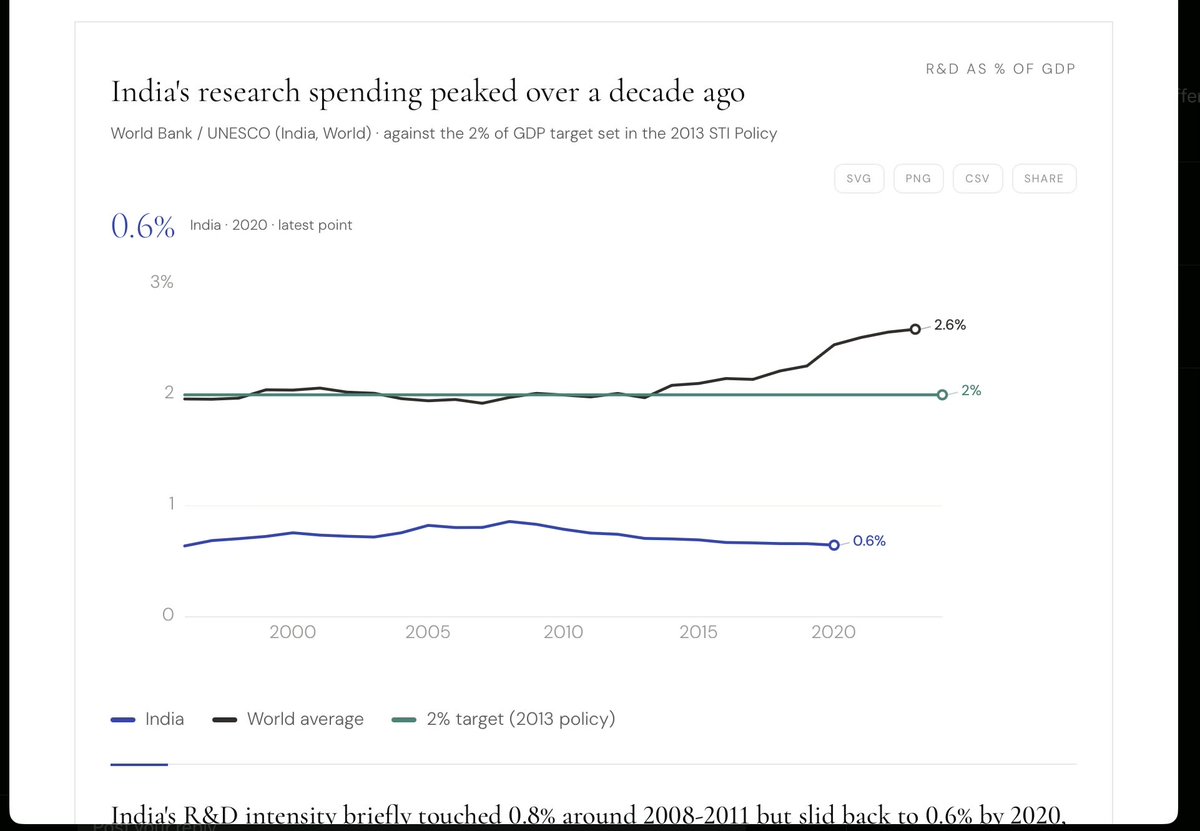
"The mkt will assign higher multiples to these companies as the period of competitive advantage extends through R&D. This multiple expansion will more than compensate for lower short-term earnings. In today’s world, anyone not innovating will ultimately fade away." Akash Prakash.


New Data Byte: Women's absence from India's workforce is most evident in their 20s, by @akwaghmare The share of people in an age group who are either working or looking for work is known as the labour force participation rate (LFPR). The LFPR is an important indicator to measure whether most adults are in the productive economy. In India, female labour force participation is far lower than that of males at every age. Across the world, labour force participation rises with age once adults complete their education, and then falls in old age. This is certainly the case for men in India. Men's LFPR increases sharply from the teenage years until the mid-twenties, and remains at nearly 100% during the prime working years. It then reduces slowly until the age of 60, and sharply after that. The likelihood of an Indian woman being in the labour force (two in five) is half of that of an Indian man (four in five). In India's Periodic Labour Force Survey, women report household duties, including child care and chores, as the main reason for staying out of the labour force. But the gap between male and female labour force participation rates is widest in their twenties and thirties. The main reason for this demographic blip in women's labour participation is child-bearing and child-rearing. About 70% of births in India are now to women in their twenties. #Jobs #Women #Employment #Work #India #DataForIndia


The internet gave every single person on Earth access to all of MIT's lectures for free and I think most of us would agree that it hasn't made us that much smarter. I don't think the main problems and solutions here are technological.

Delhi’s Aero City. No compound walls, perfect pavements ✅ The first world vibes!


Super thrilled to appear on @zerodha 's In the Money podcast, where we talk about all things AI, and a few things finance: youtu.be/Q8Hj-AP1cx4?si… Oh, and the quality of production is something else from everything else I've appeared on! Thanks @bebhuvan and @mysandz


🚶 BENGALURU'S FOOTPATHS ARE GETTING THEIR SPACE BACK From July 1–10, the Greater Bengaluru Authority (GBA) is running a 'Safe Footpath Campaign' across 1,000 km of road network — clearing encroachments from footpaths in all five city corporations. 📊 WHY THIS MATTERS 30% of every 1,000 road accident deaths in Bengaluru are pedestrians. The Supreme Court has been clear: walking on a footpath safely is a fundamental right, not a privilege. 🚫 WHAT'S BEING CLEARED ➡Illegal parking on footpaths (vehicles will be towed) ➡Name boards, chairs, tables, and kiosks blocking pedestrian paths ➡Vendors and shops spilling onto walkways ✅ HOW IT'S BEING DONE ➡Notices will be issued before any action — not a sudden crackdown ➡Action will follow the Street Vendors' Protection Act and SC guidelines ➡Municipal officers, police, and clearance teams will coordinate ➡Damaged slabs and kerbs will be repaired alongside clearance It follows the #1KmChallenge encouraging people to walk short distances instead of driving — Bengaluru is trying to become more walkable, one footpath at a time. 🗣️ WE NEED YOUR EYES ON THE GROUND Let's make Bengaluru's footpaths walkable again — together. #SafeFootpathBengaluru #PedestrianRights #GBA #WalkableBengaluru #BengaluruTraffic #Bengaluru #Citylife #CommuterLife

At Data For India, we spend a lot of time on big questions about India: female employment, household spending, fertility, health, the economy, and more. These often require deep research, large datasets, and long-form insights. But sometimes, you just want a clear answer to one sharp question: When will India’s population stop growing? What makes up India’s GDP? Which diseases affect Indians the most today? We are now ready to answer those questions for you. Introducing Data Bytes: one chart about India every week, and the story behind the data. Every Monday, starting 6th July, we will answer one simple question you might have about India, through one easy-to-understand chart and the context you need to interpret and use the information. You can already read the first three Data Bytes on our platform, and subscribe now to get the next one in your inbox: dataforindia.com/data-bytes/?ut… If there is a question about India you would like us to answer, write to us at info@dataforindia.com.


The visa website of a country renowned for its people’s IT skills resembles a Geocities page from 1999. Register for free to discover why it is unlikely to improve any time soon econ.st/4pg1Qxb Illustration: Lehel Kovacs