
PS retweetledi
PS
348 posts



I've been a long time fan of @karthiks's writing and this was a super fun conversation on all things LLMs 😬
I'm a writer and I have dog**** video skills so please forgive me for the imposition of my terrible voice. Mute me and listen to Karthik.
Karthik S@karthiks
Super thrilled to appear on @zerodha 's In the Money podcast, where we talk about all things AI, and a few things finance: youtu.be/Q8Hj-AP1cx4?si… Oh, and the quality of production is something else from everything else I've appeared on! Thanks @bebhuvan and @mysandz
English


PS retweetledi

This is Advertisement from 2011…
Is there even a possibility of any brand challenging the establishment like this?
English
PS retweetledi

“The celebration of jugaad is, at its core, a
celebration of underinvestment. And the
people who pay the price are always the
workers.”
Venki Padmanabham former CEO Royal Enfield.
English
@VivekVRao1 is there real alpha in academic literature ? I thought it was mostly overfitting/ p-hacking
English

Some research on alpha decay finds that edge gets smaller but does not disappear after publication. Does Academic Research Destroy Stock Return Predictability? (2013) by McLean and Pontiff fmg.ac.uk/sites/default/… "[studied] the out-of-sample and post-publication return-predictability of 82 characteristics that are identified in published academic studies. The average out-of-sample decay due to statistical bias is about 10%, but not statistically different from zero. The average post-publication decay, which we attribute to both statistical bias and price pressure from aware investors, is about 35%, and statistically different from both 0% and 100%."
A ChatGPT survey of the research on alpha decay is at chatgpt.com/share/69c27e51….
Christina Qi@christinaqi
I shouldn't have to say this but never buy a quant strategy or course. By the time a strategy appears in a course or paper, its edge is GONE. Courses teach you frameworks, not alphas.
English

Everyday Anthropic is launching something new in Claude.
Thariq pe Thariq pe Thariq.
English
@__paleologo @ArunKrishnan_ this actually tells more about his biases than anything else
English


"Foreword by Wendy Doniger".
Tells me all I need to know about this book. Thanks, but no thanks.
Gappy (Giuseppe Paleologo)@__paleologo
Just got this and I am reading. It’s excellent. The 10 books of the integral edition are too much for me. $16. Still, 900pp. If you don’t want to read it, the “Mahabarata” by Peter Brook (a movie) is free on the Internet Archive. Great. Still, 5hrs of a movie. Ok: read the Bhagavad-Gita. Be Oppenheimer a bit… In sum: get some Mahabarata. Top Ten in universal literature ever, everywhere. Dramatically underrated by non-Indians.
English
PS retweetledi

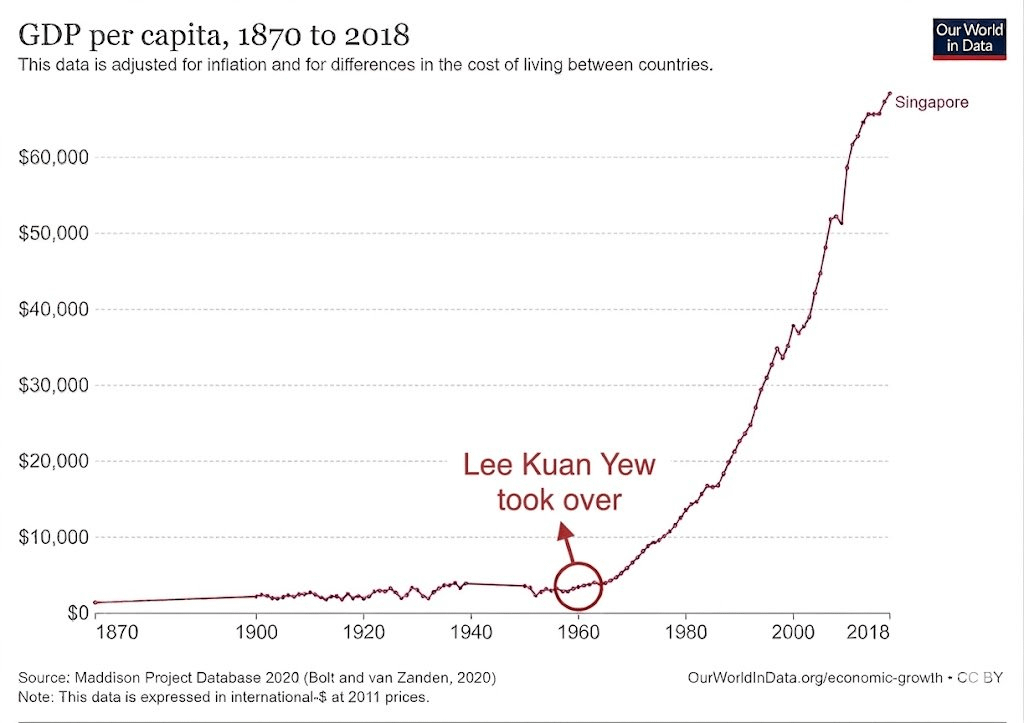
Think it's worth saying a bit more about the breadth of Tyler Cowen's accomplishments.
Each one of these alone would be enough to make most people's careers:
1. Marginal Revolution is the most successful econ blog of all time
2. Emergent Ventures has given grants to ~1,000 ambitious young people
3. Fast Grants awarded $50 million for COVID research
4. The Great Stagnation and other Cowen books continue to be influential
5. Conversations with Tyler has been one the best long-form interview podcasts for years
6. Between the e-learning platform (Marginal Revolution University) and the textbook (Modern Principles of Economics), he's one of the leading economics educators of his generation
7. GMU econ and Mercatus are vibrant intellectual communities and they wouldn't be what they are without Tyler
The list could go on and on (his work with Derek Parfit, his culinary contributions, etc).
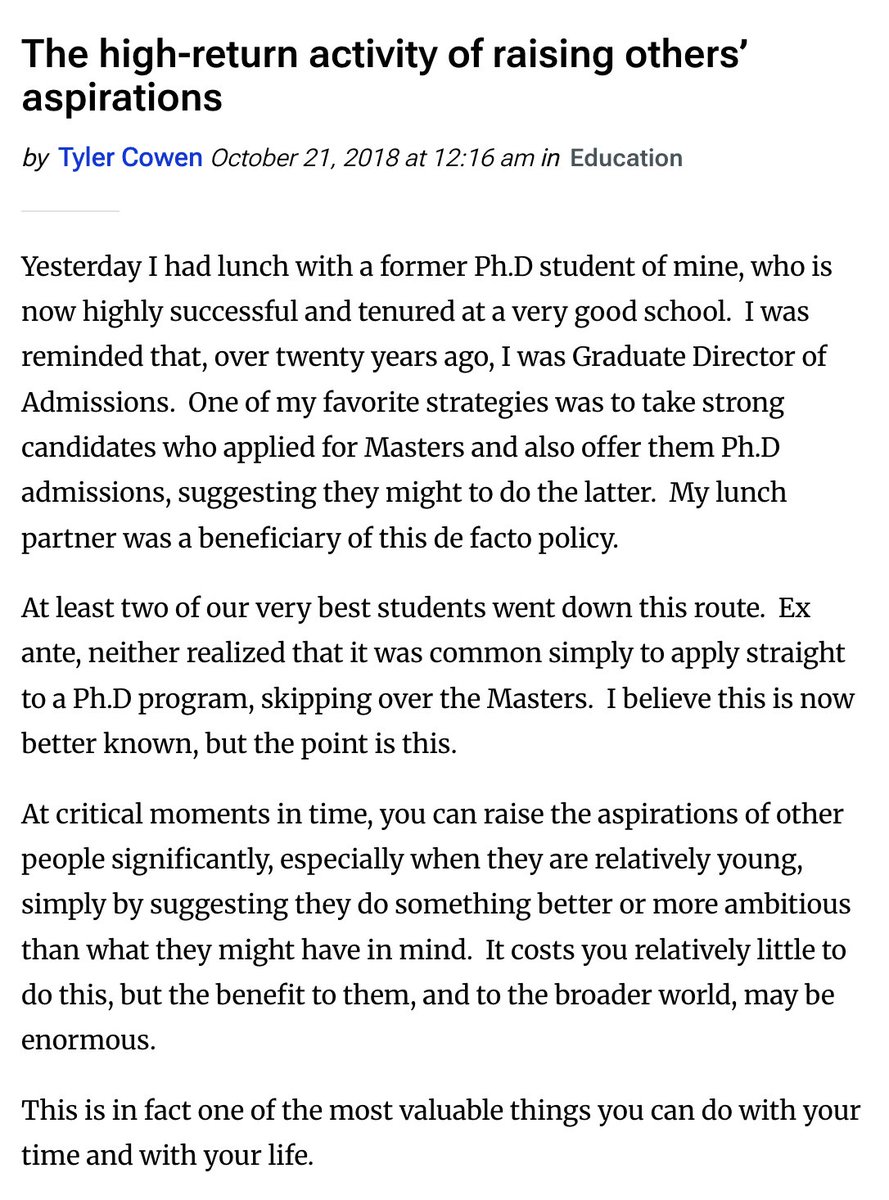
But most of all, Tyler is a mensch. One of the most important things he does is "raise the aspirations of others."
He did that for me, and for countless others.
T. Greer@Scholars_Stage
Thoughts on the Cowen debate: 1) I think Cowen looked at the world in the aughts and realized “I can be a normal economist or the world’s most influential blogger” and he clearly chose the latter. This was a good choice, and has led him to great heights. 2) Breadth is its own sort of depth, and the world has great need of generalists who actually do the reading 3) One reason #2 matters: most public intellectuals of a certain stature—the stature where they are invited to dinner parties with fancy people—are reduced to publicly recycling the opinions of the other dinner guests. There are lots of reasons why that happens but one obvious one is that the pundits in question don’t actually have the breadth of experience or reading to reflect on dinner party opinion. Tyler is this one of the few public intellectuals whose opinions are reliably made better because of his access to the high and mighty. 4) There is probably no academic in America who has a larger number of mentees; I cannot think of any academic who has jump-started more careers than Cowen has. It was only possible because of reasons 1-3. This is a significant achievement. It will be his greatest legacy. Full disclosure: I have received grants from Cowen myself so I am biased in the ways you would expect.
English
English

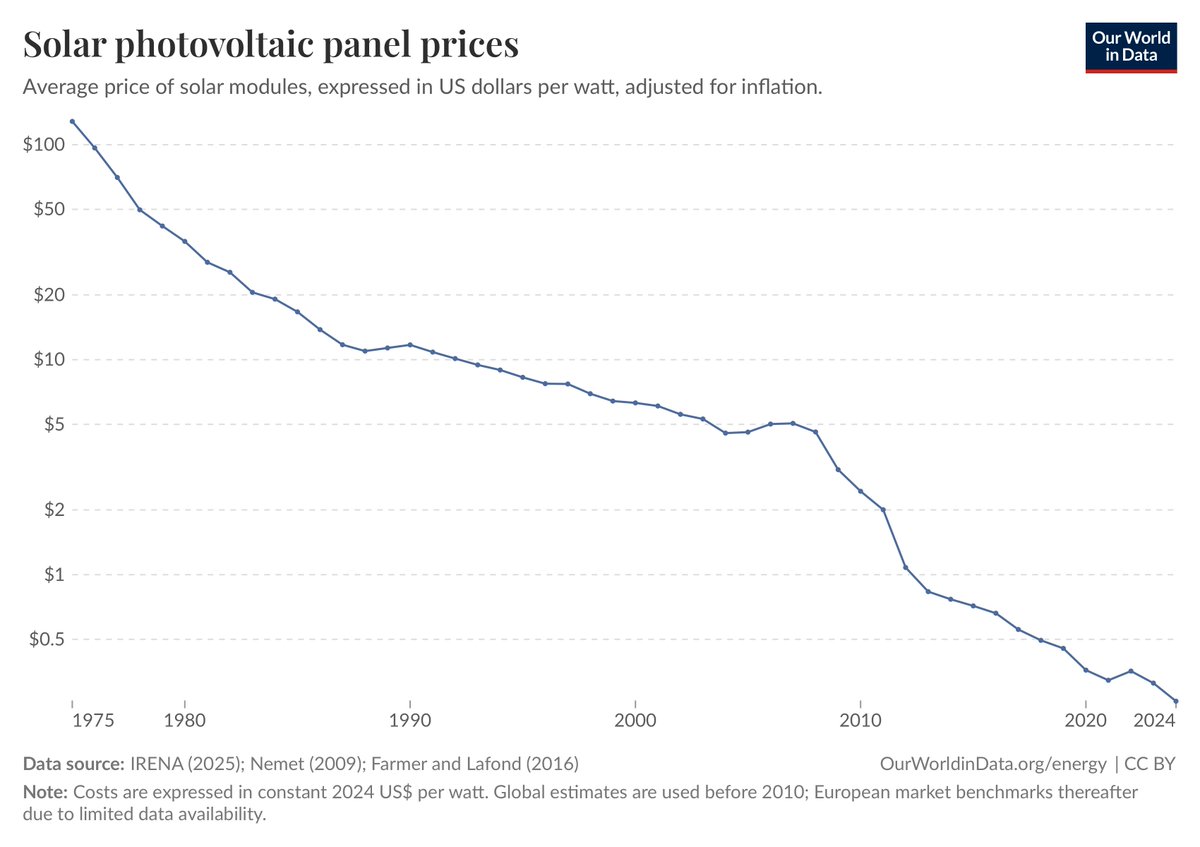
The cost of solar has dropped 99.8% worldwide since 1975 and 94.4% since 2008.
Solar is the future.
English
PS retweetledi


@kyle_e_walker Any specific cases that you find it to be better than Claude ?
English

I'm a loyal Claude Opus / Claude Code user, but I have to say...
They are right about Codex 5.3
English

I’ve been evaluating both sides of the “Claude can code now so software is dead” debate and reading more than usual on a topic. This is one of the most thoughtful pieces on the subject and they make the software portion free to read w/o a sub, which I’m contemplating. 5/5
Tech Fund@techfund1
Having done tons of coding, cloud engineering, as well as covering the software sector as an equity analyst over the last 15+ years, I'm really not seeing a software disruption here. Jensen is focused on boosting the productivity of his workforce, which can easily result into an economic value of >$100 billion for his company, as opposed to doing a set of highly risky and complicated software transitions that might save him $500 million. And other enterprises are doing the same going through recent earnings calls. All the sudden experts in software underestimate gravely how complicated it is to rip out and replace an ERP, database, CAD, supply chain management, or other core tool that runs the backbone of a business. These are complicated 2-4 year projects with mixed results of success, frequently resulting into earnings warnings and failed projects. The real value currently is to insert as much AI into your business as possible and boost productivity. And the easiest way to do is having AI leverage your core tools. We're currently using all our software tools more than ever before, as now our AIs are also using them as well. So, we're spending more on AI and software and this continues to accelerate. Where's the money coming from? We're spending less on human services as we can do more ourselves now. So, we'd be bearish on companies that provide services such as consulting, IT services, freelancing etc. However, for key software tools, revenues and EPS will accelerate from here in our view, as these names are typically building AI agents into their current tooling. From everything we're seeing, enterprises are very keen to lever these AI capabilities. It's not like enterprises - and especially SMBs - have a deep pool of AI talent to build this themselves. Free open source software also has been available for decades, illustrating that price is not the key factor in selecting a tool. It's about security, reliability, and network effects around software tools. techinvestments.io/p/the-bull-cas…
English

@systematicls would love to have access, one HFT gave me a test on finding bugs in their tick by tick data. I wasnt able to clear the test
English

Almost all of us will deal with tick data at some point in our careers. Even a MFT book will likely deal with tick data to transform it into some aggregated form.
Unlike aggregated price data, it can be tricky to deal with the large volume of data in real time. Most practitioners will implement some kind of filter for both historical/live to catch any outliers.
There are "goldilocks" methods that allow us to approximate "optimal filtering" when dealing with millions and millions of rows, and this article discusses exactly one of them!
As usual, happy to share the article with some who retweet and comment on THIS post!
English

@moonsez Yes, generally true for all carbs. Leftovers are healthier
English

cc: @krishashok is this true?
Shining Science@ShiningScience
Here’s how to slash sugar spikes from pasta — and make it healthier. Scientists discover that cooling cooked pasta for 24 hours transforms its starch into a gut-friendly fiber that slashes blood sugar spikes. When you cook pasta and then cool it for at least 24 hours, the starch molecules undergo a process called retrogradation. This molecular reorganization transforms digestible starch into "resistant starch," which functions more like fiber than a simple carbohydrate. Instead of being rapidly absorbed in the small intestine and causing a sharp rise in glucose, it travels to the large intestine where it feeds beneficial gut bacteria as a powerful prebiotic. This simple kitchen hack not only supports a healthy microbiome but also encourages the production of short-chain fatty acids that help reduce internal inflammation. Beyond gut health, this transformation provides a significant advantage for metabolic wellness by slowing sugar absorption and improving insulin response. Perhaps most surprisingly, these health benefits remain largely intact even if you choose to reheat the pasta before eating. By simply planning ahead and refrigerating your noodles overnight, you can effectively lower the caloric impact of your meal while maintaining more stable energy levels throughout the day. This game-changing strategy allows you to enjoy favorite comfort foods while prioritizing long-term health and better blood sugar control. Source: Bullen, A. (2022). Is Reheated Pasta Actually Better for You? Cleveland Clinic Health Essentials.
English