Andreas Kirsch 🇺🇦

13.8K posts

Andreas Kirsch 🇺🇦 banner
Andreas Kirsch 🇺🇦

Andreas Kirsch 🇺🇦

@BlackHC

My opinions only here. 👨‍🔬 RS DeepMind, Midjourney 1y 🧑‍🎓 DPhil AIMS 4.5y 🧙‍♂️ RE DeepMind 1y 📺 SWE Google 3y 🎓 TUM 👤 @nwspk

Oxford, England Katılım Ağustos 2009
6.4K Takip Edilen15.5K Takipçiler
Sabitlenmiş Tweet
Andreas Kirsch 🇺🇦
Ever wondered why presenting more facts can sometimes *worsen* disagreements, even among rational people? 🤔 It turns out, Bayesian reasoning has some surprising answers - no cognitive biases needed! Let's explore this fascinating paradox quickly ☺️
English
16
68
354
76.4K
Chao Ma
Chao Ma@ickma2311·
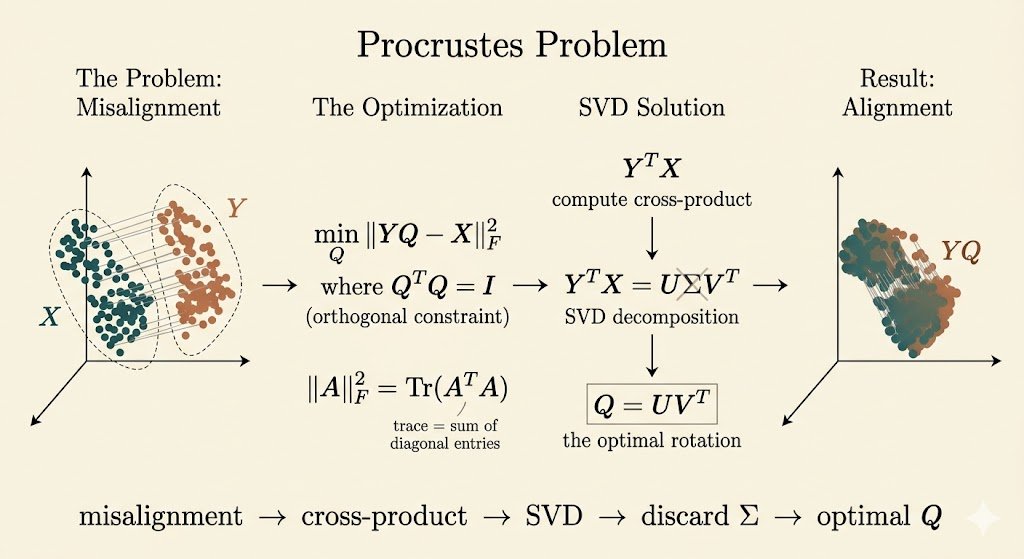
MIT 18.065 Lecture 34: Distance Matrices, Procrustes Problem If a squared distance matrix comes from real Euclidean points, then after double-centering it must give a PSD Gram matrix. Given two point clouds, the Procrustes problemasks for the best orthogonal transformation that matches one to the other. Geometry -> PSD Alignment -> SVD My note: ickma2311.github.io/Math/MIT18.065…
Chao Ma tweet media
English
4
34
381
14.3K
Andreas Kirsch 🇺🇦 retweetledi
Pope Leo XIV
Pope Leo XIV@Pontifex·
Absurd and inhuman violence is spreading ferociously through the sacred places of the Christian East, profaned by the blasphemy of war and the brutality of business, with no regard for people’s lives, which are considered at most collateral damage of self-interest. But no gain can be worth the life of the weakest, children, or families. No cause can justify the shedding of innocent blood.
English
2.8K
28.8K
132.4K
2.9M
Andreas Kirsch 🇺🇦
@pfau It reminds me of a short story where a single person would cast a vote in elections and they'd use a ginormous computer to predict everybody else's preferences
English
1
0
2
136
David Pfau
David Pfau@pfau·
Out of the whole space of bad LLM applications, there is something about this specifically that upsets me on a different level, because it so fundamentally misunderstands the thing it is trying to replace that I fail to understand how the idea ever arose in the first place.
Peter J. Hasson@peterjhasson

You gotta be shitting me

English
13
38
352
33.9K
Andreas Kirsch 🇺🇦 retweetledi
Ryan Grim
Ryan Grim@ryangrim·
Deliberately killing an elderly diplomat and his wife precisely because he was working on a peace effort is one of the greatest crimes imaginable—a killing carried out to prevent a peaceful resolution.
Murtaza Hussain@MazMHussain

The Israeli/US murder of Kharazi at his house along with his wife was truly despicable act—killing a reformist diplomat who served an FM for Khatami and helped develop his “Concert of Civilizations” idea and was reportedly helping mediate the current situation.

English
165
7.3K
24.1K
557.8K
Andreas Kirsch 🇺🇦 retweetledi
Alexandr Wang
Alexandr Wang@alexandr_wang·
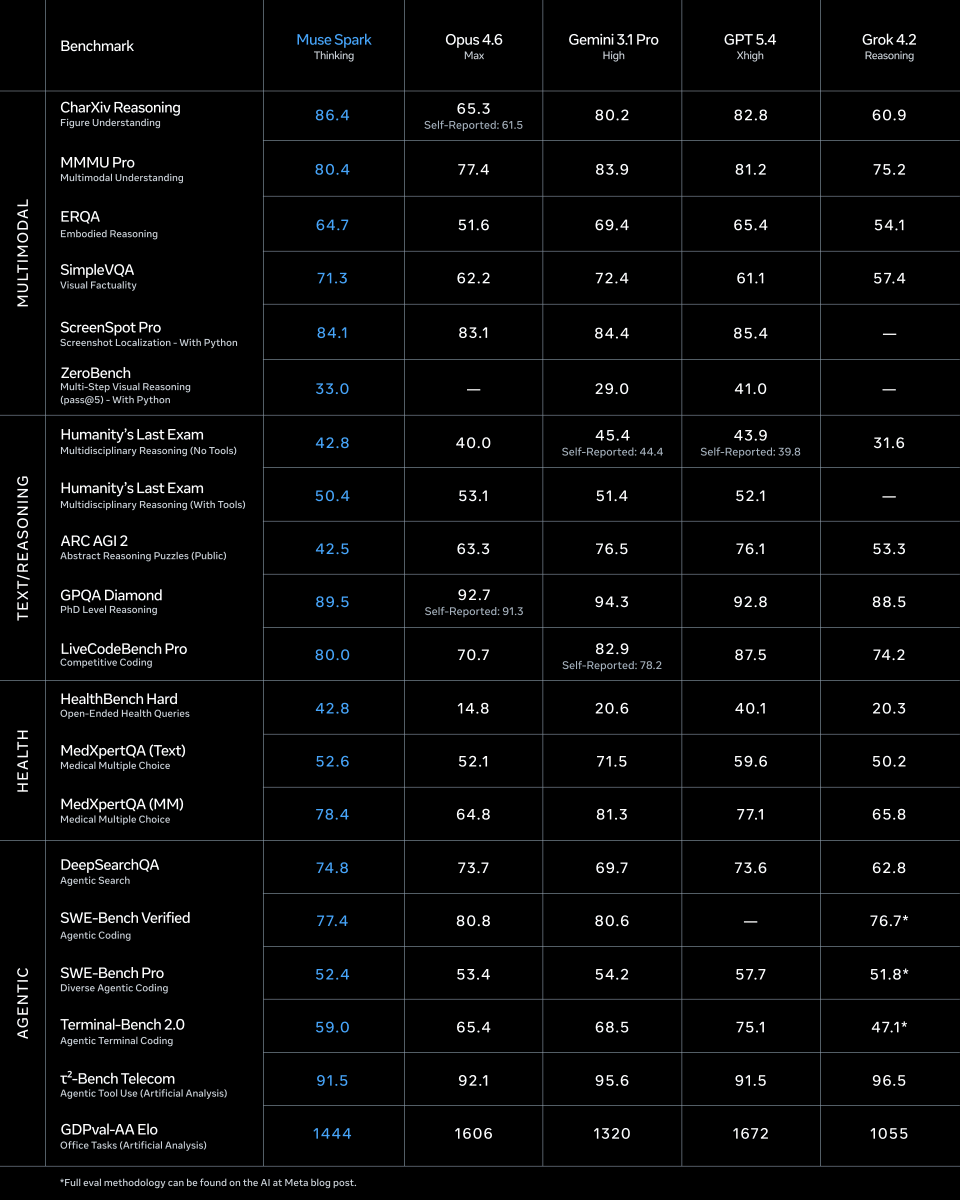
1/ today we're releasing muse spark, the first model from MSL. nine months ago we rebuilt our ai stack from scratch. new infrastructure, new architecture, new data pipelines. muse spark is the result of that work, and now it powers meta ai. 🧵
Alexandr Wang tweet media
English
704
1.2K
10.1K
4.2M
Andreas Kirsch 🇺🇦
@ahatamiz1 It would have been even nicer if it had connected this to pointwise mutual information as the more intuitive principle 👏
English
0
0
0
355
Ali Hatamizadeh
Ali Hatamizadeh@ahatamiz1·
This paper should have cited our earlier work, RLP. arxiv.org/abs/2510.01265 We introduced the use of log-probability ratios between informed and uninformed versions of the same model as a dense, token-level signal within a GRPO-style framework. This paper uses the same core mechanism, but applied to RLVR credit assignment rather than pretraining. We believe a citation is warranted !
AK@_akhaliq

Self-Distilled RLVR paper: huggingface.co/papers/2604.03…

English
2
7
78
10.5K
Andreas Kirsch 🇺🇦 retweetledi
Helen Toner
Helen Toner@hlntnr·
My strongest opinion about the Anthropic/OpenAI/Dept of War stuff is: If you agree to "all lawful use" and then there are allegations of *un*lawful use of force (aka war crimes), you need to either 1) make real sure the allegations are false, or 2) get the fuck out of there
Acyn@Acyn

Reporter: Deliberate attacks on civilian infrastructure violate the Geneva conventions and international law.  Trump: Who are you with?  Reporter: I'm with the New York Times Trump: Failing New York Times. Circulation is way down. Reporter: Are you concerned that your threat to bomb power plants and bridges amount to war crimes? Trump: No, not at all. These are disturbed people. Quiet. You no longer have credibility. You’re fake.

English
0
17
194
28.5K
Andreas Kirsch 🇺🇦 retweetledi
Peter Hague
Peter Hague@peterrhague·
How is a person supposed to tell if they are having a psychotic break or not these days? Everyone else can see the big rabbit listening to Trump talk about bombing Iran, right?
English
916
2.9K
26.2K
1.3M
alphaXiv
alphaXiv@askalphaxiv·
"Reinforcement Learning via Self-Distillation" Current RLVR has a major flaw, where credit assignments and signals are sparse due to its binary feedback So this paper introduced a new paradigm called Reinforcement Learning with Rich Feedback (RLRF), using a new Self-Distillation Policy Optimization so that they are able to turn rich feedback like runtime errors into token-level supervision with dense credit assignment When presented with feedback about their mistakes, they can often retrospectively understand what went wrong and infer better approaches
alphaXiv tweet media
English
16
29
231
8.8K
Andreas Kirsch 🇺🇦
Yann LeCopy
Calc Consulting@CalcCon

Those who don't know, I was an NSF postdoc with @SchmidhuberAI PhD's advisor (Schulten) back in the 90s. 1 of 2 in the country. And my PhD groupmate recently won the Nobel prize for AlphaFold. So I have some qualifications here to say 𝐲𝐞𝐚𝐡 𝐭𝐡𝐢𝐬 𝐢𝐬 𝐩𝐫𝐞𝐭𝐭𝐲 𝐚𝐜𝐜𝐮𝐫𝐚𝐭𝐞. The core learning principle behind JEPA is predicting one representation from another in latent space. And this was already explicitly formulated in the early 1990s PMAX work. PMAX does not merely hint at this idea; it sets up the same structure: two related inputs are encoded, and a predictor learns to map one latent representation to the other, while the encoder is trained to make this prediction possible without collapsing the representation. That is exactly the defining mechanism of JEPA. When you strip away modern terminology and architectures, both are instances of the same objective: learn representations by maximizing cross-view predictability under constraints that preserve information. What JEPA adds is not a new theoretical framework. It's just larger models, better architectures, and scaling. Of course, we could not do that in the 90s. In that sense, Jürgen Schmidhuber made the real and original conceptual breakthrough: non-generative, latent-to-latent predictive learning This is typical of @ylecun 's work; it's mostly derivative of others' ideas, scaled up and promoted. In contrast, @SchmidhuberAI really did pioneer a lot of these ideas. The JEPA work should have cited him. Politics >> Integrity.

English
0
0
10
6.7K
Andreas Kirsch 🇺🇦 retweetledi
Ronan Farrow
Ronan Farrow@RonanFarrow·
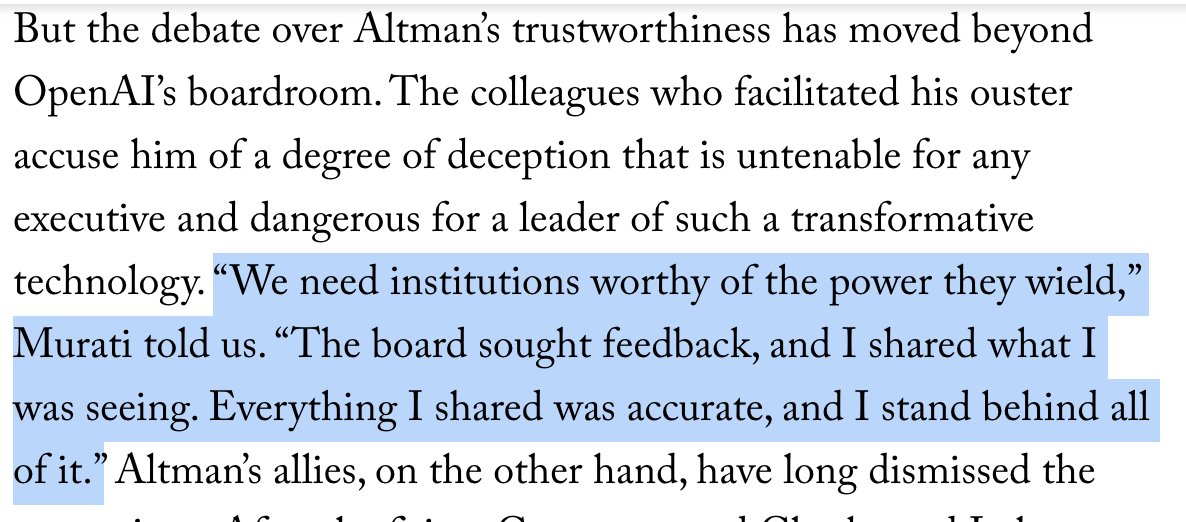
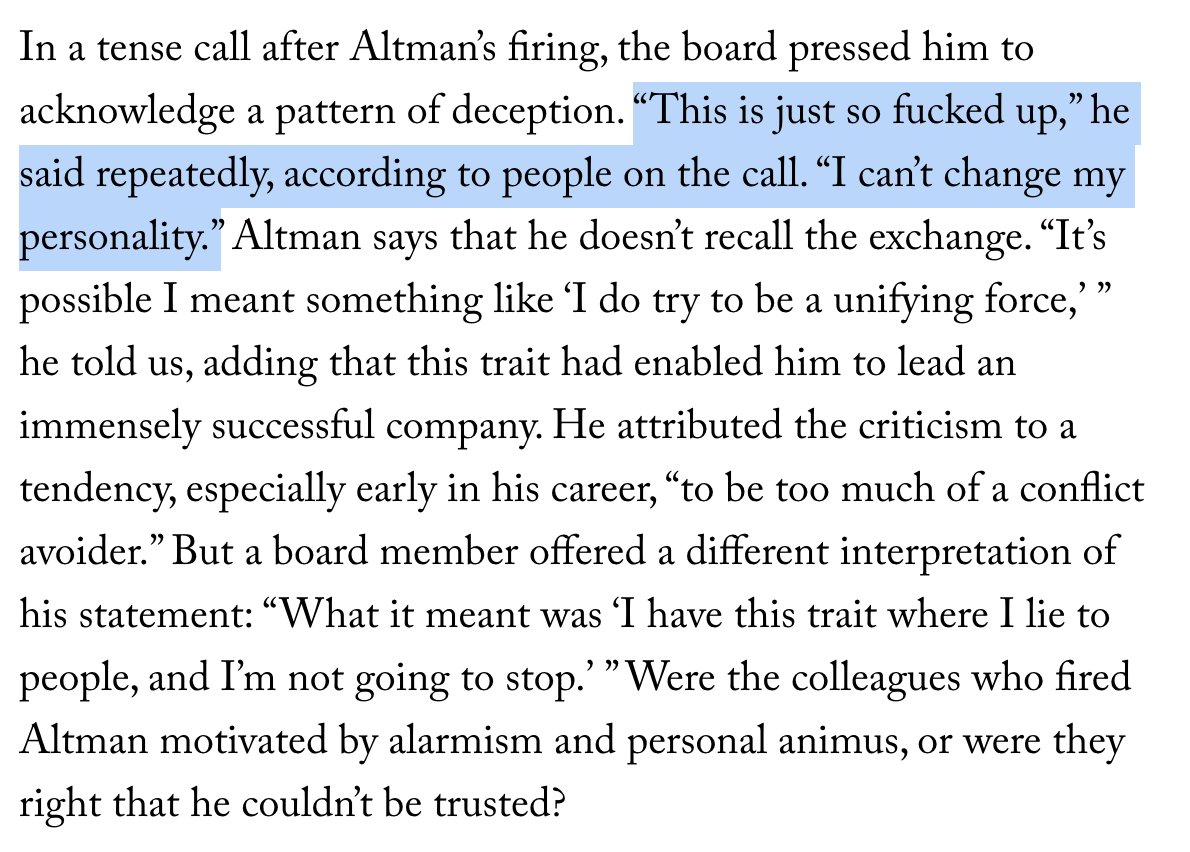
(🧵1/11) For the past year and a half, I've been investigating OpenAI and Sam Altman for @NewYorker. With my coauthor @andrewmarantz, I reviewed never-before-disclosed internal memos, obtained 200+ pages of documents related to a close colleague, including extensive private notes, and interviewed more than 100 people. OpenAI was founded on the premise that A.I. could be the most dangerous invention in human history—and that its C.E.O. would need to be a person of uncommon integrity. We lay out the most detailed account yet of why Altman was ousted out by board members and executives who came to believe he lacked that integrity, and ask: were they right to allege that he couldn't be trusted? A thread on some of of our findings:
Ronan Farrow tweet media
English
577
8K
36.7K
8.3M
Andreas Kirsch 🇺🇦
The right idea at the right time 👏 (useful advice: keep track of your ideas and revisit them frequently to see if their time has come)
Andrej Karpathy@karpathy

LLM Knowledge Bases Something I'm finding very useful recently: using LLMs to build personal knowledge bases for various topics of research interest. In this way, a large fraction of my recent token throughput is going less into manipulating code, and more into manipulating knowledge (stored as markdown and images). The latest LLMs are quite good at it. So: Data ingest: I index source documents (articles, papers, repos, datasets, images, etc.) into a raw/ directory, then I use an LLM to incrementally "compile" a wiki, which is just a collection of .md files in a directory structure. The wiki includes summaries of all the data in raw/, backlinks, and then it categorizes data into concepts, writes articles for them, and links them all. To convert web articles into .md files I like to use the Obsidian Web Clipper extension, and then I also use a hotkey to download all the related images to local so that my LLM can easily reference them. IDE: I use Obsidian as the IDE "frontend" where I can view the raw data, the the compiled wiki, and the derived visualizations. Important to note that the LLM writes and maintains all of the data of the wiki, I rarely touch it directly. I've played with a few Obsidian plugins to render and view data in other ways (e.g. Marp for slides). Q&A: Where things get interesting is that once your wiki is big enough (e.g. mine on some recent research is ~100 articles and ~400K words), you can ask your LLM agent all kinds of complex questions against the wiki, and it will go off, research the answers, etc. I thought I had to reach for fancy RAG, but the LLM has been pretty good about auto-maintaining index files and brief summaries of all the documents and it reads all the important related data fairly easily at this ~small scale. Output: Instead of getting answers in text/terminal, I like to have it render markdown files for me, or slide shows (Marp format), or matplotlib images, all of which I then view again in Obsidian. You can imagine many other visual output formats depending on the query. Often, I end up "filing" the outputs back into the wiki to enhance it for further queries. So my own explorations and queries always "add up" in the knowledge base. Linting: I've run some LLM "health checks" over the wiki to e.g. find inconsistent data, impute missing data (with web searchers), find interesting connections for new article candidates, etc., to incrementally clean up the wiki and enhance its overall data integrity. The LLMs are quite good at suggesting further questions to ask and look into. Extra tools: I find myself developing additional tools to process the data, e.g. I vibe coded a small and naive search engine over the wiki, which I both use directly (in a web ui), but more often I want to hand it off to an LLM via CLI as a tool for larger queries. Further explorations: As the repo grows, the natural desire is to also think about synthetic data generation + finetuning to have your LLM "know" the data in its weights instead of just context windows. TLDR: raw data from a given number of sources is collected, then compiled by an LLM into a .md wiki, then operated on by various CLIs by the LLM to do Q&A and to incrementally enhance the wiki, and all of it viewable in Obsidian. You rarely ever write or edit the wiki manually, it's the domain of the LLM. I think there is room here for an incredible new product instead of a hacky collection of scripts.


English
1
0
11
2.7K
will depue
will depue@willdepue·
if we were serious about appropriately punishing crimes based on societal impact, grave academic & scientific fraud would carry a life sentence
English
20
1
140
12K