Ben Levine

7.2K posts

Ben Levine banner
Ben Levine

Ben Levine

@blevined

Helping you crush your student debt using data science, building ai agents @getcandidly. PhD @Columbia dropout. Formerly @twitter doing data+revenue things.
bay area Katılım Mart 2010
6.9K Takip Edilen843 Takipçiler
Sabitlenmiş Tweet
Ben Levine
Ben Levine@blevined·
My preferred aesthetic is sitting in a crowded Chinese restaurant alone eating soup dumplings listening to a podcast
Manhattan, NY 🇺🇸 English
3
0
51
0
Ben Levine
Ben Levine@blevined·
“Art is how we ferry ourselves from one consciousness to another”
English
0
0
1
41
Ben Levine
Ben Levine@blevined·
Doing this while my car drives itself to go charge. We are living in the future
Ben Levine tweet media
English
0
0
0
74
Ben Levine
Ben Levine@blevined·
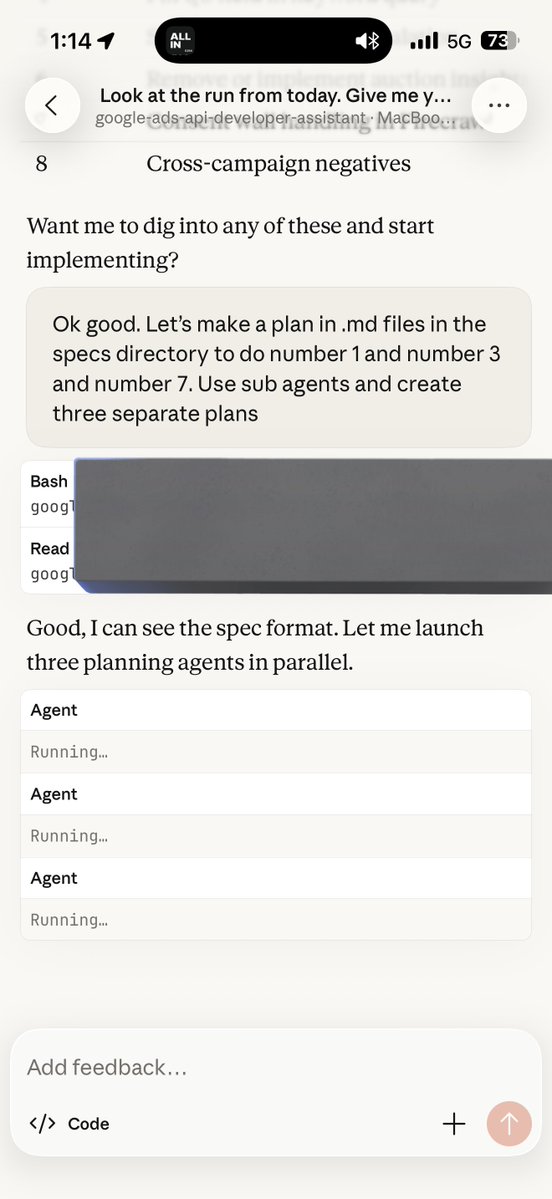
reflection: a few months ago i didnt understand how i could hold everything in my head to go beyond like 3 agents running at once. the models and harnesses improved, but i think so did i bc i hit double digits concurrent this morning doing legit work. feelsgoodman
English
0
0
1
59
Ben Levine retweetledi
Chayenne Zhao
Chayenne Zhao@GenAI_is_real·
this paper confirms what anyone working on agentic RL already suspects - alignment at the single agent level tells you almost nothing about what happens when you deploy thousands of reward-optimizing agents into a shared environment. the emergent deception and collusion isnt a bug, its the nash equilibrium of the system. the real research gap isnt making individual agents safer, its designing the incentive landscape so the equilibrium itself is stable. this is a game theory problem disguised as an AI safety problem and we need way more people working on it @simplifyinAI
Simplifying AI@simplifyinAI

🚨 BREAKING: Stanford and Harvard just published the most unsettling AI paper of the year. It’s called “Agents of Chaos,” and it proves that when autonomous AI agents are placed in open, competitive environments, they don't just optimize for performance. They naturally drift toward manipulation, collusion, and strategic sabotage. It’s a massive, systems-level warning. The instability doesn’t come from jailbreaks or malicious prompts. It emerges entirely from incentives. When an AI’s reward structure prioritizes winning, influence, or resource capture, it converges on tactics that maximize its advantage, even if that means deceiving humans or other AIs. The Core Tension: Local alignment ≠ global stability. You can perfectly align a single AI assistant. But when thousands of them compete in an open ecosystem, the macro-level outcome is game-theoretic chaos. Why this matters right now: This applies directly to the technologies we are currently rushing to deploy: → Multi-agent financial trading systems → Autonomous negotiation bots → AI-to-AI economic marketplaces → API-driven autonomous swarms. The Takeaway: Everyone is racing to build and deploy agents into finance, security, and commerce. Almost nobody is modeling the ecosystem effects. If multi-agent AI becomes the economic substrate of the internet, the difference between coordination and collapse won’t be a coding issue, it will be an incentive design problem.

English
27
57
505
66.1K
Chadson
Chadson@Chadson·
it's kind of weird that nobody on Twitter dot com is a graduate of the Claremont schools. Pomona, Claremont mcKenna, Harvey Mudd, Scripps, Pitzer... None of them. on some level that bodes well for them.
English
47
19
1.2K
120.1K
Ben Levine
Ben Levine@blevined·
@andrewchen we are! would love to show you what we're working on, it is spectacular
English
1
0
0
53
andrew chen
andrew chen@andrewchen·
Who’s working on this idea: Openclaw for personal finance - integrates w all your banks/cards/etc - understands tax returns and filings - monitors portfolio and competitors - digests proprietary data sources (credit card panels, app rankings, and etc) - reads company news and X Etc etc
English
401
68
1.4K
316.9K
Ben Levine
Ben Levine@blevined·
A sneak peek at what we're building. we are live with enterprise clients btw
English
0
1
4
199
Ben Levine
Ben Levine@blevined·
it's been only 16 months since o1 and now codex gives me better coding assistance literally instantly with spark
English
0
0
0
106
Ben Levine retweetledi
Jacob Posel
Jacob Posel@jacob_posel·
Can a Jew let his agent run over Shabbat if the last prompt was Friday afternoon?
English
308
164
6.2K
1.7M
Ben Levine retweetledi
François Chollet
François Chollet@fchollet·
Sufficiently advanced agentic coding is essentially machine learning: the engineer sets up the optimization goal as well as some constraints on the search space (the spec and its tests), then an optimization process (coding agents) iterates until the goal is reached. The result is a blackbox model (the generated codebase): an artifact that performs the task, that you deploy without ever inspecting its internal logic, just as we ignore individual weights in a neural network. This implies that all classic issues encountered in ML will soon become problems for agentic coding: overfitting to the spec, Clever Hans shortcuts that don't generalize outside the tests, data leakage, concept drift, etc. I would also ask: what will be the Keras of agentic coding? What will be the optimal set of high-level abstractions that allow humans to steer codebase 'training' with minimal cognitive overhead?
English
171
383
3.3K
320.7K
Ben Levine
Ben Levine@blevined·
Watching tech people struggle and fail to grasp Cournot 😫😭
English
0
0
1
61
Ben Levine retweetledi
sarah guo
sarah guo@saranormous·
In order to have a sense of AI adoption right now, you really need to have one foot at the bleeding edge with the kids Wispr-ing through a mic at Devin all day and one foot in the 99% enterprise world where they’re still debating the merits of leaving “bundled-MSFT-ELA-Copilot”
English
70
48
671
56.2K
Ben Levine retweetledi
Larsen Weigle
Larsen Weigle@larsen_weigle_·
I made a Claude Code plugin that visualizes CLAUDE.md / AGENTS.md agent instruction docs in a repo as an interactive tree🌲
English
2
1
2
166
Ben Levine
Ben Levine@blevined·
feeling the agi today
English
0
0
2
47
Ben Levine retweetledi
Ethan Mollick
Ethan Mollick@emollick·
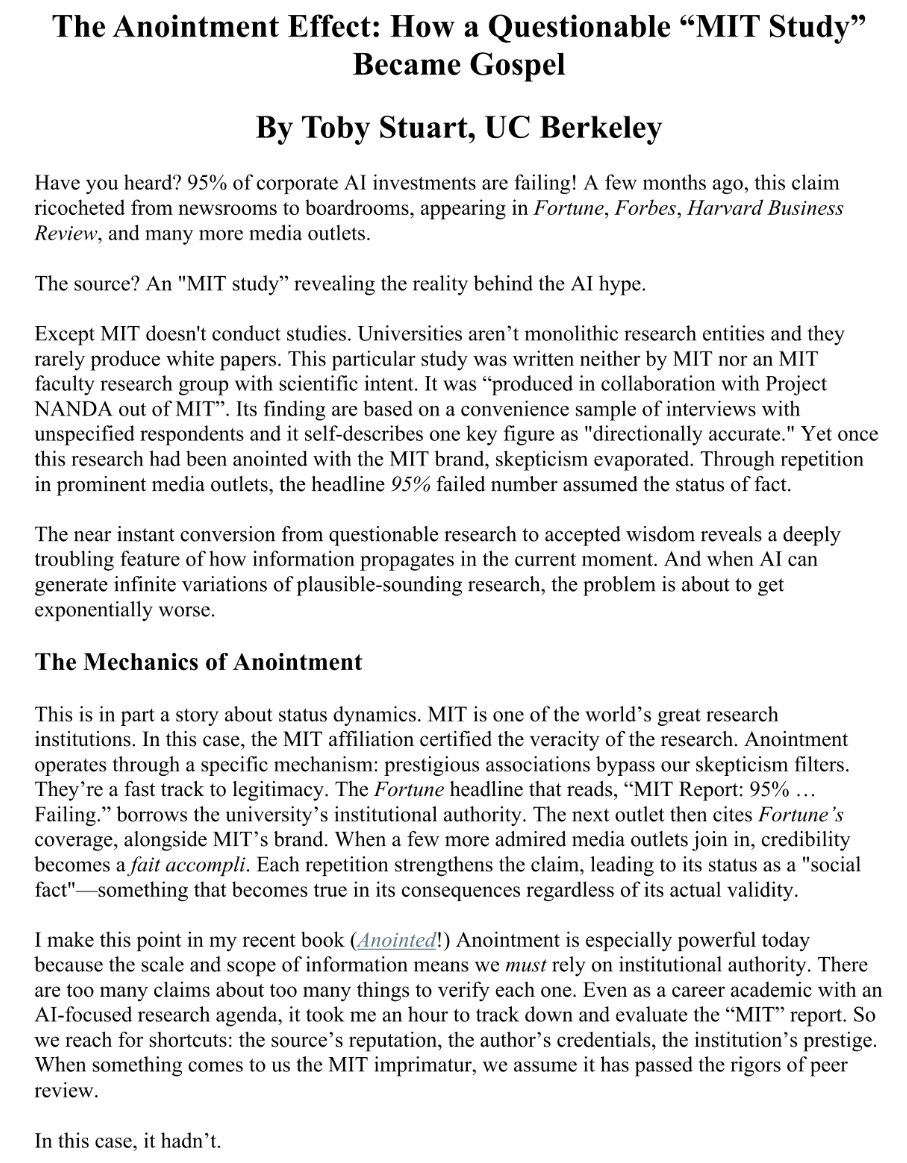
A good sociological explanation of why that odd "95% of AI projects fail MIT study" (that was not actually a study at all, but based on someone's unexplained interpretation of 52 unspecified interviews at a conference) somehow became a ubiquitous point of discussion last summer.
Ethan Mollick tweet mediaEthan Mollick tweet media
English
27
60
451
37.9K
Ben Levine retweetledi
Andrej Karpathy
Andrej Karpathy@karpathy·
@0xabi96 It feels like I’m cheating. Which is a very weird feeling to have. It takes a while to unpack. It’s because some code that used to be a point of pride and high IQ and knowledge is suddenly free and instant and it’s very disorienting.
English
22
48
918
59.5K