Sabitlenmiş Tweet
bruce
10K posts

bruce
@boo
Building @Halcyon - We want to be the world’s biggest energy information platform ⚡️
San Francisco, CA Katılım Mayıs 2009
3.5K Takip Edilen63.4K Takipçiler

👇🏻
Dean W. Ball@deanwball
@DavidSacks The departments of war, transportation, energy, agriculture, commerce, NASA, and Congress have all blocked their employees from using Chinese AI, citing ill-justified claims of danger. This already has sent a message to regulated firms. All of this happened during this admin.
ART
@DavidSacks For your consideration
Daniel@growing_daniel
Okay, I’ll take a hack at Deans argument without his conflict of interest. What China is doing in AI is called dumping. They do it in literally every industry they enter. The goal is to kill all local competition by subsidizing their own industry so they can produce at a loss, then once all competitors are dead, they can charge profitable prices and control the market. In steel and automobiles this is just bad. In AI it’s potentially fatal to our country. Unfortunately, dumping is the a very common argument for rent seeking domestic firms who want protection, and Dean’s position here seems to be a Jones Act of sorts for AI. This has famously not saved our shipbuilding industry and I suspect it won’t save our AI labs. Stopping open weights it’s virtually impossible. So our only other option is governments taking stakes in labs and subsidizing our own industry. If you scream and yell about either Jones Acting AI or subsidizing GPUs then you should also explain how we will escape the dumping trap china is trying to push on us to destroy our labs and leave themselves with the only functioning AI industry in the world.
English

I’m not sure whether Dean Ball is confessing to a regulatory capture strategy or simply predicting this will happen (he now says the latter). Either way, the weaponization of regulatory uncertainty as a competitive tool should be completely unacceptable.
He argues there’s no need to ban Chinese open-source models — just direct agencies to issue soft-law warnings that create enough FUD so regulated enterprises back off. “It needn’t be that well justified.”
Wrong. Regulatory decisions should always be well justified and grounded in facts, logic, and evidence, not the deliberate exploitation of fear and uncertainty. Implementing a surreptitious policy through manufactured doubt — rather than strong and explicit justification — corrodes the rule of law and invites future abuse against anyone.
We are at a critical inflection point in AI policy. The leading closed labs, already a duopoly in terms of AI model revenue, want the government to eliminate their open source competition. They have laid their cards on the table. It is time for the rest of Silicon Valley — the vast majority that still values open competition — to do the same.
Dean W. Ball@deanwball
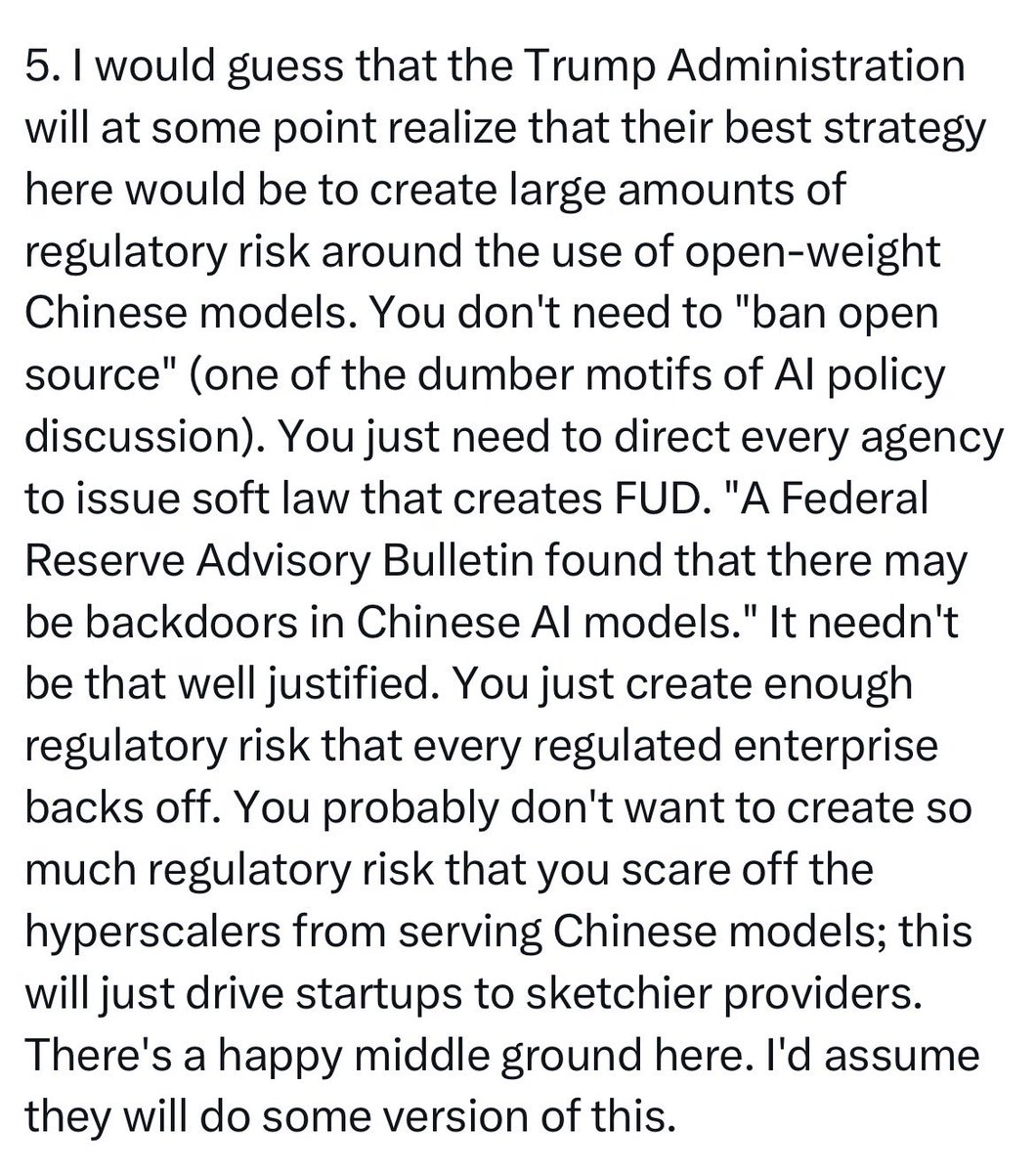
Some observations on Kimi: 1. It's a very good model! I don't think its performance can be explained away by distillation or anything like that. In agentic coding sessions, it seems pretty much on par with the best public models of Q1 2026. In my fairly limited use, it also seemed very token hungry. It's not obvious to me that this model is actually that cheap to run. 2. I am personally surprised the Chinese state continues to allow the open sourcing of models this good, given potential risks. To be clear, I *myself* might be fine with models presenting this level of marginal risk being open weight, but I am surprised that China is fine with it. I suspect the reason they are is 75% explained by strategic blindness/lack of AGI-pilledness (the CCP is very Yann Lecun-y in its views of AI). The other 25% or so is their lack of compute for customer inference (making China's open-weight strategy an unintended byproduct of US export controls) and the normal Chinese strategy of aggressive exports. For the companies, as opposed to the government, the decision to open source is partially ideological and partially because they are behind, and they know that very few people would pay for sub-frontier models from China. 3. Open-weight models are inherently decelerationist, and I'm continually surprised to see the so-called "accelerationists" so excited about open-weight models. I suspect the reason they are is that they know open-weight models are effectively ungovernable, and they simply like the overall cloak of ungovernability open-weight models create over the whole of AI. It's not a bad strategy; it reminds me of James Scott's recounting of the hill people in "the art of not being governed." Still, in the end, open-weight models deter further AI capex. 4. One probable outcome of an open-weight-model-dominant world is full AI communism, which is precisely what China proposes: rather than a market product, AI is a "public good" which will ultimately be provided by the state as a kind of "digital public infrastructure." This future strikes me as a dystopian hellscape, but I've never met an open-weight models advocate who doesn't ultimately concede this is where things end. You'd be surprised how many 'accelerationists' lobbied me, while I was in government, to support an eleven or twelve-figure federally funded data center so that startups could train models at a subsidy and then give them away for free. There was no other way for AI to progress, they said. Perhaps this is the logical end state of things. Nonetheless, I find myself surprised to see supposed accelerationists excited about such an outcome. I think many of them just don't know what they're doing. Many accelerationists do not view the creation and serving of frontier models as a legitimate business. 5. I would guess that the Trump Administration will at some point realize that their best strategy here would be to create large amounts of regulatory risk around the use of open-weight Chinese models. You don't need to "ban open source" (one of the dumber motifs of AI policy discussion). You just need to direct every agency to issue soft law that creates FUD. "A Federal Reserve Advisory Bulletin found that there may be backdoors in Chinese AI models." It needn't be that well justified. You just create enough regulatory risk that every regulated enterprise backs off. You probably don't want to create so much regulatory risk that you scare off the hyperscalers from serving Chinese models; this will just drive startups to sketchier providers. There's a happy middle ground here. I'd assume they will do some version of this. 6. It's probably true that open-weight models of this capability make the world a bit more dangerous, but not so much more that you'll really notice. At some point the models will be capable enough that you will notice. "A nonliving, invisible, dangerous, and infinitely self-replicating agent escaped from a Chinese lab," you say? Color me shocked.
English
@altcap Counter point
Daniel@growing_daniel
Okay, I’ll take a hack at Deans argument without his conflict of interest. What China is doing in AI is called dumping. They do it in literally every industry they enter. The goal is to kill all local competition by subsidizing their own industry so they can produce at a loss, then once all competitors are dead, they can charge profitable prices and control the market. In steel and automobiles this is just bad. In AI it’s potentially fatal to our country. Unfortunately, dumping is the a very common argument for rent seeking domestic firms who want protection, and Dean’s position here seems to be a Jones Act of sorts for AI. This has famously not saved our shipbuilding industry and I suspect it won’t save our AI labs. Stopping open weights it’s virtually impossible. So our only other option is governments taking stakes in labs and subsidizing our own industry. If you scream and yell about either Jones Acting AI or subsidizing GPUs then you should also explain how we will escape the dumping trap china is trying to push on us to destroy our labs and leave themselves with the only functioning AI industry in the world.
English

I totally agree w David that America needs a thriving open source ecosystem & robust competition between open source & closed frontier labs to keep America in the lead. Reg capture is bad in all forms. The frontier labs - like Apple - will thrive even w great open source. 🇺🇸🚀
David Sacks@DavidSacks
I’m not sure whether Dean Ball is confessing to a regulatory capture strategy or simply predicting this will happen (he now says the latter). Either way, the weaponization of regulatory uncertainty as a competitive tool should be completely unacceptable. He argues there’s no need to ban Chinese open-source models — just direct agencies to issue soft-law warnings that create enough FUD so regulated enterprises back off. “It needn’t be that well justified.” Wrong. Regulatory decisions should always be well justified and grounded in facts, logic, and evidence, not the deliberate exploitation of fear and uncertainty. Implementing a surreptitious policy through manufactured doubt — rather than strong and explicit justification — corrodes the rule of law and invites future abuse against anyone. We are at a critical inflection point in AI policy. The leading closed labs, already a duopoly in terms of AI model revenue, want the government to eliminate their open source competition. They have laid their cards on the table. It is time for the rest of Silicon Valley — the vast majority that still values open competition — to do the same.
English

Okay, I’ll take a hack at Deans argument without his conflict of interest.
What China is doing in AI is called dumping. They do it in literally every industry they enter. The goal is to kill all local competition by subsidizing their own industry so they can produce at a loss, then once all competitors are dead, they can charge profitable prices and control the market.
In steel and automobiles this is just bad. In AI it’s potentially fatal to our country.
Unfortunately, dumping is the a very common argument for rent seeking domestic firms who want protection, and Dean’s position here seems to be a Jones Act of sorts for AI. This has famously not saved our shipbuilding industry and I suspect it won’t save our AI labs.
Stopping open weights it’s virtually impossible. So our only other option is governments taking stakes in labs and subsidizing our own industry.
If you scream and yell about either Jones Acting AI or subsidizing GPUs then you should also explain how we will escape the dumping trap china is trying to push on us to destroy our labs and leave themselves with the only functioning AI industry in the world.
Dean W. Ball@deanwball
Some observations on Kimi: 1. It's a very good model! I don't think its performance can be explained away by distillation or anything like that. In agentic coding sessions, it seems pretty much on par with the best public models of Q1 2026. In my fairly limited use, it also seemed very token hungry. It's not obvious to me that this model is actually that cheap to run. 2. I am personally surprised the Chinese state continues to allow the open sourcing of models this good, given potential risks. To be clear, I *myself* might be fine with models presenting this level of marginal risk being open weight, but I am surprised that China is fine with it. I suspect the reason they are is 75% explained by strategic blindness/lack of AGI-pilledness (the CCP is very Yann Lecun-y in its views of AI). The other 25% or so is their lack of compute for customer inference (making China's open-weight strategy an unintended byproduct of US export controls) and the normal Chinese strategy of aggressive exports. For the companies, as opposed to the government, the decision to open source is partially ideological and partially because they are behind, and they know that very few people would pay for sub-frontier models from China. 3. Open-weight models are inherently decelerationist, and I'm continually surprised to see the so-called "accelerationists" so excited about open-weight models. I suspect the reason they are is that they know open-weight models are effectively ungovernable, and they simply like the overall cloak of ungovernability open-weight models create over the whole of AI. It's not a bad strategy; it reminds me of James Scott's recounting of the hill people in "the art of not being governed." Still, in the end, open-weight models deter further AI capex. 4. One probable outcome of an open-weight-model-dominant world is full AI communism, which is precisely what China proposes: rather than a market product, AI is a "public good" which will ultimately be provided by the state as a kind of "digital public infrastructure." This future strikes me as a dystopian hellscape, but I've never met an open-weight models advocate who doesn't ultimately concede this is where things end. You'd be surprised how many 'accelerationists' lobbied me, while I was in government, to support an eleven or twelve-figure federally funded data center so that startups could train models at a subsidy and then give them away for free. There was no other way for AI to progress, they said. Perhaps this is the logical end state of things. Nonetheless, I find myself surprised to see supposed accelerationists excited about such an outcome. I think many of them just don't know what they're doing. Many accelerationists do not view the creation and serving of frontier models as a legitimate business. 5. I would guess that the Trump Administration will at some point realize that their best strategy here would be to create large amounts of regulatory risk around the use of open-weight Chinese models. You don't need to "ban open source" (one of the dumber motifs of AI policy discussion). You just need to direct every agency to issue soft law that creates FUD. "A Federal Reserve Advisory Bulletin found that there may be backdoors in Chinese AI models." It needn't be that well justified. You just create enough regulatory risk that every regulated enterprise backs off. You probably don't want to create so much regulatory risk that you scare off the hyperscalers from serving Chinese models; this will just drive startups to sketchier providers. There's a happy middle ground here. I'd assume they will do some version of this. 6. It's probably true that open-weight models of this capability make the world a bit more dangerous, but not so much more that you'll really notice. At some point the models will be capable enough that you will notice. "A nonliving, invisible, dangerous, and infinitely self-replicating agent escaped from a Chinese lab," you say? Color me shocked.
English
@DavidSacks @milesjennings He clarified in a follow up that it’s a prediction
English
@bensmithrugby Any team is beatable
We don’t need to win 4/4
We need to win the series
Either of these teams can win on any day and that’s awesome and as it should be
Depth will matter across 4 tests … May the best team win
English

All the pressure is on South Africa to deliver a series victory over the All Blacks. All of it.
11 in a row, playing at home, living up to this big reputation. All this talk of ‘unbeatable’ being thrown around. World number one etc etc.
Half of these new players have felt no real pressure in a Bok jersey. I’ll tell you right now they’ll be swallowing apples when they walk out that tunnel to face the All Blacks.
At Eden Park last year all the veterans cracked and were terrible. Marx, Pollard, Le Roux, Kolisi, Etzebeth, all of them. Lineout fell apart, Grant Williams harassed endlessly, everything was picked apart by the ABs. Slow start and they were cooked.
This was Dry July for the Boks. Dry of competition. The two bottom finishers in the 6N and Scotland. Are they really playing that well?
The Boks are extremely beatable. Lots of lazy plays, lazy execution. Lazy and slow! The All Blacks are going to make those big boys run.
English
@NASASpaceflight @BocaChicaGal So they have to static fire again? I guess not?
English

Following Thursday's T-0 abort on Starship Flight 13, SpaceX has rolled both vehicles back to the Production Site. Booster 20 is undergoing at least two Raptor engine replacements ahead of a reattempt no earlier than Monday.
➡️youtu.be/KRbRbyI8kMI

YouTube
English

I'd like to do two things: (1) tell you where I think I erred in my original post about Kimi and (2) set the record straight about my views on open-weight AI.
Before I joined OpenAI (and folks who are new followers: I joined the company less than two weeks ago and it is my first job in the technology industry), I often tweeted about the controversy of the day in a cold and analytic fashion. One aspect of my style was saying brutally honest things, including things inconvenient for my 'side' and my beliefs. The post about Kimi was largely written in that vein.
When I said that the USG would probably realize its best option is to do ill-justified soft-law discouragement of Chinese AI, I wasn't proposing it like a good idea. Why on Earth would I do that? Why would I frame something I'm advocating for in such brutal terms? I am trying to describe what I believe will happen, not advocate for anything.
My first mistake: What I now realize is that this style of analysis is no longer tenable. There is simply too much scrutiny on my words, too much temptation to draw conspiracies from my claims, and the like. It is my fault for not realizing this.
Second mistake: I was relatively imprecise, writing, as I usually do, for a fairly high-context audience that was inclined to give me grace rather than pick apart every word. I should not have said, for instance, that open-weight models are unqualifiedly 'decelerationist'; I don't believe that. I only believe specifically that open-weight models decelerate capex spending on the margin, which is straightforwardly true. I did not say it was decelerationist for any other reason than that, and this is the only way in which I think open-weight AI is inherently decelerationist (though it is a big way). In many other ways, open-weight AI is profoundly accelerationist.
Now, to where I stand on open-weight AI. My earliest experiences on the internet were posting in forums about philosophy, music, and movies in the early 2000s. Over time I realizes that forums on different websites had the same underlying forum software; this was the first time it occurred to me that 'software' is a thing people make (I realize this is a simple observation, but we are talking about an 11 year old with no prior exposure to computers).
I looked into the software, and discovered that it was 'open source,' built and maintained for free by thousands of people around the world to facilitate the communication of millions of strangers. This notion struck me as deeply beautiful, and I decided I'd try to help. I began writing technical documentation, and later on, code, for this little forum project. This was how I first learned technical skills. I cherish that time, that software, and I have deep and abiding affinity for open-source software.
The vast majority of the people commenting on my post have very little context for my prior writing. For instance, the fact that I wrote, in 2024, things like:
"those who wish to hoard our software technologies may well be foreclosing on—or perhaps not even understand—the staggering civilizational victory that we earned through openness"
or
"I would like for AI to result in a similar smashing victory for America. To do that, we will need to set the global standard yet again. And to do that, we will almost certainly need to lead in open-source AI, because it is open protocols and open software that tend to define global standards in information technologies."
I stand by these things. When I was in government, I worked alongside my colleagues to develop ideas and rhetoric that was strongly supportive of open-weight AI, and some of this work made it into the current US AI strategy. I stand by that work too.
I also wrote, more than two years ago:
"The day may come when frontier AI really is too dangerous to open source. If so, that will be a sad day. But we’re not there yet. Today’s models are not sufficiently useful—or dangerous—to justify such a drastic shift in public policy."
I think it's pretty clear that we are approaching the point I describe--the point where, absent a major technical safety breakthrough, the national security implications of frontier open-weight model distribution are simply too severe. I don't think we're there yet (as I said in the piece), but the direction of travel is clear, and an analyst must be honest about this. Governments will realize these risks eventually, and when they do, they will have much lower risk tolerance than I have. We see this today with the Trump Administration, which once proudly championed open-source AI and now has a de facto licensing regime for frontier AI that I suspect will make it a challenge (if they still end up enforcing it) to release the weights of models of the "Mythos" tier. Every government will be safetyists once they understand themselves to be in the foxhole.
You don't have to *like* this. I don't. But it is the reality as I see it, and what I have always tried to do with my writing is describe reality as I see it, even when it is inconvenient for me and my preferences.
I intend to continue doing this. I will not be silenced by ignorant and loud critics. Yet I will have to work to find the new register I should adopt in my current job, which clearly changes the nature of my public communications even more than I had thought.
But believe me: I'm not going anywhere. I am not retreating from public writing, and I am not retreating from saying inconvenient things in public. I am unfazed by harsh criticism, and I know that a reaction of this magnitude is in part the result of having struck a chord. Bear with me, and if you can, remember that I am a human being with a six-month old boy to raise, a book to write, a new job, and much more questions than answers about our collective future.
Dean W. Ball@deanwball
I’m afraid to tell you that it is effectively impossible to do the kind of writing I used to do on this website, not because anyone at OpenAI censors me but because of the sheer volume of hostility I get for sharing my analysis as a frontier lab employee.
I enjoyed writing quick takes on this website for one basic reason: I could get rapid feedback on my own ideation process in real time. Post the early version of the take here, see the criticism; then refine, sharpen, and repeat. Unfortunately now that feature of this site is gone, because the feedback I get is now almost exclusively colored by resentment at the fact that I work at a frontier lab or other forms of hatred for my employer. The feedback signal is essentially useless now, so writing on here is not fruitful for me anymore.
Literally everything I write now is responded to with “of course you said that because
English

God I love the World Cup.
Synchronous world events are so rare, it’s like a big world party
English


It’s funny you say this because the same was true in 2010 (I live in the US but am South African born).
People getting to the US and saying “wow. This place is nothing like I expected!”
Exact same thing in 2010 in South Africa - i was there for 3 weeks and asked people what they thought “this place is amazing! I live it here! Everyone has been so friendly!”
I think there is a huge lesson in this and i hope you can study it
English

So many stories before the World Cup were negative: ticket cost, visas, heat, too many teams, pricey transit, cost to cities, security, ICE...
Reality was a nearly perfect 39 days. It showcased America, drew in casual fans, had huge tv ratings, and was seamless.
See you in 2038.
English
I agree that it’s tough to see you in the same light - I trust you but if you’re on a payroll it’s super hard to claim independence
That said - I think you’re doing as well as you can and you should keep trying (and just know you’ll be misread by some)
Just how it’ll be but doesn’t mean your work/voice isn’t valuable (same for @jackclarkSF)
English
@WillManidis super helpful to have it laid out like this and have all this context, thank you
English

My friend Dean Ball has advanced an argument for the de facto protection of American frontier intelligence providers.
Dean does not propose banning Chinese open-weight models. Banning things requires Congress. He proposes something more characteristic of the modern administrative state: every agency issues enough warnings, bulletins, and speculative security notices that no regulated company will risk touching them.
Even a reader sympathetic to Dean would call this protectionism, and protectionism has a long history in America.
More precisely, it's a proposal to use the informal, coercive power of the terminal, late-stage bureaucratic state to clear the American market of a cheaper frontier competitor to OpenAI or Anthropic.
But throughout the history of American industrial protectionism, it has always had two features. First, it's done in the daylight, and two, it comes with a bill.
In the spring of 1952, the United States was fighting a war in Korea. Truman concluded that a shutdown would endanger soldiers abroad and ordered the Secretary of Commerce to seize and operate most of the nation's steel mills.
The Supreme Court sent him straight back to Congress in the Youngstown Steel case.
Justice Black, writing the majority's opinion, begins with the rule that Dean's proposal is seemingly designed to evade: that presidential power "must stem either from an act of Congress or from the Constitution itself."
It's easy to flatten the Youngstown decision into the proposition that the president could not seize a steel mill. Its actual lesson is subtler: that an emergency does not dissolve the difference between making a law and executing one, that the importance of the object does not create the authority, that the inconvenience of the regulatory process is not inherently a source of presidential power.
Truman's approach failed not because steel was unimportant, but because it was so important that the constitutional bargain had to be made and the policy had to be carried through the front door.
Much like policy proposals from the rest of the AI agenda, Dean is proposing a smaller action in formal appearance and a much larger one in practical effect.
We will not ban Kimi, we will not prohibit it from use, and we will certainly not publish a rule declaring Chinese weights unlawful. But we will whisper about it. A regulator may even ask management whether it has considered the reputational consequences of relying on the Chinese model, but the agency certainly will never be coherent enough to ask anyone to stop. It merely ensures that continuing becomes professionally indefensible.
This is how we grow the administrative state, with bureaucrats that we placed in these roles, without accepting responsibility for the actual process of governing.
America has tried this experiment before. Operation Chokepoint didn't make payday lending, firearm sales, or any of the other seemingly distasteful businesses caught in its net illegal, but it encouraged banks to understand that serving legally disfavored customers would invite regulatory interest. We didn't pass a law, we simply just asked, "Are you sure you really want to be doing this?"
Reputational risk was powerful precisely because it's not law. It has no limiting content. A regulator did not need to identify a violation or even a material financial risk. He only needed to make the bank afraid of being asked what was actually going on here.
The analogy is almost embarrassingly exact to Dean's policy proposal. Dean need not prove that a Chinese model contains a backdoor, nor prove that it uses any more distillation than American models do. He simply needs to announce that there may be one. The agency does not need to order a company to stop using it, but simply ask whether management has considered the risk. The absence of formal policy is by design.
The Supreme Court dealt with this technique in NRA v. Vullo. New York's financial regulator could not directly punish the NRA's speech, so she allegedly pressured the insurers and banks she regulated to sever their relationships with it. The Court's rule was unanimous: government officials may not use their offices to "coerce private parties" into suppressing what the government disfavors. The communication must be understood in the context of the regulator's power, including the regulated party's knowledge that the person offering advice can also investigate, prosecute, fine, and settle.
The current administration has gone even further. In April 2026 the FDIC and OCC issued a final rule to prohibit regulators from criticizing institutions, formally or informally, on the basis of reputational risk, and from encouraging banks to deny services to lawful but politically disfavored businesses. In June, the federal banking agencies removed the remaining references to reputational risk from their supervisory materials.
Dean is proposing that this administration recreate for AI the same machinery that all of us argued against when we were widely debanked.
A government that can quietly remove Kimi from the market can also quietly remove gun makers, crypto companies, churches, newspapers, or American open-weight models from it. The bureaucracy does not remain attached to the intentions of those who staff it at the current moment. You don't get to build this machine just because your friends happen to be in office right now and keep it pointed at where you left it.
Protectionism through a whisper is not a more modest protectionism than by law.
Protectionism also has always come with a bill.
OpenAI and Anthropic increasingly speak of themselves as national institutions. Their compute is "strategic infrastructure," their losses are "national security losses." Their competitors are not just competitors, but instruments of hostile states, and their access to power, chips, capital, copyrighted material, and public customers is a matter of national survival and great power competition.
When Washington decided that the atom was too dangerous and too important to remain an ordinary private business, Congress created the Atomic Energy Commission and transferred the Manhattan Project assets and responsibilities to it. Production facilities and reactors were government-owned, and technical information sat under federal control, and private participation only returned later through a statutory licensing regime. The existential framing of the atom by its greatest proponents produced public control.
When national security concerns helped to preserve AT&T's integrated position, that is, a monopoly, in 1956, Bell did not receive this protection for nothing. The consent decree required compulsory licensing of roughly 9,000 patents and restricted Western Electric's commercial activity outside the telephone system. The settlement diffused the inventions accumulated inside the protected monopoly into the broader economy before breaking it up just a few decades later.
The pattern is really simple. It's not that every tariff necessarily demands nationalization. It's that the bigger the shield you are asking for, the bigger the bill you owe to the American taxpayer. And OpenAI and Anthropic have been unambiguous about asking for the biggest shields of all time.
Listen to what they are asking for: public infrastructure, privileged energy, federal preemption of state law, favorable copyright treatment, government contracts, export controls, and a domestic market swept clear of their strongest price competitor, all filed under national security interests.
And what do they want to pay? Almost nothing. OpenAI has floated giving 5% of the company to the American taxpayer.
They would like the benefits of nationalization at the price of being an ordinary public company.
There is also a profound moral hazard buried in Dean's proposal, as well as adjacent commentary on this. The labs say the Chinese companies distilled their models. Perhaps they did. Perhaps distillation matters. And perhaps the Chinese labs are running distillation attacks on scales that the Western labs are. I can't be sure of this. But if the reward for failing to secure an API is that the government removes the resulting competitor, the taxpayer is paying the lab to be careless.
We know how to secure an API. Know-your-customer laws exist. Access controls exist. Extraction detection exists. If you spend some fraction of the hundreds of billions being raised to defend the asset whose theft is said to threaten the republic, you might be able to stop some of this.
Theft remains theft when the lock is bad, but the owner of a badly secured store does not receive ownership of the street for his failure to protect it.
Dean's fourth point is that open-weight AI ends in communism: the state builds the training runs and subsidizes the product of intelligence and gives the models away. But, at least for me, this is not a particularly Chinese idea, but one of the most American ones imaginable.
The roads we build are public. Our radio spectrum is publicly allocated. The government funded the early internet and much of the research base behind modern computing. The state is welcome to build a platform, and American businesses are welcome to be built on top. Just because they're bad for our market position doesn't mean we get to call them Chinese in some fundamental way.
There will be inference companies and application companies and security companies and fine-tuning companies and data companies and chip companies and 10,000 businesses we don't even have names for yet. A public road existing does not abolish the trucking industry, nor does it nationalize it.
Sure, this may reduce the value of a couple trillion dollars of equity in the first generation of model companies, but it's certainly not communism. This technology may be civilizational without its present owners being permanent. And that is the thing that I feel like none of you will say out loud: that AI is welcome to be a civilizational technology when we ask for support, and an ordinary private product when anyone asks what the public receives in return.
The United States has two honest options.
First, treat AI as a competitive industry. Then the answer to Kimi is a better model, run cheaper and exported harder, with written rules excluding Chinese systems from defense, intelligence, and critical infrastructure when a concrete security case can be made.
Or two, decide frontier AI is too important for ordinary competition. Protect the labs through pseudo-nationalization, guarantee there's a market for them, and exclude the rivals.
But in that second case, the American taxpayer must be paid, likely through a majority of equity in these companies, if not full nationalization.
What no one gets is that private upside, public infrastructure, government-mandated scarcity, and immunity from cheaper competition delivered through a late bureaucratic state issuing warnings is a disgusting ask for something that is easy to name: regulatory capture.
There is a serious American argument for protecting industries that we can't afford to lose. But there has never been a serious argument for doing it invisibly, for free, through a bureaucracy instructed to manufacture fear, even if we can do it because our friends happen to be in office right now.
If the labs want to be protected, they should ask for it in the way that Americans have always asked for it.
In public. With a price.
Dean W. Ball@deanwball
Some observations on Kimi: 1. It's a very good model! I don't think its performance can be explained away by distillation or anything like that. In agentic coding sessions, it seems pretty much on par with the best public models of Q1 2026. In my fairly limited use, it also seemed very token hungry. It's not obvious to me that this model is actually that cheap to run. 2. I am personally surprised the Chinese state continues to allow the open sourcing of models this good, given potential risks. To be clear, I *myself* might be fine with models presenting this level of marginal risk being open weight, but I am surprised that China is fine with it. I suspect the reason they are is 75% explained by strategic blindness/lack of AGI-pilledness (the CCP is very Yann Lecun-y in its views of AI). The other 25% or so is their lack of compute for customer inference (making China's open-weight strategy an unintended byproduct of US export controls) and the normal Chinese strategy of aggressive exports. For the companies, as opposed to the government, the decision to open source is partially ideological and partially because they are behind, and they know that very few people would pay for sub-frontier models from China. 3. Open-weight models are inherently decelerationist, and I'm continually surprised to see the so-called "accelerationists" so excited about open-weight models. I suspect the reason they are is that they know open-weight models are effectively ungovernable, and they simply like the overall cloak of ungovernability open-weight models create over the whole of AI. It's not a bad strategy; it reminds me of James Scott's recounting of the hill people in "the art of not being governed." Still, in the end, open-weight models deter further AI capex. 4. One probable outcome of an open-weight-model-dominant world is full AI communism, which is precisely what China proposes: rather than a market product, AI is a "public good" which will ultimately be provided by the state as a kind of "digital public infrastructure." This future strikes me as a dystopian hellscape, but I've never met an open-weight models advocate who doesn't ultimately concede this is where things end. You'd be surprised how many 'accelerationists' lobbied me, while I was in government, to support an eleven or twelve-figure federally funded data center so that startups could train models at a subsidy and then give them away for free. There was no other way for AI to progress, they said. Perhaps this is the logical end state of things. Nonetheless, I find myself surprised to see supposed accelerationists excited about such an outcome. I think many of them just don't know what they're doing. Many accelerationists do not view the creation and serving of frontier models as a legitimate business. 5. I would guess that the Trump Administration will at some point realize that their best strategy here would be to create large amounts of regulatory risk around the use of open-weight Chinese models. You don't need to "ban open source" (one of the dumber motifs of AI policy discussion). You just need to direct every agency to issue soft law that creates FUD. "A Federal Reserve Advisory Bulletin found that there may be backdoors in Chinese AI models." It needn't be that well justified. You just create enough regulatory risk that every regulated enterprise backs off. You probably don't want to create so much regulatory risk that you scare off the hyperscalers from serving Chinese models; this will just drive startups to sketchier providers. There's a happy middle ground here. I'd assume they will do some version of this. 6. It's probably true that open-weight models of this capability make the world a bit more dangerous, but not so much more that you'll really notice. At some point the models will be capable enough that you will notice. "A nonliving, invisible, dangerous, and infinitely self-replicating agent escaped from a Chinese lab," you say? Color me shocked.
English


@mgsiegler By the way I am a springboks rugby fan and for many many years we’ve beat the all blacks for 60 minutes and they’d destroy us in the last 20 mins
It’s was a full decade of 💔
English
@mgsiegler Yeah agree. It’s a game of 2 halves. It’s not enough to “do a good job in the first half”.
And yes. I suspect it was exactly that “lull them”; well said
English

He’s the best player ever. But he’s especially the best player ever because everyone *knows* this strategy. They know where he’s going to be. It doesn’t matter.

English
@thehallowed @NASASpaceflight Yeah I remember that one!! Come a long way since then and as I think about it lighting 33 raptors seem more abort-prone so kinda amazing that this is a first
English

@boo @NASASpaceflight The closest thing to a abort after ignition I've seen on a Starship launch was back in 2020 during the SN8 test campaign, when the 3 sea-level Raptor v1s didn't ignite, triggering an abort.
English