
Sabitlenmiş Tweet
Bradford Baris
29K posts


Bradford Baris
@bradbaris
tech cloud infra graphic design culture memes hawaii • webdev since HTML1 • versatilist/generalist • 🛸
Honolulu, HI Katılım Aralık 2008
3.3K Takip Edilen905 Takipçiler
Bradford Baris retweetledi

This is the the quote I've been citing a lot recently.
kache@yacineMTB
you can outsource your thinking but you cannot outsource your understanding
English
Don’t forget about the reading comprehension distribution x.com/athenaeumbc/st…
Tim Urban@waitbutwhy
Everyone in the world has to take a private vote by pressing a red or blue button. If more than 50% of people press the blue button, everyone survives. If less than 50% of people press the blue button, only people who pressed the red button survive. Which button would you press?
English
Bradford Baris retweetledi

@AutismCapital We don’t have a college problem or a trade problem.
We have a status problem.
Too many people chasing approval instead of competence.
English
Bradford Baris retweetledi
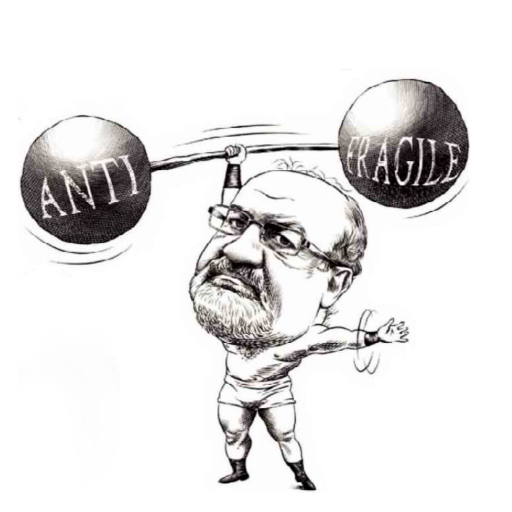
"The true hero in the Black Swan world is someone who prevents a calamity and, naturally, because the calamity did not take place, does not get recognition or a bonus for it." - Nassim Nicholas Taleb in Antifragile
English
Maybe it goes over their heads.
Ignorance is bliss.
Athenaeum Book Club@athenaeumbc
About 54% of U.S. adults (ages 16-74) — roughly 130 million people — read below a 6th-grade level. Why does nobody talk about this?
English
Bradford Baris retweetledi
In fact programming is particularly good at teaching you how to think. Programs are literally built out of ideas. Which is one reason it's still a good idea to study CS in the AI era. It's still important to be able to think well.
Computer Science@CompSciFact
'Learning to program teaches you how to think. Computer science is a liberal art.' -- Steve Jobs
English
Bradford Baris retweetledi

The hyperscalers have already outspent the most famous US megaprojects

English
Bradford Baris retweetledi

Bradford Baris retweetledi

I said this I forgot to who but I said it
BigTech will eventually come for all apps / startups / companies because they can fill the niches now that before could not because they were too small
Those niches is where entrepeneurs hung out, nice parts of the market people could build a little SaaS with $100K/y to even $100M/y, notjing like the $100B/y revenue BigTech was doing, but worth it
With AI now BigTech can fill those niches + they are the ones training and owning the best models, and keeping the best models for themselves they can outcompete anyone who doesn't own them (everyone except other BigTech)
End game for their survival is simply trying to take every business, it's just capitalism
This completely changes the prospect for entrepreneurs as there won't be much left, because BigTech is financially incentivized to have to take everything
Because if they don't, their competitor will!
x.com/marmaduke091/s…
English
Bradford Baris retweetledi

SOMEONE BUILT A MAP THAT SHOWS EXACTLY WHERE EVERY POWER PLANT, TRANSMISSION LINE, SUBSTATION & DATA CENTER SITS ON THE US GRID
all on one interactive map. all free
you can see how the grid is laid out... where the datacenters cluster... which transmission corridors carry the load... where the high-capacity connection points are
opengridworks.com/power-plants
zoom into any region and the whole picture comes into focus why energy costs what it costs, why data centers go where they go, why some states are power exporters and others aren't
this is the kind of infrastructure visibility that used to require expensive industry reports
now it's one tab
English
Bradford Baris retweetledi
I had the same experience. The view we had as young men stems from our ignorance of civilization’s fragility.
We naively believed that social order “grows on trees”; that it is the automatic, default, thing that we must resist to avoid total soulless conformity.
But once you mature you realize, no, it is basically the opposite. The default state of existence is squalor, war, disease, and death. The 3rd world is what happens when you try hard to have civilization. And the first world is what happens when you are blessed by God with daily miracles which should make you weep with gratitude.
Unfortunately, the vast majority of people are too stupid to ever comprehend this truth. Which is part of why it’s all so fragile.
Sivori@sivori
I'm guessing this guy is mid-20s. I used to be 23 and hate the oppressive surveillance apparatus, seeing it as some techno-daddy or god to overthrow in my total rebellion. I would pop off at cops when they pulled me over for traffic violations. My pen would bleed with manifesti. As Lucifer says in "Paradise Lost" when being cast out from Heaven, "Non serviam", I will not serve! But then I realized that I had more to fear from the daily oppression of criminals, the violent in thought and behavior and people who cannot manage themselves in a free society, people who subject others to their own disorder, harming the peace and security that a society depends on.
English
Bradford Baris retweetledi

If you gave away $126 billion to subsidize free flights between LA and San Francisco at current demand levels, you could fund roughly 150 to 200 years of travel before the money runs out.
KTLA@KTLA
In a 60 Minutes report, officials said they now believe the rail line linking L.A. and San Francisco could ultimately cost about $126 billion, more than triple the original price tag approved by voters. ktla.com/news/californi…
English
Bradford Baris retweetledi

The number one thing people underrate for recruiting and retention is having a competent team.
More than mission or money, people want to work with really good people.
Now, to get really good people you usually need mission or money.
But people don’t realize that those are actually much more often proxies for wanting to work with really good people.
So companies make the same mistake -
When people get upset they try paying people more or restating the mission.
But they don’t do the thing that will actually work - fire every obviously bad person, especially every very senior person that clearly incompetent or political or toxic or a leach.
English
Bradford Baris retweetledi

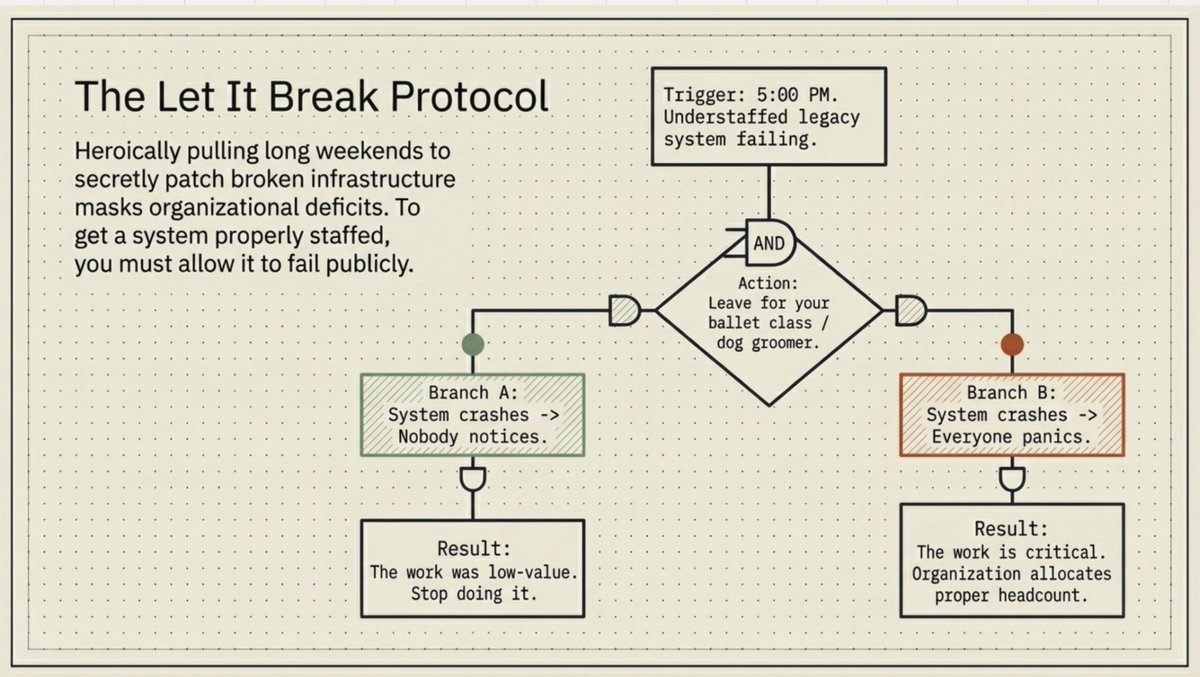
Google has an internal "let it break" essay about a hero engineer whose hard work ends up being a net negative (by masking the underlying issues). My manager sent me that essay when I was trying too hard to get the collective TensorFlow unit test suite green.
English
Bradford Baris retweetledi

Airbnb CEO Brian Chesky on why your company has too many meetings (and it's not what you think)
Most companies blame meeting overload on bad habits, weak managers, or poor scheduling. @bchesky thinks they're looking in the wrong place entirely.
The real culprit is simpler and harder to fix than any of those things. You just have too many people.
"The reason there's too many meetings in a company isn't because they don't have meeting-no-meeting Wednesdays. It's because they have too many people. People create meetings. And the best way to get rid of meetings is to not have so many people."
His argument runs deeper than headcount management.
It's about what happens when you hire people who aren't truly excellent and what those people inevitably do next.
You've probably heard the classic line: A-players hire A-players, B-players hire C-players. Chesky amends it:
"B players hire lots of C players — not just a few, but a lot. Because those are the kind of people that like building empires."
The reason is structural, not personal. A person who can't do the job can't hire someone better than themselves, so they hire down. Then they need two or three of those people just to cover the gap.
Those people scatter, pulling in different directions, and suddenly you have more meetings, more overhead, and less output.
Chesky's response at Airbnb was surgical. He removed layers of management and returned to a functional structure with one strict rule:
You can only manage a function if you're actually an expert in it.
"The head of design has to actually manage the work first. You don't manage people. You manage people through the work."
He credits this thinking to Jony Ive. At most tech companies, heads of design manage the people rather than the design itself, a separation Chesky found completely incoherent.
"How can you manage the people separate from the design? Jony Ive would say, 'No, my main job is to manage the work. I build a team and we design together, but I'm mostly looking at the work. I'm not having career conversations all day long. That's crazy.'"
Lean means every person is genuinely excellent and led by someone embedded deeply enough in the craft to judge their output.
When that's true, decisions move faster and work gets evaluated on its merits.
Most companies treat meeting overload as a scheduling problem.
Chesky thinks that's the wrong diagnosis entirely, and until you address the root cause, no policy is going to fix it.
English
Bradford Baris retweetledi

Why does it cost less to build a base on the moon than high speed rail from sf to la
Kalshi@Kalshi
JUST IN: NASA announces $20 billion plan to build permanent moon base
English
Bradford Baris retweetledi

Silicon Valley thinks AI agents are a $20/mo self-serve subscription.
Main Street is paying local agencies $10,000 just to turn them on.
Everyone assumes AI will be bought primarily online like Slack or Zoom. I think they are wrong.
Some of the biggest winners in the AI boom won't be the software vendors. It will be the humans installing it.
Here is the reality of SMBs right now:
• 54% lack internal AI expertise.
• 41% have data quality too poor for AI to even work.
• 41% already prefer buying AI through a local IT provider.
You cannot "1-click install" a genius AI into a messy CRM or a 15-year-old server. It will just execute the wrong tasks at the speed of light.
The AI software will be cheap and a lot will absolutely be bought online. Making it actually work for a messy, real-world business will be expensive.
Very bullish on the "Do It For Me" economy being back.
English
Bradford Baris retweetledi

Introducing TurboQuant: Our new compression algorithm that reduces LLM key-value cache memory by at least 6x and delivers up to 8x speedup, all with zero accuracy loss, redefining AI efficiency. Read the blog to learn how it achieves these results: goo.gle/4bsq2qI
GIF
English
Bradford Baris retweetledi

AI truths people hate to admit:
1) AI “not working” in your job is almost always a skill issue now
2) Transforming a shitty business with AI is like putting rocket boosters on a PT Cruiser
3) 90% of AI transformation has nothing to do with AI. It comes down to people, process, data.
4) Strict AI governance for enterprises is important. It’s also going to lead to a brain drain of top performers quitting to be closer to the frontier.
5) Job seniority & AI expertise are often inversely correlated now
6) CEOs are lying to employees faces if they say that AI won’t cause job loss long term
7) The least sexy AI initiative is likely the right one for most companies: get an enterprise LLM subscription and enable your entire org on the tools, starting with engineering
8) 90% of your time working with LLMs should be organizing and feeding the right context to a model
9) Most execs do not have a compelling answer to “what is your moat?” in a post-AI world
10) Most companies don’t have cohesive AI strategies. They have a hodgepodge of initiatives that don’t work together, have no measurable ROI, and don’t address the core issue.
English