
Brandon Hoffman

5.8K posts

Brandon Hoffman banner
Brandon Hoffman

Brandon Hoffman

@BrandonHoffman_

investing in life-changing emerging tech | building SoCal’s largest startup community @emerging_LA | former CVC @samsung & research @morganstanley

Los Angeles, CA Katılım Mart 2012
4.2K Takip Edilen3K Takipçiler
Sabitlenmiş Tweet
Brandon Hoffman
Brandon Hoffman@BrandonHoffman_·
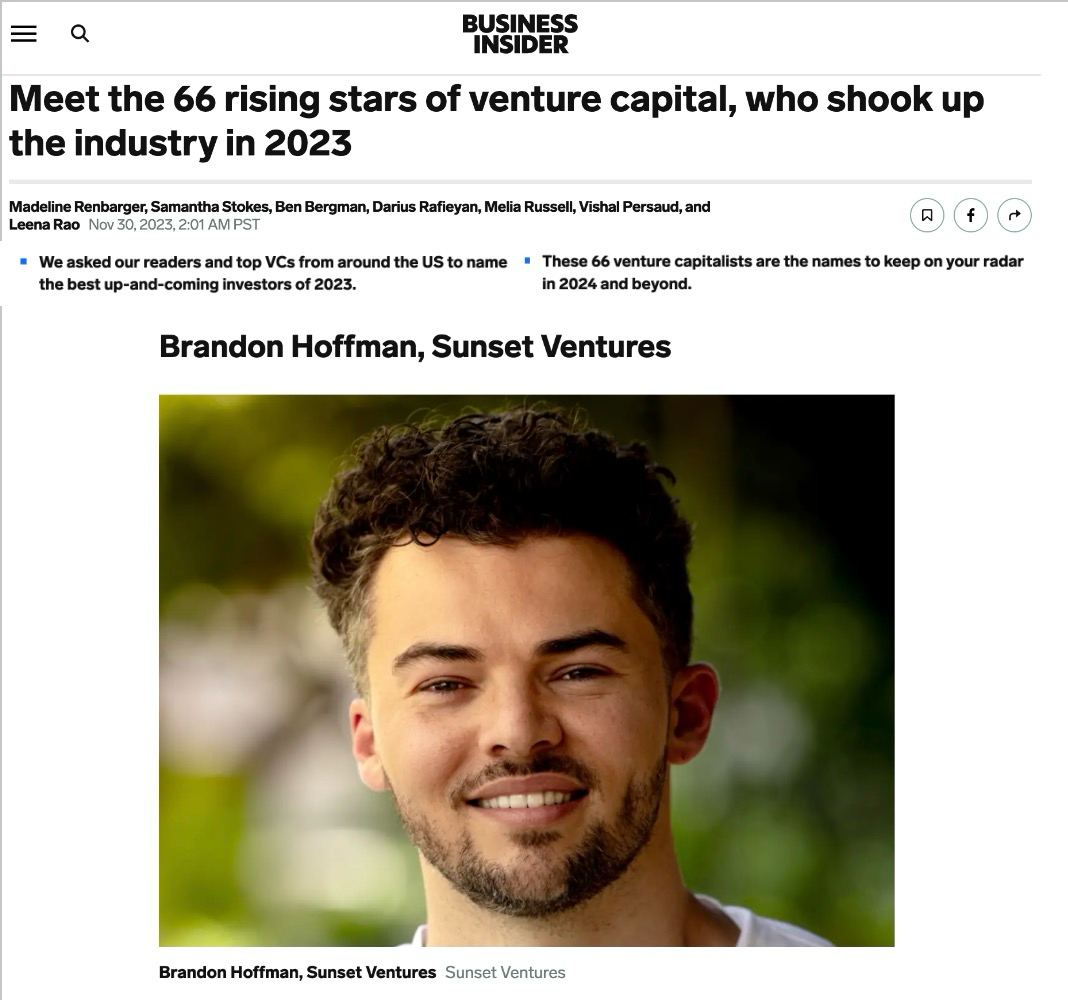
I am honored to be a @BusinessInsider rising star of venture capital in 2023 ⭐ From bank teller to VC, it is honestly still a dream that I get to work in venture for a living! Thank you to the BI team for sharing my story 🙏🏼 I hope it inspires the next generation of VCs! I hope it shows that anyone can break into VC, even those with an uncommon background. Full write up for those who can't access paywall: -- "Hoffman began his career as a bank teller in 2006 at a local bank in downtown Anaheim. He used his wages to pay for college and eventually built a music production studio, and eventually worked in equity research at @MorganStanley. Hoffman got the startup investing bug and joined Samsung Electronics's innovation and VC firm, @SamsungNext, where he helped lead investments in @readyplayerme , @yugalabs, and @WonderDynamics. Last year, Hoffman broke out on his own with @SunsetVC , an early-stage fund that got the backing of @BankofAmerica and @alexisohanian's @sevensevensix Hoffman says the best way to break into investing is by getting "hands-on experience doing the work of a VC." "Start by joining VC communities and programs that offer intern, fellow, or scout opportunities," said Hoffman. He said he started angel investing with small amounts on AngelList and then built an angel community. He also volunteered as an intern at @HarlemCapital in 2018 when their first fund was being launched."
Brandon Hoffman tweet media
English
14
8
100
13.7K
Brandon Hoffman retweetledi
Gregory Blotnick
Gregory Blotnick@gregoryblotnick·
"Tiger Cub Investment Framework" -- taught by John Griffin in his Security Analysis class at Darden & CBS decades ago
Gregory Blotnick tweet mediaGregory Blotnick tweet mediaGregory Blotnick tweet mediaGregory Blotnick tweet media
English
10
104
1.3K
208.5K
Brandon Hoffman retweetledi
Gavin Baker
Gavin Baker@GavinSBaker·
The mega bull case for AI infrastructure would be *if* market share shifted away from certain frontier labs with 90%+ inference margins toward cheaper models, whether open-source or closed. It would increase the ROI on AI spend for end customers by increasing intelligence per dollar, which would drive incremental token demand. Margin dollars would effectively get redistributed from the frontier labs to AI infrastructure providers. The infra winners would be those with the lowest per token cost and the winners at the model layer would be those with the highest token efficiency. There are many reasons Jensen is so focused on open source, but this is likely the most important one as I think he is probably less worried about a monopsony these days. Lower margin % at the model layer = more margin $ at the infra layer all else equal. With SpaceX and Meta being vertically integrated and possessing the #3 and #4 models respectively it is more possible than ever. Note that Grok 4.5 is ahead of Fable for some useful tasks at a much lower cost, so ranking them #3 is conservative. This is not happening yet. Cheap, mostly open source tokens are likely the majority of volume today but the majority of economic value is still accruing to the most intelligent models. Might change though. We will see.
Cassandra Unchained@michaeljburry

This is true as I have heard this from contacts in the Valley. Goes with my pinned post. The AI race is shifting from bigger models to cheaper, smarter systems cnbc.com/2026/07/10/the…

English
413
1.2K
5.8K
3.2M
Brandon Hoffman retweetledi
Brett Calhoun
Brett Calhoun@brettcalhounn·
The world is run by: - dropouts - scrappy founders - and people who just went for it Keep building.
English
37
24
346
9K
Brandon Hoffman retweetledi
Hubert Thieblot
Hubert Thieblot@hthieblot·
"We spent too much time building the human interface, and not enough building the agent interface." Hearing this everywhere right now. It might be time to start designing for agents first.
English
41
6
184
8.9K
Brandon Hoffman retweetledi
Ricky Ho
Ricky Ho@rickyho_1989·
The economics behind AI infrastructure may be even more attractive than the economics of training frontier models themselves. This analysis estimates that SpaceX’s compute contracts generate roughly $15 billion of annual revenue from Anthropic and another $11 billion from Google, producing EBIT margins between 70% and 83%, ROIC ranging from 70% to well above 120%, and capital payback periods of less than eighteen months. Even allowing for estimation error, the conclusion is difficult to ignore: in a supply-constrained market, leasing AI compute may be one of the highest-return businesses in technology. The implications extend well beyond SpaceX. Meta’s latest Muse Spark 1.1 benchmark demonstrates that its AI models are now approaching the frontier. Muse Spark 1.1 scores 51 on the Artificial Analysis Intelligence Index, effectively tying GPT-5.4, GPT-5.6 Luna and GLM-5.2 while remaining among the most token-efficient and lowest-cost models in its performance tier. The intelligence gap between frontier labs continues to narrow, while inference costs continue to fall. That combination changes the economics of AI. As models become increasingly commoditized, competitive advantage shifts away from model intelligence alone and toward the infrastructure required to train and serve them. The real bottleneck is no longer algorithms. It is compute. If external developers are willing to pay economics similar to the SpaceX contracts, Meta’s enormous GPU fleet becomes more than an internal expense. It becomes an asset capable of generating infrastructure-like cash flows. Leasing even a portion of unused capacity at comparable pricing could produce tens of billions of dollars of incremental revenue with exceptionally high operating leverage, while simultaneously improving returns on the hundreds of billions of dollars already committed to AI capital expenditure. This is why Mark Zuckerberg recently described the SpaceX compute model as “quite interesting.” The strategic value lies in optionality. Meta can continue using its infrastructure to train increasingly competitive frontier models while retaining the flexibility to monetize excess capacity whenever external demand exceeds supply. Those two businesses are complementary rather than mutually exclusive. Internal AI development strengthens long-term competitiveness, while compute leasing generates immediate cash returns that help finance the next generation of infrastructure. This also reinforces a broader shift occurring across the AI industry. For much of the past three years, investors focused almost exclusively on benchmark leadership. Increasingly, however, AI is becoming an infrastructure business. The companies controlling GPUs, networking, power, cooling and data centers may ultimately capture as much economic value as the companies building the models themselves. The AI race is therefore evolving from a software competition into a capital allocation competition. As frontier models converge in capability, the scarce resource becomes compute capacity rather than intelligence. Companies that own and efficiently monetize that infrastructure may end up earning the most durable returns. In that sense, Meta’s greatest AI asset may not be Muse Spark itself. It may be the massive compute platform sitting behind it. Long Meta.
Ricky Ho tweet media
English
8
37
175
30.2K
Brandon Hoffman retweetledi
Dilip Kumar
Dilip Kumar@kmr_dilip·
If you’re a founder or work in a startup, you should know- no one cares about you. Not your employees. Not your investors. Not your customers. Not your insurance. Not your team members. Nobody. Everyone will pretend because they want something from you. But if you stop caring about yourself, you’re screwed. Your priority should be to work on your health- both physical and mental. Just the way you work on your startup. Else there will be no coming back. The number of people who have earned so much and are leaving it all to fix what’s broken is mind boggling. Your ability to bounce back when things don’t work is a bigger status symbol than your valuation or esops. You are the greatest project you’ll ever work on.
English
65
88
1K
45.8K
Brandon Hoffman retweetledi
Tibo
Tibo@tibo_maker·
they said no to $2.5M in VC money for their 6 month old saas I would've done the same I can't say this enough: VC math and saas math are two different games. a fund needs you to swing for a billion or die trying a good saas business just needs happy customers paying every month most founders confuse the two and sign up for the wrong game this reddit story is a perfect example - tiny team, no full-time hires, and in 6 months they built one of the craziest organic growth stories I've seen 1200+ paying customers, 150k monthly visitors, MRR closing in on $50k. a VC saw it, loved it, offered $2.5m with a fast wire they rightly said no, and their logic was great too the term sheet had a liquidation preference. if things go wrong, investors get paid back first and founders keep the wreckage I get it, but the fund had nothing strategic to offer either no client intros, no distribution, no marketing muscle - just money and monthly check-ins and the biggest thing is their growth doesn't require capital they got here with almost no paid channels. LinkedIn and SEO did all the work you can't wire $2.5m into organic channels and make them compound faster money buys paid acquisition and headcount, and they needed neither see, to be fair, raising makes sense for things like hardware, long R&D cycles, markets where whoever scales first wins capital is the product there but a profitable saas growing 40-60% a month on organic channels is not that. raising there doesn't buy growth, it buys a boss if your customers are already funding you, you don't need a VC to do it
Tibo tweet media
English
55
5
134
16.2K
Brandon Hoffman retweetledi
Nikunj Kothari
Nikunj Kothari@nikunj·
Spilling the sauce but two universal truths when it comes to founders & VCs.. 1) if you see them make a lot of noise on X, they ARE definitely fundraising.. even though wink wink they are not. 2) every event thrown is a sourcing event (founders for VCs, talent for founders). that friendly poker night, sourcing. yes, that cute indie movie event, sourcing. anthropic researchers coming, 100% sourcing. Like it is foretold by our forefathers, everything is sales!
English
34
15
372
28.8K
Brandon Hoffman retweetledi
Mike MacCombie 💬
Mike MacCombie 💬@MikeMacCombie·
Raising a pre-seed/seed round? I'll help make some intros. I like to make sure no great deals are prevented from getting done, especially during the summer, and we’re back again for the July edition :) I made 227 intros for founders raising last month, and doing the process again this week to help some more. Doing my next experiment for 30.07 hours (ends 7/11, 10 pm ET): *Read this closely* 1) Email *all of*: deck link+blurb+traction+round size+round terms (if established)+3 reasons your company is compelling (the more factual/data-based the better, could be traction, team, or other, and put in it the third person, not first. Eg "their traction" vs. "our traction")+your LinkedIn link+company URL+company HQ location+a TLDR pro + TLDR con (in third person again) to mike+20267@mikemaccombie.com, hard deadline tomorrow at 10 pm ET. 2) Title must be *exactly*: "30.07-hour experiment 2026-7” and must include *all* the above elements for consideration. 3) I’ll share at least the top 3 companies w/ 100+ VCs next week. Last time I did this, I got 36 investor intros for the founders I shared. (Last year, I invested in 2 companies that originally came to me through one of these challenges. And at least one company that came to me got a check from an LP of mine.) I cannot promise a reply to every person who emails me - but I read every email that comes in with all parts submitted.
English
28
7
215
20.7K
Brandon Hoffman retweetledi
Martin Tobias (Pre-Seed VC)
Martin Tobias (Pre-Seed VC)@MartinGTobias·
The worst founders I’ve backed had one tell: every failure had an external author. The best had one habit: “That’s on me. Here’s the fix.” Same intelligence. Same market. Different ownership. Responsibility is the first bet. Everything else is monkeying around.
English
16
5
86
4K
Brandon Hoffman retweetledi
Mark Zuckerberg
Mark Zuckerberg@finkd·
(1) Today we're releasing Muse Spark 1.1 -- a strong agentic and coding model at a very low price. It's available through our new Meta Model API and in Meta AI.
English
5.2K
3.6K
45.5K
23.1M
Brandon Hoffman retweetledi
Jason ✨👾SaaStr.Ai✨ Lemkin
I don’t know if this is really true at YC, but it’s always been true for me / @saastrfund Why? If you have 10 true, unaffiliated customers (not your friends or batchmates), then you almost always you find another 10, another 10, and so on But < 10 customers? You can fall right back to 0 customers. Often do
YC Insights.@YCInsight

The minimum viable traction before applying to YC: - Option A (strongest): 10+ paying customers - Option B (strong): 3 paying customers + pipeline - Option C (good): 5 signed LOIs + 20 interviews - Option D (apply anyway): exceptional founder-market fit + 60 deep user interviews Most founders think they need Option A. YC has funded companies with Option D. Know which option you have. Apply with what's true.

English
10
8
48
20.9K
Brandon Hoffman retweetledi
Thomas D.
Thomas D.@ThomasAlxDmy·
Too early to tell right now but I wonder if History will look back at this $7.5-40B Anthropic/SpaceXai deal as the biggest unforced error of the AI era. Did the management team thought XAI was too far from the frontier to be a real threat ? Otherwise why give so much money to a direct competitor? Grok 4.5 is impressive and lands exactly where I thought it would few months ago: close to top intelligence at a fraction of the cost. Actually SOTA in quite few areas. There is a scenario in which users move to SpaceX for most token exchange and Claude is only used for the top tasks. Meaning Anthropic massive growth would be transferred to SpaceXAI. This would seriously complicate their IPO & ability to produce SOTA after that (need compute $$$). During that time SpaceXAI is getting their datacenters reimbursed, premium data and gets to build the space AI infrastructure with the money.
English
141
100
2K
1.1M
Brandon Hoffman retweetledi
Dara
Dara@dara_venture·
Lazy VC → Great VC "What's your TAM?" → "Who said no last week?" "Who are your competitors?" → "Who thinks you're wrong?" "What's your moat?" → "What do you know that I don't?" "What's your CAC/LTV?" → "Which number is bullshit?" "What's your 5 year vision?" → "Who did you fire last and why?" "Tell me about your team." → "What's your cofounder better at than you?" "What's your GTM?" → "Who ghosted you?" "How big can this get?" → "What kills this?" "What keeps you up at night?" → "What were you wrong about?" "Why now?" → "What failed first?" "What's your burn?" → "No funding. Then what?" "Use of funds?" → "Who scares you to hire?" "Unfair advantage?" → "What surprised you?" "Any churn?" → "Why did they leave?" "What's the roadmap?" → "What won't you build?" "AI defensibility?" → "What can't AI do here?" "Who's on the cap table?" → "Whose pass hurt?" "What are your KPIs?" → "What number do you hide?" "Tell me about yourself." → "Why this, really?" "Questions for us?" → "What did I miss?"
English
5
3
36
1.9K
Brandon Hoffman retweetledi
YC Insights.
YC Insights.@YCInsight·
The minimum viable traction before applying to YC: - Option A (strongest): 10+ paying customers - Option B (strong): 3 paying customers + pipeline - Option C (good): 5 signed LOIs + 20 interviews - Option D (apply anyway): exceptional founder-market fit + 60 deep user interviews Most founders think they need Option A. YC has funded companies with Option D. Know which option you have. Apply with what's true.
English
22
15
209
36.6K
Brandon Hoffman retweetledi
Melvin
Melvin@MelvinInvests·
This chart is the most bullish thing you'll see on memory all year (Save this). DRAM prices are up 250–300% in 2026 and Goldman's June update, revised significantly upward from their January forecast now projects another 300–350% increase on an ASP basis in 2027. The heat map is still deep red through every single quarter of 2026 and well into 2027, with no meaningful easing anywhere on the horizon. The reason tightness keeps getting worse rather than better is that every new generation of AI chip consumes exponentially more memory. A single Nvidia Blackwell GPU requires 192GB of HBM3E, 8 stacks, 24 chips, all running at 8 TB/s of bandwidth and the Rubin generation coming next will require even more. Hyperscalers are deploying these by the hundreds of thousands and Goldman projects combined hyperscaler capex approaching $1 trillion by 2027 with a meaningful percentage flowing directly into memory procurement. Micron's CEO has said they can only satisfy 50–65% of medium term HBM demand and no meaningful new capacity comes online until late 2028 at the earliest. When your biggest customers, Microsoft, Google, and Amazon are reportedly offering to fund your fab construction just to secure supply, that is not a sign that this trade is over. This chart is not saying this trade is over but rather that the next chapter is just starting. Long Micron and make sure to follow @melvininvests for more updates around Memory trades.
Melvin tweet media
English
6
35
146
10.8K
Brandon Hoffman retweetledi
Oguz Erkan
Oguz Erkan@oguzerkan·
This is just ridiculous.. 2027 P/E multiples per BofA: $AMZN, 21.4x $MSFT, 18.7x $META, 16.3x $NVDA, 15.7x S&P 500 is currently at 21x forward earnings. These are the highest quality companies in the index with way above average growth projections, yet $AMZN trades at index multiple while $META, $MSFT and $NVDA are discounted relative to the index. This is outright ridiculous and won’t be sustained. They’ll eventually be re-rated. All are no-brainers here.
Oguz Erkan tweet media
English
70
121
747
107.2K