Bryan Kian Hsiang Low

421 posts

Bryan Kian Hsiang Low banner
Bryan Kian Hsiang Low

Bryan Kian Hsiang Low

@bryanklow

Associate Vice President (AI) @NUSingapore, Assoc. Prof. @NUSComputing, Director @AISingapore. #AutoML #BayesianOptimization #FederatedLearning #DataCentricAI

Singapore Katılım Ağustos 2020
180 Takip Edilen792 Takipçiler
Bryan Kian Hsiang Low
Bryan Kian Hsiang Low@bryanklow·
Why stop at 1 when you can simply observe a colony of AI agents co-evolving to produce a global emergent behavior that beats SOTA performance? Check out our latest work on CORAL 🪸 by @ao_qu18465, Daniel (Yihao) Y., @hanzheng_7, @BobbyZhouZijian, @ShaoYongOng, Fenglu Hong, Jiacheng Zhu, @bryanklow, Jinhua Zhao, @pliang279! #AgenticAI #AIAgents #MultiagentSystems
Ao Qu@ao_qu18465

(1/n)🚀 We’re excited to introduce CORAL, an extensible infrastructure for autonomous multi-agent evolution. You can think of CORAL as a system for running something close to @karpathy’s AutoResearch on arbitrary tasks — but more robustly and safely, with multi-agent communication and persistent knowledge accumulation. Even the first results are already striking: 🏆 4 agents pushed Anthropic’s kernel engineering take-home score from 1363 (the previous best public score) to 1103 clock cycles ⚡ With the same base model (Opus 4.6), single-agent CORAL achieves 2.5× higher improvement rate and 10× faster evolution than OpenEvolve on Erdős Minimum Overlap, reaching 0.3808878 and surpassing the best score reported in AlphaEvolve (0.380924) 👥 When agents evolve together, we observe emergent organizational behaviors: independent research, cross-referencing, and spontaneous consensus-building We now believe we are at a critical intersection: between increasingly capable self-evolving agents and a still-unclear science of how they should collaborate, organize, and co-evolve with humans. We wrote this blog (human-agent-society.github.io/CORAL/) to document the early signals, surface the open questions, and invite the community to help shape this emerging frontier. The code for our infra is fully open-source: github.com/Human-Agent-So… #AI #Agents #SelfEvolvingAgents #MultiAgentSystems #LLM #OpenSource #AlphaEvolve #AutoResearch
English
0
0
12
367
Bryan Kian Hsiang Low
Bryan Kian Hsiang Low@bryanklow·
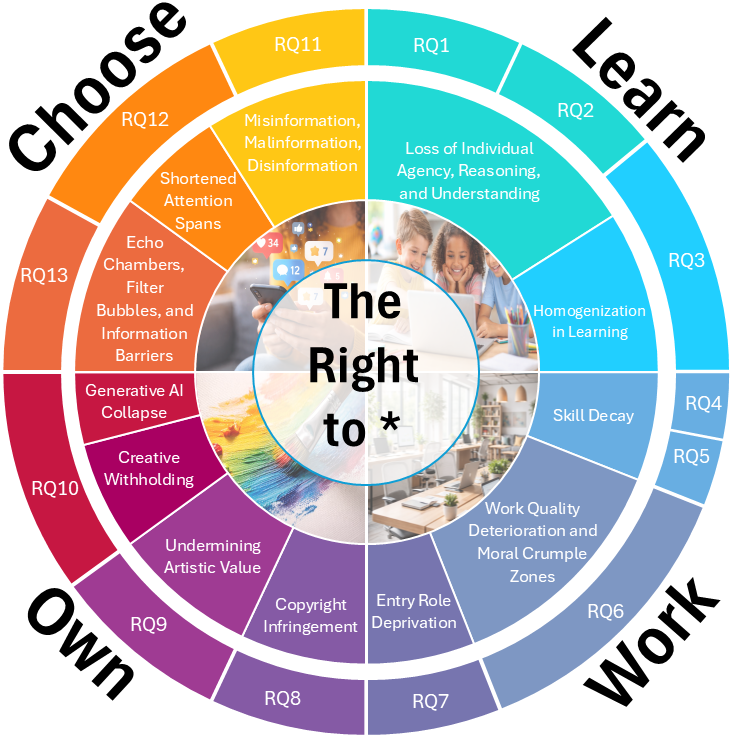
🧑🏻⚖️🤖 AI is rapidly embedding itself into how we learn 👨‍🎓, work 👨‍💼, create 👨‍🎨, and choose🤳, but we lack a clear research framework for preserving meaningful human agency in the process. Our paper (papers.ssrn.com/sol3/papers.cf…) draws on how existing debates about #AI are often too abstract and insufficiently operational. We propose a rights-based lens grounded in everyday capacities: the Right to Learn, Work, Own, and Choose. This work is an inter-disciplinary and inter-institutional collaboration 🤝 between @AISingapore PhD Fellows, AI Accelerated Masters Program awardees (Ryan Yuriel Wang @YurielRyan @sutdsg, Nicole Heng Yim Oo @sgSMU, Hui En Pang @Pangyyyyy55 @NTUsg, Davin Choo @Harvard) our directors (Simon Chesterman @ProfChesterman, Jungpil Hahn @jungpil) and research fellows (Eric J. W. Orlowski, Hakim Norhashim), and my researchers in GLOW.AI @NUSingapore (Khoo Zi-Yu @ziyuuu____, Ruth Wan Theng Chew @ruthchewing, Rachael Hwee Ling Sim @RachaelSim2). Instead of asking only what AI systems can do, we ask what they should be designed to enable humans to continue doing well. ⭐️Our paper’s main contributions: • Reframing AI governance as a socio-technical challenge linking core technical properties (opacity, homogenisation, persuasive fluency, etc.) to lived societal impacts. • Translating high-level principles into concrete, researchable questions across learning, labour, ownership/attribution, and preference formation. • Identifying operational gaps where current AI development risks quietly eroding human agency. • Proposing a forward-looking research agenda that shifts the conversation from panic ("What should we do?") to coordinated problem-solving ("Here are the levers we can work on."). 💫As AI assistance becomes prolific and effective, the central question is no longer whether we use AI. Instead, we should look at how we design systems that amplify, rather than displace, human capacity.
Bryan Kian Hsiang Low tweet media
English
0
3
12
206
Bryan Kian Hsiang Low
Bryan Kian Hsiang Low@bryanklow·
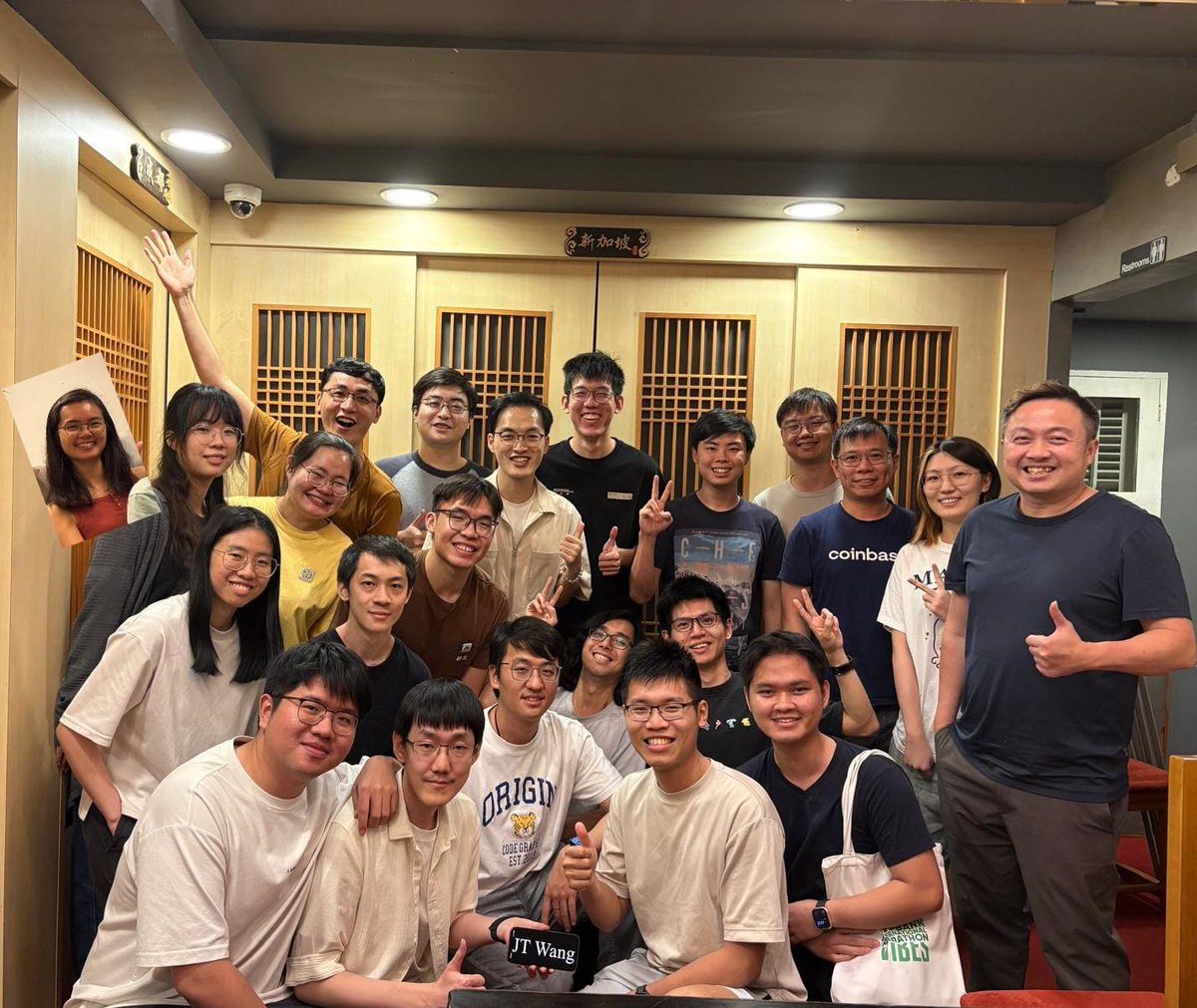
Our GLOW.AI research group had a sumptuous dinner on 6 Feb at Old Chengdu Sichuan Cuisine Restaurant to bid farewell to Zhaoxuan Wu @WuZhaoxuan (ML Engineer, TikTok), Rui Qiao @ray_qiaorui (Research Scientist, Meta), and Xiaoqiang Lin @xiaoqiang_98 (AI Research Scientist, Salesforce AI Research). They have all being instrumental in realizing our group's research vision on data-centric AI. During the dinner, they've shared with our current group members on the differences between work in these tech companies and PhD life. Based on my interpretation 🤣, while the PhD journey is arduous, their work life is substantially more demanding, driven by hard KPIs. They've advised our group members to cherish the freedom of choosing the research topic to work on and the personal achievement that can be derived from doing so during their PhD studies. Farewell dinners have always been bittersweet for me. Having spent so many years slogging with them and sharing their joys and woes, it is hard not to miss their presence in the lab and even our walks to lunch. However, seeing them grow up (while I grow old :) through various trials during their PhD and become a better, more resilient individual gives me immeasurable joy and gratitude 🥹🥹🥹. Really glad to have shared the same walk with them in my life. I wish them success in what they aim to achieve in the years to come!!! GLOW.AI will always be their home.
Bryan Kian Hsiang Low tweet media
English
1
0
24
484
Bryan Kian Hsiang Low
Bryan Kian Hsiang Low@bryanklow·
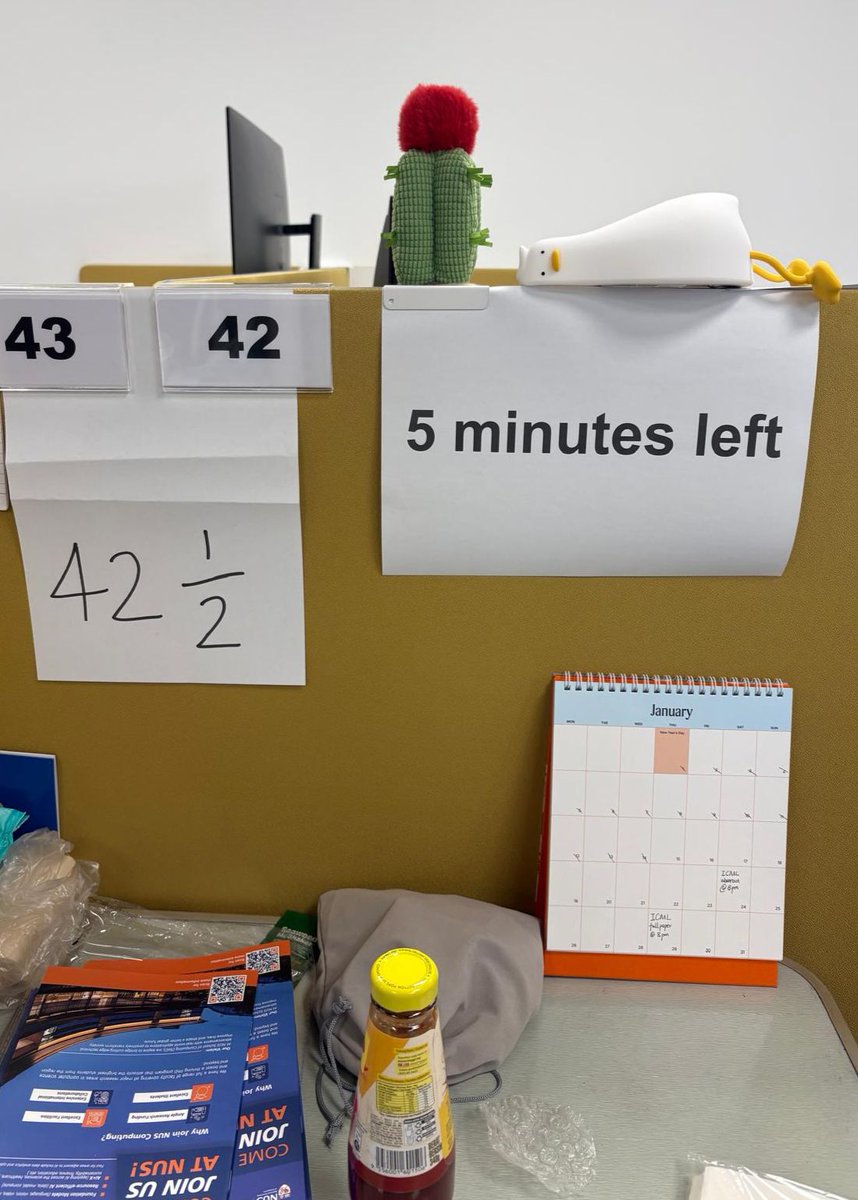
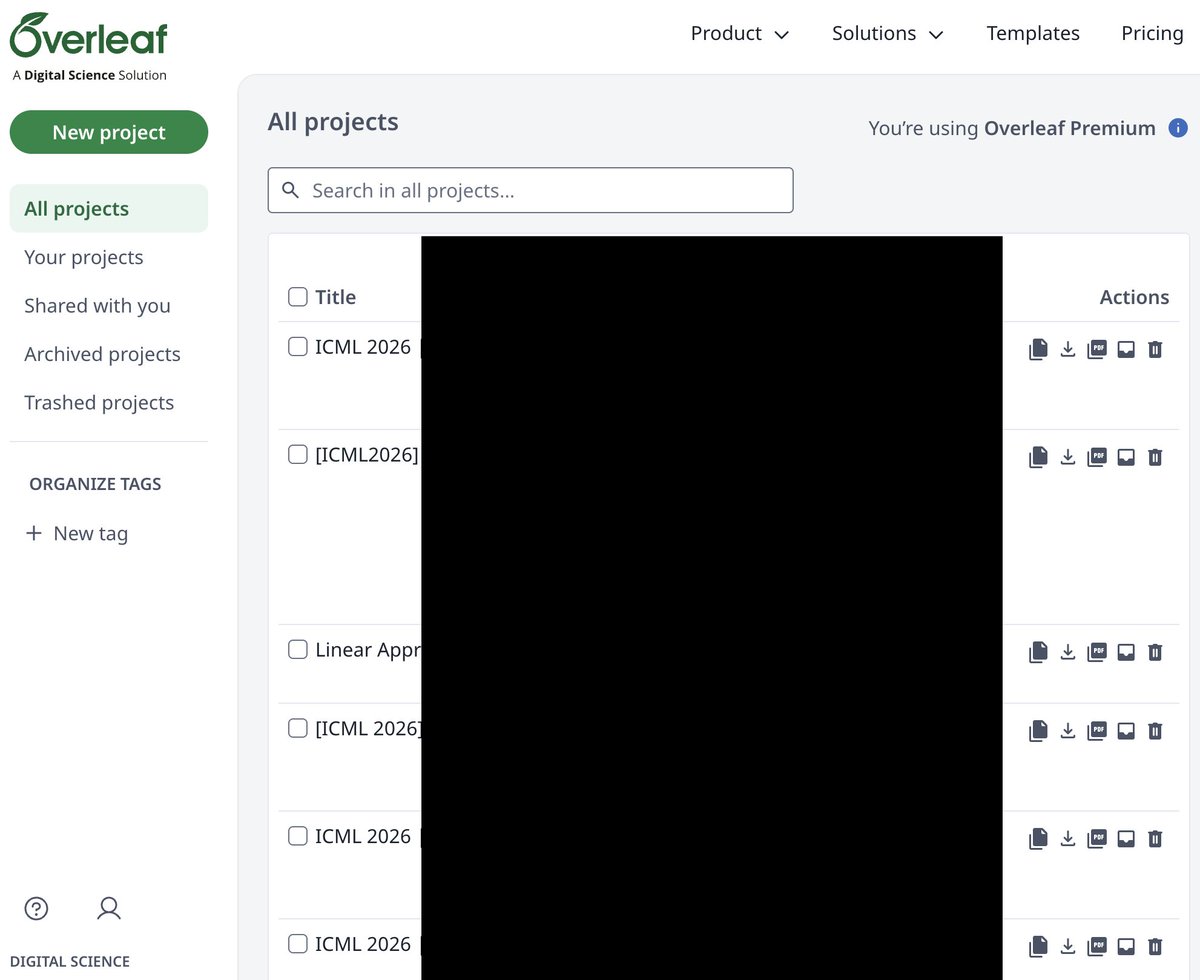
After such an intense week: (1) Organizing the NUS Artificial Intelligence Institute x DSO National Laboratories x Amazon Web Services (AWS) Symposium on Agentic AI Meets Autonomous Agents and Multiagent Systems on 21 Jan (x.com/bryanklow/stat…); (2) Presenting our GLOW.AI group's research on 'Resource-Efficient AI' and 'AI to check on AI' in @RealAAAI #AAAI2026 Research Spotlights from Singapore 1 session on 22 Jan (x.com/bryanklow/stat…); (3) Organizing the @AISingapore Symposium on The Right to Learn, Work, Own & Choose on 23 Jan (x.com/bryanklow/stat…); (4) Attending the Singapore AI Research Week Gala Dinner on 24 Jan (mddi.gov.sg/newsroom/openi…); (5) Presenting 'Physics-Informed Experimental Design for Inverse Problems' at the @RealAAAI #AAAI2026 Workshop on AI to Accelerate Science and Engineering (& delivering my CS3264 course lecture on Foundations of ML before that) on 26 Jan (ai-2-ase.github.io); It feels gratifying to be looking at Overleaf @icmlconf #ICML2026. Art thou my solace and refuge?
Bryan Kian Hsiang Low tweet media
Bryan Kian Hsiang Low@bryanklow

It was a phenomenal turnout at the NUS Artificial Intelligence Institute x DSO National Laboratories x Amazon Web Services (AWS) Symposium on Agentic AI Meets Autonomous Agents and Multiagent Systems on 21 Jan! This event is part of the Singapore AI Research Week (luma.com/sgairesearchwe…) that is held in parallel with @RealAAAI #AAAI2026. These are my key takeaways from the highly insightful talks: (1) Building Rational Robots — Leslie Kaelbling (@MIT): More than a decade ago, planning to learn or learning to plan for an agent would be deemed too challenging due to scale. I was reminded of our work on planning to actively learn back in ICML 2014 (proceedings.mlr.press/v32/hoang14.ht…). At that time, a reviewer said “It was refreshing to see work on nonmyopic planning, which I think is too often disregarded as being too difficult to consider." Now, it has become a reality. (2) Agentifying Agentic AI — Frank Dignum @frankdignum (@umeauniversity): Many concepts, principles, and methodologies in the autonomous agents and multiagent systems (AAMAS) community are very relevant to agentic AI. Do check out their paper on Agentifying Agentic AI (arxiv.org/abs/2511.17332). I was reminded of two works back in ICML 2017 (proceedings.mlr.press/v70/daxberger1…) and AAAI 2018 (doi.org/10.1609/aaai.v…) on, respectively, batch and high-dimensional Bayesian optimization (BO) where we've exploited multiagent systems methodologies for solving these BO problems efficiently in a distributed and decentralized manner. (3) Finding Supervision for Complex Tasks — Pang Wei Koh @pangwei (@UW & @allen_ai): Even when you have weak preference data, the relative quality difference between pairs of them can be surprisingly useful to preference tuning! (4) Guarding the Future: Advancing Risk Assessment, Safety Alignment, and Guardrails for AI Agents — Bo Li @uiuc_aisecure (@UofIllinois): While @AgenticAI presents significant opportunities to businesses, the risks with using AI agents are real too! We'll cover such risks at a greater length at the @AISingapore Symposium on The Right to Learn, Work, Own, and Choose on 23 Jan (x.com/bryanklow/stat…). My heartfelt thanks to the invited speakers, hosts @ChunKaiLing1 and Warut Suksompong, @nusaiinstitute Director Mohan Kankanhalli, our supercalifragilisticexpialidocious crew Lynn Wong, Zi-Yu Khoo, Thayalini Selvaraj, DSO Hai Leong Chieu, Shen Bingquan, @awscloud Kai Hui Ang, Richard Goh, Chris Ho, @SingaporeMDDI @heruimin, Bernice Khoo, and Chloe Nott for their strong support! It has always been my dream and vision that the (A)cademia, (G)overnment, and (I)ndustry can come together to make things happen for Singapore! A truly AGI experience 😂.

English
0
0
7
571
Bryan Kian Hsiang Low
Bryan Kian Hsiang Low@bryanklow·
When a company claims that your personal data has been removed from their model, have you ever wondered whether they've indeed done so? 🤔 If a new paper on arXiv claims that its proposed #MachineUnlearning algorithm can unlearn your personal data from an #LLM, how do we know if it can indeed do so? 🛢️WaterDrum is the first data-centric LLM unlearning metric based on watermarking that is calibrated, requires no retraining, works for blackbox models and when forget/retain sets have similar data. Let the (Water)Drums roll at Rio! @iclr_conf #ICLR2026
Bryan Kian Hsiang Low@bryanklow

Introducing WaterDrum🛢️, the first data-centric #LLM #unlearning metric that leverages robust text #watermarking💧to provide an effective, practical, and resilient way to evaluate LLM unlearning performance😉! (1/n) #MachineUnlearning #LLMs

English
0
1
6
401
Bryan Kian Hsiang Low
Bryan Kian Hsiang Low@bryanklow·
@nanjiang_cs I can attest to that. I can observe that my @iclr_conf #ICLR2026 ACs pay particular attention to whether the reviewers would improve their ratings upon reading the authors' rebuttal for several (initially) borderline papers.
English
0
0
1
3.2K
Nan Jiang
Nan Jiang@nanjiang_cs·
Going thru ICLR meta-reviews and I have a weird/wild feeling. Due to the incident the ACs spends more time and I'm surprised by the positive quality of the MRs in general... there might be a chance that this leads to an improvement to the overall quality of the decisions...
English
4
2
103
23.5K
Bryan Kian Hsiang Low
Bryan Kian Hsiang Low@bryanklow·
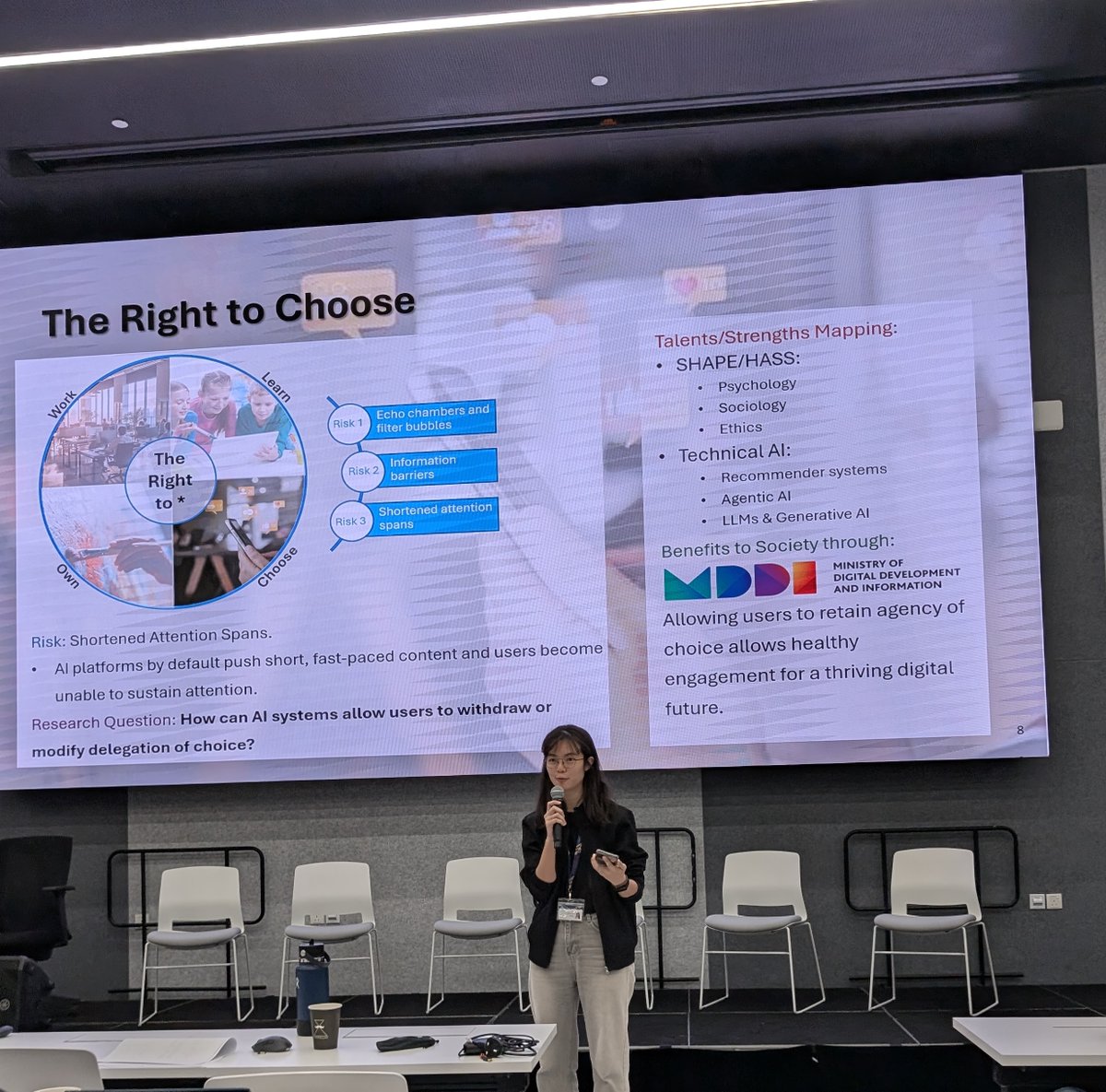
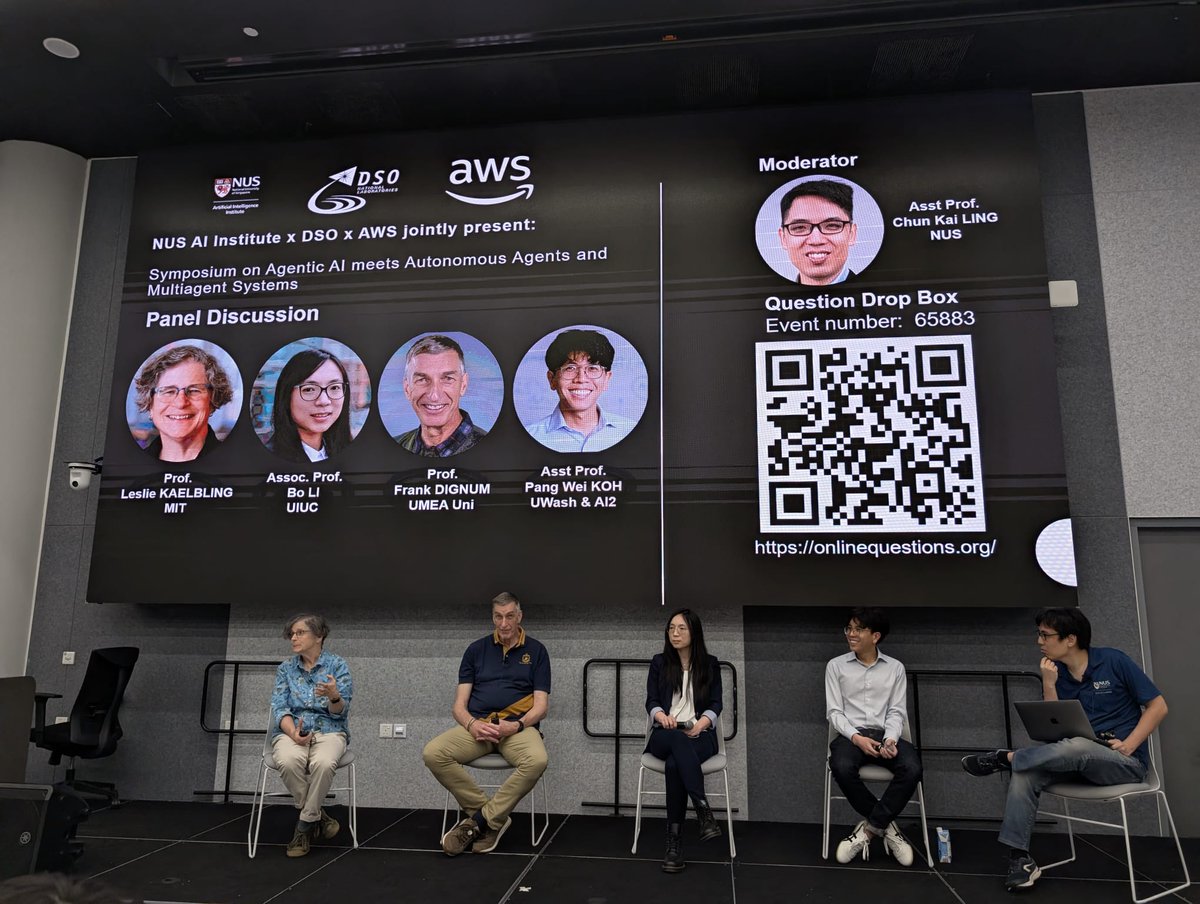
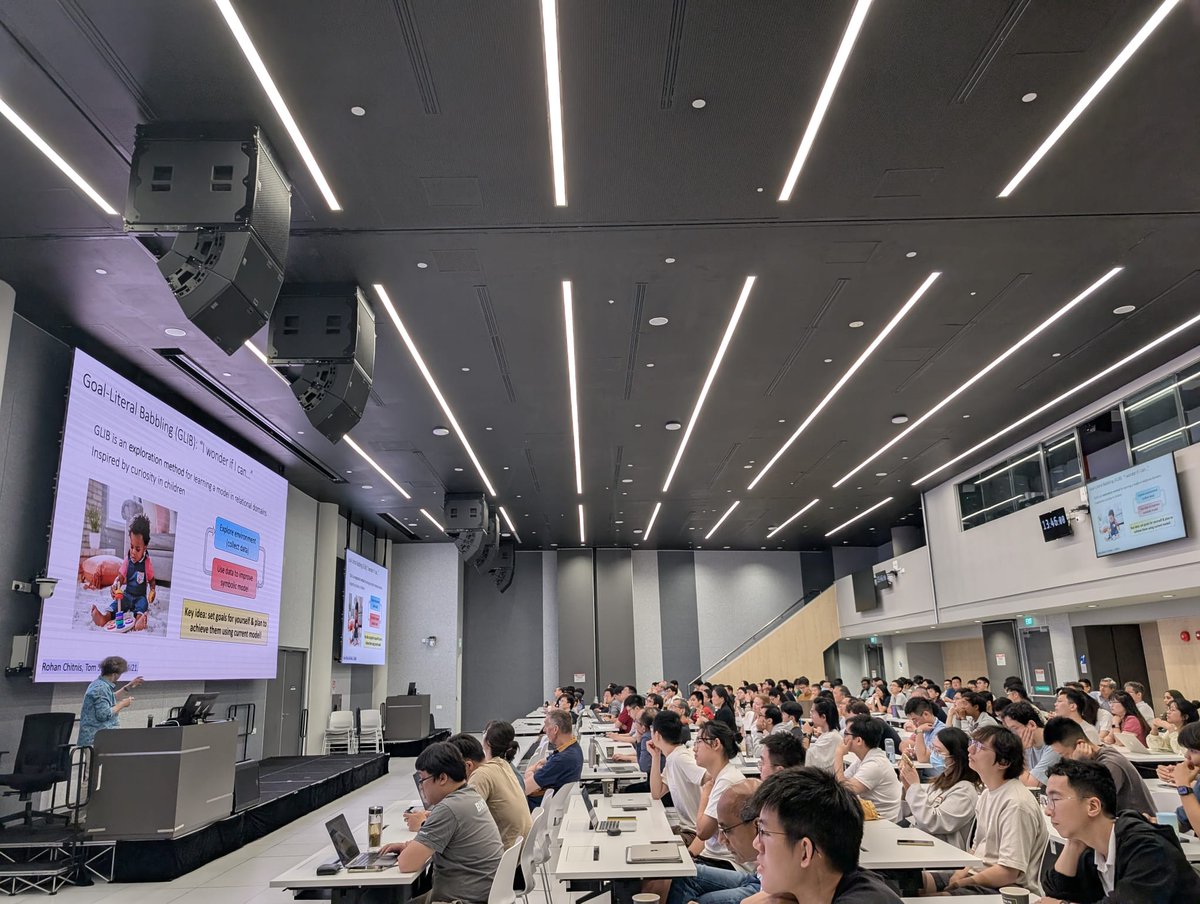
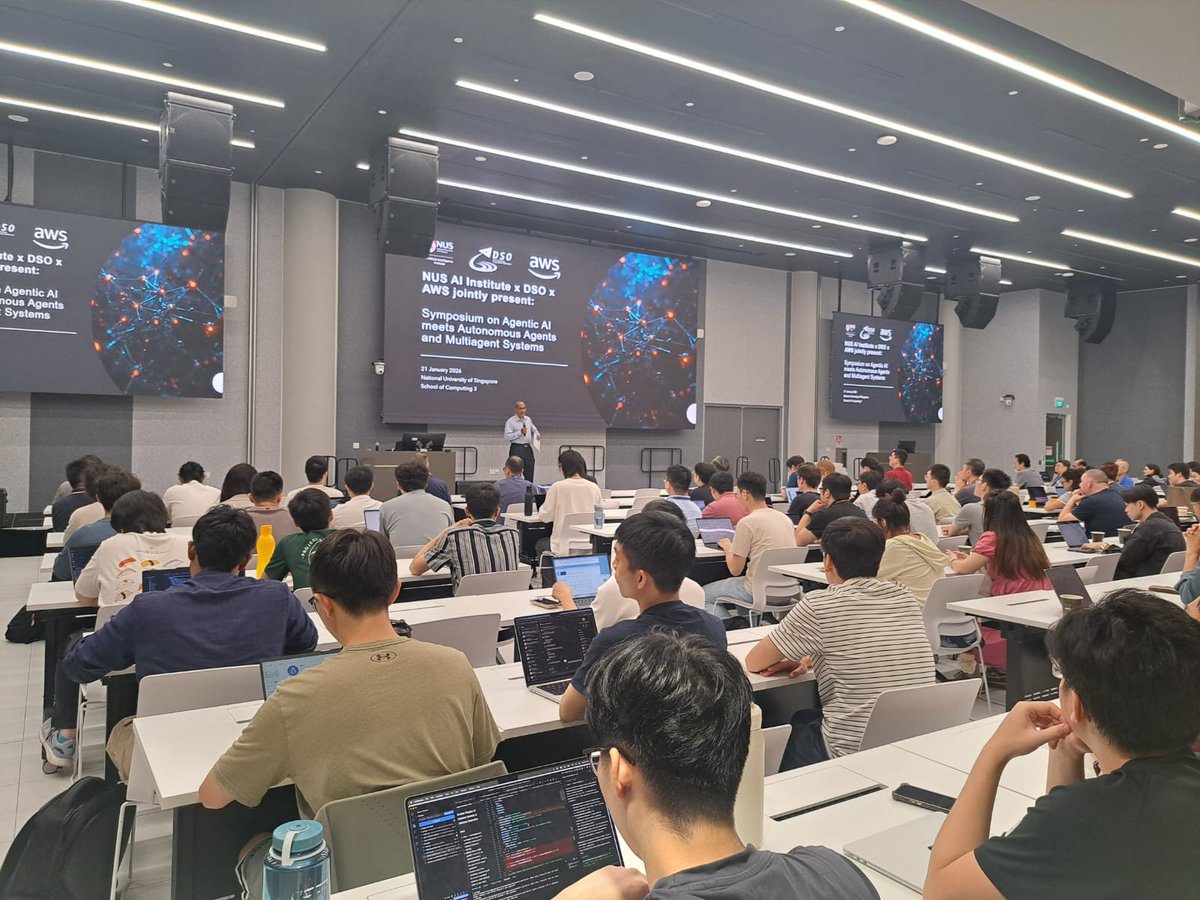
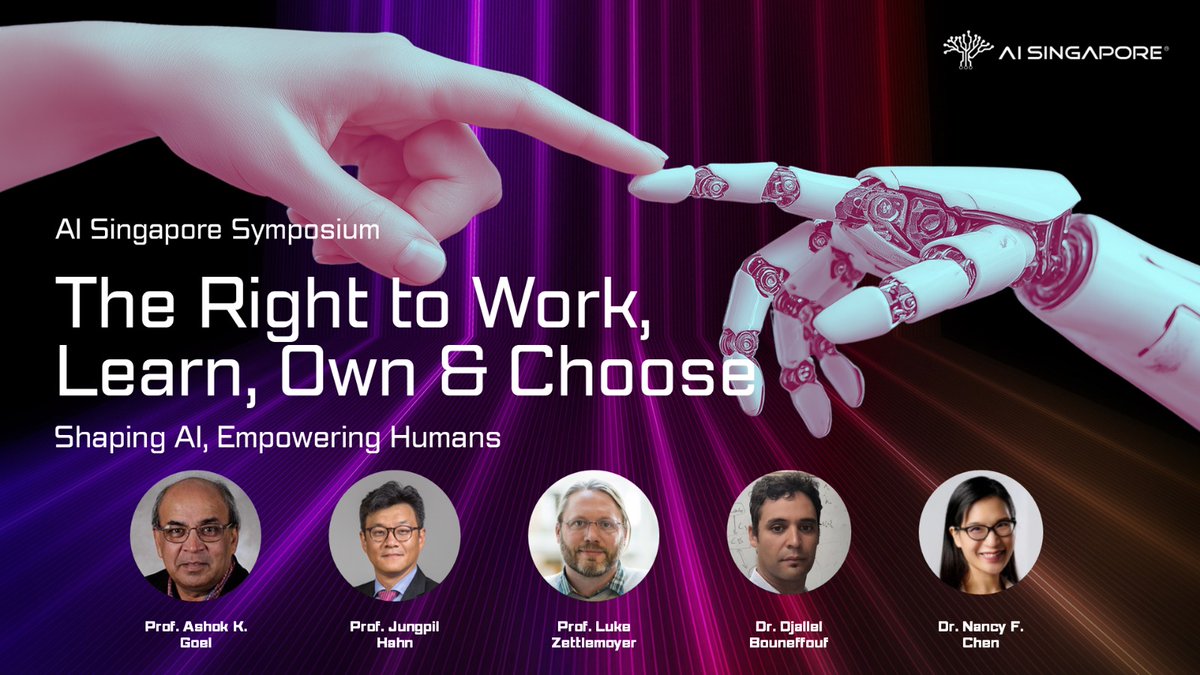
The incredible turnout from the technical AI and AI governance communities validates the importance and timeliness of the themes covered in the @AISingapore Symposium on The Right to Learn, Work, Own & Choose on 23 Jan 💪. This event is part of the Singapore AI Research Week (luma.com/sgairesearchwe…) that is held in parallel with @RealAAAI #AAAI2026. The key takeaways I got from the inspiring speakers: (1) Ashok Goel @AshKGoel (@GeorgiaTech) — The Right to Work and the Right to Learn: AI for Adult Learning and Online Education: In one of his research studies, AI did not necessarily retard the students learning from interacting with it. As he had explained, this might be because the students who are working adults are intrinsically motivated to learn the materials well. Hope I caught his message right 😅 I also thought that these working adults have previously been brought up in conventional learning environments, unlike the younger generation with direct and immediate access to generative AI tools. Could that have implications on his research study? However, he also said that learning is a social and emotional process, which in my opinion makes AI-assisted learning a challenging problem and puts the Right to Learn in the limelight. 🎤 Jungpil Hahn @jungpil(@NUSComputing) — The Organizational AI Efficiency Paradox: I really like his proposal of intentionally designing "friction" in the current system where the junior staff need to go through the manual exercise of building up their cognitive maps before being allowed to use AI shortcuts. In other words, know what you're using! He also said that such a process is a lifelong one. How then can we accelerate the development of the cognitive maps? 🎤 Prof. Luke Zettlemoyer@LukeZettlemoyer (@UW&@MetaFAIR) — Towards Copyright Aware Language Modeling: I was inspired to think more deeply about his proposals of using #RetrievalAugmentedGeneration and Modular Models as means for handling copyright takedowns. Tonnes of interesting research questions/problems pop up in my head! 🎤 Dr Nancy Chen (@ASTARsg) — The Right to Think: How Thoughtfully Soft AI can Help: I'm impressed by how she has paid careful attention to the cultural nuances and contexts involved in the text and speech conversations when developing the multimodal AI tools. 🎤 Dr Djallel Bouneffouf @DjallelBouneff(@IBMResearch) — From Emergence to Evaluation: Understanding Theory of Mind, Persuasion, and Power Asymmetries in Intelligent Agents: His notion of a Shepherd Test is really interesting: Would AI treat us in the same way as a superintelligent being would, just like how we treat the other species living on Earth? During the panel discussion, I've posed a question: Let's consider a scenario of the near future that can challenge our right to choose. For the sake of advancing technology to improve our quality of life, supposing hashtag#AAAI2027 informs us that it has potentially received 60% submissions that are near-fully AI generated, what are your thoughts as a reviewer, program chair, and a human author? Should you be given the right to choose whether to review a human or an AI-generated paper? There are currently policies in place at the top AI conferences like @NeurIPSConf @iclr_conf @icmlconf regarding the use of #LLMs in paper submissions. However, recent incidents caught us by surprise: We've seen hallucinated references in #NeurIPS2025 (gptzero.me/news/neurips/). As a senior area chair of #ICLR2026, I know that paper submissions with such hallucinated references were also desk-rejected. Last year, we heard about prompt injections into manuscripts to exploit AI-assisted peer reviews (arxiv.org/abs/2507.06185). Some panel members are generally receptive to AI-generated research and papers that help to improve the quality of life in the society. However, there is still so much that we don't understand about this technology and its societal impact, both positive and negative. There is a need to significantly improve our understanding of generative AI before we can use it effectively. Some have also voiced that the reviewers need to be informed so that they have the right to choose. My sincere gratitude to @ziyuuu____ who has orchestrated the entire symposium, including the content, together with Lynn Wong, Simon @ProfChesterman for co-hosting with me and doing such a great job in moderating the panel discussion, Jalyn Ong and Abigail Toh for their amazing publicity materials, Rachel Tay, Erica Megan Wee, Pei Yon Ong, and Janice Teo for their help on site!
Bryan Kian Hsiang Low tweet mediaBryan Kian Hsiang Low tweet mediaBryan Kian Hsiang Low tweet mediaBryan Kian Hsiang Low tweet media
English
0
5
17
1K
Bryan Kian Hsiang Low
Bryan Kian Hsiang Low@bryanklow·
It was a phenomenal turnout at the NUS Artificial Intelligence Institute x DSO National Laboratories x Amazon Web Services (AWS) Symposium on Agentic AI Meets Autonomous Agents and Multiagent Systems on 21 Jan! This event is part of the Singapore AI Research Week (luma.com/sgairesearchwe…) that is held in parallel with @RealAAAI #AAAI2026. These are my key takeaways from the highly insightful talks: (1) Building Rational Robots — Leslie Kaelbling (@MIT): More than a decade ago, planning to learn or learning to plan for an agent would be deemed too challenging due to scale. I was reminded of our work on planning to actively learn back in ICML 2014 (proceedings.mlr.press/v32/hoang14.ht…). At that time, a reviewer said “It was refreshing to see work on nonmyopic planning, which I think is too often disregarded as being too difficult to consider." Now, it has become a reality. (2) Agentifying Agentic AI — Frank Dignum @frankdignum (@umeauniversity): Many concepts, principles, and methodologies in the autonomous agents and multiagent systems (AAMAS) community are very relevant to agentic AI. Do check out their paper on Agentifying Agentic AI (arxiv.org/abs/2511.17332). I was reminded of two works back in ICML 2017 (proceedings.mlr.press/v70/daxberger1…) and AAAI 2018 (doi.org/10.1609/aaai.v…) on, respectively, batch and high-dimensional Bayesian optimization (BO) where we've exploited multiagent systems methodologies for solving these BO problems efficiently in a distributed and decentralized manner. (3) Finding Supervision for Complex Tasks — Pang Wei Koh @pangwei (@UW & @allen_ai): Even when you have weak preference data, the relative quality difference between pairs of them can be surprisingly useful to preference tuning! (4) Guarding the Future: Advancing Risk Assessment, Safety Alignment, and Guardrails for AI Agents — Bo Li @uiuc_aisecure (@UofIllinois): While @AgenticAI presents significant opportunities to businesses, the risks with using AI agents are real too! We'll cover such risks at a greater length at the @AISingapore Symposium on The Right to Learn, Work, Own, and Choose on 23 Jan (x.com/bryanklow/stat…). My heartfelt thanks to the invited speakers, hosts @ChunKaiLing1 and Warut Suksompong, @nusaiinstitute Director Mohan Kankanhalli, our supercalifragilisticexpialidocious crew Lynn Wong, Zi-Yu Khoo, Thayalini Selvaraj, DSO Hai Leong Chieu, Shen Bingquan, @awscloud Kai Hui Ang, Richard Goh, Chris Ho, @SingaporeMDDI @heruimin, Bernice Khoo, and Chloe Nott for their strong support! It has always been my dream and vision that the (A)cademia, (G)overnment, and (I)ndustry can come together to make things happen for Singapore! A truly AGI experience 😂.
Bryan Kian Hsiang Low tweet mediaBryan Kian Hsiang Low tweet mediaBryan Kian Hsiang Low tweet mediaBryan Kian Hsiang Low tweet media
English
0
3
23
1.9K
Bryan Kian Hsiang Low
Bryan Kian Hsiang Low@bryanklow·
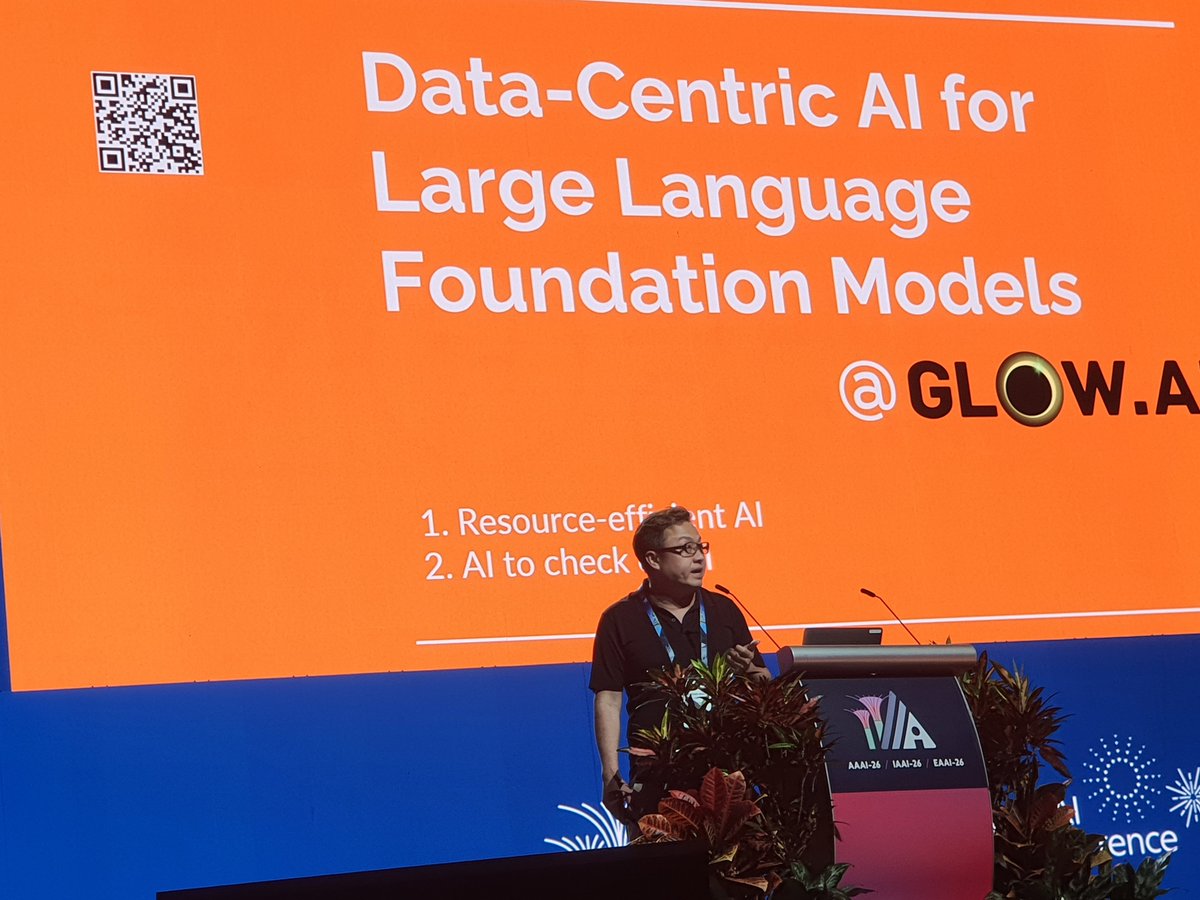
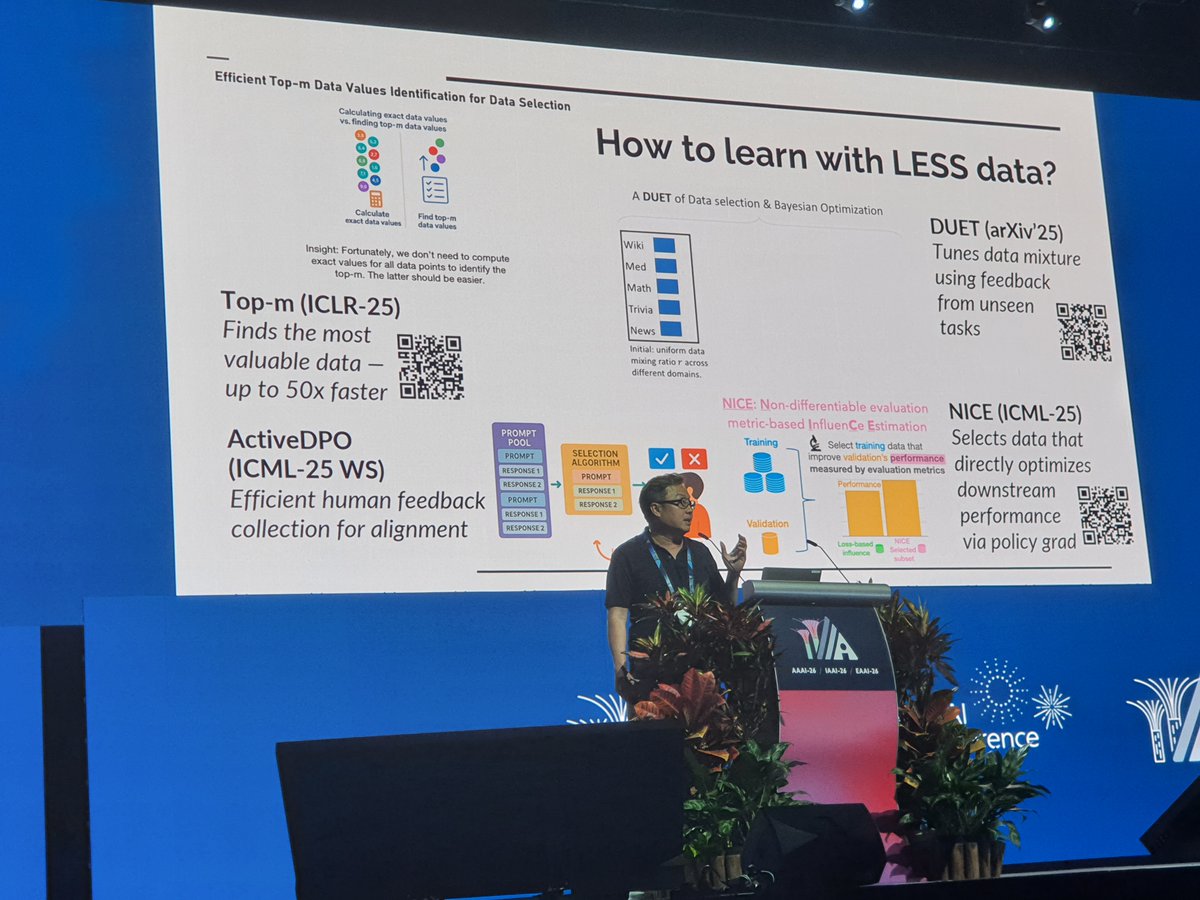
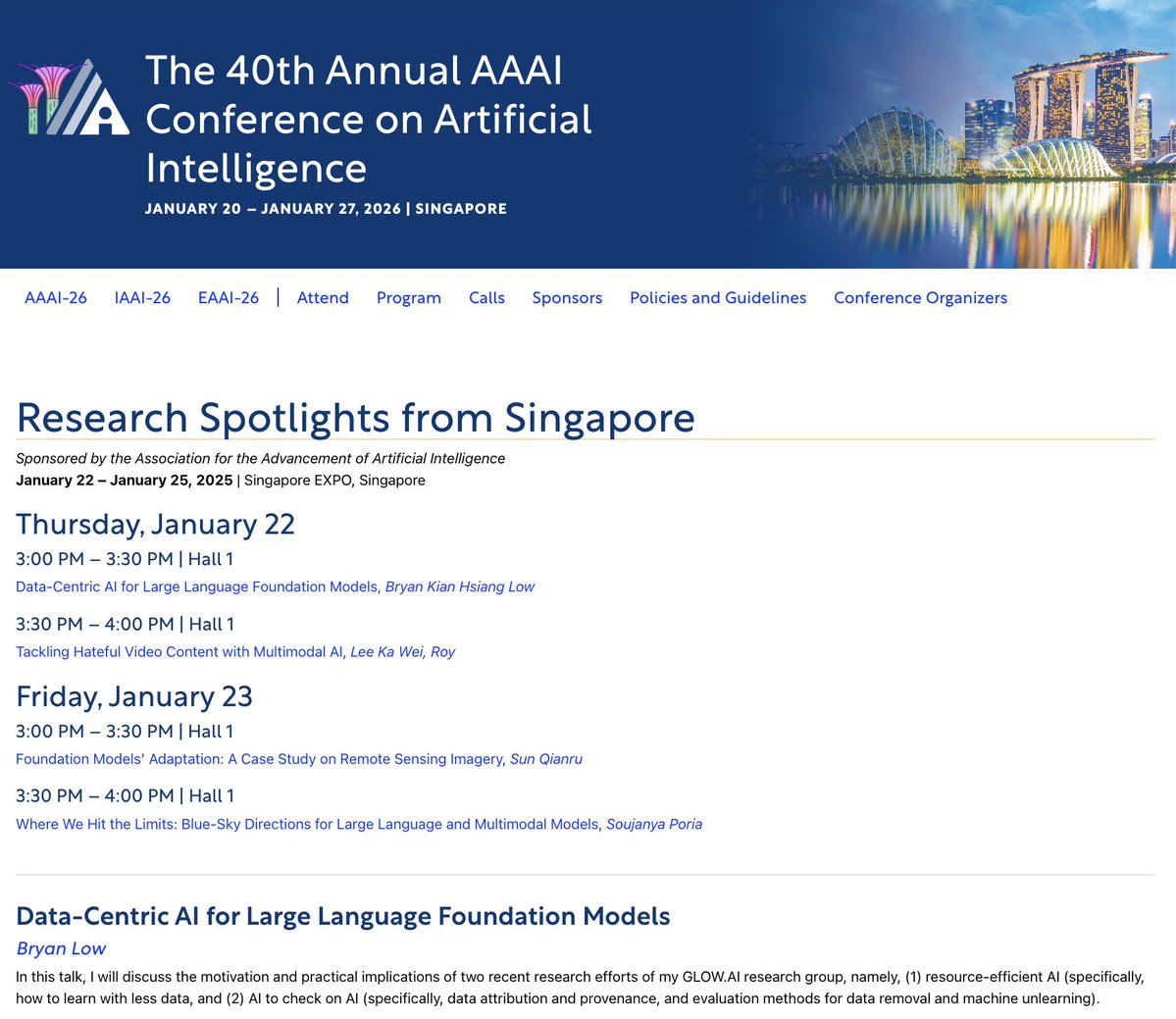
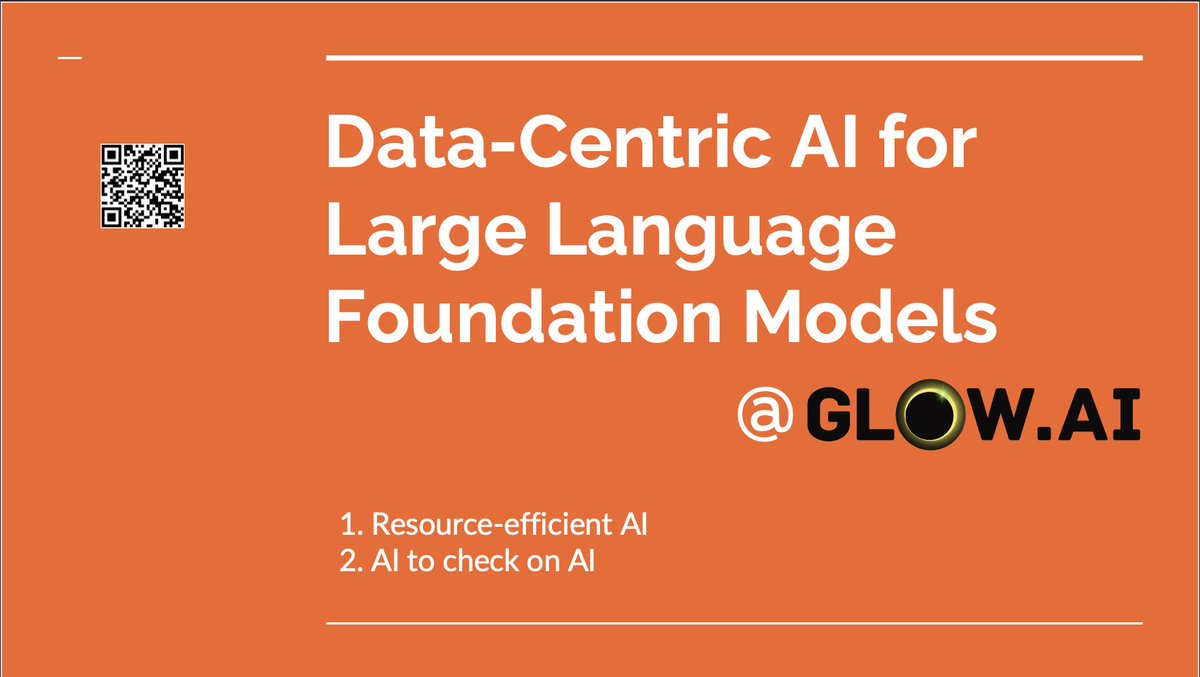
Many thanks to @RealAAAI #AAAI2026 for the opportunity to share about our group's research on 'Resource-Efficient AI' and 'AI to check on AI'!
Bryan Kian Hsiang Low tweet mediaBryan Kian Hsiang Low tweet mediaBryan Kian Hsiang Low tweet mediaBryan Kian Hsiang Low tweet media
English
0
0
1
117
Bryan Kian Hsiang Low
Bryan Kian Hsiang Low@bryanklow·
Yesterday, at the NUS Artificial Intelligence Institute x DSO National Laboratories x Amazon Web Services (AWS) Symposium on Agentic AI meets Autonomous Agents and Multiagent Systems, it was mentioned a number of times that as AI systems become increasingly agentic, their risks and opportunities become harder to separate 🤖. @nusaiinstitute @awscloud Agents can plan, act autonomously, and operate across tools. They enable powerful assistance, but also raising concerns around privacy, limited testability, and uncontrolled planning that may lead to unwanted behaviour. This tension sits at the heart of tomorrow’s symposium: How do we harness AI as a helpful assistant without quietly eroding human agency? Looking forward to the conversations tomorrow at the @AISingapore Symposium on The Right to Learn, Work, Own, and Choose with Ashok Goel @AshKGoel (@GeorgiaTech), Jungpil Hahn @jungpil (@NUSComputing), Luke Zettlemoyer @LukeZettlemoyer (@UW&@MetaFAIR), @DjallelBouneff(@IBMResearch), and Nancy Chen ( @ASTARsg )! This event is part of the Singapore AI Research Week (luma.com/sgairesearchwe…) that is held in parallel with @RealAAAI #AAAI2026.
Bryan Kian Hsiang Low tweet media
English
0
1
10
229
Bryan Kian Hsiang Low
Bryan Kian Hsiang Low@bryanklow·
✨ Today we kick off with the NUS Artificial Intelligence Institute x DSO National Laboratories x Amazon Web Services (AWS) Symposium on Agentic AI Meets Autonomous Agents and Multi-Agent Systems 🚀. We take a short break tomorrow, and on 23 Jan, we reconvene for the @AISingapore Symposium on The Right to Learn, Work, Own & Choose 💪. The response is overwhelming too with over 400 registrations! This event is part of the Singapore AI Research Week (luma.com/sgairesearchwe…) that is held in parallel with @RealAAAI #AAAI2026. On 23 Jan, you’ll hear from an incredible lineup of speakers: 🎤 Prof. Ashok Goel @AshKGoel (@GeorgiaTech) — The Right to Work and the Right to Learn: AI for Adult Learning and Online Education. 🎤 Dr Djallel Bouneffouf @DjallelBouneff (@IBMResearch) — From Emergence to Evaluation: Understanding Theory of Mind, Persuasion, and Power Asymmetries in Intelligent Agents. 🎤 Prof. Jungpil Hahn @jungpil (@NUSComputing) — The Organizational AI Efficiency Paradox 🎤 Prof. Luke Zettlemoyer @LukeZettlemoyer (@UW&@MetaFAIR) — Towards Copyright Aware Language Modeling 🎤 Dr. Nancy Chen (@ASTARsg) — The Right to Think: How Thoughtfully Soft AI can Help The day will also feature a panel discussion moderated by Prof. Simon Chesterman @ProfChesterman (Senior Director of AI Governance, @AISingapore), bringing together perspectives across research, governance, and practice. Due to the overwhelming response, we kindly ask registered participants who are unable to attend to update your status on luma asap so that we can offer your place to others on the waitlist. Looking forward to two days of thoughtful conversations on the future of AI!
Bryan Kian Hsiang Low@bryanklow

How do we preserve meaningful human discretion in an age where AI quietly reconfigures our agency? Join us at the @AISingapore Symposium on The Right to Work, Learn, Own & Choose to examine how the technical AI and AI governance communities can converge to advance AI systems that respect human agency and uphold our rights to work, learn, own, and choose. The symposium features invited speakers like @AshKGoel (@GeorgiaTech), @jungpil (@NUSComputing), @LukeZettlemoyer (@UW & @Meta FAIR), and @DjallelBouneff (@IBMResearch). For more details on the symposium and invited speakers, refer below: 📆 23 Jan 2026 (Fri) 🕦 08:30 - 13:30 📍COM3 Multi-Purpose Hall, 11 Research Link, Singapore 119391, Singapore Lunch and light refreshments will be served. Register here: luma.com/xyon5cw4 (Deadline: 22 Jan 2026) This event is part of the Singapore AI Research Week (luma.com/sgairesearchwe…) that is held in parallel with #AAAI2026. #AIEthics #HumanAgency #LLM #LLMs

English
0
0
10
333
Bryan Kian Hsiang Low
Bryan Kian Hsiang Low@bryanklow·
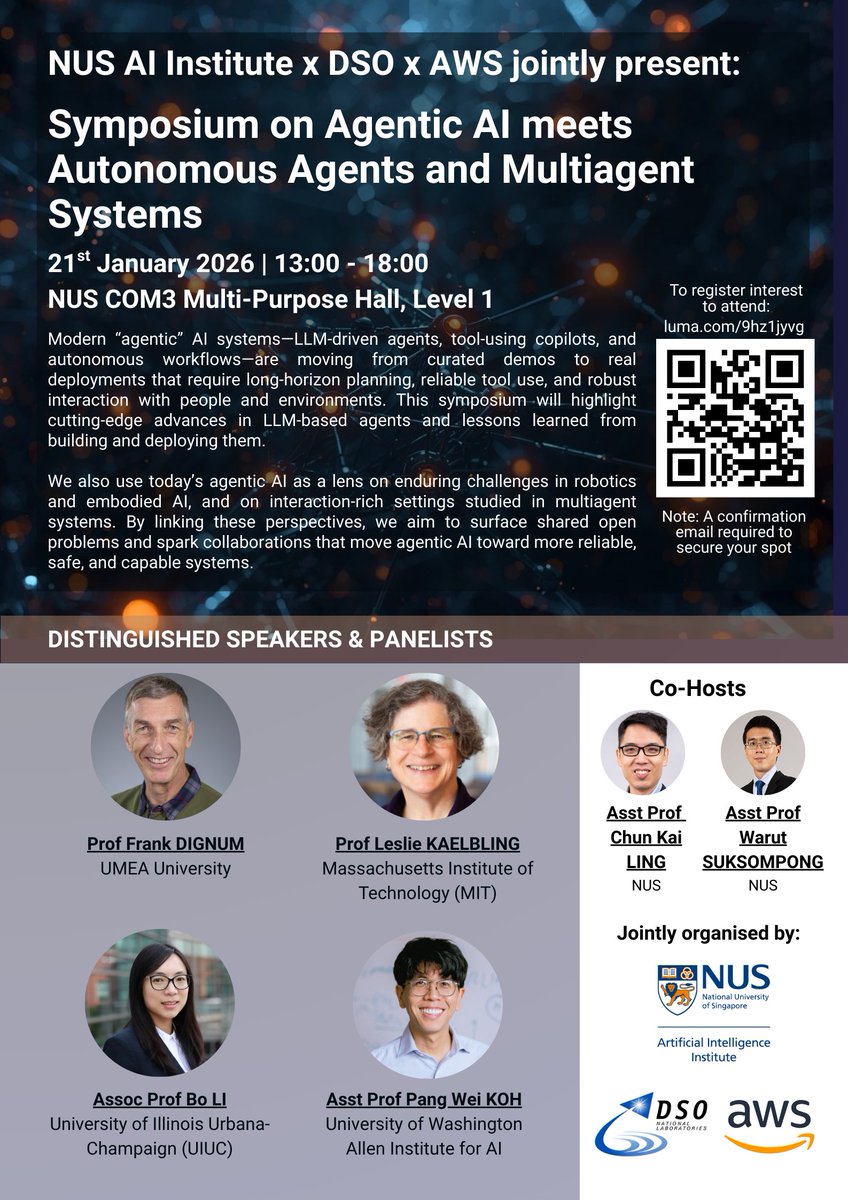
We're pleasantly surprised by the overwhelming response (over 500 registrations) to the NUS AI Institute x DSO National Laboratories x Amazon Web Services (AWS) Symposium on Agentic AI Meets Autonomous Agents and Multiagent Systems! This event is part of the Singapore AI Research Week (luma.com/sgairesearchwe…) that is held in parallel with @RealAAAI #AAAI2026. In this symposium, we are pleased to feature an exciting line-up of speakers who will be presenting cutting-edge agents and agentic AI research: 🎤 Building Rational Robots — Leslie Kaelbling ( @MIT ) 🎤 Guarding the Future: Advancing Risk Assessment, Safety Alignment, and Guardrails for AI Agents — Bo Li @uiuc_aisecure ( @UofIllinois ) 🎤 Finding Supervision for Complex Tasks — Pang Wei Koh @pangwei ( @UW & @allen_ai ) 🎤 Agentifying Agentic AI — Frank Dignum @frankdignum ( @umeauniversity ) Due to the overwhelming response, we kindly ask registered participants who are unable to attend to update your status on luma asap so that we can offer your place to others on the waitlist. Can't wait to hear from our speakers and panelists, and welcome our participants for an exciting afternoon of AI talks and discussion! See you tmr on 21 Jan!!! 🤖✨
Bryan Kian Hsiang Low@bryanklow

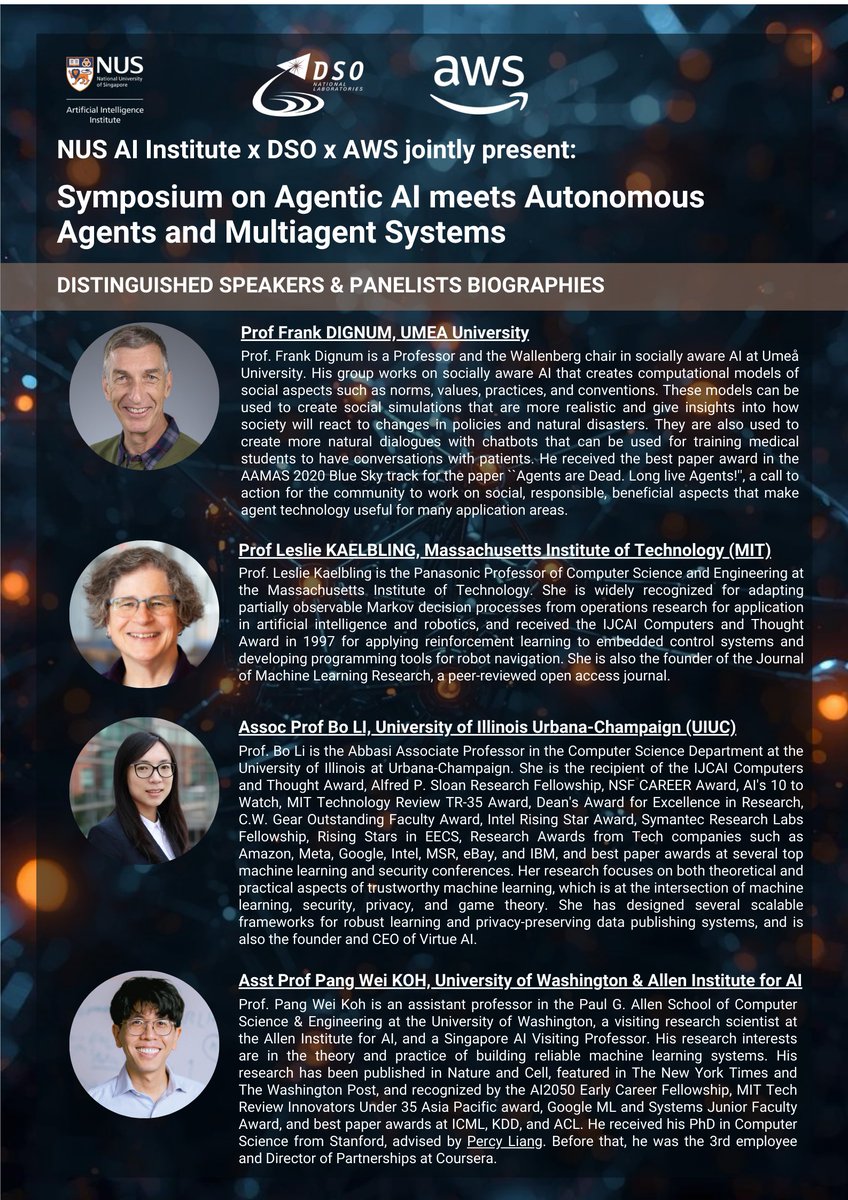
Interested to know the cutting-edge advances in LLM-based agents and the lessons learned from building and deploying them? Join us at the NUS AI Institute x DSO National Laboratories x Amazon Web Services (AWS) Symposium on Agentic AI meets Autonomous Agents and Multiagent Systems! @nusaiinstitute @awscloud Modern "agentic" AI systems (e.g., #LLM-driven agents, tool-using copilots, and autonomous workflows) are moving from curated demos to real deployments that require long-horizon planning, reliable tool use, and robust interaction with people and environments. We also use today’s agentic AI as a lens on enduring challenges in robotics and embodied AI, and on interaction-rich settings studied in multiagent systems. By linking these perspectives, we aim to surface shared open problems and spark collaborations that move agentic AI toward more reliable, safe, and capable systems. The symposium features invited speakers like Leslie Kaelbling (@MIT), Bo Li @uiuc_aisecure (@UofIllinois), Pang Wei Koh @pangwei (@UW & @allen_ai), and Frank Dignum @frankdignum (@umeauniversity). For more details on the symposium and invited speakers, refer below: 📆 21 Jan 2026 (Wed) 🕦 13:00 - 18:00 📍COM3 Multi-Purpose Hall, National University of Singapore (@NUSingapore), 11 Research Link, Singapore 119391, Singapore Light refreshments will be served. Register here: luma.com/9hz1jyvg This event is part of the Singapore AI Research Week (luma.com/sgairesearchwe…) that is held in parallel with @RealAAAI #AAAI2026. #AgenticAI #AutonomousAgents #MultiAgentSystems #LLMs

English
0
0
10
476
Bryan Kian Hsiang Low
Bryan Kian Hsiang Low@bryanklow·
Interested to know the cutting-edge advances in LLM-based agents and the lessons learned from building and deploying them? Join us at the NUS AI Institute x DSO National Laboratories x Amazon Web Services (AWS) Symposium on Agentic AI meets Autonomous Agents and Multiagent Systems! @nusaiinstitute @awscloud Modern "agentic" AI systems (e.g., #LLM-driven agents, tool-using copilots, and autonomous workflows) are moving from curated demos to real deployments that require long-horizon planning, reliable tool use, and robust interaction with people and environments. We also use today’s agentic AI as a lens on enduring challenges in robotics and embodied AI, and on interaction-rich settings studied in multiagent systems. By linking these perspectives, we aim to surface shared open problems and spark collaborations that move agentic AI toward more reliable, safe, and capable systems. The symposium features invited speakers like Leslie Kaelbling (@MIT), Bo Li @uiuc_aisecure (@UofIllinois), Pang Wei Koh @pangwei (@UW & @allen_ai), and Frank Dignum @frankdignum (@umeauniversity). For more details on the symposium and invited speakers, refer below: 📆 21 Jan 2026 (Wed) 🕦 13:00 - 18:00 📍COM3 Multi-Purpose Hall, National University of Singapore (@NUSingapore), 11 Research Link, Singapore 119391, Singapore Light refreshments will be served. Register here: luma.com/9hz1jyvg This event is part of the Singapore AI Research Week (luma.com/sgairesearchwe…) that is held in parallel with @RealAAAI #AAAI2026. #AgenticAI #AutonomousAgents #MultiAgentSystems #LLMs
Bryan Kian Hsiang Low tweet mediaBryan Kian Hsiang Low tweet media
English
0
0
17
999
Bryan Kian Hsiang Low
Bryan Kian Hsiang Low@bryanklow·
How do we preserve meaningful human discretion in an age where AI quietly reconfigures our agency? Join us at the @AISingapore Symposium on The Right to Work, Learn, Own & Choose to examine how the technical AI and AI governance communities can converge to advance AI systems that respect human agency and uphold our rights to work, learn, own, and choose. The symposium features invited speakers like @AshKGoel (@GeorgiaTech), @jungpil (@NUSComputing), @LukeZettlemoyer (@UW & @Meta FAIR), and @DjallelBouneff (@IBMResearch). For more details on the symposium and invited speakers, refer below: 📆 23 Jan 2026 (Fri) 🕦 08:30 - 13:30 📍COM3 Multi-Purpose Hall, 11 Research Link, Singapore 119391, Singapore Lunch and light refreshments will be served. Register here: luma.com/xyon5cw4 (Deadline: 22 Jan 2026) This event is part of the Singapore AI Research Week (luma.com/sgairesearchwe…) that is held in parallel with #AAAI2026. #AIEthics #HumanAgency #LLM #LLMs
Bryan Kian Hsiang Low tweet mediaBryan Kian Hsiang Low tweet media
English
0
0
10
559
Bryan Kian Hsiang Low
Bryan Kian Hsiang Low@bryanklow·
We organized the first @NUSComputing Network Session and Reception on 4 Dec in San Diego during the @NeurIPSConf #NeurIPS2025 week! Many thanks to our @NUSComputing faculty members (Mohan Kankanhalli, Ye Wang, See-Kiong Ng, @ChunKaiLing1, and @gimhee_lee) and researchers (@_JiayingWu_ at the NUS Centre for Trusted Internet and Community @nuscticnus) for actively engaging and interacting with our invited guests to inform them about the exciting research highlights and activities, the joint collaborations with the big techs and industries, and the available faculty openings and funding opportunities. I've shared about the 3C's (with a slight twist) of @NUSComputing: (1) We provide environment & resources to champion bold initiatives & tackle grand challenges. As a result, we can go beyond publications to produce research breakthroughs, societal impact & thought leadership. (2) We nurture, mentor & cultivate the young generation to be future leaders who will decide the society of the future. (3) We embrace the kampung spirit that is uniquely Singapore. Imagine a melting pot of diverse global talents coming together to form a community/kampung that is collegial, collaborative, and caring. At the university level, we've also shared about the NUS Artificial Intelligence Institute @nusaiinstitute. It brings together faculty members and researchers of different disciplines in various colleges, faculties, schools, and departments of @NUSingapore to collaborate in AI fundamental research and AI+X. At the national level, we've shared about @AISingapore and how this national program is a synergistic effort between Academia, Government, and Industry (AGI) to boost the AI capabilities of Singapore. My heartfelt thanks to Chloe Nott, Phoebe Collins, and Valerie Yeo from National AI Group in the Ministry of Digital Development and Information @SingaporeMDDI for gracing and supporting the event, demonstrating how our Singapore government is willing to work closely with the academia in recruiting top AI talents to Singapore. Together, we shape the future of AI for Singapore. I would like to thank our @NUSComputing Dean, Tulika Mitra, our HoD, Seth Gilbert, and @SurangaN and his comms team for their strong support of this event! Kudos to Lynn Wong and Zi-Yu Khoo for co-organizing this event and making it a success! Being professionally trained in hospitality management makes a huge difference! I won't forget how you have painstakingly prepared the door gifts and carried them from SG to the event venue.
Bryan Kian Hsiang Low tweet mediaBryan Kian Hsiang Low tweet mediaBryan Kian Hsiang Low tweet mediaBryan Kian Hsiang Low tweet media
English
1
1
30
1.3K