Bertrand Schmitt
157 posts

Bertrand Schmitt
@bschmitt
EIR at https://t.co/PsjFadhSki, Co-Host https://t.co/N0YudeVBDW, Co-Founder @AppAnnie/@DataAI, @ISEP and @Wharton alum, 🇫🇷 born and raised. Tweets are my own





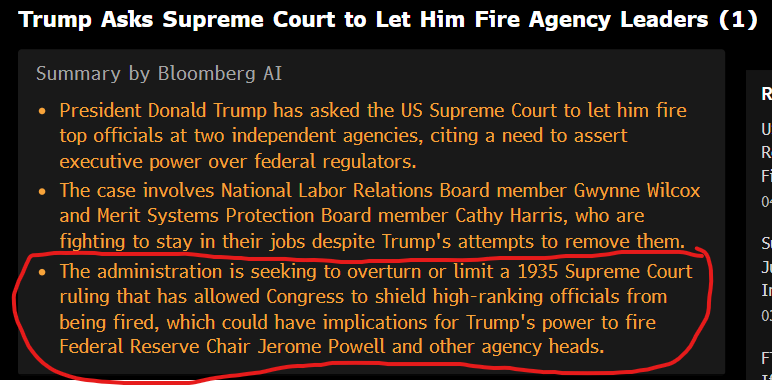
The first headline that is quoted in Bob's thread is not an accurate headline. Maybe it's engagement farming, maybe people just don't know better. Just because someone puts it in caps doesn't make it an accurate headline. The Trump administration said in February it was going to seek to overturn Humphrey's, which is the legal decision upon which most scholars think Fed independence rests. Humphreys was actually decided in the spring of 1935, when the Congress was passing the Banking Act of 1935 that created the modern Fed. It established the FOMC as a monetary policy making body, which hadn't been part of the original 1913 Act. Congress relied on Humphreys when creating staggered terms for Fed governors, among other measures, that were explicitly designed to insulate the central bank from presidential control (notably, against the wishes of the then-Fed chair, Marriner Eccles, who wanted a central bank board that answered straight up to the president). It is true that overturning Humphreys could have significant consequences for the Fed, but this is not a given and either way, Trump has asked to fire FTC commissioners and NLRB members, not Fed governors. His DOJ is challenging, head on, a decision that is widely viewed as insulating Fed governors from removal. It is possible that the Supreme Court would design a ruling that nukes the job-security protection for FTC commissioners and NLRB board members but does not do so for the Fed. Whether the Roberts Court does that is a separate question entirely. For more on this, I highly recommend former Fed governor Dan Tarullo's recent law review article that walks through many of these issues. To get to the point of his article, it "discusses why and how, notwithstanding these apparent constitutional vulnerabilities, the Court might well not hold the core delegation to, and structural features of, the Federal Reserve to be unconstitutional. As to why—members of the Court’s conservative majority may be more favorably inclined toward a central bank than other economic regulatory agencies. A more tangible consideration is the difficulty the Court would have in fashioning a remedy for the supposed unconstitutionality of the FOMC structure or mandate that did not risk major disruption to monetary policy, and thus the U.S. economy." "As to how.... the Court may find that, on the merits, the Federal Reserve enjoys an exception to the doctrines the Court’s majority has been building. This second way itself has two branches. One is based on the history of the regulation of money going all the way back to the First Bank of the United States. The other rests on perceived functional differences between the Federal Reserve and other independent agencies—an 'anomaly,' as then Judge Kavanaugh once described it." southerncalifornialawreview.com/2024/05/14/the…






Introducing our new product category, the Framework Desktop! This is a tiny, 4.5L machine with massive performance inside using AMD’s new Ryzen AI Max processors, an awesome machine for gaming, workstation, and AI crunching! Pre-orders are open now. frame.work







Bringing back American manufacturing is one of the most important challenges we face as a nation, and @garrytan is being delusional. That’s okay, btw; VCs have to be delusional—it’s part of their job. The source of his (and many VCs') delusion is that they think bringing back American manufacturing can be solved by robotics, software, and efficiency. Unfortunately, the problem is much deeper than that. Time for a quick history lesson...because it’s important to understanding how we fix this. LET'S HEAD OVER TO CHINA... Because fixing this problem involves figuring out what we are competing against. Let’s go back to 1979. Deng Xiaoping decides to open up China. He enacts a few policies that have MASSIVE impacts on the United States' ability to manufacture—specifically related to financial subsidies: Special Economic Zones: Geographic zones were created with lower taxes to establish CLUSTERS of manufacturing expertise. This was massive. The entire chain of manufacturing was strategically geolocated to minimize supply chain friction. Financial subsidy here? Lower taxes. Infrastructure Investment: They built out massive infrastructure projects, but I’m going to highlight two important ones: highways and industrial parks. The government ACTIVELY BUILT COMMERCIAL REAL ESTATE that they gifted to the chosen few. This is insane. Imagine us doing this at SCALE. Financial subsidy here? Literally free infrastructure. Direct Manufacturing Subsidies: Where do we even start here? -They gave free land to factories. -They provided below-market loans to entrepreneurs. -They SUBSIDIZED ELECTRICITY, WATER, AND RAW MATERIALS. They gave REBATES FOR EXPORTS (!!!). Don’t believe me? Let’s look at a few examples. Steel Industry: Baosteel (now part of China Baowu Steel Group) received massive state support, including:Below-market loans worth billions from state banks Government-funded infrastructure for new plants Subsidized iron ore through state trading companies Hebei Iron & Steel (HBIS) benefited from:Provincial government land grants Electricity subsidies Debt-to-equity swaps when struggling Aluminum Processing: China Hongqiao Group became the world’s largest aluminum producer through:Subsidized coal power from the local government Discounted loans from state banks Tax rebates on exports Chalco (Aluminum Corporation of China) received:Direct cash grants for technology upgrades Preferential access to bauxite resources Government-backed bonds for expansion Notice how I haven’t even MENTIONED the low-cost labor. Maybe that’s for a different thread. Let’s look at some fun numbers from the Kiel Institute: According to conservative estimates, China’s industrial subsidies amounted to €221 billion or 1.73% of GDP in 2019. This is 3–4 times higher than subsidy levels in large EU countries and up to 9 times higher in more comprehensive studies. Over 99% of listed firms in China received direct government subsidies in 2022. If you aren’t sensing a theme here yet, let me make it explicit: China used the power of government subsidies to dominate the entire manufacturing world in 25 years. They may be smart. They may be hardworking. But the main reason they won was INSANE government subsidies that would give your favorite libertarian cold sweats. Trump and JD Vance claim to want to bring back American manufacturing. Some of their advisors also claim to want small government. Unfortunately, this problem (imo) is ONLY solved by an extreme partnership between the government and private industry. IMO, you can have one of two options: No government involvement, and we continue losing manufacturing to China. Lots of government involvement, and we maybe win. All of you e/acc / reindustrialization fans need to start writing letters to Congress, lmao.

Folks. Banking regulations DO NOT require banks to kick out Politically Exposed Persons (@pmarca ). They just have to go through enhanced due diligence and monitoring. The practical effect may indeed be to cause management to blanket disallow them, because the fines are huge.

I'm German. 16 years ago, the EU and US economies were neck and neck. Today, the US economy is 50% larger than the entire EU combined. Here's the devastating truth behind Europe's ongoing economic suicide 🧵:


Newsom Vetoes SB 1047 in Victory for AI Sector Sunday afternoon, Gavin Newsom vetoed SB 1047, the high-profile AI bill whose early versions would establish a new government agency to enforce a compliance scheme on developers of “covered models” — those that used 10^26 or 10^25 floating point operations (FLOPs) for training or fine tuning, respectively — under threat of perjury. Critics of the bill, which included Silicon Valley venture capitalists, California startup founders, AI policy wonks, academics, and a bi-partisan set of lawmakers, argued it would stifle AI innovation and throttle California’s economy. “[T]he bill as currently written would be ineffective, punishing of individual entrepreneurs and small businesses, and hurt California’s spirit of innovation,” Ro Khanna, the Democratic lawmaker who represents California’s 17th district, said last month in a statement condemning the bill. Days later, top Democrat Nancy Pelosi published a statement opposing the bill, saying, “While we want California to lead in AI in a way that protects consumers, data, intellectual property and more, SB 1047 is more harmful than helpful in that pursuit.” Before his veto, Newsom echoed these concerns, saying the bill could have a “chilling effect” on the AI sector. Lawmakers began publicly opposing 1047 after persistent criticism and behind-the-scenes work from Silicon Valley executives and AI policy researchers. In early August, a16z's Chief Legal Officer Jaikumar Ramaswamy sent a 14-page letter to Sen. Scott Wiener, who introduced the bill, arguing that 1047 would favor closed-source over open source models and was too vague to be actionable, but nevertheless would impose criminal penalties on developers for noncompliance. And in June, a16z and Y Combinator co-published a letter in opposition to the bill signed by 140 AI startup founders. Advocacy groups opposed to 1047 such as Context Fund, an open-source community, pursued direct efforts in Sacramento as well. “Back in late March, we were talking to Senator Wiener's office. We spent about a month with them, expressing concerns and trying to get amendments into the bill, but that didn’t happen,” founder Chris Lengerich told Pirate Wires in July. “From the scientific community, the builders, the investors, and broadly — across the board — there's been a universal rejection of the ambiguous regulatory regime that SB 1047 imposes,” he said. “From the scientific community, the builders, the investors, and broadly — across the board — there’s been a universal rejection of the ambiguous regulatory regime that SB 1047 imposes,” he said. The bill was also criticized because it was all but authored by the Center for AI Safety (CAIS), an advocacy firm highly aligned with — and funded by — Effective Altruists, a group that believes AI will eradicate humanity unless the state regulates it. In addition to pushback from Silicon Valley and policy groups, a broad set of high-profile figures and academics in AI made statements opposing 1047. Meta's Chief AI Scientist Yann LeCun called the bill “extremely regressive,” and UC faculty and students circulated an open letter in opposition to Wiener's bill. Stanford Institute for Human-Centered Artificial Intelligence (HAI) co-director Dr. Fei Fei Li, HAI deputy director Russell Wald, and Bren Professor of Computing at CalTech and former senior director of machine learning research at Nvidia Anima Anandkumar all came out against the bill as well. Since introducing the bill in February, Wiener has steadfastly deflected criticism of the bill by characterizing its opponents as “the loudest voices,” “[insisting] that SB 1047 is ‘light-touch’ regulation supported by the vast majority of Californians and opposed only by a vocal minority of billionaire accelerationists.” Dan Hendrycks, one of two executives at CAIS, has argued that 1047 would establish “commonsense safeguards to mitigate against critical AI risk.” Several high-profile figures in the tech community made statements supporting the bill, including Elon Musk, Turing Award winning computer scientist and professor Yoshua Bengio, and Anthropic CEO Dario Amodei. “This is a tough call and will make some people upset, but, all things considered, I think California should probably pass the SB 1047 AI safety bill [...],” Musk posted on X in August. “For over 20 years, I have been an advocate for AI regulation, just as we regulate any product/technology that is a potential risk to the public.” In the run-up to the bill landing on Newsom’s desk, Vox, LA Times, Fortune, and other mainstream outlets published editorials supporting 1047. “California’s governor has the chance to make AI history,” Vox’s headline read. Its subhead: “Gavin Newsom could decide the future of AI safety. But will he cave to billionaire pressure?” In July, Pirate Wires reported that CAIS is closely connected to Effective Altruism — having received around $10m in funding from EA’s philanthropic arm Open Philanthropy. In the piece, we pointed out the apparent conflict of interest represented by the fact that while Hendrycks was significantly involved in drafting 1047 through his leadership role at CAIS, he launched an AI safety compliance company called Gray Swan that seems poised to capture demand for third-party compliance firms the bill would create. In so doing, Hendrycks would essentially serve as a primary enforcer of AI safety compliance and thus wield outsized influence over the sector. A week after our reporting on the conflict of interest, Hendrycks said he would divest his equity stake in Gray Swan. Last month in Pirate Wires, Mercatus Center Research Fellow Dean W. Ball further detailed CAIS’ involvement in the bill, and Weiner’s long-term relationship to Effective Altruists: "[To help draft the bill,] Wiener — one of California’s most powerful and ambitious politicians— turned to Hendrycks and CAIS…[who] even set up a distinct lobbying group, the Center for AI Safety Action Fund, after "getting lots of inquiries from policymakers, including Senator Wiener... to have a vehicle that could do more direct policy work," per Nathan Calvin, CAIS senior policy counsel. Then, as a co-sponsor of 1047, CAIS and Hendrycks drafted the bill in all but name [...] When Wiener sent out the bill of intent for 1047, lines of communication had already been open between Wiener and EA for years. The Senator has been a champion of YIMBY initiatives since at least 2018, and Open Philanthropy was the "first institutional funder of the movement," per its Wikipedia page. As of late last year, it's donated around $5 million to YIMBY efforts, $500,000 of which had gone to the nonprofit California YIMBY by the time it sponsored Wiener's SB 10, a housing bill that passed and was ultimately signed into law by Gavin Newsom in 2021." "I'm heartened that reasonable and informed voices prevailed. But SB 1047 is just the beginning, not the end, in terms of making sure AI regulation advances beneficial technologies, including supporting open source and startups," policy researcher and investor Lauren Wagner, who recently debated Hendrycks on the bill for the Carnegie Endowment, told Pirate Wires. "I want to see transparency requirements and increased state capacity for AI expertise, so that policymakers are making decisions based on evidence and a plethora of expert voices," she added. Newsom’s veto marks a notch in the discourse on the role of regulation in nascent technology sectors. Earlier this month, Newsom signed a string of AI related bills into law concerning AI generated deepfakes, AI-generated election-related memes, and using AI to clone actors and actresses. — @brandongorrell ━━━━━━━━━━ References for this post are in the article on our site. Go to Pirate Wires to read it.

Many in Washington are preoccupied with China. If this article is accurate, the #1 thing we could do to improve US competitiveness, would be to open the door much more broadly & quickly to skilled immigration. Give these amazing entrepreneurs a home on US soil. @committeeonccp

🇪🇺 eu/acc A few weeks ago Mario Draghi asked my recommendations for his report that came out today about European competitiveness I had a call with him and summarized my problems with doing business in the EU I wrote this which is included in the report presented to the European Union today: 1. Minimum revenue cut offs for current and new regulation Exempt small businesses with annual revenues below €10 million from complex regulations like VATMOSS, GDPR, the EU AI Act, and certain labor laws. This approach encourages innovation and growth by allowing startups to focus on product development and market validation without the heavy burden of regulatory compliance. Once these businesses surpass €10 million, they will have the resources to comply with regulations, ensuring that growth is not stifled. 2. Simplify starting a pan-EU business with an EU-wide Incorporation (Inc.) business form Currently, starting and operating a business across the EU is complex due to 27 member states, each with its own company registration requirements. To streamline this process and make it easier for entrepreneurs to operate across Europe, there should be a single, standardized business entity that applies uniformly across all EU countries. I call this the European Inc. 3. Start an EU business fully online, no physical offices, notaries, lawyers etc To continue, right now starting a business in most EU member states it’s complicated, very time and resource intensive, and often involves lawyers and notaries. Instead, it should be as simple as going online to a centralized EU website, where entrepreneurs can register their business and details in just a few clicks. The entire process should be streamlined and efficient, allowing businesses to start operating immediately. The EU government taxes and bookkeeping of this business should also be fully online in an EU portal/dashboard. 4. 0% corporate tax for first 3 years of any new business Countries like Singapore have successfully attracted new businesses from around the world by giving them a massive tax discount during the first 3 years of business. Because they know that’s the most difficult time of a business: figuring out what product it makes and if there’s a market for it. That takes pressure off startups and business founders that they can focus on creating a great product and innovating. 5. Change tax on stock options: don't tax when a stock option is exercised, but tax it when the stock is sold The current tax policy in the EU taxes stock options at the time they are exercised, creating a significant financial burden on employees who have not yet realized any tangible financial gain. This approach stifles innovation, discourages entrepreneurship, and places the EU at a competitive disadvantage compared to other regions like the United States. I propose a simple change: Tax stock options when the stock is sold, not when the option is exercised. 6. Don’t see tech or AI as an enemy, but as a burgeoning and essential industry The most popular companies in tech are focused on AI right now for a reason. It’s the next frontier of computing. The European Union seems to consider AI the enemy. Any technology can be used for good or bad. By regulating it even before Europe has made much contributions (Europe has almost no tech companies leading in AI), it has stifled any potential innovation in AI from the start. Apart from the regulation itself, the optics of it make the EU look bad on a global scale. Why would tech founders move to Europe to start a business if the EU is actively positioning itself as Anti-AI? AI has gigantic potential to be used for good: think of the medical field for diagnosis of diseases, generally in programming (it helps programmers to create software faster/better), etc. This goes further than AI. The same applies to tech in general. It seems the EU is on a crusade against technology while not being able to compete in it itself. It feels a case of sour grapes: if we can’t build great technology in EU, nobody is allowed to do so! 7. Teach tech/coding/AI topics in all schools and unis It would help a lot if the EU has a focus on teaching AI and tech in schools and universities. Making the new generation competitive in this field instead. To secure the future prosperity of the European Union, we must prioritize education in technology, coding, and AI across all levels of schooling, from primary education to universities. This strategic focus is not just an educational reform—it’s a critical investment in the future competitiveness, innovation, and economic resilience of the EU.