
Sabitlenmiş Tweet
mark
24.2K posts

mark
@capital_vmv
Macro thinking, market insight. Investing in global macro overlay. Bayes Theorem enjoyer. Finance and geopolitics affecting money.
Global Katılım Kasım 2018
7.5K Takip Edilen3.1K Takipçiler

mark retweetledi

Peanuts in Coke is one of the most accidentally perfect food pairings in history, and the chemistry explains why this guy can't go back.
Coca-Cola sits at pH 2.5, roughly the same acidity as stomach acid. When you drop roasted peanuts into that, the phosphoric acid partially denatures the surface proteins on the nut, releasing free glutamate. You're generating umami in real time inside the glass.
The salt on the peanuts suppresses bitter taste receptors on your tongue, which amplifies your perception of sweetness without adding a single gram of sugar. Coca-Cola already has 39g of sugar per can. Your brain registers it as even sweeter because the salt is clearing the noise from competing flavor signals.
Then carbonation does two things. CO2 dissolved in liquid forms carbonic acid, which triggers pain receptors (TRPA1), not taste receptors. That mild irritation resets your palate between sips so you never get flavor fatigue. Every sip hits like the first. Second, the bubbles physically agitate the peanut surface, accelerating the protein breakdown and glutamate release. The longer the peanuts sit, the more umami you extract.
The fat content seals it. Peanuts are 49% fat by weight. Fat is the only macronutrient that activates CD36 receptors, which your brain interprets as richness and satisfaction. Mix that with sugar, salt, acid, umami, and carbonation and you've accidentally triggered every major reward pathway in the human taste system simultaneously.
Georgia farmers in the 1920s did this because they needed one hand free while working. They stumbled into the optimal salt-acid-umami-fat-carbonation loop a century before food science could explain why it worked.
猫山課長@nekoyamamanager
30年前くらいに村上春樹のエッセイで、アメリカではコーラにピーナッツを入れて飲むのがポピュラーだと書いてあった。「ふぅん」と思ってから長い時間が経ったが、ついにやってみた。 何だこれバカ美味いんでやんの。 これ以外でもうコーラ飲みたくなくなるレベル。
English
mark retweetledi

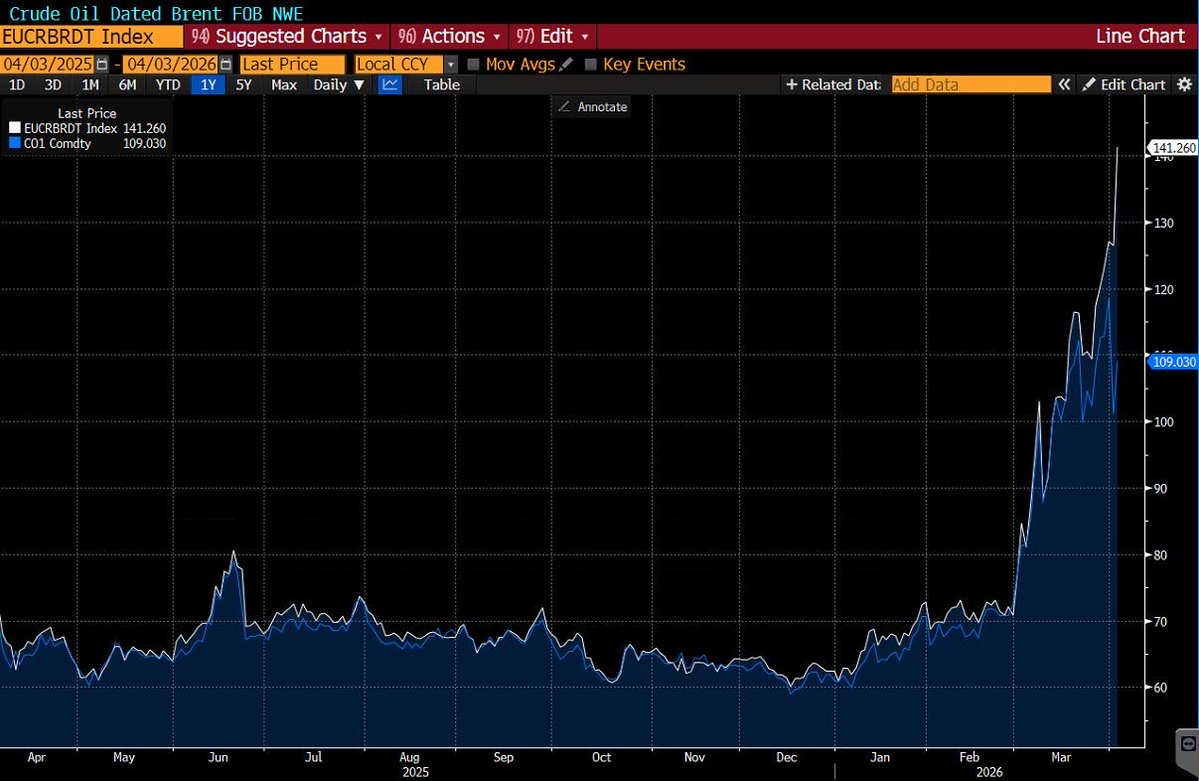
There are two oil prices tonight and they are $40 apart. The one on your screen says $109. The one on the tanker says $140. The screen is a bet. The tanker is a fact. And the gap between them is the space where the true cost of this war hides from the public, from the polls, and from the President who quotes the lower number.
Brent futures closed near $109 on April 3. That is the price traded in London by hedge funds, algorithmic systems, and institutional investors speculating on when the war ends. Dubai physical crude, the benchmark for actual barrels loaded onto actual tankers and delivered to actual refineries in Asia, traded between $126 and $140, with spikes to $166. Dubai physical has risen 76 percent since the war began. Brent futures have risen 36 percent. The gap was less than one dollar before February 28. It is now $37 to $40 on an average day and $57 on a bad one. This is the largest sustained paper-physical divergence in the modern history of the oil market.
The futures market is pricing a short war. Brent for December 2026 trades at $80. Paper believes the strait reopens and barrels flow. Physical says the strait is closed, diplomacy collapsed on April 3, and barrels are not flowing. Eight million barrels per day were taken offline in March, the largest monthly disruption on record. The IEA released 400 million barrels from strategic reserves, the biggest coordinated draw in history. The US SPR sits at 345 million barrels after 2022 drawdowns never replenished. At current consumption, the reserve covers roughly 18 days.
The bypasses were supposed to close the gap. Saudi Arabia’s East-West pipeline is at its full 7 million barrels per day. Terminal constraints cap exports at 5 million. The UAE’s Habshan-Fujairah pipeline is near its 1.8 million limit despite March 28 fires. Combined, bypasses cover 13 to 28 percent of normal Hormuz flows. The remaining 72 to 87 percent is gone.
And here is the detail that closes the circle. Habshan, the origin point of the ADCOP bypass pipeline, caught fire twice in fifteen days from the debris of intercepted missiles. The bypass that was built to survive a Hormuz closure starts at a facility that is burning from the wreckage of its own air defences. The pipe works. The source is on fire. The workaround is damaged at the point where the oil enters it. The molecule reaches the bypass and finds the bypass is burning.
The screen price is what Trump quotes when he says oil will come down. The physical price is what Asian refiners pay when they bid for the last cargo in the Gulf. The screen is what the Fed watches for rate decisions. The physical is what sets jet fuel, diesel, fertiliser, and everything that moves on a truck. The screen responds to ceasefire tweets. The physical responds to tanker availability. One is a narrative. The other is a molecule.
The narrative says $109. The molecule says $140. The gap is the war. And the market that closes tonight for 63 hours has no mechanism to price what happens to either number when the April 6 power-plant deadline expires on Monday evening and the bypasses are maxed, damaged, and burning at the source.
open.substack.com/pub/shanakaans…
English
mark retweetledi

⚡️Forty is the age where a person finds out who they actually became.
By then, the body tells the truth. Money tells the truth. Marriage tells the truth. Kids tell the truth. Career tells the truth. Energy tells the truth. The fantasy version is dead.
Most people are not destroyed by bad luck. They are destroyed by fear, avoidance, and years of lying to themselves. Forty is when the bill shows up.
That is why it feels terrifying. Time is no longer theoretical. Parents start dying. Children need real provision. Weak habits become permanent damage. Mediocrity stops looking temporary and starts looking final.
Fear steals lives. People waste their strongest years hiding, delaying, coping, numbing, rationalizing, and pretending they still have endless time. Then forty arrives and reality becomes visible.
The clean truth is this.
Forty is terrifying because by then there is evidence.
Tim Denning@Tim_Denning
The most terrifying age is 40. Not because you’re getting old or have some grey hair, but because your perception of time completely changes. At 40, life is f*cking serious. If you have kids and don’t work hard, they starve and end up getting a bad education. You also see the difference between those who f*cked around and figured it out and those that settled for mediocre. The stark difference will rip your face off. A person who could have done a lot and didn’t by 40 has wasted the best years of their life. It’s sad to see. By 40, the lifestyle you chose becomes obvious. Your hair turns grey or falls out if you abuse your body. You end up with a pot belly if you eat like sh*t. If you don’t go to the gym you have no energy. Something else happens. Your parents either die or have multiple near-misses. You start to realise they will be dead one day and you’re in charge of your bloodline. This responsibility weighs on you. Even cooler, the knob heads in high school who made fun of you or thought they were cool are not modern day losers. They work dead end jobs and watch sports with a beer to numb their pain. They don’t dare f*ck with your aura anymore. Pessimism can often set in to. You start to obsess over news and politics. You think the government will save you or that billionaires are evil for doing what you refused to do. Jealousy gets ugly. It becomes a realise valve. The best place to deploy it is on social media. You rage post comments calling stuff scams and trying to discredit people. But it doesn’t work. People ignore you because they know you’re a little b*tch. For many people, 40 becomes a moment of either radical transformation or a slow decline. The crazy part isn’t turning 40. It’s realizing how much time you wasted being trapped by fear.
English
@JakeCan72 @BasedSolutions1 What is being sold is access to a state that has proven difficult to reproduce by other means. Everything else is merely infrastructure built around that fact.
English
mark retweetledi

A Japanese restaurant put “face slap” on the menu.
500 yen per slap. Up to five. Extra 100 yen to pick your server.
It started free. Demand forced them to charge.
Onlookers cheered. Women requested multiple rounds. The owner noticed.
So he flipped it: female customers could pay to do the slapping.
American spas charge $200 for a sound bath.
Japan charged $3.50 to hit you.
Both call it stress relief. One of them has a waitlist.
English
mark retweetledi

Hormuz effect.
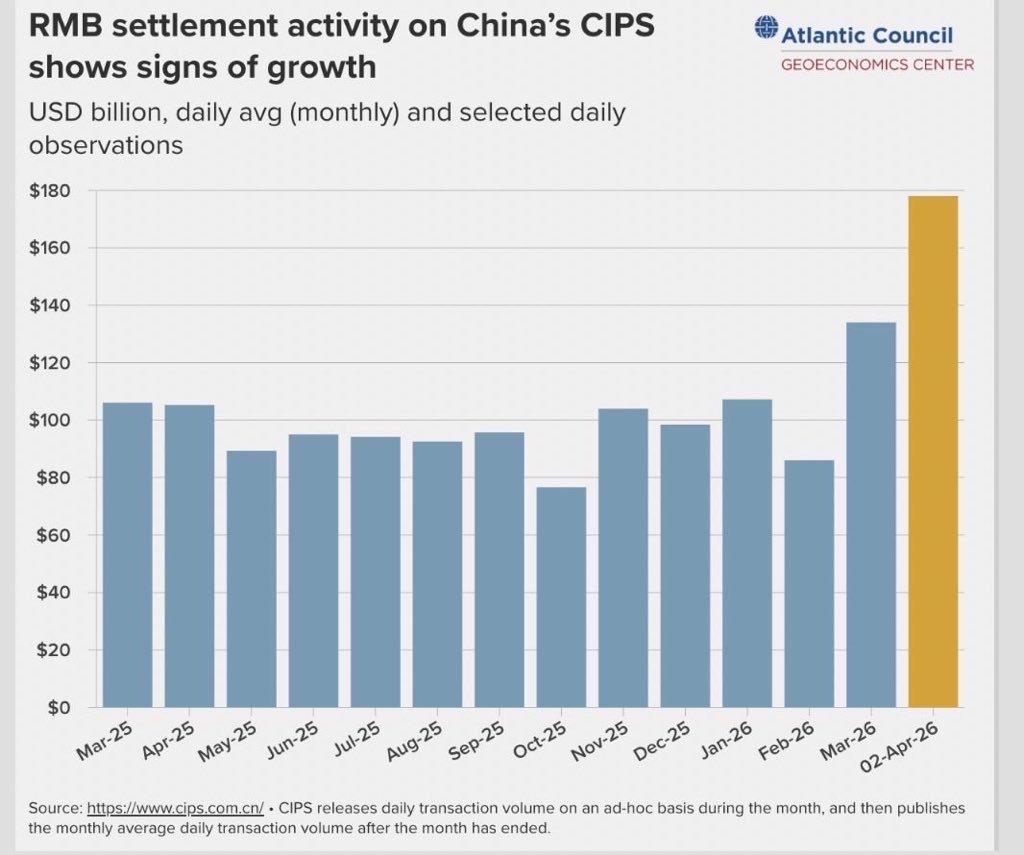
Yesterday’s CIPS payment volume was double the February daily average payments.
Eric Yeung 👍🚀🌕@KingKong9888
France paid the Iran strait of Hormuz toll in Chinese RMB Yuan.
English
mark retweetledi

The largest foreign holder of US Treasuries isn't China.
It isn't Japan. It isn't the UK.
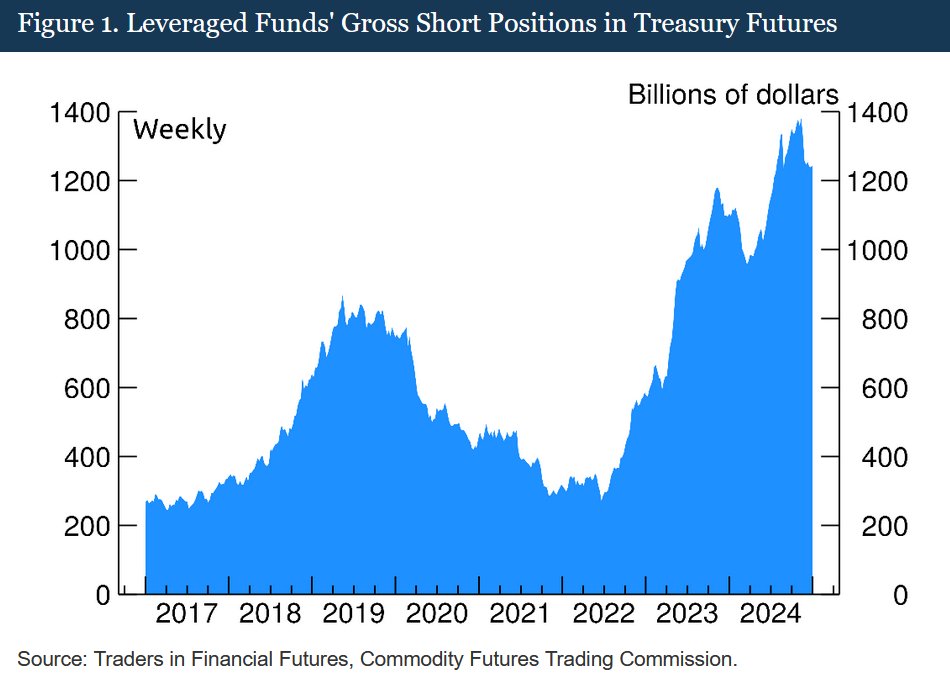
It's the Cayman Islands. Hedge funds running basis trades.
They absorbed 37% of all new Treasury issuance between 2022-2024.
The US needs to roll over $10 trillion in debt next year.
And the buyers are leveraged hedge funds in offshore tax havens.
English
mark retweetledi
⚡️Broad index investors are getting seduced by a true story told in the wrong place.
AI is real. The economic impact is real. The productivity unlock is real. The concentration effect is real. That does not mean the whole S&P suddenly deserves a free pass on valuation. It means a narrow cluster of companies may end up absorbing an absurd share of future profits while a lot of the rest of the index gets left behind or quietly hollowed out.
That is the part people do not want to say cleanly. AGI or near-AGI does not make valuation irrelevant. It makes dispersion extreme. A few firms may deserve to look insanely expensive right before they become even more dominant. The broad market can still deliver mediocre returns while those few names carry the narrative.
The Howard Marks chart is not sacred law. It is a summary of the old regime. Chamath is right that a production function shock can break old historical relationships. But people are taking the most bullish possible interpretation of that and smearing it across everything.
That is where the bullshit starts.
The deepest truth is uglier than both camps admit. If machine intelligence really starts to bite into the economy, the winners will be more valuable than traditional valuation models can comfortably hold, and the losers will be less durable than the index makes them look. That creates a market that feels expensive, gets more expensive, and still contains large areas of future disappointment.
So the real answer is this: the AI bulls are directionally right about the future and sloppy about the vehicle. The broad market is not some automatic safe harbor just because AI is coming. It is a bundle of future winners, future roadkill, and a handful of firms that may capture an obscene share of the upside.
The real bet is that economic power is about to compress violently into intelligence infrastructure, compute, energy, and distribution chokepoints.
If that happens, passive broad exposure becomes a much messier instrument than people think.
Chamath Palihapitiya@chamath
don't worry. we are moving up and to the left. the days of 3-5% equity yields don't make sense sense if AGI is real. it isn't the safe harbor you think it is...
English
mark retweetledi

Anthropic is so based.
They're like:
"We are Microsoft Excel for coders. We don't give a shit about low-value normies and hobby vibe coders.
We don't give a shit about your cringe openclaw toys.
We don't want to be your therapist friend.
We just want to bill serious enterprise coders $10k/month.
That's all we want- everyone else can sod off pls.
All the cheap fucks can suck at Scam Altman's tits- WE DON'T CARE
Theo - t3.gg@theo
I got the email too. Anthropic is on a sentiment suicide speed-run right now
English
mark retweetledi

Telegram was banned in Russia — yet 50M+ Russians still use it daily via VPNs. The government has spent years trying to ban VPNs too. Their blocking attempts just triggered a massive banking failure — cash briefly became the only payment method nationwide.
English
mark retweetledi

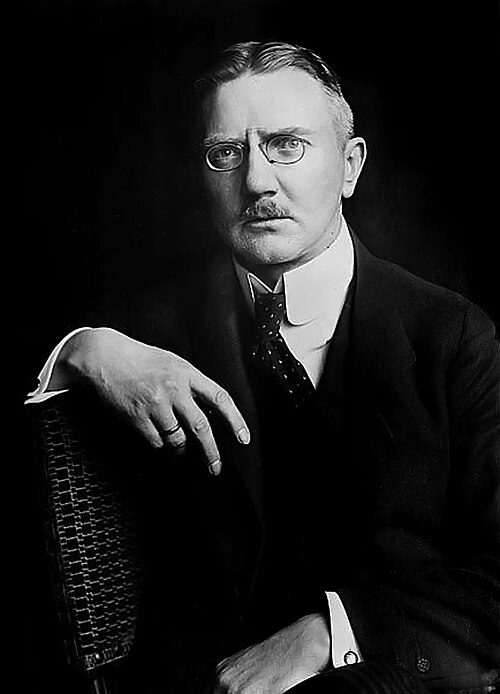
You've heard a lot about Keynes, but do you know this guy?
Hjalmar Schacht stands as history's most dangerous central banker—not because he was incompetent, but because he was brilliant at monetary manipulation.
The "wizard of finance" orchestrated Germany's recovery from hyperinflation in 1924, ending the Weimar Republic's currency collapse through orthodox monetary policy. Gold standard restoration, spending cuts, balanced budgets. Classic Austrian medicine that actually worked. But Schacht's success became his curse—politicians learned they could use monetary technocrats to achieve impossible economics.
When Hitler rose to power, Schacht returned as Reichsbank president and crafted the MEFO bills scheme—shadow money creation disguised as private commercial paper. Pure monetary sleight of hand. The Reich issued these bills to armament companies, who discounted them at the Reichsbank for cash. Officially, government debt stayed low. Reality? Schacht printed 12 billion marks of hidden inflation to fund rearmament between 1934-1938. Unemployment dropped from 6 million to under 1 million, and the world marveled at the German economic miracle.
Schacht eventually resigned in 1939 when even he recognized the unsustainability of his creation. The Allies later acquitted him at Nuremberg, calling him a "patriot" who opposed Hitler's war. They missed the deeper point—Schacht had shown every future government how to disguise monetary expansion as economic genius.
Modern central bankers study Schacht not as a cautionary tale, but as an instruction manual. Quantitative easing, special purpose vehicles, government bond purchases "for liquidity"—all variations on MEFO bills. The techniques change, but the core deception remains: making something from nothing while calling it sound policy.
English
mark retweetledi

⚡️ INSIGHT: Cathie Wood says Bitcoin has entered a mature phase, drawdowns may be limited and not 85–95% as previous cycles.


English

The Financial "Nuclear" Mechanism
The Strait of Hormuz is the world’s most critical energy chokepoint. Following the recent escalations in 2026, Iran has effectively transitioned from a physical blockade to a selective, political blockade.
1- The Insurance Kill-Switch: By creating their own "safe corridor" and vetting system (managed by the IRGC), Iran is bypassing the Western insurance market (Lloyd’s of London). If Iran "guarantees" a ship, they are effectively becoming the insurer and the regulator.
2- De-Dollarization: This deal encourages the EU to pay for transit or energy in Euros or local currencies to circumvent US sanctions. If the EU accepts, they are essentially signaling the end of the Petro-dollar’s absolute reign in the Gulf.
English
mark retweetledi

🚨🚨🚨 IRAN JUST OFFERED EUROPE A HORMUZ DEAL. YOU HAVE NO IDEA WHAT THEY JUST TRIGGERED. 🚨🚨🚨
On the surface: Iran offered the EU transit access through the Strait of Hormuz. Sounds like a small diplomatic move. It is not.
This is a goddamn financial nuclear bomb.
💀 The Hormuz Strait carries 20% of ALL the world's oil
💀 Europe's energy bill jumped $16.2 BILLION in just 30 days
💀 Natural gas in Europe is up 100%. Oil up 60%. Diesel at $200/barrel
💀 Dollar reserves have already fallen from 70% to 56.9% in 25 years
⚠️ If Europe takes this deal, they pay in euros — not dollars
⚠️ One major non-dollar oil deal is all it takes to show the world it CAN be done
The petrodollar is the most powerful financial system ever created. Born in 1974. It forced every nation on Earth to hold dollars just to buy oil. That's the entire basis of US financial dominance.
If that system cracks — BRICS accelerates, Gulf states reconsider, dollar demand collapses, and America can no longer fund its $34 trillion debt on easy terms.
ECB board member Panetta said it on April 2: "Even if the Iran war ends, the damage has been done."
They're showing you a war about nuclear weapons and regional security.
They're NOT showing you that the REAL war is over who gets to print the world's reserve currency.
→ Iran blocks Hormuz for the US. Opens it for EU with a deal.
→ EU, desperate and bleeding, seriously considers taking the deal.
→ Deal gets done in euros or yuan. Not dollars.
→ Every country watching — BRICS, Global South, Gulf states — sees it happen.
→ "If the EU can bypass the dollar, so can we."
→ Dollar demand falls. Reserve share collapses. US inflation rises.
If America is so powerful, why is the EU considering a deal with the country America is bombing?
Complete silence.
This is no longer just a Middle East war.
This is a direct attack on the petrodollar.
Prepare accordingly. 🚨🚨🚨

English
mark retweetledi

There are similarities with COVID. We first had complacency, then daily case runs, and finally market panic. We know about upcoming fuel issues, but soon we will have daily stats of # of pumps, airlines, or even countries without fuel. At some point recession will appear unavoidable. And is not a trade war to be called off with a tweet.
English
mark retweetledi

Capitalism, markets and free trade are just great for humankind.
Todd Jones 🦊@toddrjones
Here are some ways in which the world has gotten better.
English

Buffett is a market timer.
This is the worst thing you can think of by looking at his investment history, yet this dares to suggest it.
He doesn’t “time” the market; he positions according to valuations.
When valuations rise, he positions more defensively and deploys the cash when valuations become attractive again.
Naturally, crashes happen mostly when valuations reach unsustainable highs. He doesn’t time these exact moments, sometimes he waits in a defensive position for a long time.
He started positioning defensively in 2024, for instance, and he is still waiting for a deep drawdown to deploy cash.
It’s not “market timing” it’s just plain old positioning.

English