

crets
2.4K posts

@john_doe1479 Where did you hear this? Who the fuck are you to have heard this? Stop posting unsubstantiated shite.
English

$onds heard iron drone was perfect 100% in DOW TREX 2 challenge. 11 hostile drones taken down. Zero misses.
Every military base WW needs best CUAS tech. ONDS got it in spades
Paid about $1.5 mm to buy Iron Drone. It’s kicking a**/ taking names. ID IS MASSIVELY ACCRETIVE
English
crets retweetledi

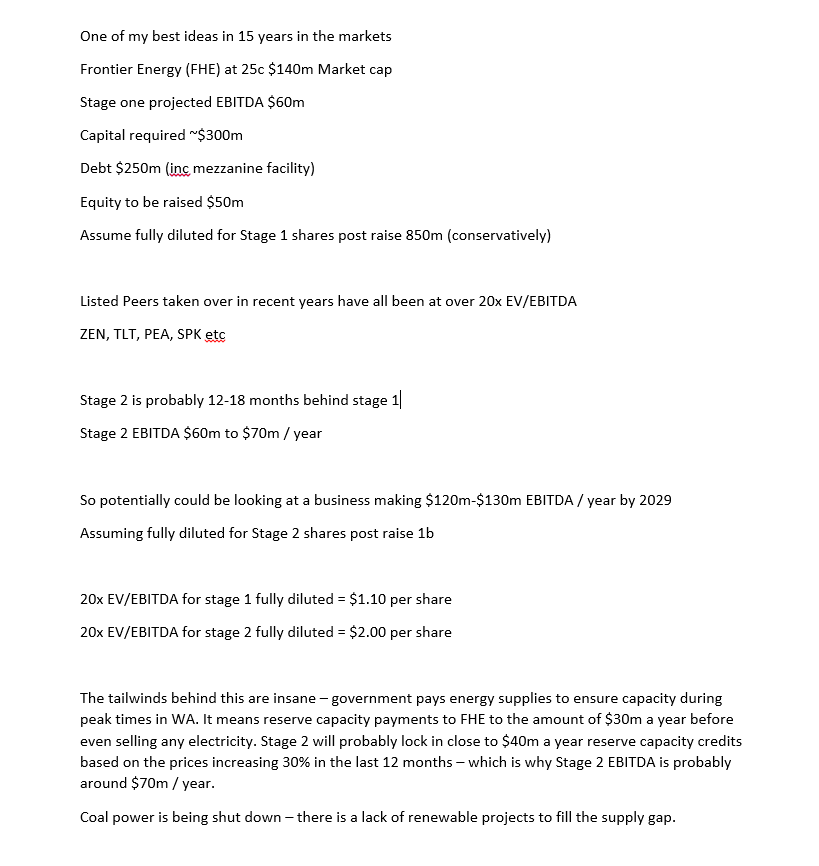
I am long $FHE $FHE.ax. This name has everything going for it. Back of envelope thesis below.
MARKETS FULL OF R3TARD5@ShitValueFund
Later today I will be sharing what I believe is one of my best investments in all my years in the markets. Doesn't get affected by wars, economy, demand increasing - lack of supply. HUGE tailwinds... strong insider buying....
English
crets retweetledi


crets retweetledi

🚨 ServiceNow CEO Bill McDermott just dropped this on the AI hype:
“Most businesses don’t want to build workflow software for everything internally. They want one responsible AI Control Tower.”
ServiceNow is becoming the fabric connecting every hyperscaler, every LLM, systems of record and now full security (cybercrime = $1 Trillion/month problem).
True agentic enterprise is here: MoveWorks, VZA identity, Armis OT/security. Integrated major moves in just 20 days.
Jensen Huang ( $NVDA CEO) approves, they’re teaming up on the agentic future.
2030 Price Target: $1,200 – $2,000+ per share as they hit $30B+ revenue and own the enterprise AI operating system.
While others talk apocalypse, ServiceNow is building it.
$NOW to the moon.
Who’s loading up?
English
crets retweetledi
crets retweetledi

crets retweetledi

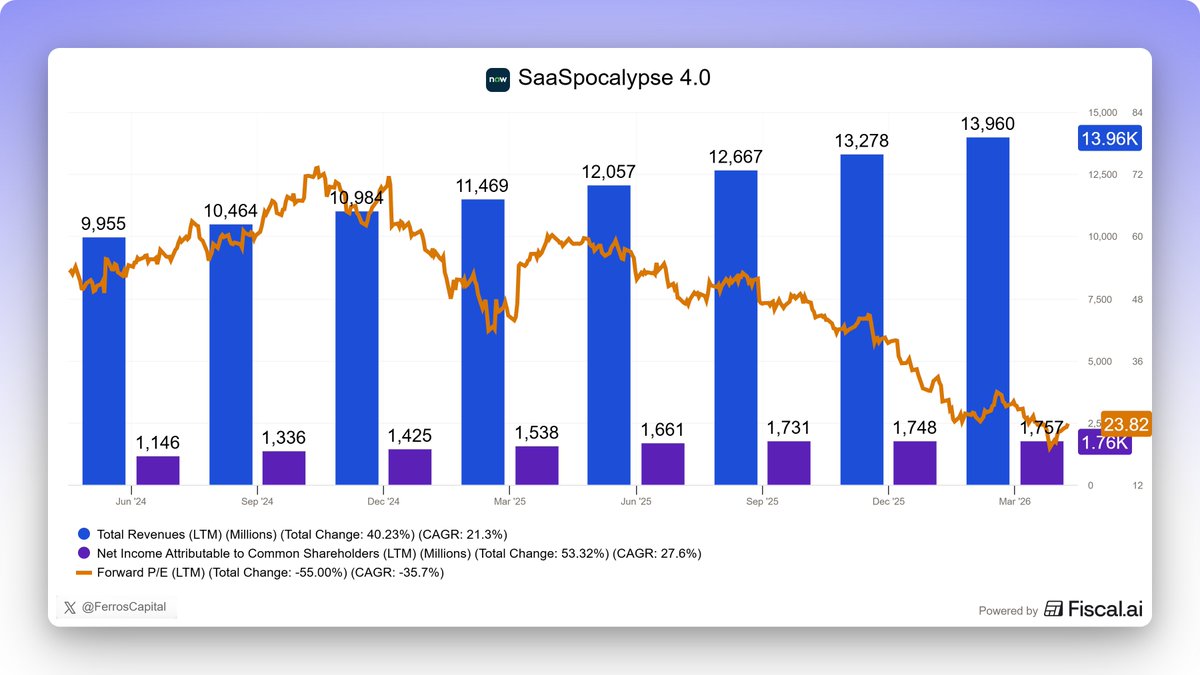
Wall Street’s SaaSpocalypse (4.0 Now!) is the most expensive delusion of 2026. I didn't think I would have to write this out but given the current Stock drop on $NOW , it seems appropriate.
Truthfully, I have never been in pure SaaS stocks besides $ADBE and $CRM for a short term years ago. Now, with the current re-rating from over 200$ per share to below 90$, this deserves my attention - and probably other investors too.
The whole panic thesis still assumes generative AI lowers the barrier to entry so drastically low, that Fortune 500s will fire all their SaaS vendors and build custom software with prompt engineers.
Let's actually audit $NOW (ServiceNow) to dismantle this mathematically and see if there is any merit to it.
1. Massive Enterprise Liability: LLMs are probabilistic engines. In mission-critical Tech, hallucinations can and will break systems. The more you have worked with AI, the more familiar this is to anyone reading this.
Equipping an entry-level developer with AI does not magically forge a master architect. Nor does it neutralize the immense gravity of legacy enterprise code. A sprawling architecture so complex that even the senior engineers who built it are usually terrified to alter it.
Unrestricted AI is a liability; governed AI can be a weapon.
2. Architectural Gravity: You don't rip out the operational nervous system of a global enterprise with a custom ChatGPT wrapper. ServiceNow’s moat isn't just code; it's decades worth of compliance, security, and integration logic.
Rebuilding that foundation requires an army of top-tier engineers. This structural moat applies equally to giants like $MSFT and other Software stocks. The barrier to entry hasn't fallen; the complexity of orchestration has exponentially increased.
3. The Physics of Compute: AI tokens burn massive capital. If you have scaled API infrastructure yourself, you know that token consumption obliterates budgets instantly. Even worse so at enterprise scale.
The foundational API providers (Anthropic, OpenAI) simply do not possess data center capacity to support this.
Even now, Anthropic is already putting restrictions on newer Models because they simply cannot service everyone, despite saying otherwise. ServiceNow already commands this infrastructure on optimized hyperscaler rails.
ServiceNow Chairman and CEO Bill McDermott's first sentences in the last earnings report were: "Since our founding, we’ve built our platform around the work customers need to accomplish. Today, they rely on ServiceNow to be their AI control tower for business reinvention." -> Enterprises demand an orchestration layer and $NOW is delivering.
Despite this, algorithms just wiped 16% off the stock over noise. Look at the actual Q1 reality:
• Remaining Performance Obligations (RPO) hit a staggering $27.7 Billion (+25% YoY). Enterprises aren't leaving; they are locking in for the next decade.
• Now Assist AI customers spending >$1M surged 130% YoY.
• The price collapsed to $86 at the time of writting. Against $4.17 Fwd 2026 EPS, the Forward P/E drops to 20.6x.
• Against a 20%+ Forward EPS CAGR, the PEG compresses to a flawless 1 (assuming they can keep up their EPS growth).
The workflow Software monopolies aren't dying. They are evolving into the ultimate AI toll-bridges. $NOW extracts the tax on the enterprise deployment of AI.
Compute is physically so constrained by HBM memory (Check out my $SKHynix thesis), enterprises are forced to rely on highly efficient, centralized platforms like $NOW to orchestrate their workflows.
Sooner or later, this negative Sentiment will pass - at least for $NOW. Are you buying the Dip?
Data & Chart by @fiscal_ai
English
crets retweetledi

$ONDS received an initial $10M order under a broader $50M Israel border demining award.
Including its separate Syria border project, Ondas now has about $80M in active demining tenders.

English
crets retweetledi

You can become a millionaire in 2026.
Just follow the right traders on here.
Last year, I nailed:
$ONDS at $0.83
$IREN at $6.30
$CIFR at $3.01
$OPEN at $0.58
And many more.
You would’ve made multiple 10x trades.
More recently:
$SATL at ~$3
$FLY at ~$20
$SIDU at ~$2
I’ll share another potential 10x gem soon.
Don’t miss out this time.
English

Japan has a 112-year-old gas monopoly that heats an entire prefecture.
Zero competitors. No debt. ¥5B cash on the balance sheet.
Trading at 42 cents on the dollar of book value.
1.9× EBITDA.
The reason it's cheap: nobody on Wall Street has ever heard of it.
$9537.T (bio for more info)

English
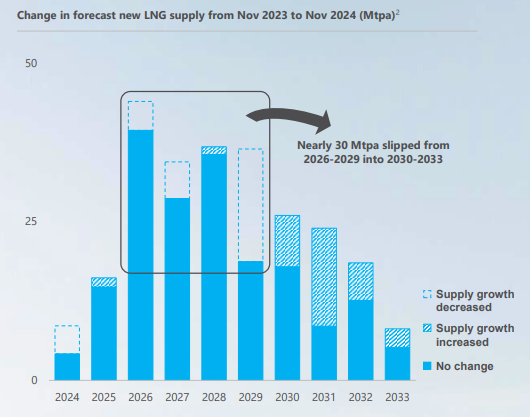
@ShitValueFund What’s happening to MLG, PRN, EHL… no more diesel available in Australia?
English
Ok not too bad $AUE $AUE.Ax raising to $PRU with MD putting his money where his mouth is
English
crets retweetledi

crets retweetledi
Completely 👍
Kristin Rowe@MsKrowe1376
. @AurumResources (#ASX: $AUE) is rated BUY by Petra Capital with a $1.84 price target, implying ~188% upside to the current share price of $0.64. The note follows a 26% increase in the Boundiali Resource to 3.03Moz, lifting total group resources to 3.90Moz including Napié. Petra says the upgrade confirms Boundiali as “a premier large scale West African gold asset”, with Indicated Resources increasing 49% to 1.37Moz. The resource also includes 1.6Moz at 1.7g/t gold, a higher grade component that could support faster project payback. With 12 rigs drilling, a 100,000m program underway, and the Boundiali PFS due this quarter, Petra highlights strong momentum as the project continues to move toward development. Full report here: aurumres.com.au/wp-content/upl…
English
@Peter_Lukacs_R I know plenty in the Australian stock exchange
$EHL $PRN
English

Sure but everyone knows of $META
I need an overlooked/hated compounder gem
Like a Finnish forklift operator with a local monopoly or something
English
@value_screener looks cheap at P/Es of 6-7x, especially given 40%+ margins and prospects of starting deleveraging and buybacks!
this 1E acquisition I am not smart enough to understand if it will be disruptive or not... they paid a lot for it...l
English

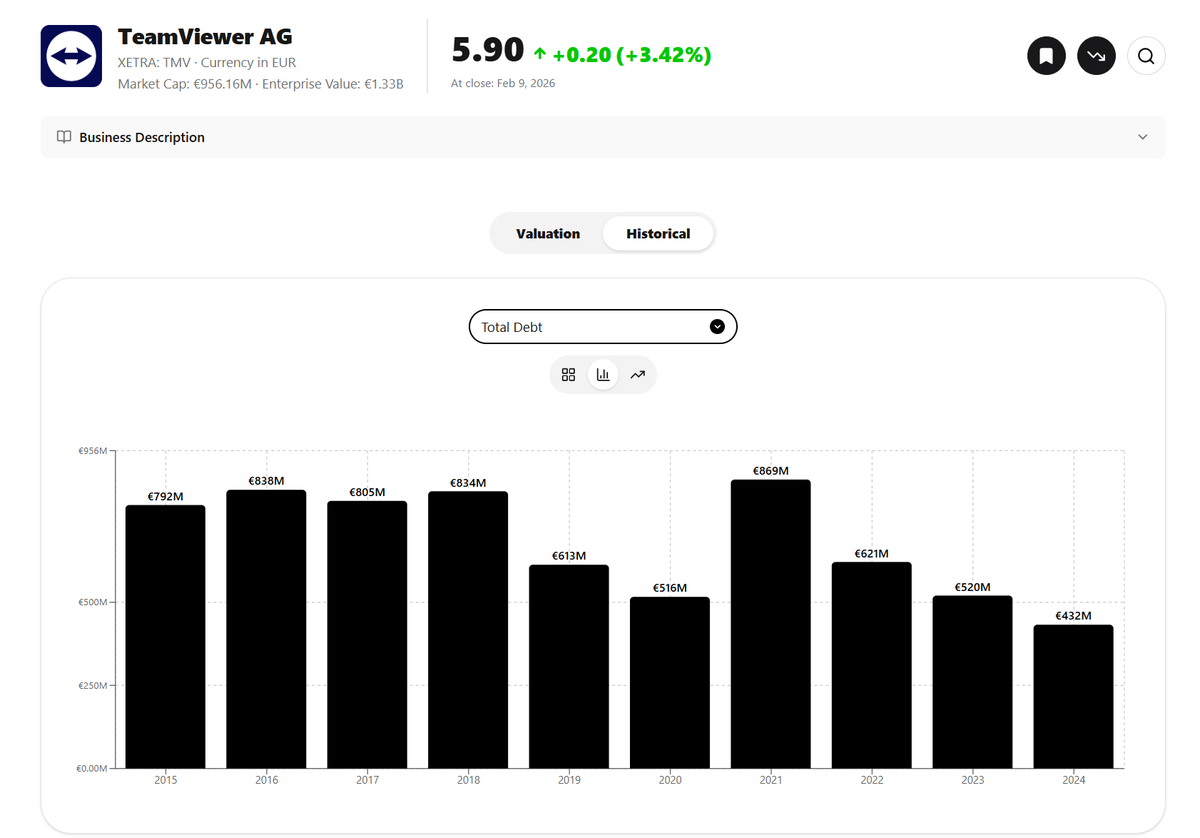
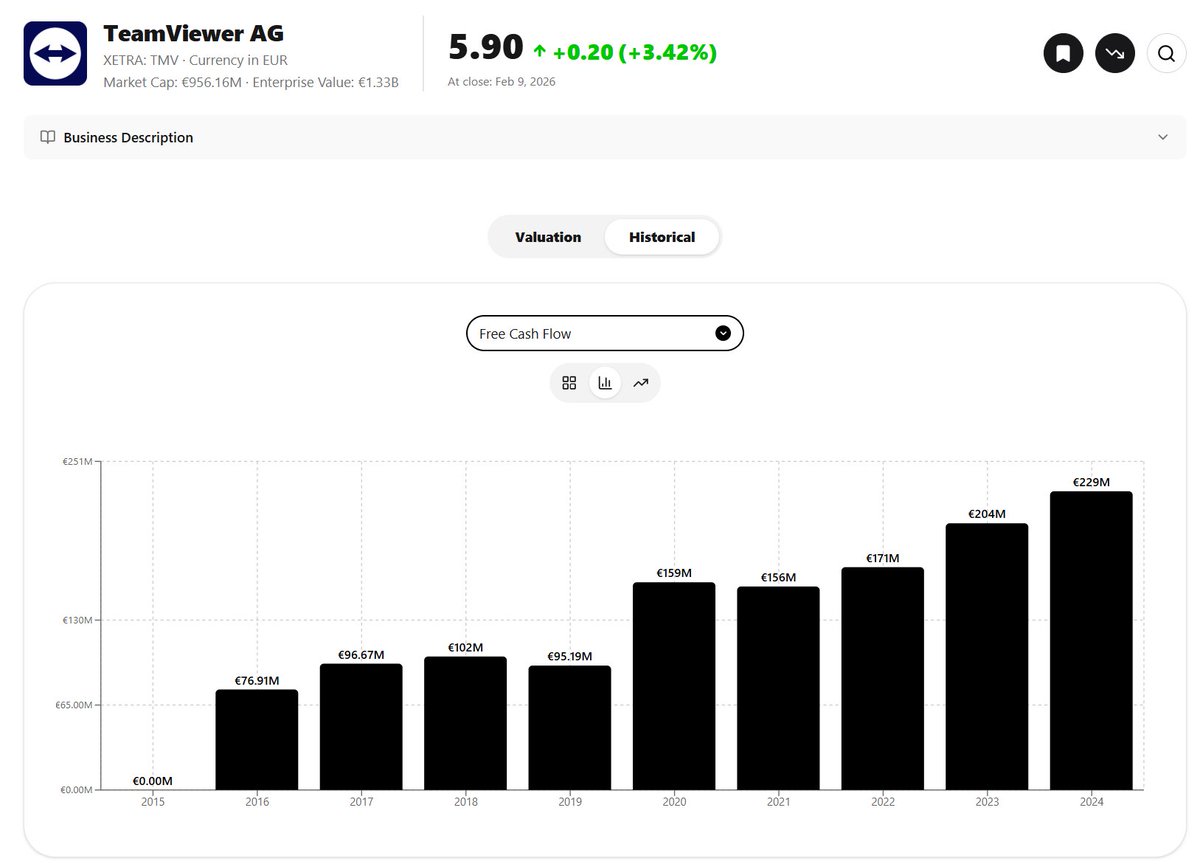
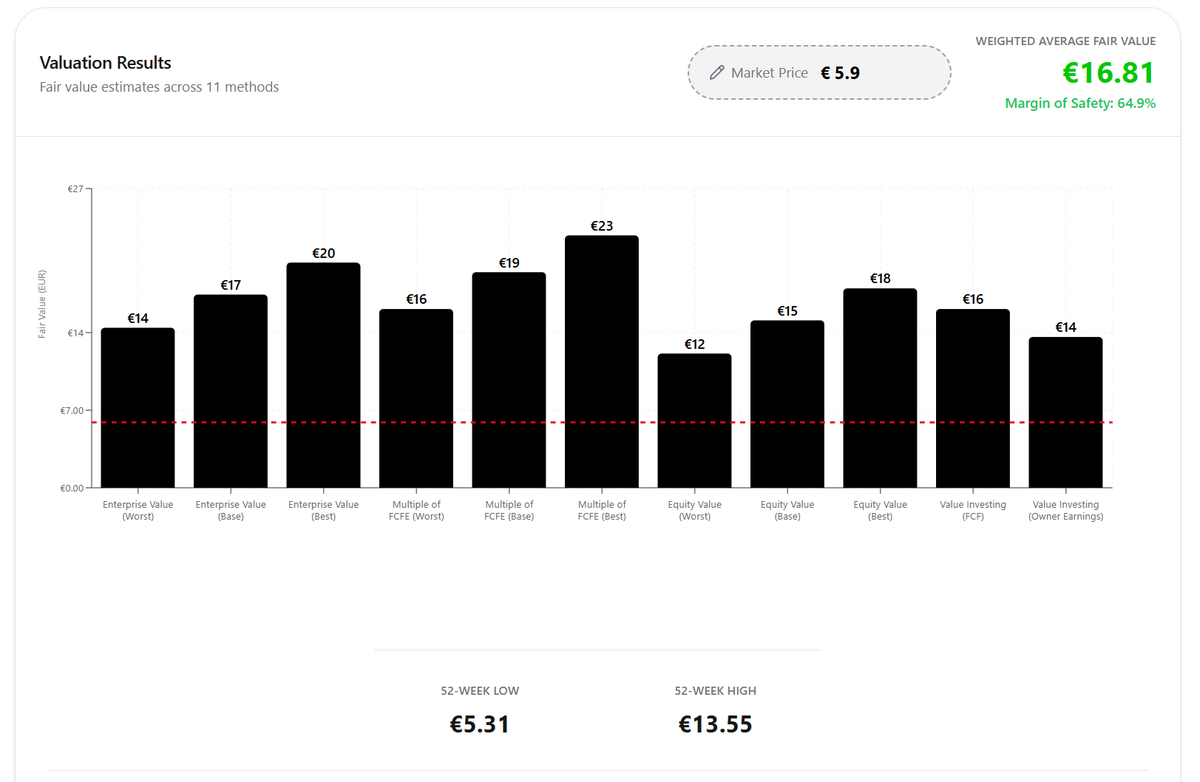
TeamViewer AG $TMV is deleveraring nicely. Grows nicely. Is hidden from big money because it's makes less than $1B in sales. Consistently spitting FCF.
And it is drastically undervalued. While trading near its 52wk low.
You are welcome.

English