

DaySleeper
5.3K posts

DaySleeper
@capnstickyleaf
DaySleeper
United States Katılım Aralık 2011
2.2K Takip Edilen358 Takipçiler

Which crypto sector dominates your portfolio right now?
English

Can we really trust the people who prefer chicken breast to chicken thighs?
English
DaySleeper retweetledi

Your brain has a circuit that doesn't know you live in a city. Its only job is to monitor whether birds are still singing. Right now, in this room, it is on.
The circuit predates primates. Mammals have been using ambient soundscape continuity as a predator-detection system for roughly 200 million years. Birds stop singing when something larger moves through their territory. For most of mammalian history, a forest full of song meant no large predator was nearby, and the cessation of sound was the warning. Your nervous system never updated this software.
The Max Planck Institute tested the inverse in 2022 with 295 participants. Six minutes of birdsong dropped anxiety with a medium effect size. Six minutes of traffic noise raised depression with the same. The effect worked on subjects who lived in dense urban environments and had no regular contact with nature. The brain still ran the check.
Birdsong sits in the 1,000 to 8,000 Hz range. Your brainstem reads continuous patterns in that band as a signal that nothing dangerous is currently moving through the environment. EEG data shows birdsong at 45 to 50 decibels boosts alpha wave activity by 14.1% relative to silence. Alpha is the brainwave signature of relaxed alertness. Push the same birdsong above 60 decibels and the response flips. Stress markers rise 29%. The circuit only trusts the signal at the volume of quiet conversation, which is exactly the volume birds sing at from a typical distance.
Three things happen simultaneously when the brain registers ambient safety. The amygdala downregulates. The parasympathetic nervous system takes over from the sympathetic. Heart rate variability rises, cortisol drops. The posterior cingulate cortex, which sits at the center of the rumination circuit, quiets down. King's College London tracked this through a smartphone study with over 1,200 participants and found the mood lift lasted hours after the sound stopped. People diagnosed with depression got the same response as healthy controls.
Most of what gets labeled mental fatigue is hypervigilance running in the background. Birdsong tells the circuit it can stand down, and the brain reallocates the freed compute everywhere else.
A quiet park feels different from a quiet office because the parks have sentinels.

English

If we 10x our productivity, you would need to do 1/10th the work to maintain the current standard of living, and you could spend the rest of your time doing art.
The world lives on like $7 a day, USA median spending is $70. If you are in USA you likely have 10x the freedom to do art then half the world.
Of course, if you did work your ass off and so did everyone else in the world, and we all 10x’d our productivity, then the rest of the world could have the option to live as well as the median American today. Consequently our standard of living would likely 10x as well.
English


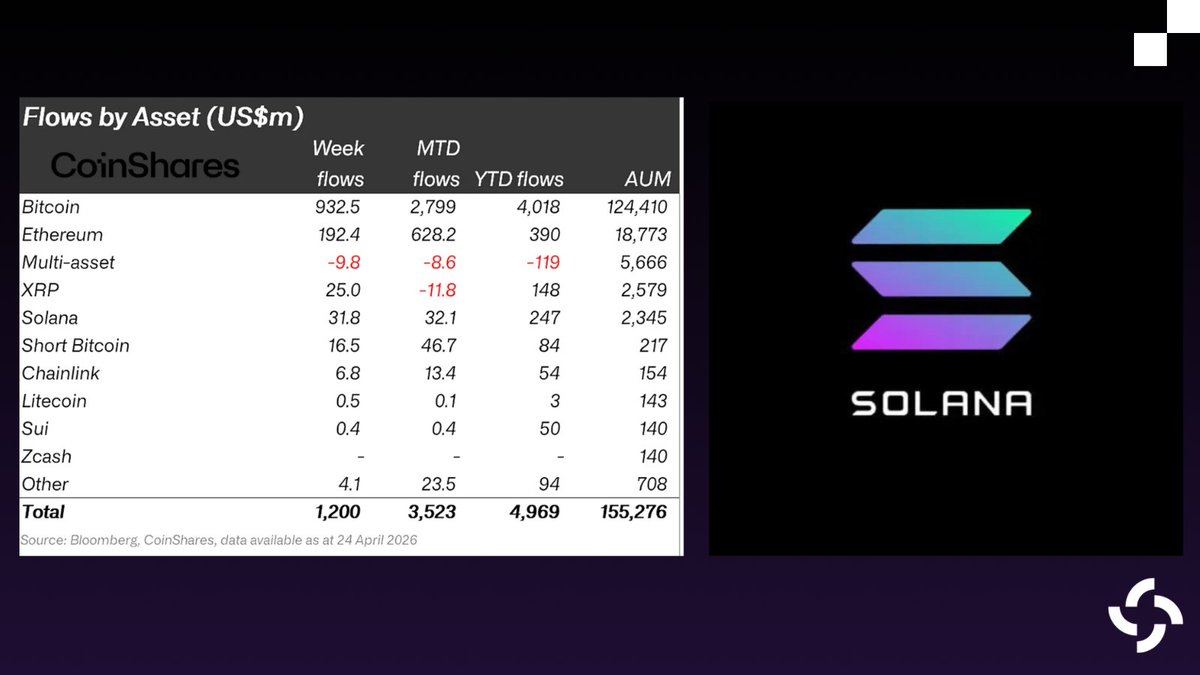
JUST IN: Digital asset investment products recorded $1.2B in inflows last week, extending the positive streak to four consecutive weeks. @Solana saw $31.8M in net inflows, breaking a two week outflow streak, with YTD inflows now at $247M.
English

DaySleeper retweetledi


DaySleeper retweetledi

few things cooler than a long, spinny bunker shot to kick-in range. but it gets a lot cooler when it’s to win your third PGA Tour event in a month. and a lot cooler than that when it earns your little brother the Tour card he’s always dreamt of. wow
English
@bryan_johnson Thoughts on drinking a ton of black tea late in the evening and pacing around the house?
English

Surprising new findings about coffee: you are drinking coffee for the gut bugs that run your brain.
> coffee affects the gut which then affects your brain
> it's the coffee bean, not the caffeine, doing most of the work
> polyphenols feed gut microbes, microbes send chemical messages, brain responds
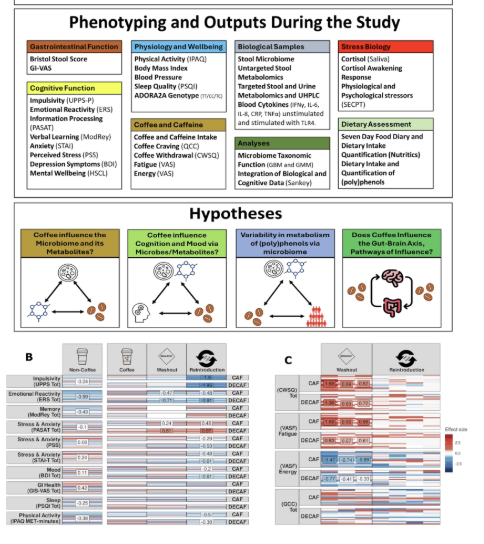
> both coffees lowered inflammation, caffeine drove it further down (IL6, IL10)
> decaf raised systemic inflammation markers (hs-CRP, TNF-alpha)
> decaf uniquely fed the protective gut microbes
> caffeine blocked those gains by pushing food through too fast for the Clostridia bacteria to finish their work
> at baseline, coffee drinkers sat in the bottom 25 to 30 percent for protective gut metabolites compared to non-drinkers
> coffee lifted mood, cut depression and stress
> caffeine specifically lowered anxiety.
> the stress hormone story people tell about coffee does not hold up, cortisol did not budge
Study details:
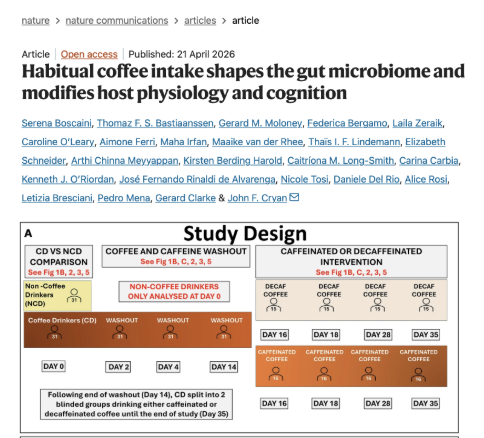
62 people, 14-day coffee washout, then 21 days randomized double-blind to caffeinated or decaf. They measured gut bacteria, stool and urine chemistry, cognition, mood, blood inflammation, and cortisol.
What to do
Caffeinated in the morning for focus and lower anxiety. Decaf in the evening for memory and gut. One cup 6 hours before bed still acts like half a cup at bedtime. Less is better than more either way.
The takeaway
You are drinking coffee for the bugs that run your brain.
English
DaySleeper retweetledi
Introducing ChatGPT for Clinicians:

Karan Singhal@thekaransinghal
Today we’re introducing two big steps for health at OpenAI: - ChatGPT for Clinicians, a free version of ChatGPT designed for clinical work - HealthBench Professional, a new benchmark to evaluate real clinician chat tasks We’re excited about what this can unlock for care. ❤️
English
DaySleeper retweetledi

Never seen something like this ever. This is incredible. Holy moly.
English
The total crypto market cap is around $2.6 Trillion. How long before it gets to $10 Trillion?
English
@Austin_Federa How many deaths has smoking weed caused? Government job isn’t to stop you from doing things that are bad for you.
English

The disastrous results of weed legalization has made me rethink a number of libertarian positions — specifically around the intersection of personal responsibility and addictive substances.
English


DaySleeper retweetledi

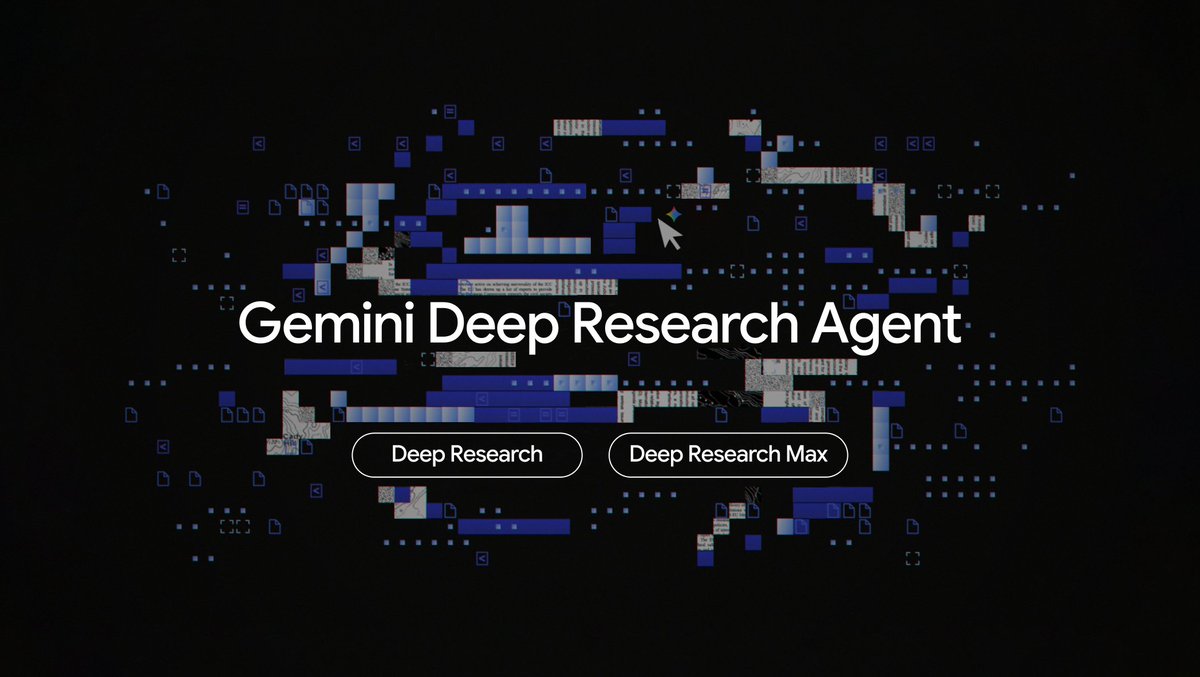
Deep Research and Deep Research Max are our latest autonomous research agents powered by Gemini 3.1 Pro.
They can safely navigate both the web and your custom data, like internal docs and specialized financial information, to create professional-grade, fully cited reports. 🧵
English
DaySleeper retweetledi
Today we've published the first position paper from the Coinbase Independent Advisory Board on Quantum Computing and Blockchain, a group of leading researchers from Stanford, UT Austin, the Ethereum Foundation, and beyond.
The short version: your crypto is safe today. But a quantum computer capable of threatening blockchain cryptography will eventually be built, and the industry needs to start preparing now, not when it's urgent.
The paper covers what's actually at risk, what isn't, where major blockchains stand on migration plans, and concrete recommendations for chains, custodians, and institutions.
We stood up this board because we believe security decisions of this magnitude should be driven by the best available science. This is our first report, but will have more updates to share as we go.
Full summary and link to the paper: coinbase.com/blog/coinbase-…
English
DaySleeper retweetledi

In crypto and defi (ie in honest markets), when a component fails, those closest to the component—whether wildly negligent or innocent victim—suffer the loss, and are burdened with that responsibility. Unequal, but proper.
In tradfi and banking (ie in coercively manipulated markets), when a component fails, the entire society is forced under the burden of its resolution. Costs are socialized. Equal, but improper.
The former, with time, becomes self-correcting, self-improving, and crucially, retains vitality. The latter, regardless of time, becomes stagnant and soulless, and here everyone can wallow in an equivalent grey.
Any man of agency should prefer the former, taking care over that to which he is proximate. It is from this that the virtue of markets emerges.
English