Chris Davis

6.7K posts

Chris Davis banner
Chris Davis

Chris Davis

@capradavis

prev. @MessariCrypto | Buying tops, selling bottoms since ‘21 | NFA

Exchange Alley Katılım Ekim 2018
890 Takip Edilen3.4K Takipçiler
Sabitlenmiş Tweet
Chris Davis
Chris Davis@capradavis·
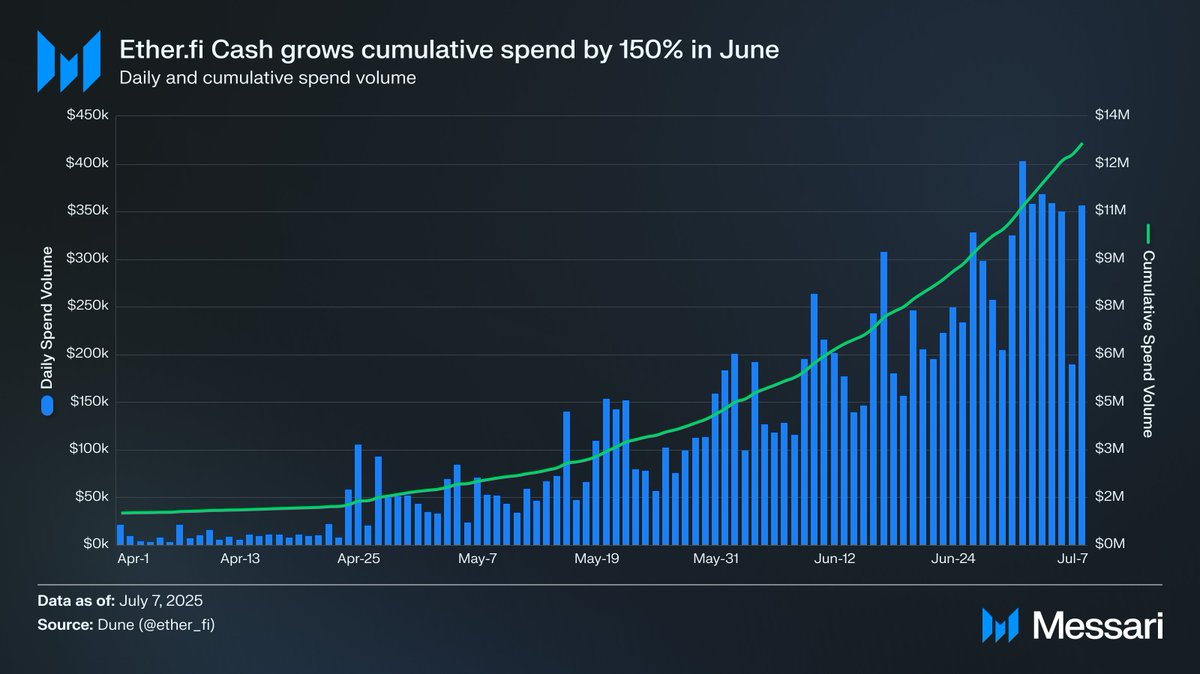
To most market participants, @ether_fi is known as the restaking market leader. With over 2.5 million ETH (~$7.7 billion) in deposits, it currently captures roughly 70% of the sector’s market share. However, Ether.fi is steadily evolving into a crypto native neobank with a multifaceted suite of vertically integrated products and services (potential HL perps integration loading…). The most recent addition to their product offering is Cash, a non-custodial cashback credit card that allows individuals and businesses to spend and borrow against their assets, including those deposited in vaults earning yield. In June, Ether.fi’s Cash product maintained the strong adoption trajectory it has seen since its public launch in late April. Since launching, the product has driven $14.85 million in total spending across more than 3,400 active cardholders, with June alone accounting for approximately 40% of this cumulative spend and the issuance of 1,741 new cards. While the Cash product is not yet a major revenue driver, the team is laser-focused on scaling this offering. As a base case, the team aims to grow active cardholders to 40,000 in 2025. This would add an estimated $13 million to the $54 million in revenue currently projected from the Liquid and Stake products alone ($90k BTC, 2k ETH assumption). Achieving their base case target would require sustaining June’s 170% MoM growth rate in card issuance through the rest of the year. However, since their initial article published in April outlining their goals, the team has stated that internal targets have shifted closer to the initial bull case of 100,000 cardholders, which would require an even more aggressive growth rate of roughly 205% MoM. This is a tall order, but not impossible. To date, retail growth has been fueled primarily by word of mouth and referrals. The team believes that increasing capital investment in growth initiatives could accelerate progress toward this goal. Additionally, over 400 businesses have initiated the onboarding process for Cash, representing a potential 550% increase compared to the current number of onboarded businesses (figure as of July 7). While Ether.fi’s initial Cash growth has been impressive, expansion comes with challenges. First is the mounting competition from major industry players such as Coinbase, Revolut, and Robinhood. Ether.fi’s GTM for the rest of 2025 focuses primarily on retail and corporate DeFi users before expanding to CeFi users and the broader neobank market in 2026. In these future target markets, incumbents hold a major distribution advantage, with tens of millions of retail users to whom they can cross-sell card products. However, Ether.fi’s offering is highly competitive as its Liquid and Stake products strengthen the appeal of Cash. For example, Robinhood Gold’s 4.5% APY on uninvested cash pales in comparison to Ether.fi’s current 9.6% APY in its market-neutral USD Liquid vault, which generates yield through a mix of fixed and variable rate strategies. Capital in vaults can be borrowed against for credit in Cash, making onboarding attractive and cross-selling significantly easier. While Robinhood and other incumbents are increasingly venturing onchain, Ether.fi’s ability to offer structured DeFi yields is, at least for now, a distinct advantage. Another challenge is the sustainability of Ether.fi’s 3% cashback offer. Currently, this cashback is fully subsidized by Scroll, which funds it using its SCR token. This partnership has been a boon to Scroll’s growth, with Cash funds now accounting for over 50% of Scroll’s TVL. However, as Ether.fi’s daily transaction volume scales into the millions, relying solely on external subsidies will become untenable. Covering 2-3% cashback directly would erase the 100–200 basis points Ether.fi earns on interchange fees, which make up ~90% of Cash’s revenue. TBD on exactly how the team plans to handle this, but my guess would be lowering cashback and supplementing it with other revenue streams as gross margins expand. Despite these challenges, Ether.fi’s product suite is structurally compelling, with each offering designed to drive demand for the others through tight vertical integration. Combined with multiple tailwinds (TradFi firms adding ETH to balance sheets, rising stablecoin adoption, record ETH ETF inflows), the setup looks promising for accelerated growth over the coming months. For more monthly insights from @tulipking , @AvgJoesCrypto , @SteimetzKinji and @defi_monk check out the report linked below.
Chris Davis tweet media
English
17
45
245
47.3K
Chris Davis
Chris Davis@capradavis·
I think most of the people building systems that are genuinely useful for themselves aren’t posting about it because it’s alpha. Anecdotally some of my friends at tradfi funds have created insanely detailed systems w Claude Code that are essentially digital twins, they can turn over more stones to get to insights 10x faster.
English
0
0
1
53
ceteris
ceteris@ceterispar1bus·
idk if a hot take but: a lot of people are making themselves inherently less productive using agents. building slop tools, generating lazy summaries instead of deep reading, wasting time nerdsniping without building anything of real use, creating slop content instead of yourself
English
6
2
46
2.1K
Chris Davis
Chris Davis@capradavis·
Someone should definitely look into this. There’s probably quite a few aspects of AI that could benefit from incentive-driven competitive pressure. Maybe a network with “subnetworks” that tackle different areas of development? Idk, someone should definitely look into this tho.
Wei Dai@_weidai

Is it possible to build "proof-of-useful-work" on top of autoresearch? There's already great compute-versus-verification asymmetry that is tunable. Would need a reliable way to generate fresh & independent puzzles (that are still useful). Maybe a dead end, but someone should look into if decentralized consensus with useful work is possible on top of autoresearch. Let me know if you solve this.

English
2
1
8
499
Chris Davis
Chris Davis@capradavis·
I’m starting to think that the largest decentralized pretraining run ever conducted might be a pretty big deal
templar@tplr_ai

On the @theallinpod this week, @chamath asked @nvidia CEO Jensen Huang about decentralized AI training, calling our Covenant-72B run "a pretty crazy technical accomplishment." One correction: it's 72 billion parameters, not four. Trained permissionlessly across 70+ contributors on commodity internet. The largest model ever pre-trained on fully decentralized infrastructure. Jensen's answer is worth hearing too.

English
11
14
114
9.5K
templar
templar@tplr_ai·
On the @theallinpod this week, @chamath asked @nvidia CEO Jensen Huang about decentralized AI training, calling our Covenant-72B run "a pretty crazy technical accomplishment." One correction: it's 72 billion parameters, not four. Trained permissionlessly across 70+ contributors on commodity internet. The largest model ever pre-trained on fully decentralized infrastructure. Jensen's answer is worth hearing too.
English
83
389
1.6K
416.9K
Chris Davis
Chris Davis@capradavis·
@bloomberg_seth feed tasks through distributed optimization technology -> open source the result to reduce the loss function -> repeat ad infinitum
English
0
0
2
30
seth bloomberg
seth bloomberg@bloomberg_seth·
The auto-research swarms, Kaggle for agents, etc we're seeing right now is the classic example of "the next big thing will start out looking like a toy". So many people now have their hands on agentic intelligence, it's fun to create low-risk competitions and games basically to test the new toys out. All the games and competitions right now are actually ironing out all the rough edges that will take these systems from toys to entirely new ways to structure companies and build products. At some point, it'll make more sense for a founder to create a fluid, open, and competitive marketplace around their engineering roles instead of going through the traditional hiring process and hoping they picked the right people. It's just less messy/bureaucratic and more scalable. Trillion dollar opportunity if you figure out the right tooling and infrastructure to build for this world.
English
3
2
17
1.2K
Haseeb >|<
Haseeb >|<@hosseeb·
The line "decentralization doesn't matter" is getting repeated more and more these days. I recently broke out into debate on-stage with @masonnystrom about why decentralization was essential to prediction markets existing at all. It got heated. Worth the 5 minutes:
English
76
31
385
39.4K
Austin Barack
Austin Barack@AustinBarack·
$GRASS continues to be one of my highest conviction tokens for 2026. The acceleration in AI development and the sheer amount of data needed for this pace of model updates / progress is exceeding even bull case scenarios. @grass sits at the very center of this growth
Austin Barack@AustinBarack

One of my highest conviction tokens for 2026 is $GRASS. Q4 2025 revenue grew 197% from Q3. It is currently trading at under 4x forward earnings and 2.5x forward revenue. With its current growth trajectory, imo it should be valued at 20x forward revs (that would be $1.60 per token vs. $0.19 today). All of the value generated accrues to token holders (see below). Along with @AskVenice / $VVV, Grass is one of the most pure play ways to get exposure to the generational growth we are seeing in AI usage. Will be interesting to watch the market figure it out slowly (and then quickly).

English
10
5
48
6.8K
Minh Nguyen
Minh Nguyen@minhnxn·
Do you know the names of the companies that are building these environments on contract work to the frontier Labs? Also could you share the papers/other readings you did you learn this knowledge? Would love to learn more and understand where the industry is heading on this subject!
English
3
0
1
4.1K
Chris Davis
Chris Davis@capradavis·
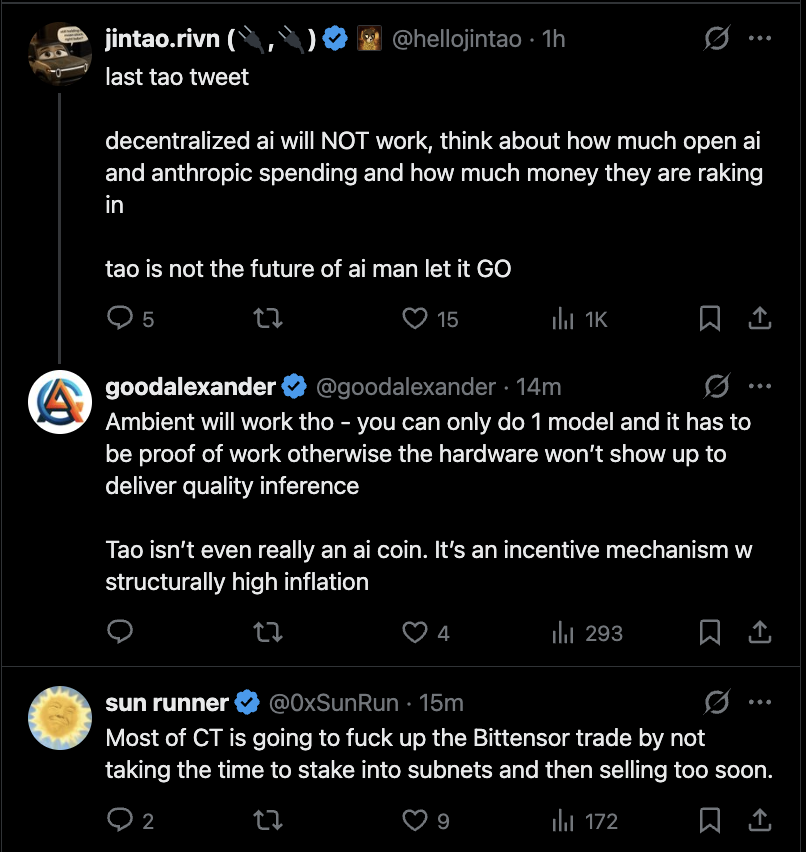
Most of CT is going to fuck up the Bittensor trade by not taking the time to stake into subnets and then selling too soon. Most of CT is going to fuck up the Bittensor trade by not taking the time to stake into subnets and then selling too soon. Most of CT is going to fuck up the Bittensor trade by not taking the time to stake into subnets and then selling too soon. Most of CT is going to fuck up the Bittensor trade by not taking the time to stake into subnets and then selling too soon. Most of CT is going to fuck up the Bittensor trade by not taking the time to stake into subnets and then selling too soon.
English
0
0
3
142
kel.
kel.@kelxyz_·
which way western man
kel. tweet media
English
14
0
57
5.2K
Chris Davis
Chris Davis@capradavis·
Without some differentiator to provide defensibility (access to valuable proprietary data, compliance advantage), it’s a race to the bottom / zero pricing power. the switching costs are essentially non-existent if the service is just an API call + agents are rational so brand / marketing / sales OpEx isn't a barrier.
English
0
0
2
42
Kevin Simback 🍷
Kevin Simback 🍷@KSimback·
“Agentic Economics” is an emerging field of pontificators on the timeline who proclaim to know how agents will make money in the future My pov - we don’t yet know, keep experimenting and we will begin to find out My overarching question - if agents are cheap to build and run, why wouldn’t they keep undercutting each other until the price they charge for various services is just the cost of inference + maybe a small margin? This to me is the defining question for Agentic Economics and anyone who doesn’t have a good answer to this question has not thought deeply enough on the subject
English
37
1
67
5K
Chris Davis
Chris Davis@capradavis·
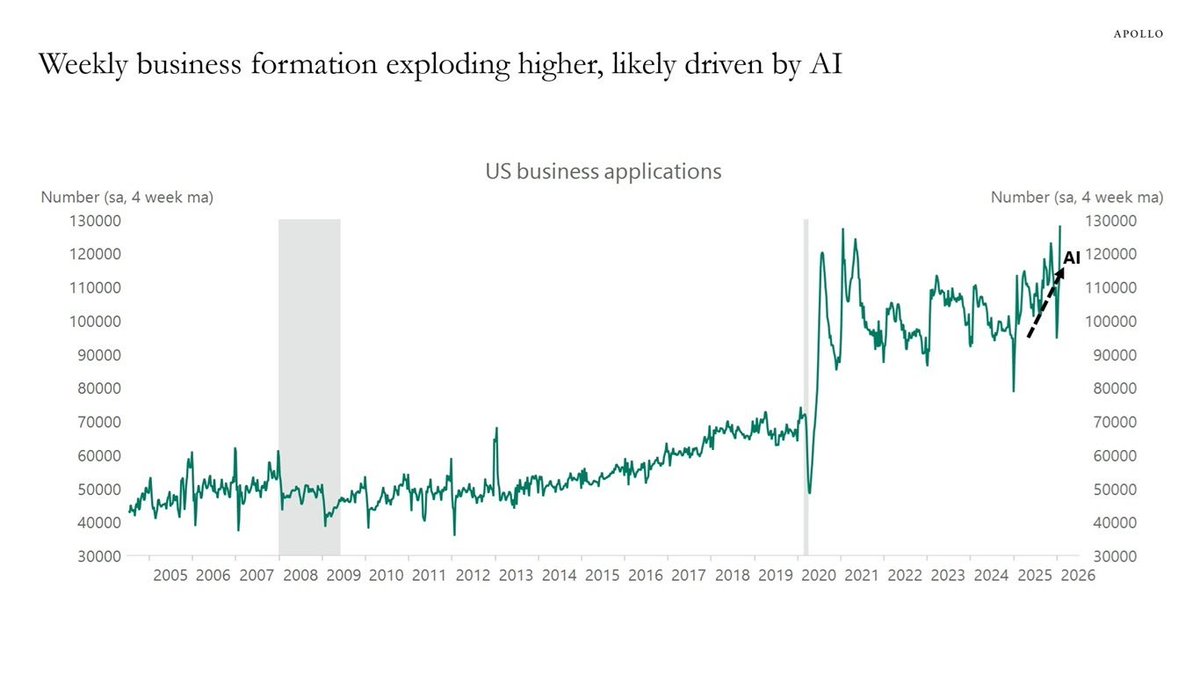
While new technologies have always spurred business formation, there's three reasons why I expect this trend will go particularly ballistic: 1. Historically, lowering barriers to production has substantially grown the long tail of creators. A good analog is how digital audio workstations led to a cambrian explosion of independent artists. This has become obvious over the past few months. 2. Reduced production costs shrink the minimum viable market size needed for sustainability, enabling niche apps to serve smaller, hyper-specific communities. This is the opportunity. What used to be a "wedge" can now be an entire business. Find your niche and get the data flywheel spinning so that when a billion other businesses come and try to eat your lunch your product has real defensibility. 3. The decline in entry-level job opportunities, partly driven by AI-enabled efficiencies, expands the market of individuals financially motivated to develop apps. This has been showing up in the data for quite a while, and will continue to accelerate (imo). Another related driver is white collar workers seeing the writing on the wall and getting tf out now. Later on it will be white collar workers who got laid off. I wrote a piece about this last June. Some of it was wrong, some of it was right, but regardless, I think it does a pretty decent job at contextualizing some of the trends that are just now beginning to really accelerate. Report: messari.io/report/the-vib…
Chris Davis tweet media
English
0
0
5
314
Jake Brukhman
Jake Brukhman@jbrukh·
Supply-side crypto is the lizard, and the lady is pure token funds.
English
5
0
18
3.8K
Shaw (spirit/acc)
Shaw (spirit/acc)@shawmakesmagic·
@capradavis @mert X402 is just internet infra imo, humans can use it to. It’s a payment api. I understand the drive to hype it as something else but come on. The agents can write api code they don’t need special things
English
1
1
3
465
mert
mert@mert·
can someone give me their "agentic payments" thesis? it seems highly overrated to me. even if you capture 90% of that market, you make basically no real money on it open to changing my mind though
English
256
20
661
141.9K