Casey A. Fitzpatrick

357 posts

Casey A. Fitzpatrick banner
Casey A. Fitzpatrick

Casey A. Fitzpatrick

@caseyfitz

@ContextualAI MTS | Quantum Information PhD

Bay Area Katılım Haziran 2011
124 Takip Edilen219 Takipçiler
Sabitlenmiş Tweet
Casey A. Fitzpatrick
Casey A. Fitzpatrick@caseyfitz·
Hard to believe it’s barely been a year since @douwekiela called to order our very first all hands, then @apsdehal and I spent hours in a tiny room with a whiteboard laying out the technical vision for what we were about to do. So proud of the team we’ve built and what’s to come!
Contextual AI@ContextualAI

We’re excited to share today that we’ve raised $80M in Series A funding to accelerate our mission to change the way the world works through AI. Read more at our blogpost: contextual.ai/news/announcin…

English

1
1
12
1.6K
Casey A. Fitzpatrick
Casey A. Fitzpatrick@caseyfitz·
@douwekiela Psyched to show the world a little bit more about how we're tackling real problems that will unblock AI's true potential.
English
0
0
1
238
Douwe Kiela
Douwe Kiela@douwekiela·
AI struggles with messy, conflicting, ever-changing data. Today's AI ranking methods can't prioritize clearly, because they lack human guidance. Introducing the world's first instruction-following, SOTA reranker! Give our reranker instructions to control exactly how it ranks: • “Prioritize recent documents” • “Prefer PDFs over other sources” • “The boss is always right” Can’t wait to see what people build with it!
English
18
48
503
210K
Casey A. Fitzpatrick retweetledi
Stas Bekman
Stas Bekman@StasBekman·
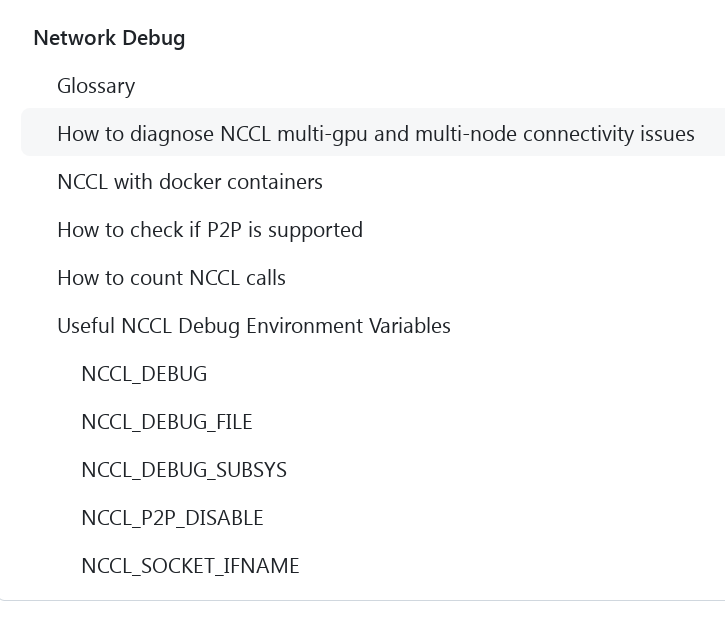
Here is a new Machine Learning Engineering chapter: Network debug github.com/stas00/ml-engi… The intention is to help non-network engineers to figure out how to resolve common problems around multi-gpu and multi-node collectives networking - it's heavily NCCL-biased at the moment. Will extend with RCCL and others when I get access to those. Your feedback and corrections are always welcome.
Stas Bekman tweet media
English
4
40
172
9.4K
Hugo Bowne-Anderson
Hugo Bowne-Anderson@hugobowne·
I'll be doing a livestream w/ @sh_reya (UC Berkeley) for @VanishingData about designing human-in-the-loop interfaces for working with GenAI and LLM systems, with a focus on evaluation (but covering lots of other fun stuff!). Sign up here 👇 lu.ma/zz3qic45?utm_s… 1/
English
2
5
31
12.8K
Casey A. Fitzpatrick retweetledi
Kawin Ethayarajh
Kawin Ethayarajh@ethayarajh·
The Orca-Math paper does a comparison of DPO and KTO for mathematical reasoning, finding that KTO is slightly better when all data is used and 25+ pts better when you have fewer positive examples than negative examples.
Kawin Ethayarajh tweet media
AK@_akhaliq

Microsoft presents Orca-Math Unlocking the potential of SLMs in Grade School Math Mathematical word problem-solving has long been recognized as a complex task for small language models (SLMs). A recent study hypothesized that the smallest model size, needed to achieve over 80% accuracy on the GSM8K benchmark, is 34 billion parameters. To reach this level of performance with smaller models, researcher often train SLMs to generate Python code or use tools to help avoid calculation errors. Additionally, they employ ensembling, where outputs of up to 100 model runs are combined to arrive at a more accurate result. Result selection is done using consensus, majority vote or a separate a verifier model used in conjunction with the SLM. Ensembling provides a substantial boost in accuracy but at a significant cost increase with multiple calls to the model (e.g., Phi-GSM uses top-48 to boost the performance from 68.2 to 81.5). In this work, we present Orca-Math, a 7-billion-parameter SLM based on the Mistral-7B, which achieves 86.81% on GSM8k without the need for multiple model calls or the use of verifiers, code execution or any other external tools. Our approach has the following key elements: (1) A high quality synthetic dataset of 200K math problems created using a multi-agent setup where agents collaborate to create the data, (2) An iterative learning techniques that enables the SLM to practice solving problems, receive feedback on its solutions and learn from preference pairs incorporating the SLM solutions and the feedback. When trained with Supervised Fine-Tuning alone, Orca-Math achieves 81.50% on GSM8k pass@1 metric. With iterative preference learning, Orca-Math achieves 86.81% pass@1. Orca-Math surpasses the performance of significantly larger models such as LLAMA-2-70B, WizardMath-70B, Gemini-Pro, ChatGPT-3.5. It also significantly outperforms other smaller models while using much smaller data (hundreds of thousands vs. millions of problems).

English
3
23
120
33.1K
Casey A. Fitzpatrick retweetledi
Omar Khattab
Omar Khattab@lateinteraction·
I'm glad that a lot more people understand the key ideas behind ColBERT and DSPy now. My only remaining goal is to make sure people can also say them correctly; both are quite tricky😆 * Col-BAIR (it's "the late" interaction retriever, get it?) * Dee-Ess-Pie (like num-pie)
English
18
11
185
33.8K
Casey A. Fitzpatrick retweetledi
fraser
fraser@Fraser·
I believe strongly that: 1) The best products that will emerge from this moment are “full stack”, with teams training their own models, and the models & UI informing one another. 2) This requires researchers who care deeply about what’s best for the product, including data
English
20
25
263
85.3K