Christine A. Shields

486 posts

Christine A. Shields banner
Christine A. Shields

Christine A. Shields

@catswx

Meteorologist ex-forecaster turned climate scientist with a love for the outdoors. Work @NCAR_CGD. Views my own.

Katılım Eylül 2013
113 Takip Edilen298 Takipçiler
Christine A. Shields retweetledi
Science Magazine
Science Magazine@ScienceMagazine·
Antarctic ice plays a crucial role in regulating Earth’s climate, global sea levels, ocean circulation, and planetary reflectivity. Learn more in a new #ScienceReview: scim.ag/42FMQPN
Science Magazine tweet media
English
9
148
431
46.5K
Christine A. Shields retweetledi
CW3E Scripps
CW3E Scripps@CW3E_Scripps·
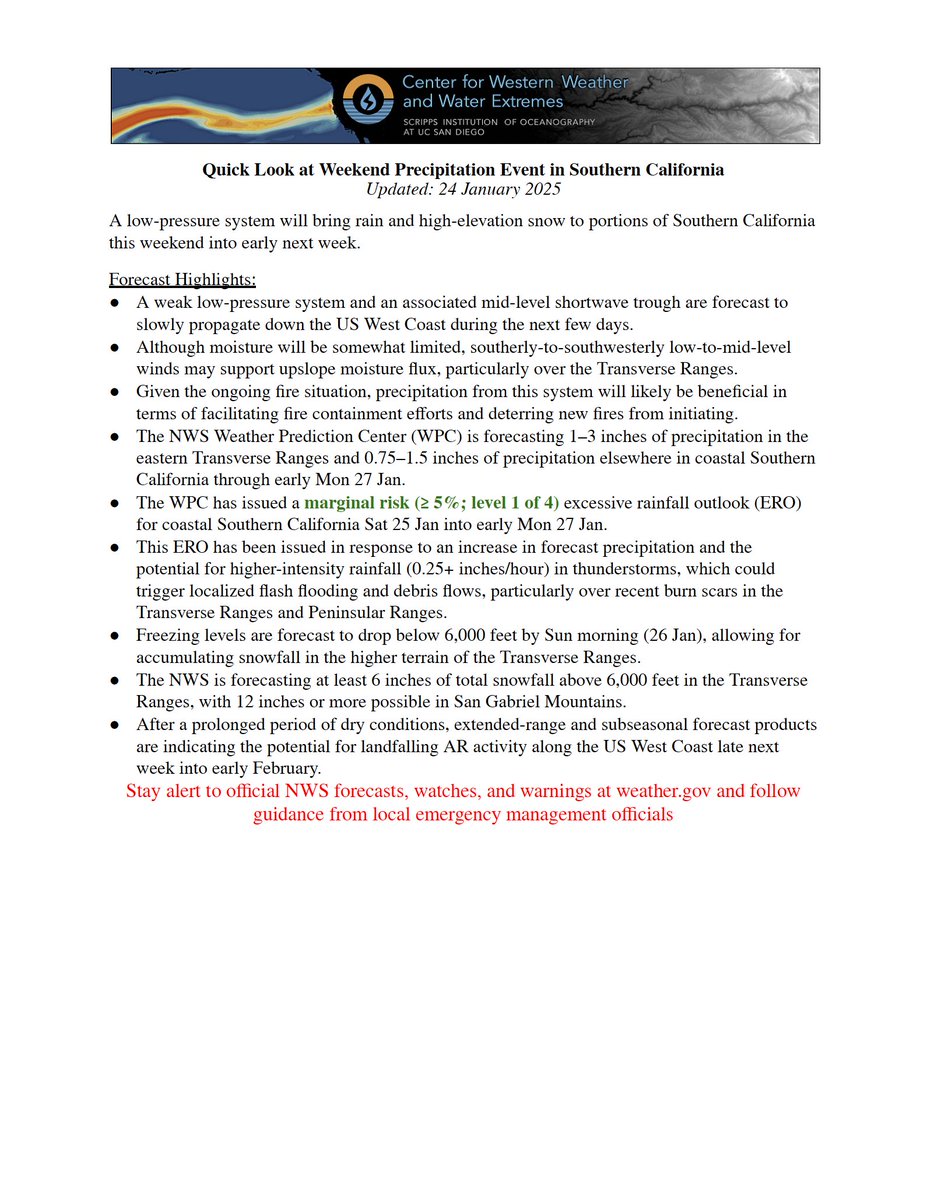
A storm will bring rain and high-elevation snow to Southern CA this weekend into early next week. Higher-intensity rainfall in thunderstorms could lead to localized flash flooding and debris flows in recent burn scars. See our latest quick look for more information: cw3e.ucsd.edu/wp-content/upl….
CW3E Scripps tweet mediaCW3E Scripps tweet mediaCW3E Scripps tweet mediaCW3E Scripps tweet media
English
0
6
13
1.6K
Christine A. Shields retweetledi
TERI
TERI@teriin·
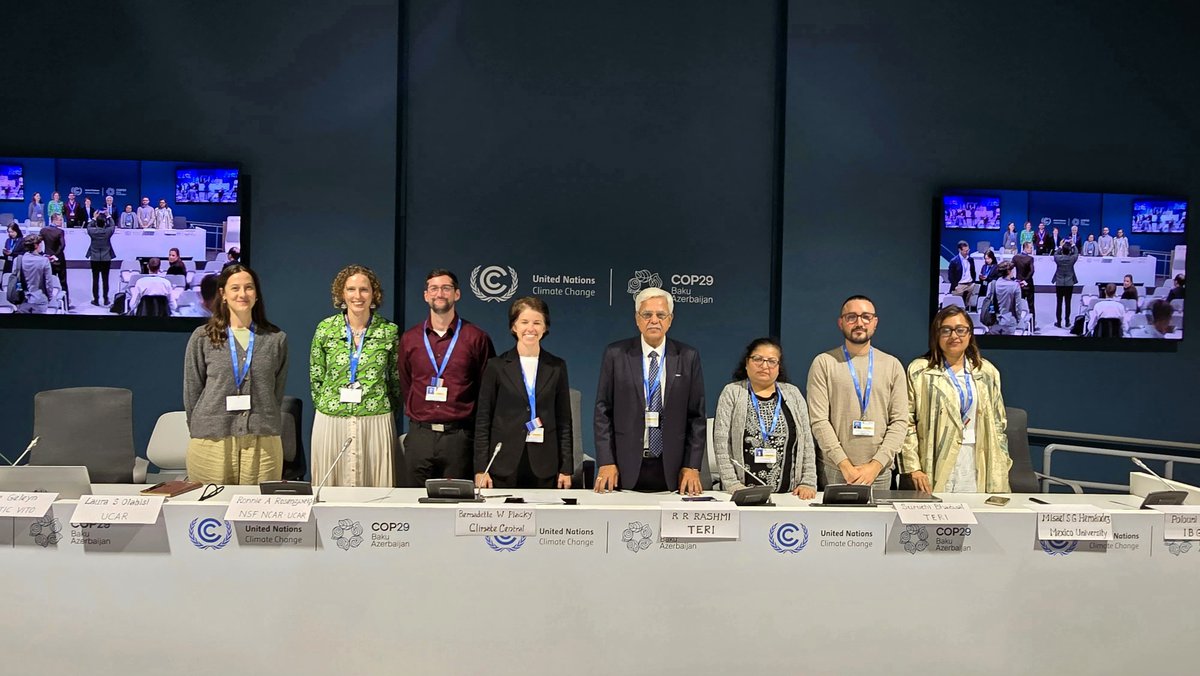
TERI and UCAR (@UCAR_News) organized a side event ‘Global Risk Resilience Discourse and Adaptation’ at COP29 in Baku today. The event brought together scientists and policy makers to reflect on the adequacy of the scope and strategies that have emerged from the negotiation process and explore the ways in which the Global Goal on Adaptation (GGA) can be truly global in its ambition. The event began with Ms Suruchi Bhadwal (@SuruchiBhadwal), Director, TERI and Dr Ronnie Abolafia-Rosenzweig, Scientist, NSF NCAR (@NCAR_Science) delivering framing presentations. While Dr Abolafia-Rosenzweig focused on intersections between #climatescience and climate adaptation, Ms Bhadwal argued for expanding the scope of the #GGA by bringing in global drivers of national adaptive capacities within its purview. A discussion paper 'A Transformative Global Goal on Adaptation: Scope, Science, and Policy' with contributions from Ms Bhadwal, Dr Manish Kumar Shrivastava (@manishipta) of TERI, and Dr Abolafia-Rosenzweig, Dr Christine A. Shields (@catswx), and Dr Mari Tye of UCAR was also launched at the event. This was followed by a panel discussion on ‘Science-Policy Interaction at Scale for Transformative Global Goal on Adaptation’. The panel discussion was moderated byMs Bernadette Woods Placky (@BernWoodsPlacky), Vice President and Chief Meteorologist, Climate Central, and Mr RR Rashmi, Distinguished Fellow, TERI. Mr Anand Patwardhan (@patwardhan_a), Professor, University of Maryland, School of Public Policy (@UMDPublicPolicy) said, “I'd like to kind of flag three opportunities that I see for the GGA to play a more transformative role for adaptation. If you look at the UNEP emissions gap report, we are looking at a likely temperature range of 2.53 degrees. Which raises the question of what is it that we are adapting to? What this means is that adaptation planning needs to consider the full range of plausible climate scenarios. "And this has really major implications, particularly for finance, because finance for adaptation is likely to scale considerably based on the needs. “Which brings me to my second point, which is about means of implementation. And then finally, while much adaptation is indeed local or national, we will need collective action, including global collective action,” he said. Mr Abolafia-Rosenzweig felt, “In order for the information to be useful for decision making at the local level, there has to be the data and the information products that people can understand, that they can use and they can implement. “And at the same time, there needs to be information about specific, specific concerns and challenges of the communities facing climate change on the front lines so that scientists can provide that information and appropriate technologies.” Stressing on the need to connect science with the communities, Ms Laura Schmitt Olabisi, (@Lkshumaine), Professor, Michigan State University said, “In my view, especially working, as I have been in West Africa for the last several years, there are many parts of the world where those connections are just not there for a number of reasons. The capacity is just not there for that communication between science at the national or even the state level and the communities. So that's a real gap and it is often felt in the most vulnerable regions.” Ms Bhadwal said, “#Adaptation is not necessarily a local issue. Adaptive capacities of countries are also embedded in the global #economicsystems, particularly the financial markets and trade patterns. For the Global Goal on Adaptation to be truly meaningful, in the spirit of the principle of equity and common but differentiated responsibility, it is necessary that the global systems related to finance, trade, IPR, #foodsecurity, #healthsecurity, etc. also become part of the GGA agenda.” Ms Ilke Geleyn, Programme Manager at G-STIC (@GSTICseries), said, “Breaking down silos between policy makers and scientific community at national and global level is absolutely critical. Equally important is the peer learning among scientists. Multistakeholder engagements are key to developing scientifically robust metrics for adaptation across scales of governance." Mr Misael Sebastián Gradilla-Hernández, School of Engineering and Sciences of the Tecnológico de Monterrey, Mexico (@UNAM_MX) , emphasized, “Some of the challenges that we really face every day are that scientists are really not leaving the labs and checking what their real needs are. At the same time, communities possess a deep understanding of their local environment." Ms Poloumi Banerjee, Vice President, IB Group (@ibgroup_india) noted, “For private sector, climate adaptation manifests in two ways. First their own operations, and second their responsibility towards #communities in bringing better adaptation strategies. “For a profit-oriented organization, resilience and stability of systems is necessary. Private sector is not yet providing resources for adaptation oriented research. There is a huge gap in adaptation finance.” #TERIatCOP29 #climatechange #reslience #ClimateFinance #COP29Baku
TERI tweet mediaTERI tweet mediaTERI tweet mediaTERI tweet media
English
2
3
3
272
Christine A. Shields retweetledi
Bob Henson
Bob Henson@bhensonweather·
Two data points to ponder: —New York + Philly both just had the driest month in their 150-year-plus weather histories. —The U.S. is having its warmest autumn on record by far. The past 2 mos are nearly 1F above any other Sep-Oct on record. yaleclimateconnections.org/2024/11/octobe…
English
3
26
46
2.9K
Christine A. Shields retweetledi
CW3E Scripps
CW3E Scripps@CW3E_Scripps·
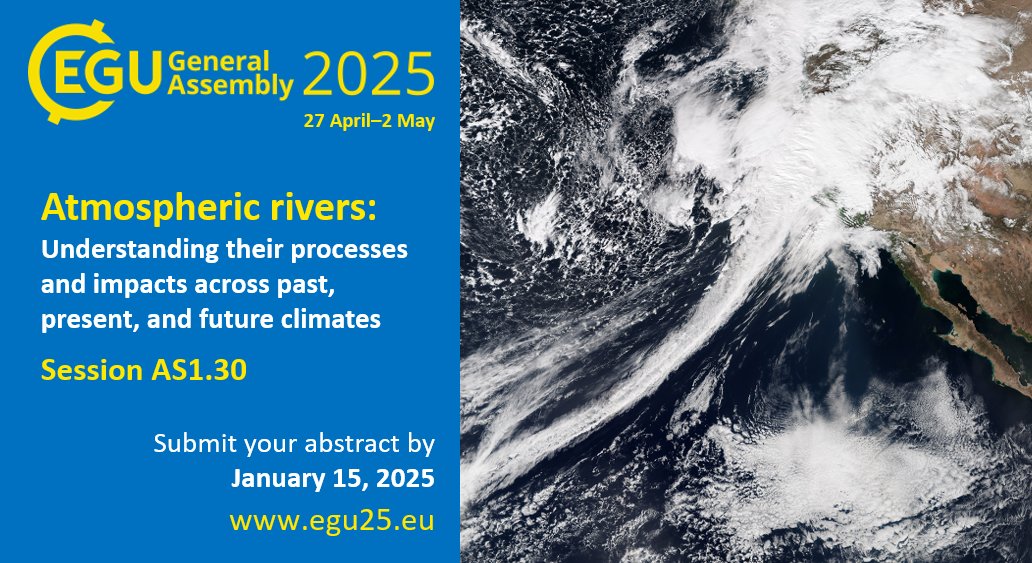
New Data Assimilation Project Scientist position focusing on atmospheric rivers at Scripps Institution of Oceanography, UC San Diego. Check it out here: apol-recruit.ucsd.edu/JPF04053
English
0
2
3
796
Christine A. Shields retweetledi
Daniel Swain
Daniel Swain@Weather_West·
1.5-3°C of #GlobalWarming may not sound like a big deal. But for perspective: the difference between recent temperatures & last glacial period (when there were glaciers thousands of feet thick in areas now home to Chicago & New York) is only around ~6°C. [Full link below.]
English
9
107
373
66.5K