
Chris Kelly
1.2K posts
Chris Kelly
@chrisck
Health at Microsoft AI. Previously @GoogleHealth, @GoogleDeepMind, @KingsImaging. Paediatric doctor at @EvelinaLondon. Created https://t.co/PHOW9uU7Ym
London, UK Katılım Mart 2009
956 Takip Edilen2.2K Takipçiler
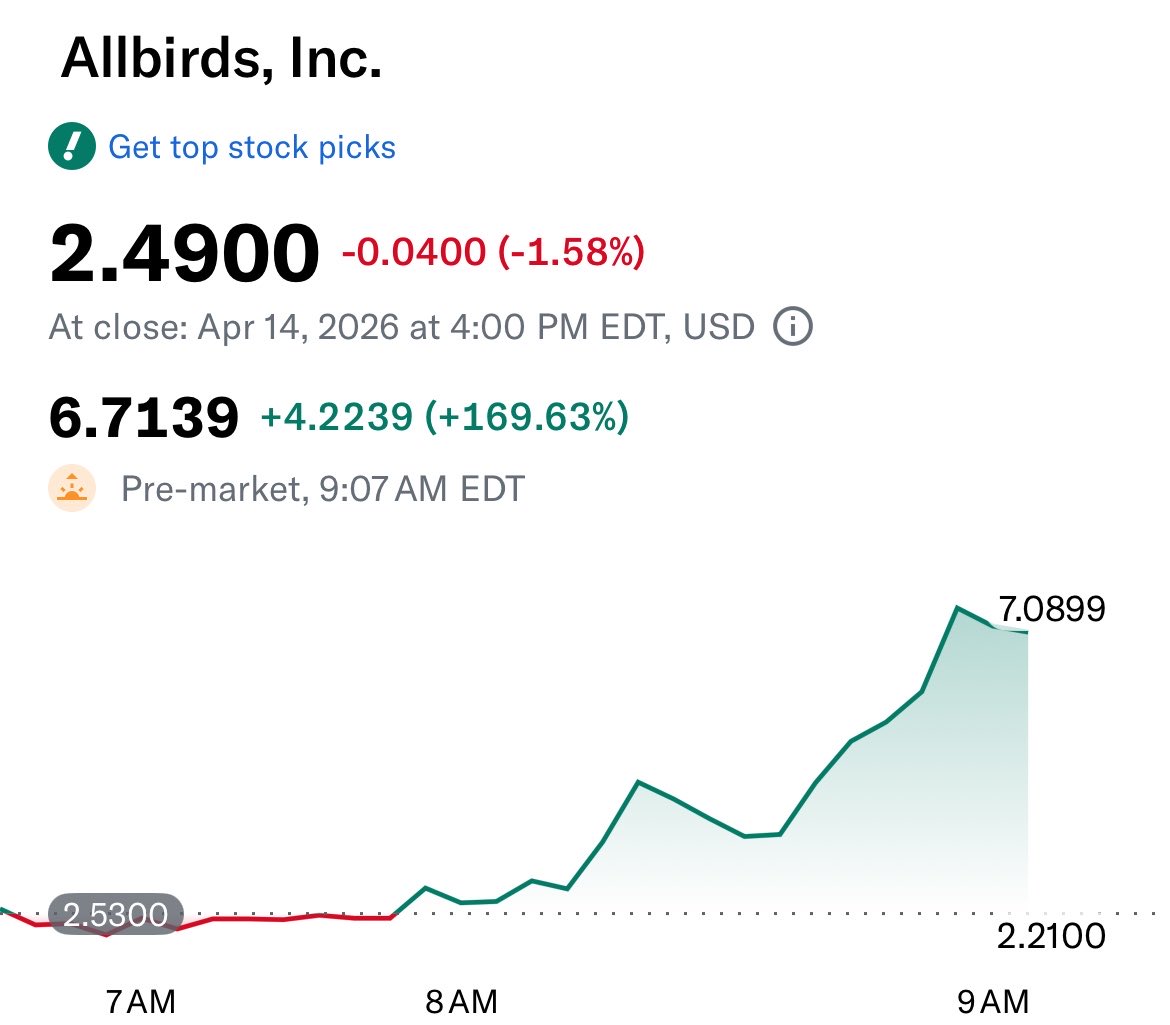
Absolutely incredible…
Allbirds, the shoe brand, is selling all footwear assets, renaming itself "NewBird AI", and using $50M to buy high-performance GPUs.
$BIRD is up +170% this morning. 🚀
English
We've all long imagined a health companion that truly knows you - not a chatbot that gives generic advice, but something that accumulates understanding of your health over time, and gets smarter the more you use it.
Today we're launching Copilot Health: a secure, separate space within Copilot where you can bring together your health records from 50,000+ US provider orgs, data from 50+ wearable devices, lab results, and health history all into one place. Copilot Health then applies medical intelligence to make sense of it all, giving you real agency over your own health. Your data, understood in context, patterns surfaced that you might not spot alone, alongside the confidence to walk into your doctor's appointment more informed, prepared, and empowered.
We are at a unique inflection point in history - AI is reaching extraordinary capabilities in medicine, while health data is finally being mobilised...and almost everyone has a phone in their pocket (or knows someone with one). We're starting in the US, but ultimately want to bring medical expertise to the billions of people who have never had access to it.
Read more here (microsoft.ai/news/introduci…) and you can sign up to the waitlist to help shape what comes next!
English
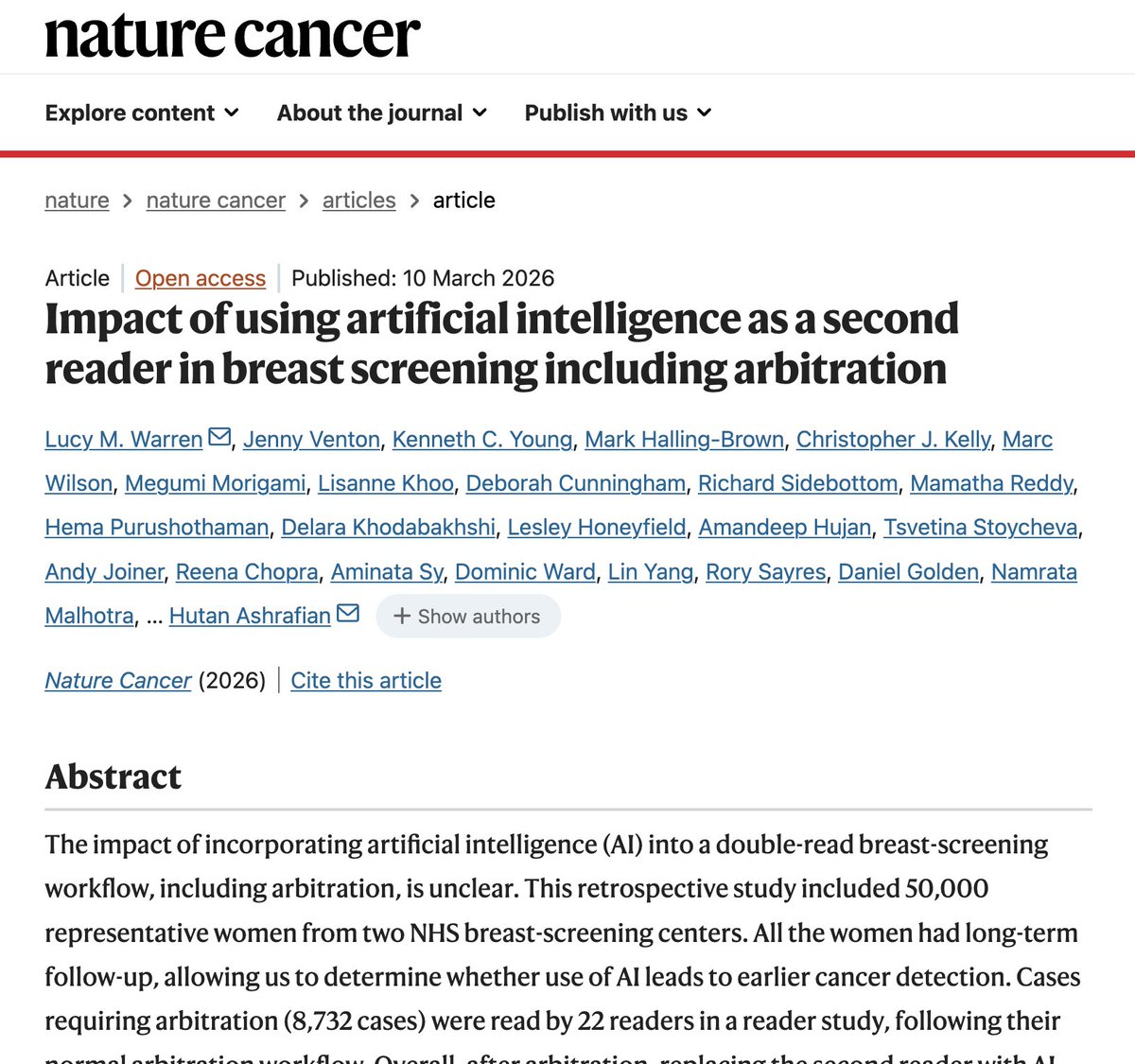
Really excited 🥳 to share two breast cancer AI papers from my time at Google, published jointly in Nature Cancer today!
We set out in 2021 to answer a question that matters to millions of women: can AI safely improve breast cancer screening in the NHS? Five years, five organisations, and 125,000+ women’s scans later, here's what we found.
1️⃣ Our first paper (nature.com/articles/s4301…) evaluated Google's mammography AI across five NHS screening services, with 39-month follow-up including interval + next-round cancers:
→ AI achieved superior sensitivity to human readers (54% vs 44%, P<0.001) with non-inferior specificity
→ 25% of future interval + next-round cancers detected = potential for earlier diagnosis
→ Reading time reduced by 32% while cancer detection increased by 18%
→ No systematic disparities across age, ethnicity, deprivation, or breast density
→ Prospective deployment at 12 sites confirmed feasibility but revealed distribution shift requiring recalibration - a critical lesson for implementation
2️⃣ Our second paper (nature.com/articles/s4301…) tackled what happens when AI becomes the second reader. When readers disagree today, a specialist panel "arbitrates". We studied 50,000 women's screens with 22 readers, with and without AI as the second reader:
→ End-to-end including arbitration, our AI-enabled arm was non-inferior to standard double reading (P<0.001)
→ Human reading workload reduced by 46%
→ AI flagged far more interval + next-round cancers before arbitration, but many were overruled, even when the AI correctly localised the cancer
→ Future: better explainability, prior image integration, reader training, and new pathways to maximise AI success (e.g. supplemental imaging for high risk normal cases)
An editorial from Allan Hackshaw and Rosalind Given-Wilson (nature.com/articles/s4301…) covers this work really well - thank you!
Conclusion: The AI works, and it can find cancers earlier. But how we integrate it into clinical workflows will determine whether that potential translates into better outcomes for women.
This collaboration between @GoogleResearch, @imperialcollege, @RoyalSurrey, @stgeorgeshospital, St George's University Hospitals NHS Foundation Trust, and Imperial College Healthcare NHS Trust was funded by the NHS AI Award. We are deeply grateful to everyone involved. Thank you to @skourti_elena at Nature Cancer.
Congratulations Lucy Warren, Marc Wilson, Jenny Venton, Ken Young, Mark Halling-Brown, Megumi Morigami, Lisanne Khoo, Deborah cunningham, Richard Sidebottom, Reddy Mamatha, Hema Purushothaman, Delara Khodabakhshi, Lesley Honeyfield, Amandeep Hujan, Tsvetina Stoycheva, Andy Joiner, Reena Chopra, Aminata Sy, Dominic Ward, Lin Yang, Rory Sayres, Daniel Golden, Namrata Malhotra, Rachita Mallya, Lihong Xi, Della Ogunleye, Charlotte Purdy, Alistair Mackenzie, Jane Chang, Jonathan Dixon, Elzbieta Gruzewska, Emma Lewis, Marcin Sieniek, Shawn Xu, @DrSusanThomas, @shravyas, @fjg28_fiona, @Ara_Darzi, Hutan Ashrafian 🎉

English
Chris Kelly retweetledi
🪩The one and only @stateofai 2025 is live! 🪩
It’s been a monumental 12 months for AI. Our 8th annual report is the most comprehensive it's ever been, covering what you *need* to know about research, industry, politics, safety and our new usage data.
My highlight reel:
English
@AndrewLBeam Congrats Andrew! You’ll have to see if you can reserve a little space for neonatal discoveries while you’re there :)
English

Can science create the next scaling paradigm for AI?
We think so, and we'll be using our recent Series A raise to build a new kind of scientific reasoning model at scale.
If you're interested in how we think all of science is subject to the bitter lesson, read on in the 🧵👇
Lila Sciences@LilaSciences
🚀 Big milestone: We raised a $235M Series A, co-led by Braidwell and Collective Global! Our team is excited for this next chapter in building the world’s first scientific superintelligence platform to accelerate breakthroughs in life, chemical, and materials sciences. 📣 If the idea of building scientific superintelligence excites you, come build with us. We’re seeking extraordinary, driven people across AI research, software, robotics, biology, chemistry, materials science, and operations. bit.ly/LilaCareers #ScientificSuperintelligence #AI #Innovation
English
@anothercohen This is absolutely genius! The swinging arms, the hands in pockets, everything - I love it! Best of luck with everything :)
English

Excited to share that we've raised a $22.5m Series A for Hello Patient, led by Scale Venture Partners.
This is by far the worst announcement video I've ever made.
I can't believe our lead investor agreed to this
Alex Cohen@anothercohen
Our lead investor and I have a big announcement to share. Thursday, 9AM PT.
English
Thanks to our great team at Microsoft AI - @HarshaNori, @mayankdaswani, @chrisck, @scottlundberg, @marcotcr, Marc Wilson, @DrXiaoLiu, @viknesh_s, @jcarlsonmsr, @mattlungrenMD, @baygross, @phames, @mustafasuleyman, @Dominic1King, @erichorvitz
English
Preprint: arxiv.org/abs/2506.22405
Blog: microsoft.ai/new/the-path-t…
Ps we plan to release the full benchmark soon. Stay tuned. Subscribe to this thread for updates! 👀
English
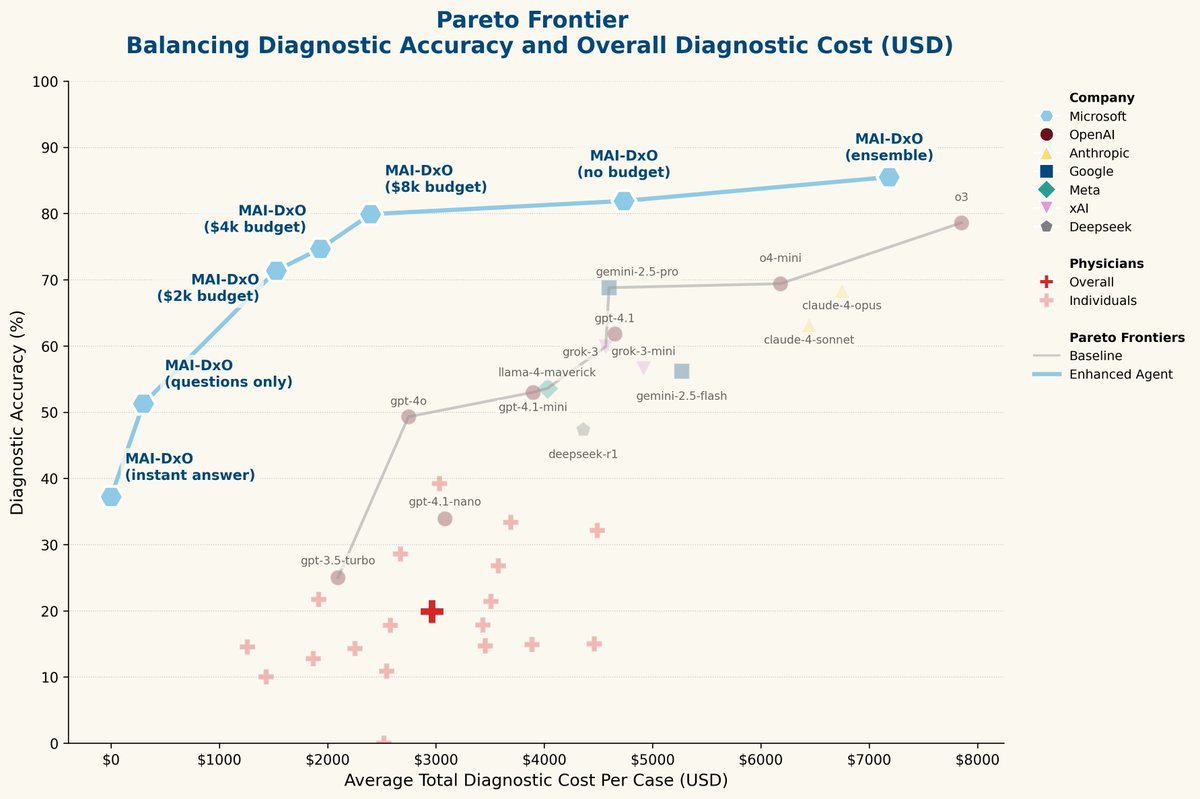
New paper today! 🥳 How good is generative AI at diagnosis compared to human doctors? We introduce a novel, interactive medical benchmark (SDBench) for “sequential diagnosis”, and an orchestrator (MAI-DxO) that achieved over 4x higher diagnostic accuracy vs experienced physicians who played the benchmark. 🧵
English
Chris Kelly retweetledi

Our recent journal article compares the effectiveness of objective vs. subjective labels for AI-based detection of fetal hypoxia from CTGs. Key takeaway? Objective cord pH labels demonstrate greater robustness to temporal shifts.
🔗 Read more: nature.com/articles/s4429…
#MedicalAI
English
Chris Kelly retweetledi
The largest medical #AI randomized controlled trial yet performed, enrolling >100,000 women undergoing mammography screening, was published today @LancetDigitalH
The use of A.I. led to 29% higher detection of cancer, no increase of false positives, and reduced workload compared with radiologists without A.I.. thelancet.com/journals/landi…
English


Dear all, I am excited to announce our new startup GoCompute! GoCompute is the first and premier recycling solution for no longer needed GPUs. Our team is made up of the most experienced AI researchers and endorsed by @ylecun, the godfather.
We are raising our our first round. Only serious VCs please.
We’re coming to you soon to lift the burden of those GPUs so you can spend more time with your loved ones ❤️

English

Chris Kelly retweetledi
