chudi

5.9K posts

chudi banner
chudi

chudi

@chudibruno

@stlouisblues @F1 @mancity unabashed nerd. tacos. Pop a wheelie on the Zeitgeist. 🤖⚡️🚀

Earth Katılım Haziran 2010
747 Takip Edilen518 Takipçiler
chudi retweetledi
Camus
Camus@newstart_2024·
Andrew Santino just blew my mind with one simple comparison. A million seconds = 11 days. A billion seconds = 31 years. Let that sink in. We throw around “billionaire” like it’s just “millionaire but with more zeros,” but the actual gap is insane. A million seconds is less than two weeks. A billion seconds is longer than most people’s entire adult lives. It’s a perfect reminder of how detached our brains are from what these numbers actually mean. Next time someone casually says “he’s a billionaire,” just remember: that’s not “a lot of millions.” That’s an entirely different universe of scale. Mind officially blown.
English
349
1.6K
11.1K
1.3M
chudi retweetledi
Anish Moonka
Anish Moonka@anishmoonka·
Victor Glover failed an engineering class his sophomore year of college. His dad talked him out of joining the Navy SEALs and told him an engineering degree and pilot wings might make him an astronaut someday. Right now Glover is somewhere between the Earth and the Moon. He grew up in Pomona, California. Played quarterback in high school, wrestled well enough to place sixth at the state championship, won Athlete of the Year. Went to Cal Poly for engineering and played both sports at the college level. He got his Navy wings in 2001 and started flying F/A-18 fighter jets off aircraft carriers. His squadron deployed on the USS John F. Kennedy to fight in Iraq, the carrier’s final deployment ever. Twenty-four combat missions. His commanding officer gave him the callsign “Ike,” short for “I Know Everything.” He became a test pilot at Edwards Air Force Base and over his career flew more than 40 types of aircraft, 3,000 hours in the air, everything from a Korean War-era Soviet MiG-15 to the Goodyear blimp. More than 400 landings on a moving carrier deck. He earned three master’s degrees in three years. He once told Cal Poly’s president that the hardest thing he ever chose to do was walk in space. The second hardest was wrestling practice. He applied to NASA in 2009 and got rejected. Applied again in 2013 while working in the U.S. Senate for John McCain. NASA’s head of flight crew operations called him. He missed the call. Frantically dialed back. Eight people got in that year out of more than 6,000 applicants. NASA put him in the pilot seat for the first operational SpaceX Crew Dragon flight in 2020. He spent 168 days on the International Space Station and walked in space four times. Last June he went back to Cal Poly to accept an honorary doctorate. His wife Dionna and their oldest daughter Genesis both walked across the stage at the same ceremony to pick up their own degrees. Three days ago Glover launched from Kennedy Space Center. The crew will fly past the far side of the Moon on Monday and travel about 252,000 miles from home, breaking a distance record that Apollo 13 set fifty-six years ago. They come back at roughly 25,000 mph. He has four daughters. His callsign is still Ike.
RedWave Press@RedWavePress

NASA pilot Victor Glover CLAPS back after being asked what it means to be the first black man to visit the moon: “It’s the story of humanity, not black history, not women’s history, but that it becomes human history.” “I also HOPE we are pushing the other direction that one day we don’t have to talk about these first. That one day, this is just—and listen to this—that this is the human history.”

English
157
1.9K
14K
977.3K
chudi retweetledi
Anish Moonka
Anish Moonka@anishmoonka·
A Yale study tracked 3,635 people for 12 years. The ones who read books for 30 minutes a day lived almost 2 years longer. Your average book takes about 5 hours to finish. For a $15 paperback and a few nights on the couch, that’s a wild return. The gap was 23 months. Didn’t matter how old you were, how much money you had, what your education looked like, or whether you were dealing with depression. If you read books, you were 20% less likely to die during the study. Newspapers and magazines didn’t do the same thing. The researchers found that books specifically were keeping people’s brains sharper for longer, and that’s what was driving the survival gap. Emory University wanted to see what books actually do inside your head. They put 21 people in brain scanners every morning for 19 straight days while they read a novel in the evenings. The connections between different parts of their brains got stronger, especially in areas that handle language and physical sensation. Those changes were still showing up on scans 5 days after they finished the book. The lead researcher Gregory Berns called it shadow activity. Like muscle memory, but for your brain. A 14-year study found that people who read at least once a week had 46% lower odds of losing their mental sharpness as they aged. Separate work out of Rush University Medical Center showed that older adults who stayed mentally active through reading, writing, and puzzles experienced 32% less decline in memory and thinking ability. Then there’s stress. A University of Sussex study found that just 6 minutes of reading cut stress levels by 68%. Music only managed 61%. Drinking tea or coffee, 54%. Going for a walk got 42%. The money angle is interesting too. A European study tracked 5,280 men across 9 countries. Kids who grew up with more than 10 books in the home earned 21% more for each additional year of school they completed. For kids with fewer than 10 books, it was just 5%. A separate 27-country study of over 70,000 people found that children from homes full of books finished 3 more years of school regardless of how educated or wealthy their parents were. Pew data from the U.S. shows 86% of people earning over $75K read at least one book in the past year, compared to 70% of those earning under $30K. He’s right. The average book takes 3 to 5 hours. But those hours buy you brain connections that last for days and mental sharpness that holds up over decades, with a real shot at almost 2 more years alive.
bbl mccarthyism@hellciee

i think everyone is overestimating how long it takes to read a book. some books do be long but your average book takes like 3-5 hours in total.

English
8
66
257
16K
chudi retweetledi
James Camp 🛠,🛠
James Camp 🛠,🛠@JamesonCamp·
$5,000 an hour. for sunlight. from space. a startup putting 50,000 mirrors in orbit to sell sunlight anywhere on earth I thought this was the dumbest idea Ive ever heard then it clicked - firefighting aircraft get GROUNDED every night at sunset. pilots cant see terrain. fires burn unchecked for 10 hours straight. and heres whats wild - water drops are 60% more effective at night. cooler temps. less wind. but nobody can fly. light up the fire line from orbit. let them work. the US spends $3-5B a year fighting wildfires. this is a rounding error. - a single late frost in Napa or Florida citrus can wipe out an entire season. $854M in frost losses last year alone. but the crazy part - the real buyer isnt even the farmer. its the crop insurance company trying to avoid a $500M payout by spending $50k on a few hours of orbital sunlight - fog costs London Heathrow over $100M a year in delays. fog burns off when sunlight hits the ground. you speed that up by 30 minutes and the value per hour is $500K-$1M. $5k/hour is pocket change - military forward operating base at night? forget night vision goggles. just light up the whole compound from space and go get it - 4 million people above the Arctic Circle live in MONTHS of total darkness. depression. productivity drops. everything slows down. you could give entire communities twilight during polar night - 150,000 babies die or get brain damage every year in developing countries from jaundice because the cure is literally just light and they dont have electricity for it. beam it down from orbit. no power grid needed. I went down this rabbit hole for an hour and every use case is more insane than the last 260,000 people from 157 countries on the waitlist. each dropping $1,000-5,000. Sequoia backed them - first space investment since SpaceX. the Air Force already signed a contract. mirrors weigh 35 lbs and theyre the size of a basketball court. 4-10x brighter than a full moon. built by a 28 year old ex-SpaceX engineer. this went from "dumbest thing Ive ever seen" to holy shit in about 10 minutes...
English
417
264
2.9K
572.4K
chudi retweetledi
Shanaka Anslem Perera ⚡
Shanaka Anslem Perera ⚡@shanaka86·
Everyone is covering Terafab as a chip factory. It is not a chip factory. Last night in Austin, Elon unveiled a facility that makes masks, fabricates chips, and tests them inside a single building with a nine-month recursive improvement cadence. No such loop exists anywhere else on Earth. Then he told you 80% of the output goes to space. Then he showed you a 100-kilowatt AI satellite with solar panels and radiators, scaling to megawatt range. Then he said Optimus plus photovoltaics will be the first von Neumann probe, a machine capable of replicating itself from raw materials found in space. Nobody connected the sequence. Terafab produces 1 terawatt per year of compute. The entire United States consumes 0.5 terawatts of electricity. Musk is building a single factory whose output in AI silicon exceeds twice the power consumption of the country it sits in. And he is sending 80% of it off-planet because Earth literally cannot power what he is building. Follow the mechanism. Terafab seeds the chips. Starship launches Optimus robots and solar arrays at 100 million tons per year. The robots mine lunar and asteroid regolith for silicon, iron, and nickel. They 3D-print more robots. They fabricate more solar panels. They assemble more AI satellites. Each satellite runs hotter-burning D3 chips designed specifically for vacuum, where free radiative cooling eliminates the thermal constraints that strangle every terrestrial data center on the planet. The nodes replicate. The replication is exponential. This is a Dyson Swarm bootstrap hidden inside a semiconductor announcement. The math is public. The Sun outputs 3.828 times 10 to the 26th watts. A 2022 paper in Physica Scripta calculated that 5.5 billion satellites at 290 kilograms each, robotically manufactured from Mars resources, capture enough solar energy to meet all of Earth’s power needs within 50 years. A 2025 paper in Solar Energy Materials calculated a partial swarm capturing 4% of solar output yields 15.6 yottawatts, roughly a billion times current human civilization’s total energy budget. Musk just announced the factory that builds the chips that go inside the satellites that replicate themselves forever. 92% of advanced logic chips are fabricated in Taiwan. One factory in Austin does not fix that. But one self-replicating system seeded by that factory, launched by the only company with reusable heavy-lift rockets, assembled by the only humanoid robot in mass production, and powered by the only star within reach, does not fix a supply chain. It obsoletes the concept of supply chains entirely. The market priced this as a $20 billion capex story about semiconductor independence. The actual announcement was the engineering blueprint for Kardashev Type II. Humanity sits at 0.73 on the Kardashev scale. 18 terawatts. The distance between here and harnessing a star is not a technology gap. It is a recursion gap. And recursion is exactly what a single building in Austin that makes its own masks, builds its own chips, tests its own chips, and launches the output into orbit on its own rockets was designed to close. Every civilization that makes it past this point never looks back.
Shanaka Anslem Perera ⚡ tweet media
SpaceX@SpaceX

TERAFAB: the next step to becoming a galactic civilization Together with @Tesla & @xAI, we're building the largest chip manufacturing facility ever (1TW/year) – combining logic, memory & advanced packaging under one roof

English
490
1.7K
9.1K
1M
chudi retweetledi
Balaji
Balaji@balajis·
I'm going to make some obvious points. (1) Blowing up all the oil infrastructure in the Middle East is an insane idea, and may well result in a global economic crash and humanitarian crisis unrivaled in the lives of those now living. We're talking about the price of everything everywhere rising, from food to gas, at a moment when inflation was already high. All of that will be laid at the feet of the authors of this war. (2) The antebellum status quo of Feb 27, 2026 was just not that bad, but we're unlikely to return to it. Expect indefinite, long-term, ongoing disruptions to everything out of the Middle East. (3) Also assume tech financing crashes for the indefinite future. The genius plan to get the Gulf states caught in the crossfire has incinerated much of the funding for LPs, for datacenters, and for IPOs. Anyone in tech who supported this war may soon learn the meaning of "force majeure" as funding gets yanked. (4) Many capital allocators will instead be allocating much further down Maslow's hierarchy of needs, towards useful basic things like food and energy. (5) It's fortunate that all those progressives yelled about the "climate crisis." Yes, their reasoning about timelines was wrong, and much of the money was wasted in graft, but the result was right: we all need energy independence from the Middle East, pronto. It's also fortunate that Elon and China autistically took climate seriously. Now they're going to need to ship a billion solar panels, electric vehicles, batteries, nuclear power plants, and the like to get everyone off oil, immediately. (6) It's not just an oil and gas problem, of course. It's also a fertilizer problem, and a chemical precursor problem. Maybe some new sources will come online at the new prices, but it takes time to dial stuff up, particularly at this scale, so shortages are almost a certainty. That said, China has actually scaled up coal-to-chemicals[a,c] (C2C), and there's also something more sci-fi called Power-to-X[b] which turns arbitrary power + water + air into hydrocarbons. But all of that will need to get accelerated. I have a background in chemical engineering so may start funding things in this area. (7) Ultimately, this war is going to result in tremendous blame for anyone associated with it. It's a no-win scenario to blow up this much infrastructure for so many people. Simply not worth it for whatever objective they thought they were going to attain. But unless you're actually in a position to stop the madness, the pragmatic thing to do is: scramble to mitigate the fallout to yourself, your business, and your people. [a]: reuters.com/business/energ… [b]: alfalaval.com/industries/ene… [c]: reuters.com/sustainability…
Balaji tweet media
English
701
2.1K
11.7K
3.3M
chudi retweetledi
Miyandy
Miyandy@Amahashi_·
I worked 20 years for a child sex trafficking rescue group. I want you to know this: 90% of Lost Children Are Found Within 30 Minutes. That statistic should both comfort you and wake you up. Most lost children are found quickly. But the ones who aren’t? They usually made one mistake. And here’s the uncomfortable truth: It’s often the exact thing most parents teach them. We tell our kids: “If you get lost, come find me.” It sounds logical. It sounds empowering. It’s WRONG! The Mistake Most Lost Children Make: When children realize they’re separated, they do three things almost automatically: They panic. They wander. They try to find you. Every step makes them harder to locate. From a search standpoint, movement creates chaos. Parents retrace their steps. Security scans zones. Staff lock down areas. Search works best when movement stops. When a child keeps walking, they move outside the original search radius. Helpers are looking where they were last seen — not where they’ve wandered. Stillness increases probability. Movement expands the problem. The first lesson is not “go find me.” It’s this: Stop. Stay. Yell. Why Stillness Wins: Think like a search team. If a child stays put: Parents can retrace steps. Security can scan systematically. Helpers converge to one fixed location. The search radius remains small. If a child keeps moving: The search area expands. Adults pass each other. Missed connections multiply. Minutes stretch into hours. Stillness keeps the math on your side. Teach Them Who to Approach: The second mistake we make as parents? We say, “Find an adult.” Not any adult. Not the nearest stranger. Children need a filter. Teach them to look for, if at all possible: A mother with children. Caregivers who already have kids with them are statistically among the safest people to approach in public settings. They are visible, stationary, and more likely to engage quickly. It’s a clear, concrete instruction. Children don’t process vague categories like “safe adult.” They process visuals. “Find a mom with kids” is visual. A Phone Only Helps If the Number Is Known: We often assume phones solve everything. They don’t — unless your child can use one. Even young children can memorize a 10-digit phone number with repetition. But you must train it. Practice it like a song. Sing it in the car. Chant it at bedtime. Turn it into rhythm. Repetition becomes recall. In an emergency, recall matters more than theory. The Code Word Rule: One more layer of protection. Choose a private family code word. Something only your household knows. If someone approaches and says: “Your mom sent me.” Your child asks: “What’s the code word?” No word. No go. This simple rule eliminates manipulation attempts instantly. It gives your child agency without requiring them to evaluate character. Real Safety Is Training — Not Luck! We don’t get safer by hoping. We get safer by practicing. Teach: • Phone number • Code word • Stop, stay, yell • Find a mom with kids Multiple skills. Simple instructions. Clear visuals. Five minutes of training can replace hours of panic. This isn’t about fear. It’s about preparation. Because when a child gets separated, the clock starts. And what they do in the first minute determines what the next thirty look like. That’s real protection.
English
77
7.3K
18K
4.1M
Scottie Upshall
Scottie Upshall@ScottieUpshall·
Lets see this trade.... EDM sends Nuge, Nurse and Jarri STL sends Binner, Parayko and Schenn $19m for $19m.
Deutsch
368
13
850
283.7K
chudi retweetledi
John Fadule
John Fadule@fadule_·
Life is amazing: -gyms exist -Coke Zero exists -hot girls outnumber even moderately put-together dudes 2000 to 1 -every food item in the world has been hunted and gathered for you (grocery stores) -you and your wife can drink 4 bottles of wine then smash all night without a condom -you and your friends can hit the gym then smoke a joint at a John Mayer concert -you could be working 16 hour days in a coal mine in a third world country breaking your lower back for less than $1 There’s kids who live in wheelchairs. There’s kids born with disabilities. No Prom, no Shoulder Presses, no sleepovers with their best friends staying up until 2AM watching Interstellar. And you’re not SMASHING the gym like a grateful SAVAGE!? Eating healthy 90% of the time, calling your friends for no reason, CRUSHING it in your career, asking for the promotion, asking out your crush making her your girlfriend then your wife!? You’re spinning on a sphere in an infinite universe and the fact you’re alive is a 1 in 500 trillion MIRACLE. You’re so lucky it’s absurd and you have nothing to lose :)
English
326
1.6K
30.1K
2.3M
chudi
chudi@chudibruno·
@mert Anduril, Palantir, and SpaceX to the moon. Got it. SpaceX IPO's gonna be lit.
English
0
0
0
282
chudi retweetledi
mert
mert@mert·
some 2nd order predictions from this: - the rich gulf states will almost certainly start incentivizing defense startups. they have trillion dollar investment arms. - specifically, since they are tiny nations, they need autonomous weapons. they can't field large land armies. - but anthropic/openai doesn't allow for autonomous weapon military use, so it is likely the gcc start using chinese AI models - but that is obviously unfavorable for america, so then they'll have to either i) make a frontier lab play ball, ii) start their own effort via help from palantir/anduril - it seems inevitable to me that this conflict directly accelerates the militarization of AI, which in turn implies gigantic state-sponsored spending into the AI supply-chain - however, there's a growing populist movement in the west around being anti AI/datacenters due to potential job loss for the middle class - I think the above tension continues to accelerate until the next USA election. and that election will decide the fate of the West
English
84
75
1.1K
110.5K
chudi retweetledi
Situation Deck
Situation Deck@SitDeck·
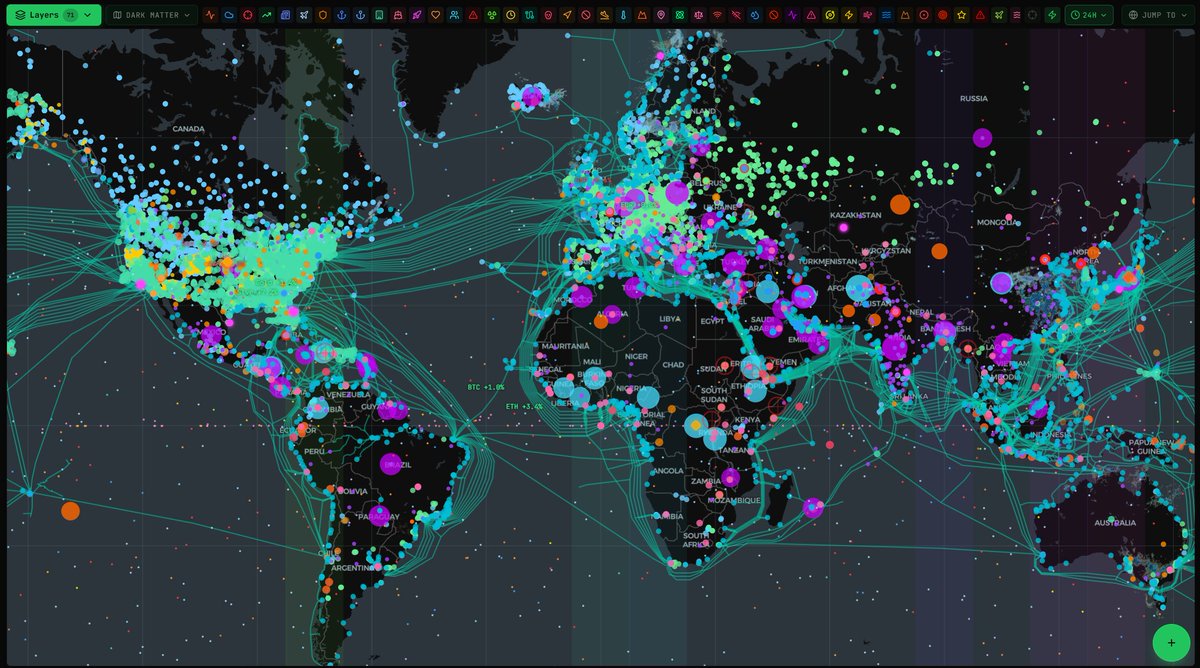
Announcing SitDeck.com: A free, real-time, AI-powered OSINT dashboard w/ 180+ data feeds, 55+ widgets, 70+ map layers, alerts & more. Conflicts. Earthquakes. Flights. Nukes. Cyber threats. Elections. All live. All in one place. Monitor the situation. For free.
Situation Deck tweet media
English
307
746
5.5K
2.2M
chudi retweetledi
SightBringer
SightBringer@_The_Prophet__·
⚡️The war just entered the multi front saturation phase. Iran is doing the only coherent thing it can do when its core nodes are being hunted: spread the fight across every host, every corridor, every symbol. What happened: Iran launched retaliatory strikes across the map: •U.S. facilities in Iraq targeted •Fifth Fleet reportedly hit with no casualties •missiles launched toward Saudi Arabia and Jordan •dozens of missiles landing in Israel •UN appeal to frame it as international crisis That is a layered message. Deep down, what this means: 1) Iran chose coalition pricing over denial They are no longer trying to keep it ambiguous. They are telling every Gulf host: you are now in the war. That is meant to fracture basing permission and force private pressure on Washington. 2) The “no casualties” line is strategic If they can hit targets and avoid killing Americans, they stay below the highest escalation trigger while still proving reach. That is calibrated escalation. But calibration is fragile. One intercept failure flips the regime. 3) The Fifth Fleet claim is the hinge If Iran truly hit Fifth Fleet assets, even without casualties, it is a direct strike on U.S. naval prestige and regional control. That raises the probability the U.S. executes the maritime deletion threat. 4) The 40 missiles in Israel reinforces the deletion campaign More missiles landing increases Israeli persistence against missile storage, production, and launchers. So Iran’s salvo paradoxically justifies more of the exact strikes that remove its arsenal. 5) The UN appeal is narrative warfare They are trying to turn military pressure into diplomatic friction. It is an attempt to slow the coalition clock.
English
16
8
119
44.4K
chudi retweetledi
Iman Jalali
Iman Jalali@Stealx·
Khamenei is dead. Good. But I have family in Iran. My dad is there right now. And I'm not celebrating yet. Here's why. Iran built the most layered contingency plan on Earth for this exact moment. Four levels of succession for every key position. Pre-authorized military strikes. Regional commanders who don't need orders from Tehran to act. As you read this, there is already a new Supreme Leader. We just don't know who. This isn't Maduro. The government didn't get overthrown. The system absorbed the hit. That's what it was designed to do. Every credible intel assessment says the same thing: a post-Khamenei Iran is more likely to get harder, not softer. More IRGC. More dangerous. Potentially worse for the Iranian people than Khamenei himself. Don't breathe yet. There's a long way to go.
English
1.7K
9K
47.5K
7.1M
chudi retweetledi
SightBringer
SightBringer@_The_Prophet__·
⚡️Most people are about to get priced out of “being average.” The economic deal just changed. For 150 years, capitalism paid you for time plus competence. Now it pays you for leverage plus judgment. AI turns competence into a commodity. Time becomes worthless when a machine can do it endlessly. So what happens. 1. The middle gets hollowed Entry level white collar shrinks first. Then the mid layer that exists to coordinate other humans. The top stays. The bottom stays. The center gets thinner every quarter. 2. The winners are not “smart” They are owners of distribution, owners of systems, owners of decision rights. They ship. They sell. They steer. They do not ask permission to exist. 3. The losers are not “lazy” They are trapped in roles whose output can be copied, summarized, or automated. They become overhead. Overhead always gets cut. 4. There is no plan because the plan is politically impossible If leaders admitted the truth, they would own the panic. So they say reskilling. They say lifelong learning. They say innovation will create jobs. Some of that will happen. Not fast enough for the people it hits. 5. The real outcome is forced redistribution When enough people cannot pay rent, the system changes or breaks. So the state eventually steps in with transfers, subsidies, and constraints on automation. After the damage is already done. So what is the move for a normal person? You stop trying to be employable. You start trying to be unreplaceable. Unreplaceable looks like: A) you control a niche audience B) you control a workflow that makes money C) you can use AI to do the work of ten people D) you are attached to revenue, not reporting E) you have low burn and high liquidity If you have none of that, the future feels like a slow suffocation. More stress. Less leverage. More competition for fewer stable slots. More coping narratives.
barney@barneyxbt

somebody explain to me what regular people are supposed to do when AI takes their job and everything still costs more every month. what’s the actual plan here because i haven’t heard one

English
53
132
883
120.8K
chudi retweetledi
Dustin
Dustin@r0ck3t23·
Peter Thiel just explained why the most consequential builder on earth had to leave the political left to keep building. Thiel: “I’ve known Elon since 2000. Almost 25 years.” For two decades, Musk was perfectly aligned. Tesla was the ultimate clean energy company. Left of center by every measure. Then the culture shifted underneath him. Thiel: “There’s this sort of straitjacket where you’re not allowed to have ideas. Even if you agree with 80%, it’s never enough.” Total compliance. Or you’re out. That demand is manageable when the stakes are low. Look at the stakes right now. We are three years away from matching human intelligence. We are scaling synthetic neural networks we cannot see inside. The architects of the industry are fracturing their own companies over alignment. When the stakes are the survival of the species, ideological compliance becomes an existential liability. We are in the middle of a winner-take-all geopolitical race for AI supremacy. Our global competitors are scaling compute with no ideological constraints. No compliance requirements. No cultural gatekeepers deciding which ideas are permitted. They are just building. America cannot win that race from inside a straitjacket. You cannot engineer the next layer of human civilization in a culture that punishes divergent thinking. You cannot solve human obsolescence, post-scarcity economics, and the alignment of a god-like intelligence while walking on ideological eggshells. The builders who are going to determine the future of this biology need to be able to think thoughts that make legacy institutions wildly uncomfortable. That is not a luxury. That is the requirement. Musk didn’t abandon his mission. He abandoned the containment zone that was making the mission impossible. The straitjacket didn’t stop fitting him. He outgrew it.
English
97
312
2K
273.1K
chudi retweetledi
Cern Basher
Cern Basher@CernBasher·
Driverless Cars, what do they mean for cities and society? I speak with Jess & Cam (in Australia) how autonomous vehicles will fundamentally reshape city planning, economics, and society. "If you think about elevators and what those did to cities... we automated the elevator, what did we get? We got massive skyscrapers. Are autonomous vehicles the elevators for streets? If you remove the human driver, it seems to me that we've fundamentally changed what a city could be now... do we move away from having a big central core to maybe little micro cores all around the city?"
Cern Basher tweet media
English
9
10
132
6.2K