Classic Genetics

166 posts

Classic Genetics

Classic Genetics

@classicg3n3tics

Software engineer with a passion for bodybuilding, history, bio-technology

Katılım Mayıs 2026
31 Takip Edilen23 Takipçiler
Classic Genetics retweetledi
Menhard
Menhard@IllyrianJ2bL283·
1/ The 2017 Lazaridis et al. Nature paper on Minoans & Mycenaeans is STILL being misused to claim “Greeks have almost continuity with Bronze Age Aegean populations.” That paper NEVER provided qpAdm models for modern Greeks. It only showed qualitative PCA + f4-stats on ~30 modern samples. No IBD. No Y-subclade TMRCA. No temporal bridge. 2/ Fast forward to 2026: Davranoglou, Lauka et al. (Nature Human Behaviour) just dropped a state-of-the-art study on Albanians using EXACTLY the methods that were missing for Greeks in 2017. What they did (and Lazaridis/Olalde did NOT do for Greeks at this resolution): • 74 new whole-genome sequenced modern ethnic Albanians • >6,000 ancient West Eurasian genomes (AADR) • qpAdm on modern Albanians → 80–90 % West Balkan LBA/IA paleo-Balkan + only 10–20 % Medieval East European (geographically structured) • ancIBD (Ringbauer 2024) between Bronze/Iron Age and modern Albanians → direct genealogical continuity • Y-chromosome subclade analysis + YFull TMRCA (Fig. 8) tracking paleo-Balkan haplogroups straight into modern carriers • Early Medieval (800–900 CE) Albanian samples already match the modern profile → clear temporal bridge • Geg/Tosk dialect structure via IBD-sharing 3/ Result: Albanians now have the strongest direct evidence of paleo-Balkan continuity in the entire Balkans. Meanwhile, for modern Greeks we still rely on: • Lazaridis 2017: qualitative PCA only • Olalde 2023: qpAdm yes,but no IBD ancient→modern Greek, no Y-TMRCA for Mycenaean lines, no 74 new WGS Greeks, no dedicated Greek Early Medieval bridge 4/ Lazaridis (heavily cited in the new Albanian paper) co-led the Southern Arc work and helped generate the ancient DNA revolution. So the question is simple: You just published the gold-standard study for Albanians with IBD, Y-TMRCA and 6,000+ ancient comparators. Why not do the exact same thing for modern Greeks? The 2017 PCA-based narrative has been circulating for 8+ years. Time to replace it with the same rigorous methods you just used for your own study. @iosif_lazaridis #AncientDNA #PopulationGenetics #Balkans @Harvard
Menhard tweet mediaMenhard tweet mediaMenhard tweet mediaMenhard tweet media
Menhard@IllyrianJ2bL283

“Genetic origins of the Minoans and Mycenaeans” (Lazaridis et al. 2017, Nature) contains NO qpAdm model for modern Greeks @iosif_lazaridis With all due respect for your work, but this is exactly the problem: Your 2017 Nature study NEVER quantitatively modeled modern Greeks. No qpAdm with Modern_Greek as target. Table 1 contains only ancient targets. For modern Greeks there is only PCA, FST, and f4 symmetry tests – all qualitative. The popular “70–86% Mycenaean” claim is a misinterpretation of the Anatolia_N column (Column C, Table 1), which gives the Anatolian Neolithic proportion WITHIN the Bronze Age populations themselves – not in modern Greeks. Ingo Olalde et al. 2023 (Cell, “A genetic history of the Balkans”) then actually performed the qpAdm modeling. The real numbers for modern Greeks: Concretely: Mainland Greeks (Peloponnese): ~25% Bronze Age Aegean + ~39% Roman-Anatolian + ~30% Slavic + ~6% Ottoman Island Greeks (Dodecanese): ~85% Roman-Anatolian continuity + ~3.5% Slavic + ~12% Ottoman A public clarification from you would do more than any single reply to Grok. What does your 2017 study actually say about modern Greeks? What does it not say? And what do the actual qpAdm numbers from Olalde 2023 tell us? That would be a service to scientific accuracy – and against the instrumentalization of both your works. @Harvard @inigoolalde @ScienceMagazine #fypシ゚viral #greece

English
6
4
34
13.4K
Classic Genetics retweetledi
Menhard
Menhard@IllyrianJ2bL283·
Dude, you're so obsessed with becoming European, you don't even read studies anymore, embarrassing personified. The authors of the study literally say: Peloponneseans are connected with the Near Eastern populations through Crete and Dodecanese. Pontic Greeks are not even the bridge; they are simply another Caucasian Middle Eastern population, and it is precisely these and other Asian Minor peoples who have forever changed the genetic landscape of Greece. To distract from your catastrophic genetic situation, you attack the Illyrians/Albanians 24/7, but they are not to blame for this catastrophe. #Illyrian #Messapian #PaleoBalkan #GreekCopium #AlbanianHistory #SouthBalkan #IBD #qpAdm #fypシ゚viral #Stamatoyannopoulos #Greece #Midleeastern #Nesreast #Syria #kurdistan
Menhard tweet mediaMenhard tweet mediaMenhard tweet media
English
8
3
34
3.4K
Classic Genetics retweetledi
Menhard
Menhard@IllyrianJ2bL283·
Scientific reinforcement for the Illyrian-Messapian connection 🇦🇱🏛️ Clip from Razib Khan’s Unsupervised Learning Podcast with Leonidas-Romanos Davranoglou: „The latest linguistic hypothesis suggests that Messapic is really closely related to Albanian, and in turn, the Albanian and Messapic clade is really closely related to the Greek and Phrygian clade.“ „Our genetic results... the predominant steppe-related lineages of the Albanians originate from the Yamnaya and not other steppe-related groups such as Corded Ware.“ „This really does provide support that Albanian originates from a Yamnaya-related language... and upcoming studies are gonna show exactly the same for Greek.“ This perfectly backs the Illyrian origins of the Messapians/Iapygians in Apulia that I posted earlier. Yamnaya steppe ancestry + Paleo-Balkan linguistic continuum = clear evidence for the deep Albanian-Illyrian-Messapic connection. #Illyrians #Messapians #Iapygians #Albanian #PaleoBalkans #Yamnaya #AncientDNA #Messapic
Menhard@IllyrianJ2bL283

Illyrian-Messapian Art from Apulia These artifacts belong to the Iapygians (Messapians, Peucetians, Daunians) – an ancient people with clear Illyrian origins. They migrated across the Adriatic Sea from the Balkans to southern Italy and maintained a distinct culture. 1. Messapian Bell Crater (4th century BC) from Roca – three veiled figures in the typical Messapian style. 2. Anthropomorphic Daunian Stele (c. 610–550 BC) – one of the finest examples of geometric Illyrian-Messapian art with meanders, hands, and symbols. 3. Peucetian Women in Chorea (a round dance) – Iapygian women were known for their magnificent traditional garments, headdresses, and jewelry with Illyrian influences. 4. Coin from Oria – one of the oldest Messapian cities. The front depicts Hercules (Heracles). The Messapians spoke Messapic, a distinct Indo-European language with strong connections to ancient Illyrian and Proto-Albanian. Their culture is closely related to the Illyrian peoples of the Balkans. A true Illyrian gem in Italy! #Illyrians #Messapians #Iapygers #Daunians #Messapic #Illyrian #AncientIllyria #BalkanRoots

English
2
4
30
1.8K
Classic Genetics retweetledi
Nelson
Nelson@Heruli_Thug·
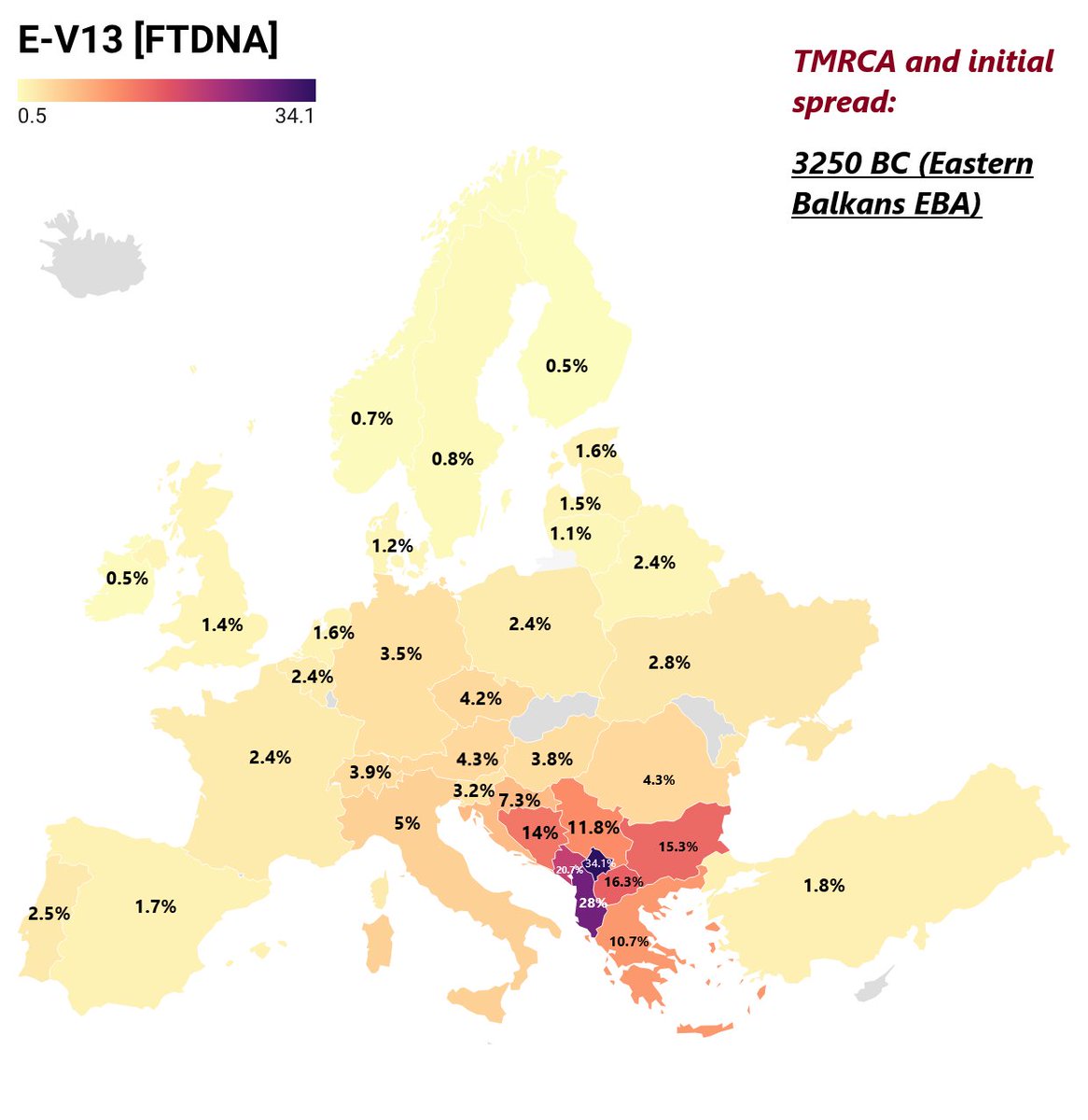
Maps of haplogroup J2-L283 and E-V13 based on FTDNA data. J-L283 is a prominent Paleo-Balkan lineage associated predominantly with Illyrians. E-V13 has deep roots in the Eastern Balkans and is associated with Daco-Thracian groups
Nelson tweet mediaNelson tweet media
English
12
17
131
10.3K
Classic Genetics retweetledi
Menhard
Menhard@IllyrianJ2bL283·
In this clip, scientist Leonidas Davranoglou confirms: Throughout mainland Greece, there is strong Albanian-related ancestry on par with other parts of the mainland. This suddenly stops as soon as you venture deep into the Mani region. This perfectly aligns with the IBD segments between modern Greeks and Albanians (Arvanite influence) and the high continuity of medieval Albanian samples to present-day Albanians. #Illyrian #AlbanianGenetics #Arvanites #BalkanDNA #aDNA #Mani #Greece
Menhard@IllyrianJ2bL283

“How can someone be so bitter and frustrated that they completely ignore science with their eyes closed?” @philosofveritas sends an autosomal DNA table and finds it “remarkable.” Yet science (including the recent study on Albanians by Davranoglu et al. + IBD analyses) shows that modern Greeks share significant IBD segments with Albanians—attributable to the Arvanites and Albanian-speaking communities in Greece, whose genetic traces are still evident today. Medieval Albanian samples cluster extremely close to modern Albanians (North and South), while many Greek profiles show strong South Balkan/Levantine shifts. This isn't an opinion; this is data. Why do some people so aggressively project their own identity crisis onto the genetics of others? The Illyrian-Albanian continuity is scientifically robust. Just accept it. ``` #Illyrian #AlbanianGenetics #Arvanites #BalkanHistory #aDNA #IBD

English
3
2
20
2.2K
Kriqlation
Kriqlation@kriqlation·
Heatmap for North Macedonia Iron Age. Distances with modern populations.
Kriqlation tweet media
English
8
14
152
7.5K
Classic Genetics retweetledi
Menhard
Menhard@IllyrianJ2bL283·
@makedonien_mk Northmacedonia is a Mix of Bulgarians and Albanians 😁
Menhard tweet media
English
0
2
7
198
Classic Genetics retweetledi
Brerore 🇦🇱
Brerore 🇦🇱@AlBrerore·
The map of Natural Albania.
Brerore 🇦🇱 tweet media
English
71
56
566
26.7K
Classic Genetics retweetledi
Menhard
Menhard@IllyrianJ2bL283·
@philosofveritas Learn to live with reality and not fight against it. People in glass houses shouldn't throw stones. People like you are a disgrace to Europe, a foreign body since your arrival, an extended arm of Putin and Erdogan. Radical Orthodox Caucasians like you harm all of Europe, not just Greece. You Caucasians wanted the comparison, and now you're crying again.
Menhard@IllyrianJ2bL283

That's not true, read the study. And subscribe to @razibkhan and listen to the podcast.

English
1
2
6
477
Classic Genetics retweetledi
Flloki🛸
Flloki🛸@SpahiuSami·
This historical map illustrates areas associated with Albanian populations during the 1300s, based on various historical records, interpretations, and scholarly research. Maps like these provide a visual way to explore how communities, cultures, and identities were distributed across different regions of the Balkans during the medieval period. Historical geography remains a subject of ongoing study and discussion, with different sources sometimes offering varying perspectives. Understanding these maps can help us learn more about the complex history, migrations, and cultural developments that have shaped Southeast Europe over the centuries. This post is shared for educational and historical discussion purposes only. Historical maps represent interpretations of past events and are shared for educational purposes only.
Flloki🛸 tweet media
English
117
15
167
34.4K
Classic Genetics retweetledi
Teemo
Teemo@TeeMemo396994·
@Dav66352635859 @IllyrianJ2bL283 Mainland Greeks have 30 - 40% admixture, not 5 - 15%. Over 20% of their patrilineages also comes from Slavic-related groups. You're right about the Albanian percentages though.
Teemo tweet mediaTeemo tweet mediaTeemo tweet mediaTeemo tweet media
English
1
1
7
175
Classic Genetics retweetledi
Menhard
Menhard@IllyrianJ2bL283·
That's not true, read the study. And subscribe to @razibkhan and listen to the podcast.
David T.@Dav66352635859

@IllyrianJ2bL283 Albanians cluster closely with mainland Greeks because they mixed much less with Slavs, similar to the Greeks. As a result, they retained a higher proportion of paleo-Balkan DNA. Slavic ancestry is estimated at roughly 10–20% in Albanians and 5–15% in Greeks, compared to 30–50%.

English
6
3
15
2.6K
Classic Genetics retweetledi
Menhard
Menhard@IllyrianJ2bL283·
🎙️ Leonidas-Romanos Davranoglou sums it up perfectly: "Albanians have very little Slavic ancestry compared to their neighbors. In some mountainous and isolated areas of Albania, there is almost no Slavic ancestry, or even 0%." "Maniots have some Slavic ancestry—but the lowest percentage on the entire Greek mainland." Genetic reality once again shatters the Greek "purity" and "Albanians are Slavicized" narratives. @philosofveritas I recommend @razibkhan podcast to everyone, and for the ultra-patriots, the best part is you don't even have to be able to read. #Illyrian #AlbanianGenetics #Maniots #aDNA #BalkanHistory #Slavicancestry @HarvardHEB
English
5
2
23
2.7K
Classic Genetics retweetledi
Menhard
Menhard@IllyrianJ2bL283·
@histories_arch @archeohistories That story isn't true. The Mesappians settled in this area, and they weren't Greeks.
Menhard tweet mediaMenhard tweet media
English
6
6
18
2.6K
Classic Genetics retweetledi
Menhard
Menhard@IllyrianJ2bL283·
@RolloRouen The Greatwst Scan In History
Menhard tweet mediaMenhard tweet media
English
1
1
4
136
Classic Genetics retweetledi
Menhard
Menhard@IllyrianJ2bL283·
This provides further evidence for the genetic formation of modern Greeks described below. Immigrants arriving in the US through Ellis Island from 1906 to 1914 photographed by Augustus Frederick Sherman x.com/echoesofempire…
Menhard tweet mediaMenhard tweet media
Menhard@IllyrianJ2bL283

We know why people like @philosofveritas claim everything is Greek, no matter how illogical. He has to question Shtike and Kenete; how else can he explain to anyone that the mainland Greeks (mostly Arvanites) are assimilated Albanians who intermarried with Armenians, Laz, and Assyrians? But Pontic Greeks, Anatolian Greeks, and Cappadocians are closer to Armenians, Assyrians, Georgians than to Arvanites or medieval Albanians. The latest DNA study confirms that a large portion of modern mainland Greek DNA segments share IBD with an individual from Roopkund, who in turn was an Albanian from Greece because he shares large segments with medieval and Modern Albanians. So now we've mixed an Albanian and an Armenian Assyrian. It's no coincidence that this results in a genetic profile that corresponds exactly to modern Greeks. @Dfire8801 #fyp #Greece #Genetics #Armenia

English
1
1
8
1.2K