Sabitlenmiş Tweet
Client Ascension
8.5K posts

Client Ascension
@clientascension
Teaching you how to build an AI Assisted Agency | @danielfazio
See how it works 👉 Katılım Mayıs 2023
184 Takip Edilen4.3K Takipçiler

Struggling to get past $30k/mo in your agency?
Or tried dozens of business models with no luck?
The biggest problem is figuring out what to sell.
Check this out:
go.clientascension.ai/?sl=TwitterCA
English
Client Ascension retweetledi

"Just post good content bro."
Worst advice on X.
Who decides if it's good?
You?
Wrong.
Your audience decides.
And they're telling you it sucks.
You're just not listening.
I see this constantly:
Creator posts "brilliant content."
Gets 8 likes.
Posts again.
12 likes.
Posts again.
5 likes.
Then cries: "Why am I not growing?"
Because your content is boring and you refuse to admit it.
The market is screaming at you.
You're ignoring it.
Here's what you're doing wrong:
Posting what you want to post.
Not what people want to read.
Then blaming the algorithm.
"My content is great, people just aren't seeing it."
No.
They're seeing it.
They scroll past in 0.3 seconds.
The feedback is right there:
8 likes = Nobody cares.
200 views = Boring hook.
0 DMs = Zero value.
These aren't vanity metrics.
They're your report card.
You're failing.
My first 3 months:
Posted "incredible insights."
Generic advice.
Perfect structure.
Nobody cared.
Result: 10-15 likes.
My cope: "People aren't ready for this."
Reality: Nobody gave a damn.
Then I tested:
Personal story about losing $40k in crypto: 500 likes.
Generic "consistency wins" post: 9 likes.
The market told me exactly what it wants.
Did I listen?
No.
Posted 10 more generic posts because I thought I knew better.
Month 4: Finally listened.
Posted raw stories.
Shared failures.
Stopped trying to sound smart.
Engagement tripled.
Here's the truth:
Your audience gives you free market research.
Every day.
Low engagement = This is boring.
High engagement = More of this.
But you ignore it.
Post the same dead content.
Expect different results.
Real data from my posts:
Personal journey: 100+ likes average.
Generic tips: 15 likes average.
Data screamed at me for 6 months.
I finally listened.
Growth exploded.
Most creators are delusional:
Think their content is great.
Engagement says otherwise.
Blame everything except their content.
Wake up.
Here's what works:
Post something.
Check engagement.
High? Do more.
Low? Kill it.
Simple.
But you won't do it.
Your move:
Stop being delusional.
Start listening to feedback.
Track what works.
Do more of that.
Kill everything else.
Your audience is screaming what they want.
Listen or stay stuck.
English

People thought I was cheating.
"You are using engagement pods and bots."
No, I don't.
Then, people say this:
"Okay but I don't have 8 hours a day like you."
No, I also don't lol.
You're already spending time creating content.
Everybody posts 3 posts a day
Everybody sends 10 new DMs a day
Everybody comments 50 times a day
They put in the work.
Just in the wrong way.
Zero ROI.
You don't need more inputs.
You need a better strategy.
English

Everyone assumes that plain text emails don’t work.
Out of the $100M+ revenue we've generated... plain text is one of our highest performers.
Because when every email looks like this:
- Product grids
- Fancy buttons
- Multiple CTAs
- Big hero image
- Discount banners
Your emails just start to scream "THIS IS AN AD."
And they get mediocre results at best.
Here's why plain-text founder emails print money and how you can use them:
1. Deliverability
Gmail treats plain-text emails like personal messages.
That means higher chances of landing in the primary tab instead of the promotions folder.
But designed emails with images, multiple links, and HTML?
Gmail knows that's marketing.
---
2. Psychology
Designed emails feel like ads.
And people are trained to ignore ads.
Plain-text emails feel like your friend reaching out to tell you something important.
There's no visual barrier....
Hence, no "marketing" filter in their brain.
It's just you talking to them.
---
3. Data
We've tested this across 100s of brands.
Plain-text emails, when done right, consistently convert higher than designed emails.
In most cases, they outperform them.
---
4. Trust
When the founder emails you directly, it feels personal and exclusive.
It's "the person who built this thing" taking time to reach out to you.
And that builds trust faster than any polished design ever could.
Thing is...
You can't send them all the time.
If every email is plain-text from the founder, the effect wears off.
One plain-text founder email per month...
Great.
Four per week is too much.
So use it for:
- Product launches
- Behind-the-scenes updates
- Re-engagement campaigns
- Apologies or transparency moments
- Sales reminders (without heavy design pressure)
- Major company announcements
This cooks.
Highly recommend.
English

A problem you've carried for more than a year isn't a problem anymore. It's a decision you keep making.
You already know which one I mean.
Think Big Minute #39
The hire you should have let go 14 months ago. The client who drains your team and pays late. The pricing you've known for a year is too low. The conversation with your business partner you keep not having.
You've named it. You've complained about it. You may have paid someone to advise you on it.
And it's still here.
Somewhere around the one year mark, a problem quietly stops being something that happened to you. It becomes something you are choosing.
The problems that finally get fixed were almost never mysteries.
When Alan Mulally took over Ford in 2006, the company was headed for a loss of more than $12 billion that year. He ran weekly meetings where executives marked every part of the business red, yellow, or green. For weeks, every executive reported everything green. A company losing twelve billion dollars, and the whole room was green. The problems weren't unknown. They were undiscussable. The day Mark Fields finally showed a red item, Mulally applauded him. Ford became the only American carmaker that didn't take a government bailout.
Domino's spent years knowing their pizza had a reputation problem. Customers said it tasted like cardboard. The company knew. They competed on speed and price and left the actual product alone. Then in 2010, under Patrick Doyle, they admitted it out loud in their own ads and reformulated the recipe. The stock was under ten dollars. It became one of the best performing stocks of the entire decade.
Lego was near bankruptcy in 2004. Not from a surprise. They had spent years overextending into theme parks, video games, and too many product lines, and they knew the core was drifting. Jørgen Vig Knudstorp took over and made the decisions that had been sitting there unmade. Cut the lines. Sell the parks. Go back to the brick. Lego became one of the most profitable toy companies in the world.
None of those were solved by new information.
Ford knew. Domino's knew. Lego knew. The problem in every case had been in plain sight for years. What changed was not knowledge. Somebody decided.
Here's what's actually going on.
A problem you keep long enough stops looking like a problem.
Furniture.
You stop seeing it. You arrange the day around it. You build little workarounds and little stories so you never have to bump into it. After a while you would almost feel strange if it were gone.
That is the tell. A problem that has become furniture is not unsolved. It has been re-chosen. Every morning you woke up, saw it, and kept it one more day.
You didn't fail to fix it. You voted to keep it.
About 365 times.
I've kept problems as furniture. I'm not writing this from the outside.
For years Legiit had a marketing problem I could describe in detail in any meeting you put me in. I knew it. I tried one fix. It didn't work, and after that I mostly stopped trying. I told myself I was being patient and waiting for the right person.
Patient was a generous word for it.
What was actually happening is that every real fix meant a hard, expensive change I didn't want to make yet. So I kept the problem and renamed the keeping.
I can tell you the year it stopped being a problem and became a decision. It was years before I admitted that. I just didn't want to know.
Here's why this is so easy to do and so hard to see.
A problem you've had for a year doesn't hurt the way a new one does. The pain is low and steady and predictable. You've adapted to it like a sound in the house you stopped hearing.
The fix is the opposite. The fix has a sharp, upfront cost. The hard conversation. The firing. The revenue you lose the month you drop the bad client. The moment you admit you were wrong for a year.
A steady ache against a sharp cost. People pick the steady ache almost every time. Not because they can't do the math. Because the ache is quiet and the cost is loud.
There's a second reason, and it's the one nobody says out loud.
The problem is useful. As long as it exists, it's the reason. The reason the business isn't bigger. The reason the numbers are flat. The reason you're tired. Fix it, and the reason is gone, and the only thing standing where the reason used to be is you.
A problem you've kept for years is paying rent. It pays in excuses.
And the help on offer rarely names this, because almost everyone who could help you is selling a solution. A system, a tool, a hire, a course. Those things are real and they work, when the problem is a true gap in knowledge or resources. But a problem you've carried for over a year is rarely a knowledge gap. You already know the fix. You've known for months. It's a willingness gap. Nobody keeps willingness on a shelf to sell you.
Stop trying to solve it.
Pick the date you stop keeping it.
Think Big
English

The retention methods that actually work in DTC right now are NOT the ones being posted on Twitter.
The good stuff stays in private Slack channels between operators who run real accounts.
What's working in the second week of November isn't what was working in May.
The flows we shipped last quarter are already getting refined again based on what the data is showing this month.
None of that conversation happens publicly because most agency owners are terrified of giving away their edge.
I'm opening up that exact conversation to 100 people.
My team running 35+ live ecom accounts will be posting inside one Skool community.
The actual tests we're running, the flows that are working this week, the things we tried that didn't.
Plus the full course I just filmed in studio, 100s of email templates, swipe files, and checklists we use internally on every account.
These are the same methods we used to take one of our clients from $50k/mo to over $1m/mo in 24 months
First 100 people in get the entire thing free forever.
After that it goes paid for everyone.
100 spots.
DM me "ACCESS" if you want behind the curtain.
English

Changed one thing and took an 8-figure brand's welcome flow from $33,000 to $210,000/month.
📁 The exact 7-step framework
┃
┣ 📁 AUDIT THE POP-UP FORM AND WELCOME FLOW TOGETHER
┃ ┣ 📁 Pull up your pop-up form and your welcome flow side by side in Klaviyo.
┃ ┣ 📁 Check whether the offer on the pop-up is the same offer carried into the welcome emails.
┃ ┣ 📁 Treat the pop-up form and welcome flow as one cohesive unit instead of two separate pieces.
┃
┣ 📁 SKIP THE SUBJECT LINES, COPY TWEAKS, AND EXTRA EMAILS
┃ ┣ 📁 Leave the subject lines alone because rewriting them brings back 10% extra revenue at best.
┃ ┣ 📁 Avoid reworking the copy inside the welcome emails since it sits in the same 10% ceiling.
┃ ┣ 📁 Go straight to testing the offer because that's the only lever that returns 5x, 6x, or 10x.
┃
┣ 📁 SET 10% OF AOV AS YOUR DOLLAR-OFF BENCHMARK
┃ ┣ 📁 Find your store's average order value inside Shopify or Klaviyo.
┃ ┣ 📁 Multiply that AOV by 10% to calculate the dollar-off figure you'll test.
┃ ┣ 📁 On a $250 AOV, the calculation lands you at $25 off as the benchmark.
┃ ┣ 📁 Match your free gift cost to the same $25 value, so all three offers weigh the same on the backend.
┃
┣ 📁 RUN THE A/B/C OFFER TEST ON THE POP-UP FORM
┃ ┣ 📁 Build 3 variations of the same pop-up form inside Klaviyo using the clone variation button.
┃ ┣ 📁 Set variation one to 10% off, variation two to $25 off, and variation three to the free gift.
┃ ┣ 📁 Change only the offer copy across the 3 variations while keeping the rest of the form identical.
┃ ┣ 📁 Split traffic evenly across the variations so the offer is the only variable moving the results.
┃
┣ 📁 FRAME THE DOLLAR OFFER AS REAL MONEY IN THE COPY
┃ ┣ 📁 Write the headline on the dollar off variation as “You’ve got $25 off” instead of “Get 10% off.”
┃ ┣ 📁 Carry the dollar figure through the CTA button and every step of the pop-up form.
┃ ┣ 📁 Give the customer a visual of a $20 bill and a $5 bill instead of a percentage they have to calculate.
┃
┣ 📁 TAG EACH SUBSCRIBER WITH A PROFILE PROPERTY AT OPT-IN
┃ ┣ 📁 Open the email submit step inside each pop-up variation in Klaviyo.
┃ ┣ 📁 Add a custom profile property called “offer,” so it fires the moment a subscriber hands over their email.
┃ ┣ 📁 Set the value on each variation to match the offer: “percent” for 10% off, “dollar” for $25 off, and "free gift" for the free gift.
┃
┣ CONDITIONAL SPLIT THE WELCOME FLOW BY PROFILE PROPERTY
┃ ┣ 📁 Drag a conditional split to the top of your welcome flow inside the Klaviyo flow builder.
┃ ┣ 📁 Branch the flow based on the “offer” property you set on the pop-up form.
┃ ┣ 📁 Build 3 identical welcome emails underneath, one per branch of the split.
┃ ┗ 📁 Swap only the offer line and the discount code between them so each subscriber receives exactly what they signed up for.
That's how one offer test took an 8-figure brand's welcome flow from $33K to $210K/month.
- Email revenue: $579K in February to $968K in March
- Form leads: 7,900 in January to 59,000 in March
- Placed order rate: 3.3% to 11.3%
- Email now 40% of total store revenue
English

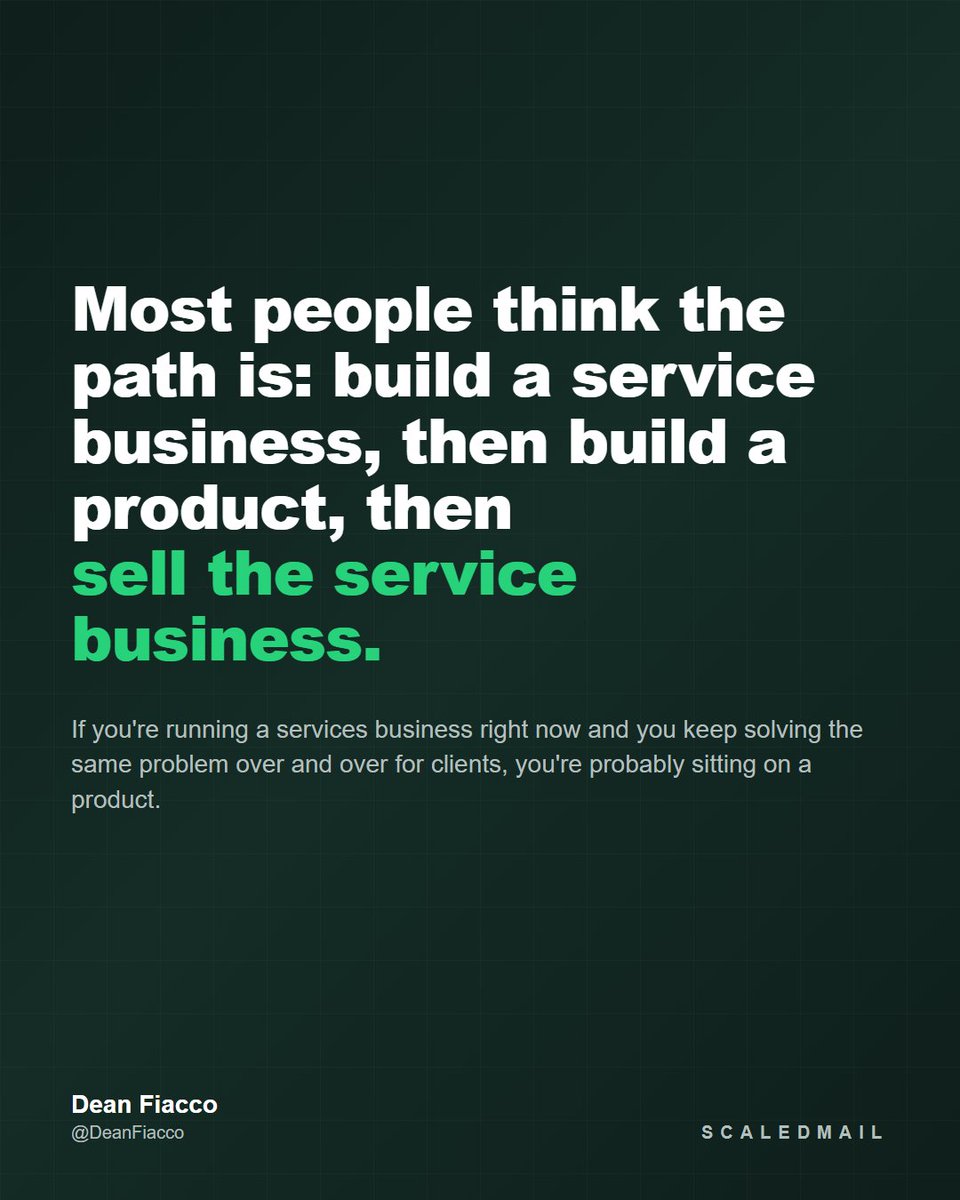
Most people think the path is: build a service business, then build a product, then sell the service business.
I did it the other way. I built them at the same time because the service business showed me exactly what the product needed to be.
We started Beanstalk in 2024. Within months of running outbound campaigns for clients I was dealing with the same infrastructure problems every single day. Domains going down, warmup issues, deliverability fires. ScaledMail wasn't some big strategic bet. It was me getting tired of solving the same problem manually for every client.
Now ScaledMail has 1,600+ subscribers running 230K+ inboxes and most of them aren't Beanstalk clients. The service business was the R&D department for the product business and I didn't have to raise a dollar to fund it.
If you're running a services business right now and you keep solving the same problem over and over for clients, you're probably sitting on a product. You just haven't built it yet.

English

Your ads are never going to work unless you nail the ARGUMENT...
I’ve made my clients well north of $50m and by far the biggest thing that determines whether or not an ad will crush is if it makes a good enough logical argument for booking a call to learn more.
The biggest mistake I see people making is treating B2B buyers like they’re normal customers…
B2B buyers care about LOGIC
They’re not going to buy because you try to get them into an emotional state… the only way they buy is because they come to the emotional state themselves through LOGIC
For example…
If you can get a B2B buyer to come to the conclusion that they’ve been using the completely wrong system, that their current system is the reason they’re running into the problems and pain points they’re experiencing… and demonstrate to them that your model is actually the SMART way to get the result they want… they’ll book a call
So when you go to write your ads, you need to think about what they’ve tried, why it’s causing the problems they’re running into, and why your solution is superior at getting them what they want compared to whatever they’re doing right now
English

The easiest way to rewire your customer's brains to make them buy more:
Get into a 'relationship' with them.
Your customers should EXPECT to hear from you every single week.
They should know roughly when your emails land and what kind of content to expect.
If someone on your list is surprised when your email shows up, your campaign strategy is broken.
Consistency builds trust in the inbox and a weekly send with recognizable content pillars is how you earn that trust.
Brands that show up consistently TRAIN their audience to open.
English