Christopher Newfield

13.5K posts

Christopher Newfield banner
Christopher Newfield

Christopher Newfield

@cnewf

Psychic life of culture, green political economy, critical university studies, knowledge-power struggles, epistemic justice.

London, England Katılım Ekim 2009
2.1K Takip Edilen4.1K Takipçiler
Christopher Newfield retweetledi
Jay Van Bavel, PhD
Jay Van Bavel, PhD@jayvanbavel·
I don't think people fully realize how badly AI has damaged higher education. This is not an easy problem to fix. There are two major issues that foster cheating with AI: 1) Friction: It used to be hard to cheat. You had to find another student to copy. Now you just drop a short prompt (or the PDF of your assignment) into a chatbot and you get a complete response. This problem is not going away, it will only get worse as AI answers get harder and harder to detect 2) Social norms: Too many students are using this technology. As more and more students use AI to cut corners, it becomes easier and easier for other students to rationalize it. At some point, you reach a tipping point where cheating (rather than following the rules) feels normative. Unless you can fix both of these issues, cheating will get worse. Much worse. The problem is that the lack of friction creates worse social norms, which then makes it easier for others to justify cheating. Even students who don't want to cheat will eventually feel that it's necessary to keep up with other students. Like many professors I know, Princeton is trying to do something to protect the integrity of their educational experience. If they don't, employers will quickly figure it out and the value of a Princeton degree will eventually approximate the value of a degree from a diploma mill. I have had to change my exams and class assignments to reflect this new reality.
Jay Van Bavel, PhD tweet media
English
43
67
257
38K
Christopher Newfield retweetledi
Gary Marcus
Gary Marcus@GaryMarcus·
“we are working harder to manage our tools than we are to solve the actual problems they were meant to fix.”
Rohan Paul@rohanpaul_ai

Harvard Business Review research reveals that excessive interaction with AI is causing a specific type of mental exhaustion ( or "AI brain fry"), which is particularly hitting high performers who use AI to push past their normal limits. A survey of 1,500 workers reveals that AI is intensifying workloads rather than reducing them, leading to a new form of mental fog. While AI is generally supposed to lighten the load, it often forces users into constant task-switching and intense oversight that actually clutters the mind. This mental static happens because you aren't just doing your job anymore; you are managing multiple digital agents and double-checking their work, which creates a massive cognitive burden. The study found that 14% of full-time workers already feel this fog, with the highest impact seen in technical fields like software development, IT, and finance. High oversight is the biggest culprit, as supervising multiple AI outputs leads to a 12% increase in mental fatigue and a 33% jump in decision fatigue. This isn't just a personal health issue; it directly impacts companies because exhausted employees are 10% more likely to quit. For massive firms worth many B, this decision paralysis can lead to millions of dollars in lost value due to poor choices or total inaction. Essentially, we are working harder to manage our tools than we are to solve the actual problems they were meant to fix. --- hbr .org/2026/03/when-using-ai-leads-to-brain-fry

English
19
62
370
44.4K
Christopher Newfield retweetledi
Arnaud Bertrand
Arnaud Bertrand@RnaudBertrand·
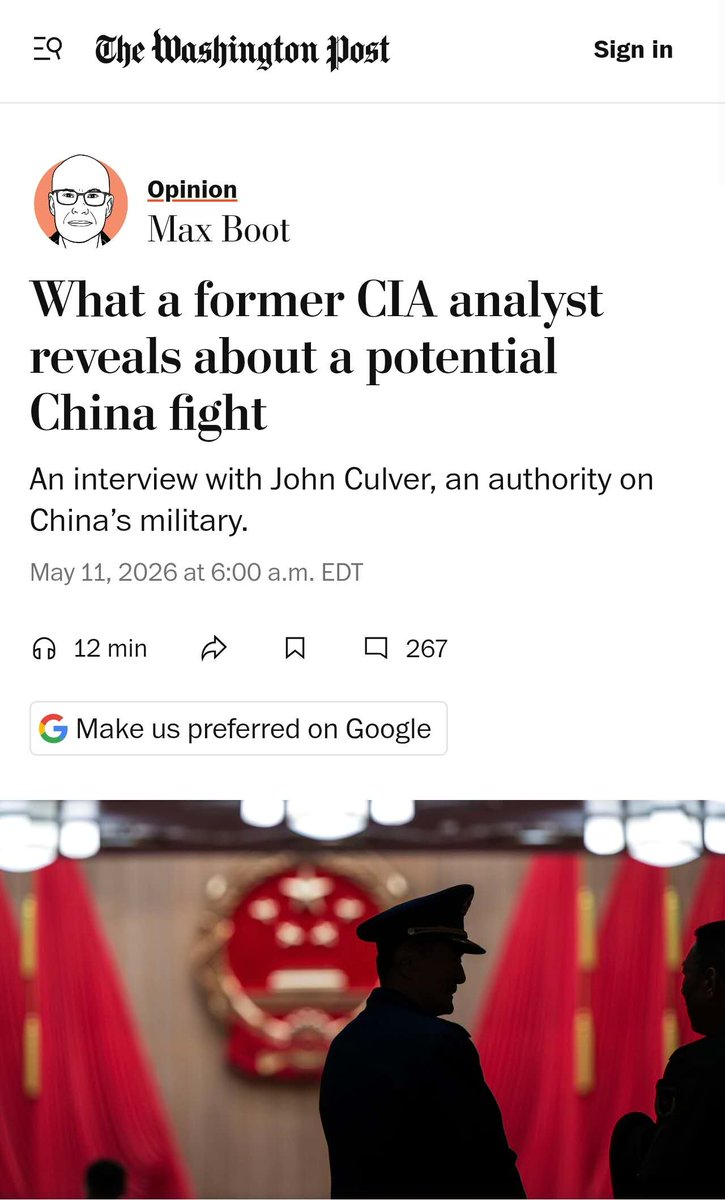
What's going on? Are neocons having a come-to-Jesus moment? After Bob Kagan writing an article on how the U.S. is facing "total defeat" in Iran (see x.com/RnaudBertrand/…), you now have Max Boot - the very author of “The Case for American Empire” and one of the most vocal advocates for the Iraq war - publishing a Washington Post interview explaining that China has surpassed the U.S. in most military domains. If anything, Boot’s interview is even more devastating than Kagan's piece, because it's not editorial opinion - he’s interviewing John Culver, a former top CIA analyst (he was national intelligence officer for East Asia) and one of the world’s foremost authorities on the Chinese military which he’s been studying since 1985. This isn't a pundit opining - this is someone who spent decades inside the intelligence community staring at the actual data. So what is Culver saying? 1) In case of war with Taiwan, the U.S. will flee the theater This is undoubtedly the single most stunning revelation in the entire piece. Culver says that - as far as he is aware - the Pentagon’s plan in case of war with Taiwan is… flee! This is the exact quote: "I think some of the thinking in the Pentagon, and it may have evolved since I retired, is that when we think there’s going to be a war, we need to get our high-value naval assets out of the theater, and then we would have to fight our way back in. From where, it’s not clear. Guam is no bastion either." Why? Because, as he explains, any high-value U.S. assets would be sitting ducks in the entire area. China can strike U.S. forces deployed to Japan, Australia, or South Korea “in a way that Iran really can't” and, given that Iran has hit at least 228 targets across U.S. bases in the Middle East - forcing the U.S. to evacuate most of them - that's saying something. Also, U.S. aircraft carriers would need to operate within 1,000 miles of the fight to matter, which - given it’s well within range of Chinese missiles - they won’t. As Culver bluntly puts it: “There's really no safe spaces.” 2) China leads in most military domains - and it's not even close Culver says that “it’s hard to not be hyperbolic” about China’s military capabilities and that, at this stage, “it’s hard to point to an area other than submarines and undersea warfare and say the United States still has an advantage.” In some critical areas, such as advanced munitions - which, when it comes to war, is pretty damn relevant - his assessment is that China leads by “magnitudes.” As a reminder, an order of magnitude means 10x so, by assuming he knows that and meant what he said, “magnitudes” means at least a hundred times more, meaning U.S. capabilities would be less than 1% those of China. At the same time, Culver also says that “whichever side runs out of bullets first is going to lose.” So if China produces “magnitudes greater than our industrial base could produce” - as he puts it - then you don't need a PhD in military strategy to put two and two together… The picture, if anything, is even more damning in shipbuilding capabilities. He reminds that a single shipyard in China - Jiangnan Shipyard, on Changxing Island near Shanghai - “has more capacity than all U.S. shipyards combined.” Put all Chinese shipyards together and China’s broader naval shipbuilding capacity is 232 times larger than that of the United States (and this is from a leaked U.S. Navy briefing slide). Culver helpfully adds that China “deploys enough ships every year to replicate the entire French navy” - which, as a Frenchman, hurts a little, but at least we'll always have the cheese (I hope). 3) Despite this, a war in Taiwan is highly unlikely If your only window into China is Western media coverage, you'd naturally assume all of the above means war over Taiwan is about to break out. After all, if China is so powerful and the U.S. so outmatched, why wouldn't it just take Taiwan and be done with it? Culver’s assessment - and mine, incidentally - is the exact opposite: China’s increasing relative strength vis-a-vis the U.S. makes war less likely, not more. How so? As Culver explains Taiwan is “a crisis Xi Jinping wants to avoid, not an opportunity he wants to seize.” The stronger China gets, the less it needs to fight: why launch a war when you can simply wait for the military balance to become so lopsided that the U.S. quietly drops its security guarantee on its own? Culver himself foresees a future “when Americans might start to say, maybe Taiwan is a war we don’t want to get involved in.” That would almost automatically mean peaceful reunification, which has always been China’s primary objective. This doesn't mean China views the U.S. as harmless. Quite the contrary - Culver says Beijing sees America “as a very militarily aggressive country” that is “declining in power and becoming more violent” as a result. Which he says is one further reason why “war over Taiwan is not something that Xi Jinping is looking for.” China doesn't want to hand a pretext to a dangerously trigger-happy power - all the more when patience alone delivers what it wants. 4) The game is up Last but not least, perhaps the most revealing aspect of the interview is that Culver doesn’t seem to see a way out: this is structural and irreversible. Asked by Boot whether “the Trump administration’s $1.5 trillion defense budget, assuming it’s approved, [would] change the trend lines” (which, as a reminder, would constitute a 50% increase in defense spending), his reply is that “it would probably help to some extent, but I worry that we could be throwing good money after bad.” Not exactly brimming with optimism… Similarly, when asked why the U.S. keeps investing billions in aircraft carriers and even “Trump-class battleships,” his answer is that it's because “the military services have a nostalgia for the things that meet their expectations for how you get promoted.” In other words, wasted money. Same thing for the Pentagon's much-hyped “Hellscape” drone strategy to defend Taiwan. Culver asks the obvious question: “What drones are you talking about launching from where?” He points out that they’d “have to pre-deploy them if not on Taiwan itself then on Luzon or the Japanese southwest islands, all of which can be struck by the Chinese.” He adds that this is “the tyranny of time and distance when you look at war in the Pacific.” The picture that emerges, both from Boot’s Culver interview and Kagan’s article, is remarkably consistent: the U.S. is “checkmate” in the Middle East, would need to entirely flee the Pacific theater before a war even starts, cannot produce enough weapons, cannot keep its supposed “allies” safe, and has no strategy to reverse any of it - nor can one even be produced given the structural nature of the gap. Even a 50% increase in defense spending, Culver says, would be “throwing good money after bad.” That's not my assessment - that's theirs. Two of America's most prominent hawks, in two of its most establishment outlets, in the space of 48 hours, have essentially published the obituary of American military primacy. Yesterday I concluded my post by saying that even the arsonists now smell the smoke. Today I'll say: the arsonists are now writing the fire report.
Arnaud Bertrand tweet media
Arnaud Bertrand@RnaudBertrand

There’s no overstating how extraordinary this Atlantic article is, given the author and the outlet. As a reminder Bob Kagan is: - The co-founder of Project for the New American Century, probably the single most imperialist Think Tank in Washington (which is quite a feat) - A man who spent his entire life advocating for American military interventions, especially in the Middle East, and a vocal advocate of the Iraq war. He started advocating for intervention in Iraq before 9/11, which speaks for itself... - The husband of Victoria Nuland, an extremely hawkish former senior U.S. official (a key architect of U.S. policy in Ukraine, with the consequences we all witness today) - The brother of Frederick Kagan, one of the key architects of the Iraq surge In other words, we ain’t exactly looking at some sort of anti-imperialist peacenik. This is quite literally the guy Dick Cheney called when he needed a pep talk. And the man is writing in The Atlantic, the most reliably pro-war mainstream media outlet in the U.S. (also quite a feat). So when HE writes that the U.S. “suffered a total defeat” in Iran that has no precedent in U.S. history and can “neither be repaired nor ignored,” it’s the functional equivalent of Ronald McDonald telling you the burgers aren’t great: it means the burgers really, really aren't great. Extraordinarily (and somewhat worryingly, for me), his arguments for why this is such a defeat are virtually the same as those I laid out in my article “The First Multipolar War” last month (open.substack.com/pub/arnaudbert…). Here they are 👇 1) Vietnam/Afghanistan were survivable, this isn't He agrees that this war - and the U.S. defeat - is fundamentally different in nature from previous U.S. interventions. Where I wrote that the wars in Vietnam and Afghanistan didn’t change the equation much in terms of power dynamics (“in the grand scheme of things, the giant walked away with little more than a bruised ego”), Kagan writes that “the defeats in Vietnam and Afghanistan were costly but did not do lasting damage to America's overall position in the world.” And when I wrote that “it’s painfully obvious that the Iran war is of a qualitatively different nature” from these, he writes that “defeat in the present confrontation with Iran will be of an entirely different character.” Same point. 2) Iran will never relinquish Hormuz and uses it as selective leverage When I wrote that Iran has turned “freedom of navigation” on its head by establishing “a permission-based regime” through the Strait of Hormuz, Kagan arrives at the same conclusion: “Iran will be able not only to demand tolls for passage, but to limit transit to those nations with which it has good relations.” He also agrees that “Iran has no interest in returning to the status quo ante,” when I myself cited Iran’s parliament speaker Ghalibaf in my article, saying: “The Strait of Hormuz situation won’t return to its pre-war status.” Same point and virtually the same words. 3) Gulf states will have to accommodate Iran He agrees that most Gulf states will have no choice but to accommodate Iran, effectively making Iran into a, if not THE, dominant regional power. Kagan writes “the United States will have proved itself a paper tiger, forcing the Gulf and other Arab states to accommodate Iran.” On my end, I wrote that “the Gulf monarchies will eventually have to choose between two security propositions. One where they stay aligned with a distant superpower that [can’t protect them]. The other proposition being: make peace with the regional power that just proved it can hit [them] whenever it wants.” Which is not much of a choice… 4) Military impossibility to reopen Hormuz Kagan writes that “if the United States with its mighty Navy can't or won't open the strait, no coalition of forces with just a fraction of the Americans' capability will be able to, either.” On my end, in my article I cited Germany’s defense minister Boris Pistorius: “What does Trump expect a handful of European frigates to do that the powerful US Navy cannot?” The exact same argument. 5) Global chain reaction Kagan agrees that this is a global strategic failure that fundamentally changes the U.S.’s position in the world. As he puts it: “America's once-dominant position in the Gulf is just the first of many casualties… America's allies in East Asia and Europe must wonder about American staying power in the event of future conflicts.” You’ll have guessed it, I wrote essentially the same thing: “Think about what it says if you’re Saudi Arabia, quietly watching your American-built defenses fail to protect your own refineries. Or any European country now facing the worst energy shock since 1973, caused not by your enemy but by your ally, and realizing that said ‘ally,’ supposedly in charge of ‘protecting’ you, couldn’t even protect Israel’s most strategic sites - when it’s the country with which it’s joined at the hip. I’m not even speaking about China or Russia who are seeing their worldview being validated on almost every axis simultaneously.” 6) Weapons stocks depleted, credibility shattered Kagan: “just a few weeks of war with a second-rank power have reduced American weapons stocks to perilously low levels, with no quick remedy in sight.” Me: “America’s most advanced weapons systems are much more vulnerable than previously thought - not theoretically, but in actual combat.” Kagan: “America's allies… must wonder about American staying power in the event of future conflicts.” Me: “The U.S. security guarantee has been empirically falsified in real time.” ----------- So, yup, Bob Kagan and I agree on nearly everything. I need a shower 🤢 Reassuringly though, we still differ on a few fundamental aspects. First of all, arguably the most important one, the moral aspect. In typical neocon fashion, his article contains not a word about the human cost of this war - not the 165 schoolgirls, not the devastation inflicted on Iranians during 37 days of bombing, not the toll this war is taking on the entire world through its devastating economic consequences (the economic devastation on ordinary people worldwide is referenced only as a political problem for Trump). For him, this is purely a strategic chess problem, morality and people don’t figure in his mental map. For me, the moral bankruptcy of this war isn't separate from the strategic failure - it is the strategic failure. Much like Gaza can only be a failure because of its sheer abjectness. Secondly, there is not an instant of reflection in the article on how we got there. Which is unsurprising because he personally, alongside his wife, his brother, and every co-signatory of every PNAC letter, spent a generation pushing for exactly this kind of confrontation. The man spend 30 years advocating for military dominance in the Middle East and hostility towards Iran, thereby forging them as an adversary and facilitating this very war that he now says has “checkmated” America. I know introspection has never been the neocon forte but at some point you have to stop setting houses on fire and then writing op-eds about how surprising the smoke is. Last but not least, we differ on what should be done. This is the funniest part of Kagan’s article - showing that the man is decidedly beyond salvation. On one hand he calls this a “checkmate” by Iran, and a U.S. defeat that can “neither be repaired nor ignored,” yet an the other hand his solution for it is… surprise, surprise… a bigger war still! He writes that what’s to be done is “engage in a full-scale ground and naval war to remove the current Iranian regime, and then to occupy Iran until a new government can take hold.” The arsonist's solution to the fire is a bigger fire ¯\_(ツ)_/¯ For my end, this was the conclusion of my previous article: "There is almost a Greek tragedy quality to U.S. actions lately where every move taken to escape one’s fate becomes the mechanism that delivers it. The U.S. went to war to reassert dominance - and proved it could no longer dominate. It demanded allies send warships - and revealed it had no real allies. It waged forty years of maximum pressure to break Iran before this moment came - and instead forged the very adversary now capable of meeting it. It started the war in part to have additional leverage over China - and handed the world the spectacle of begging China for help. The prophecy was multipolarity. Every American action to prevent it reveals it instead." I wouldn’t change a word. The only thing that's changed since I wrote it is that even the arsonists now smell the smoke. Src for the Atlantic article: theatlantic.com/international/…

English
156
1.2K
3.4K
397.2K
Christopher Newfield retweetledi
Jason Hickel
Jason Hickel@jasonhickel·
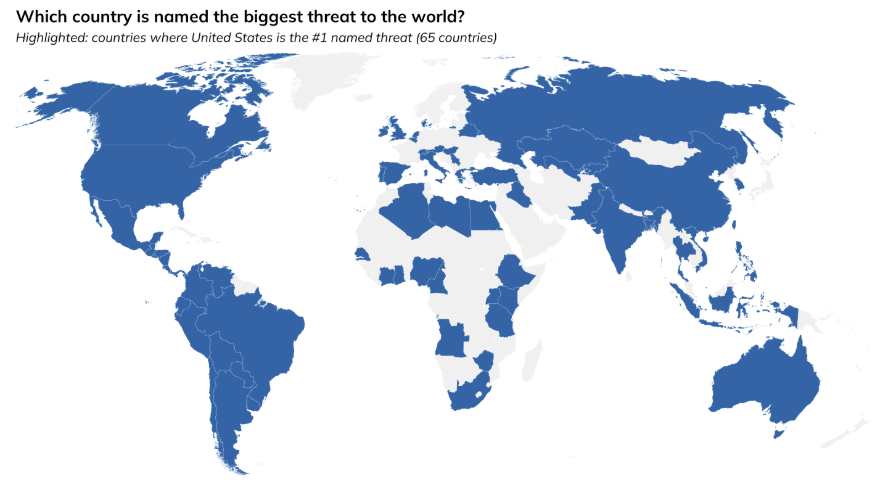
"Which country do you think poses the greatest threat to the world?" According to the new Democracy Perceptions Index report, the US is named as the top threat by people in 65 out of 84 of surveyed countries. In fact, the US is the top named threat even within the US itself.
Jason Hickel tweet media
English
78
928
2.5K
86.1K
Christopher Newfield retweetledi
Steven N. Durlauf
Steven N. Durlauf@sndurlauf·
.@cblatts I strongly disagree and urge you to reconsider the assessment. This week -Atlantic reporter Sarah Fitzpatrick was reported to be under FBI investigation after writing an article on Kash Patel’s erratic behavior. -The FBI raided the office and personal business of Virginia State L. Louise Lucas, who led Virginia redistricting efforts -A Federal Appeals Court is about to rule on the efforts of the Department of Defense to punish Senator Mark Kelly for recording a message to the military on the obligation not follow illegal orders -A US District Court ruled that the Department of Justice can keep 2020 ballots seized from Fulton County in an effort to prosecute nonexistent electoral fraud, so the Orwellian effort to rewrite the history of the 2020 election will continue And of course there is ICE. One of my children lives in Minneapolis and works near the place where Renee Good was killed. One of my best friends (my college roommate for all four years) lives in St. Paul; he and his wife were close to Melissa Hortman. This last year has made the the word fascism meaningful to them, as they would tell you and have of course told me. It is of course appropriate to condemn misconduct by demonstrators. I fully agree that acts of physical intimidation and violence are completely unacceptable and warrant long suspension and probably expulsion. But the moral idiocy of some of the campus left is a triviality compared to the actions of the Trump government.
Chris Blattman@cblatts

Woke extreme left and extreme right have in common an incapacity for pluralism. I never use the word fascist lightly, but I think the left in this country is becoming more like it than the right

English
2
11
100
14.8K
Christopher Newfield retweetledi
Oona Hathaway
Oona Hathaway@oonahathaway·
As the death toll reaches 190, it's time for another reminder that the boat strikes are unlawful under both international and domestic law--and they are a stain on our national conscience. For much more, take a look at this @just_security collection: justsecurity.org/120753/collect…
English
1
90
135
5.5K
Christopher Newfield retweetledi
Gabor Scheiring
Gabor Scheiring@gscheiring·
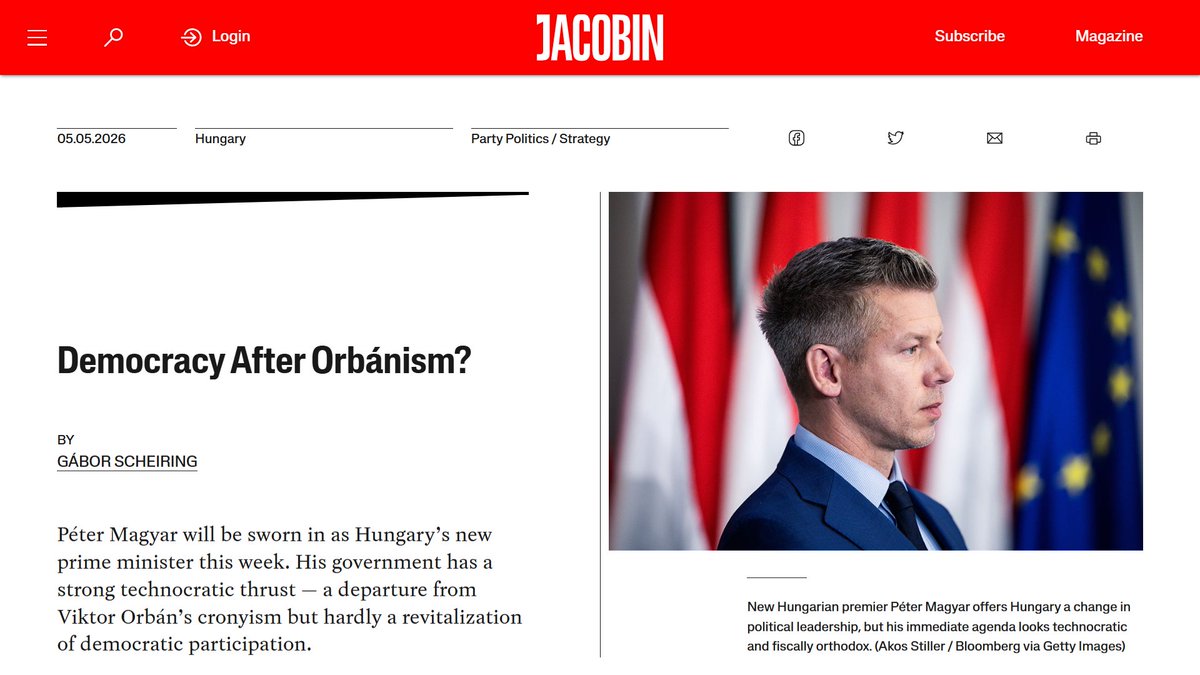
In my new @jacobin essay, I argue that Péter Magyar's incoming government has cleared the runway, but the work of democratic liftoff is only beginning. Hungary's spring of democracy is real. But the magical thinking that we can simply return to the 1990s with contemporary branding risks producing another illiberal cycle. Orbán didn't fall because Hungarian shopkeepers, truckers, and nurses suddenly took to reading John Locke. He fell because the economy collapsed, while the crony class transformed itself, and taxpayers' billions, into a new aristocracy. The road to sustainable democratization runs through three traps (economic, political, cultural) that Benedek Jávor and I, in our forthcoming book, call triple devaluation. This triple trap is not Hungarian. It is the puzzle facing democratic forces from Warsaw to Washington. 🔹 The economic trap. EU funds without a developmental-state framework are like strong coffee for an exhausted driver: it gets you through the next bend but won't get you all the way home. → In the incoming Magyar government's program, the rhetoric of economic modernization and fairness exists; a transformative developmental-state model does not. 🔹 The political trap. Defusing Orbán's institutional land mines is the "easy" part. The harder problem is the absence of counterpower in society: weak unions, exhausted civil society, a two-year-old governing party with no organized membership. → Only power restrains power, and if society is disempowered, democracy is vulnerable. 🔹 The cultural trap. A center-right civilizationist frame that competes with the far right by adopting soft xenophobia in a suit and tie is no path forward. Voters tend to choose the original over the copy. → Yet for the peripheries and the working class, the incoming government offers no new framework of recognition. The comparative record is unforgiving. Starmer in Britain. The post-Mečiar coalition in Slovakia that paved the way for Fico. The democratic parties of post-2011 Tunisia. Where democratic restoration fails to address the economic, political, and cultural traps that breed frustration, illiberalism returns. This is where the left has a role, not as a junior partner in centrist restoration, but as the force building what comes next. The old Hungarian left disqualified itself for this task: from IMF socialism in the 1990s to the post-2010 pacts that displaced the politics of inequality with symbolic constitutional liberalism. A new left has to be built on different foundations. The paramount step now is to strengthen the counterhegemonic communities and institutions that can carry green-left politics as both an idea and a social coalition. This social coalition does not emerge on its own. It must be built. And through this task, the Left can rediscover itself. #Democracy #FarRight #Illiberalism #Orbán #PéterMagyar @GUQatar jacobin.com/2026/05/hungar…
Gabor Scheiring tweet media
English
10
17
58
13.7K
Christopher Newfield retweetledi
Daniela Gabor
Daniela Gabor@DanielaGabor·
What can countries do against Trump's carbon shock therapy? We propose a Decarbonised Sovereignty, combining new politics of stabilization with transformative interventions around electrification, credit+industrial policy and a green social bargain phenomenalworld.org/analysis/again…
English
3
40
149
15.7K
Christopher Newfield retweetledi
Micah Erfan
Micah Erfan@micah_erfan·
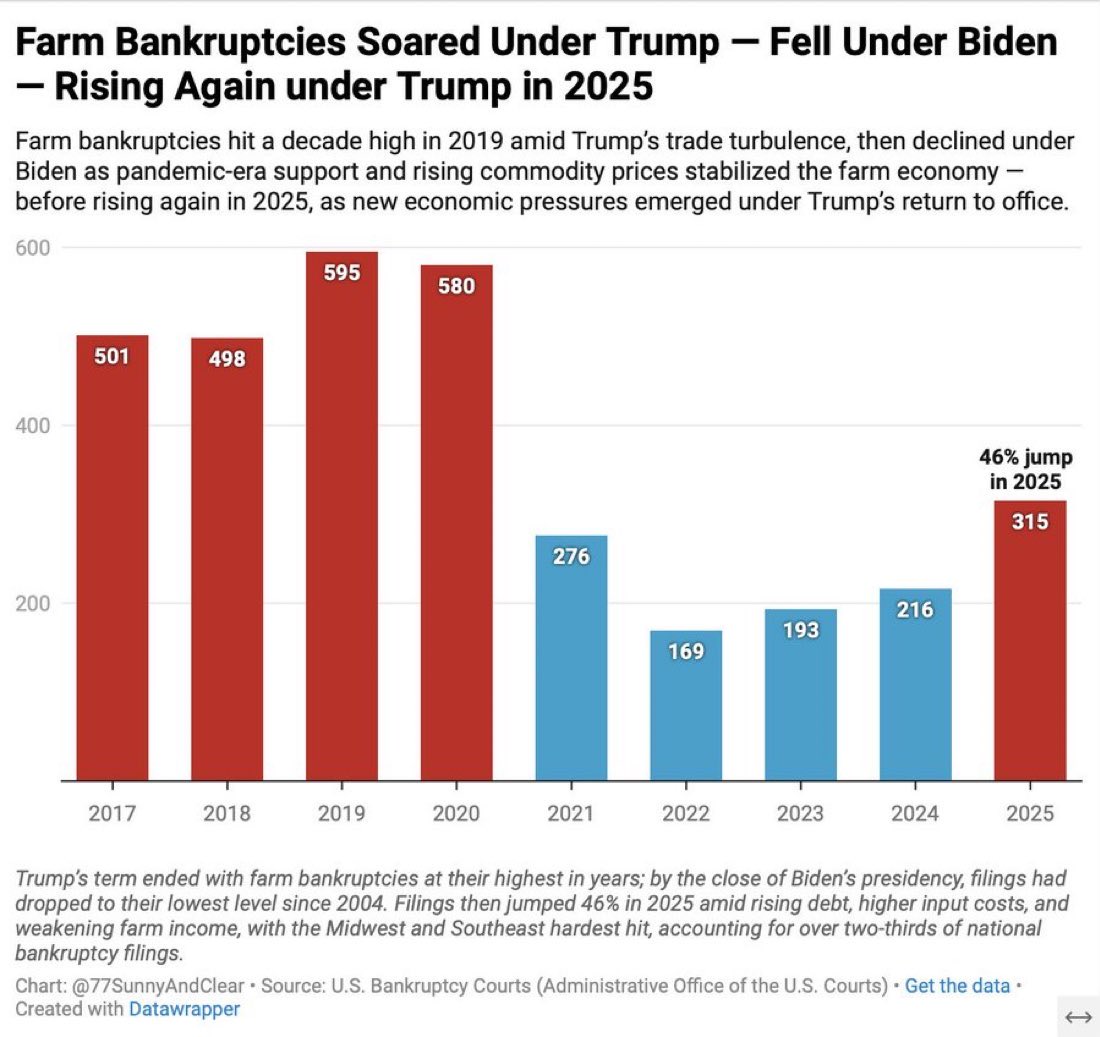
Just in case you thought people voted based on actual policy results: 77.7% of farmers voted for Trump in 2024.
Micah Erfan tweet media
English
402
2.7K
7.8K
207.9K
Christopher Newfield retweetledi
Stephanie Kelton
Stephanie Kelton@StephanieKelton·
"Unless we can break the habit of thinking like most economists do, we will sooner or later destroy our country, irreversibly damage our world, and perhaps, in the final analysis, doom the human species to a slow extinction. At a minimum, we stand no chance to improve matters, unless we can first understand, recognize, reject, and change the mental habits cultivated by conventional economics—and conventional economists." Coming 9/7/26
Stephanie Kelton tweet media
English
31
268
635
24.3K
Christopher Newfield retweetledi
Zito
Zito@_Zeets·
Beyond the arguments, it’s just really sad that most people in this country, from kids to adults, can’t and don’t read. Literacy is so essential to a dignified and intelligent life, and there used to be a national push for it not too long ago. And now it’s damn near gone.
English
33
1.7K
8.6K
252.4K
Christopher Newfield retweetledi
Trita Parsi
Trita Parsi@tparsi·
WOW! The Iranian AI Lego team has another video out. They are doubling down on building bridges between Americans & Iranians while depicting the US gov and "system" as the real enemy. The music, lyrics, and imagery are all designed to appeal to disillusioned Americans.
English
575
6.6K
20K
841K
Christopher Newfield retweetledi
The Hollywood Reporter
The Hollywood Reporter@LukeBarnett·
Give this the Pulitzer.
Katherine Argent@effthealgorithm

Search is full of ads and wrong answers. Every other email is an ad. Prime Video charges you and shows ads. Paramount? Ads. Peacock? YouTube? Hulu? Ads followed by more ads. Netflix full of ads. Meta and X, every other thing is an ad. Pinterest is nothing but ads. AI is in everything. AI finishes sentences incorrectly and won’t stop. AI reads your email and search history to target you with more ads. Every time you open an app or visit a site there’s an update making it worse. In a hurry? First, click here to agree to terms you don’t have time to read and must accept. You need an account to do that. Change your temporary password. Enter your 2FA code. Check your email and enter that code. Now use a passkey. Your password is too simple to remember. Change it. No, not like that. Now log on. Enter your 2FA code. Check your email for a code… Welcome back! We’ve updated our terms of service and privacy policy (you have none). Subscribe to the site. Subscribe to Netflix. Subscribe to toilet paper. Subscribe to these groceries. Pay a membership fee for the right to subscribe then tip your driver who delivers the subscriptions your membership lets you subscribe to. Time to work? We’ve got to update your laptop and will slow down everything you do until you agree to update. But first, click here to agree. Update installed — your laptop’s broken now. It doesn’t matter, since your boss just replaced you with AI. Go to your phone to complain on social media. Wait, your phone needs an update so we can add more AI. Click here. Oh sorry, your phone can’t handle this update. Now it’s useless. Go get the newest phone. Here’s a text from a friend, an email, a voice mail they left three days ago but you didn’t see until now because of sync problems with the cloud. It’s their GoFundMe. Their MLM. Their Patreon. Never mind, you didn’t respond to their text within 9 minutes and now you’re no longer friends. They blocked you. Make new friends. Download this app to find people in your area. In your neighborhood. On your street. Two doors down from you. Do you know this person yet, we think you’d get along. You need an account to use this app. That username is taken. Enter a password. Not that one, you used it on another site. You need to be connected to WiFi to download the app. Allow the app to connect to other devices on your network. Allow the app to access your contacts, know your precise location, store your credit card details. Oops, sorry, we got hacked now all that info is available on the web. There’s a class action suit. You can join. It’ll take a decade to get your $3.73 share of the ten billion settlement. We’ll send it via PayPal or deposit it to your bank, just tell us those details. Oh no, another hack. That info is circulating now, too. Here’s a spam call, a spam email, a spam text. Why are you angry? Why are you talking about getting rid of your phone? Why don’t you like AI, it lets us make all of this easier? Do you know how ridiculous that sounds? This is progress. You’ll be left behind. Do you want to be left behind? Do you???

English
19
670
7.8K
1.2M
Christopher Newfield retweetledi
Hollis Robbins
Hollis Robbins@anecdotal·
Academia is dismantling itself faster than its critics can. Students (and paying parents) want an education from subject matter experts, not glitchy course software. Do not be fooled that this means access. It means the soft bigotry of low expectations. insidehighered.com/news/tech-inno…
English
6
42
285
33.2K