
果實特🎒nuts.hl retweetledi
果實特🎒nuts.hl
4.5K posts

果實特🎒nuts.hl
@crazygod75
Crypto Enjoyor Since ‘18 加密一級玩家
Earth Katılım Ocak 2009
6.9K Takip Edilen1.1K Takipçiler

果實特🎒nuts.hl retweetledi

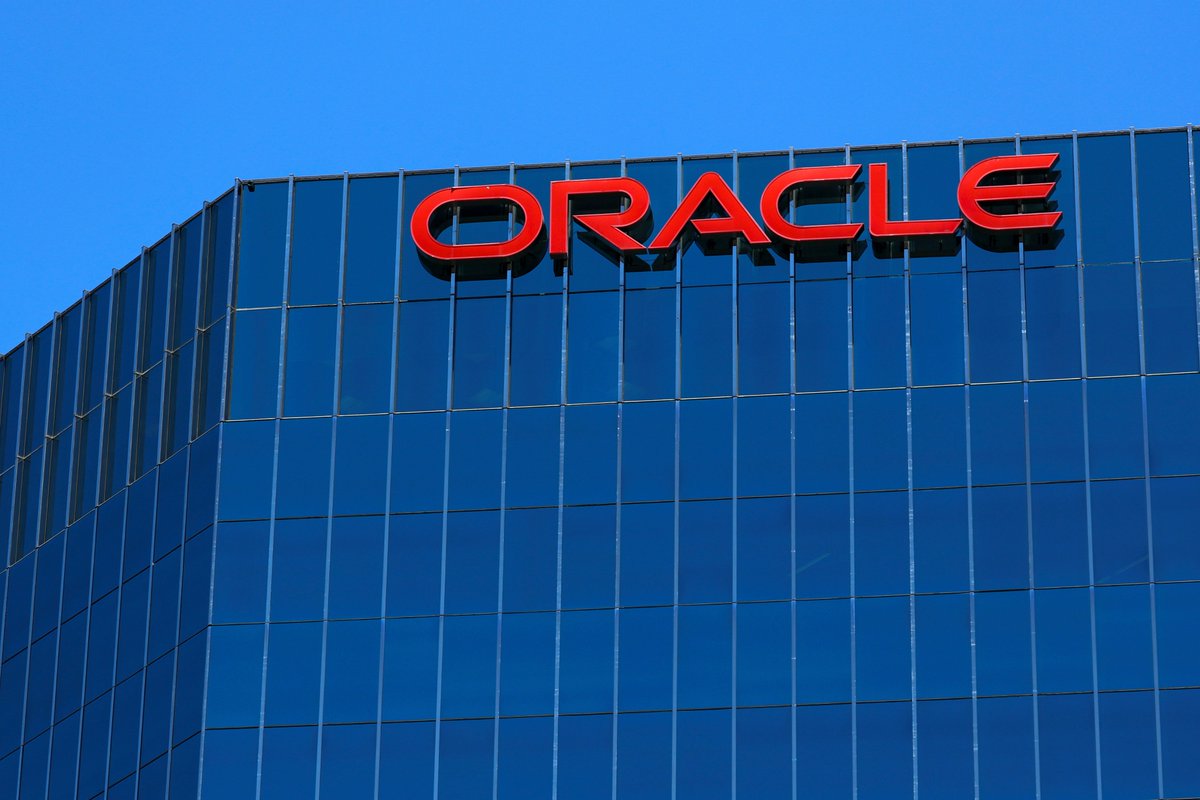
🦔 Oracle laid off between 20,000 and 30,000 employees Tuesday morning, roughly 18% of its global workforce, via a single email sent at 6am EST with no prior warning. System access was revoked almost immediately after. The cuts are expected to free up $8-10 billion in cash flow. Oracle's stock has lost more than half its value since September 2025 and the company now carries over $124 billion in debt, up from $89 billion a year ago, with free cash flow running negative $10 billion last quarter.
My Take
Oracle posted a 95% jump in net income last quarter and still eliminated 18% of its workforce by email before most people finished their morning coffee. This is not a company in distress in the traditional sense. It's a company that made an enormous debt-funded bet on AI infrastructure and is now converting its workforce into cash flow to service that debt.
We've covered Oracle's AI gamble for months. The $300 billion OpenAI deal through Stargate, $50 billion in capital expenditure this fiscal year, over $124 billion in total debt. Multiple US banks have pulled back from financing Oracle-linked data center projects. Bondholders have sued Oracle claiming it concealed how much additional debt the OpenAI deal would require. The credit default swap spread hit a three-year high earlier this year, meaning debt investors are genuinely nervous about getting paid back.
The workers who got that 6am email built the products Oracle has monetized for decades. The bet that eliminated their jobs was made by people who were already paid regardless of how it turns out. That is the part of the AI infrastructure race that doesn't show up in the capex announcements.
Hedgie🤗
English
果實特🎒nuts.hl retweetledi

Personally not trading this news that Iran wants out of the war as well.
Too many non commitals from both sides, and it still seems this could be a play for the US to try to get Iran to let their guard down before deploying troops.
I lean more that, that is NOT the case. But the crypto price action was not seeing a new higher on basically any coin.
Specifically alts, outside bitcoin, all of them didnt even break above their early month highs.
We need clear break above those areas for me to flip bullish.
Equities (stock market) showing way more strength, imo because of the inflation worries being calmed.
Biggest indicator will come end of the week when markets are closed, watch price of oil, and price of the treasury yields.
Sitting on your hands is a position too!
English
果實特🎒nuts.hl retweetledi

果實特🎒nuts.hl retweetledi


果實特🎒nuts.hl retweetledi
果實特🎒nuts.hl retweetledi

The Iran War Isn’t About Nuclear Weapons—It’s About Saving America’s Collapsing Empire
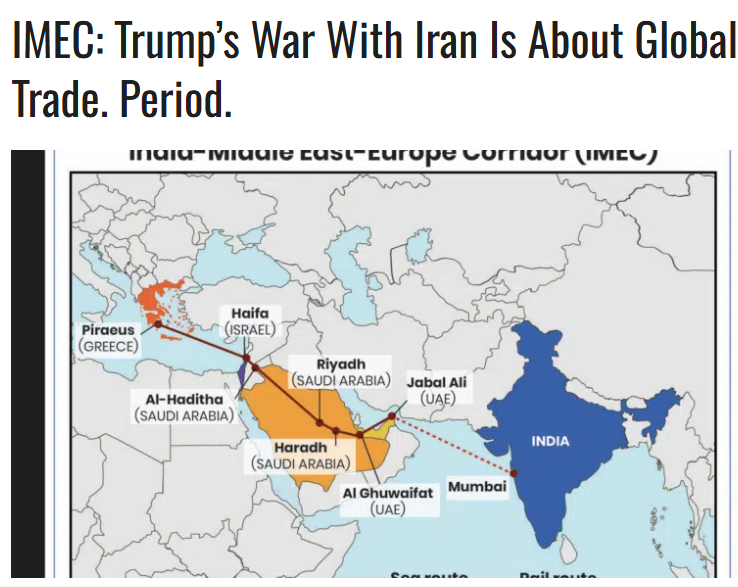
🐇The Rabbit Hole goes much deeper; the war with Iran isn’t about “terrorism” or “nukes.” It’s about securing a trade corridor — IMEC — that was designed to reroute global supply chains around China, choke China of energy, install India as the new workshop, and lock the Middle East into a US-Israel controlled infrastructure network
The article archive.is/2026.03.20-191… exposes the geopolitical plumbing, mapping the "Big Picture" that most Western analysts miss because they’re too busy counting missiles, troop deployments or chasing news cycles👇
The bombs falling on Iran are not about nuclear weapons. They are about a trade corridor called IMEC—the India‑Middle East‑Europe Economic Corridor—and the infrastructure that will determine who controls global energy, data, and supply chains for the next generation
IMEC as Imperial Infrastructure—and Why It Needs War
The India-Middle East-Europe Economic Corridor is not merely an alternative to China's Belt and Road Initiative (BRI). It is a replacement architecture designed to intercept the natural geography of Eurasian trade and force flows through Western-controlled chokepoints
Consider the geography: Iran sits at the intersection of the International North-South Transport Corridor (linking Russia to India), the Middle Corridor (China-Central Asia-Turkey-EU), and direct China-Iran rail and energy links. These routes threaten to bypass both the dollar system and American military oversight
IMEC solves this by creating a parallel network running through Israeli ports, UAE logistics hubs, and Indian manufacturing—each node controlled by US allies or dependent on American security guarantees. Jared Kushner's $4.6 billion Affinity Partners fund exemplifies the financialization of this strategy: Gulf capital flows through Israeli tech and Indian labor into European markets, generating returns while cementing political alignment
The "Abraham Accords" that enabled this were never peace deals; they were investment-grade risk instruments that transformed occupied territories into viable assets for international capital.
The "technocratic reconstruction" of Gaza fits this model. A genocidal war creates the vacancy; "development" fills it with investor-controlled zones where Palestinian sovereignty is replaced by special economic areas governed by technocratic mandates. This is not reconstruction—it is real estate colonialism with ESG branding
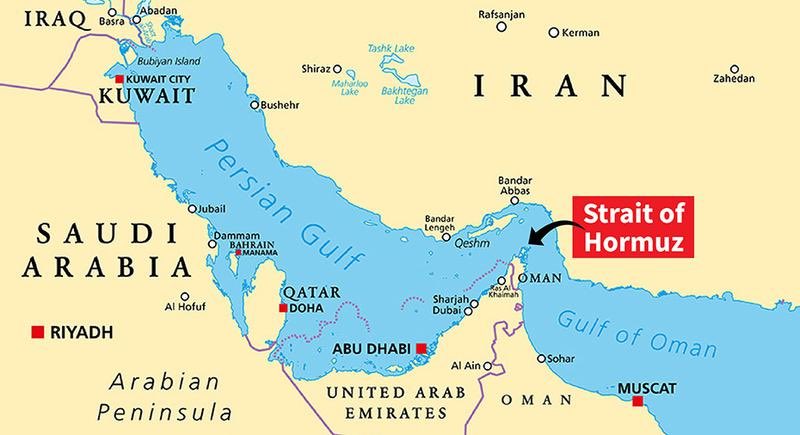
But IMEC has a fatal vulnerability: its eastern sea lane runs through the Strait of Hormuz, a 33‑km bottleneck that Iran can close at will. Without neutralizing Iran, the corridor cannot function
The Sequence: Abraham Accords → Iran War → Hormuz crisis → Gaza Reconstruction
Operation 'Epstein Fury', launched February 28, 2026, was not a spontaneous act of aggression. It was the military clearance phase of a pre‑designed infrastructure plan. The Abraham Accords (brokered by Jared Kushner in 2020) — between Israel and the Gulf states — created the political coalition. The war on Iran is an attempt to clear the military chokepoint. IMEC is the commercial payoff. These are not separate events. They are a sequenced strategy.
Kushner has already planned the reconstruction through Trump's "Board of Peace": his “technocratic administration” for Gaza—a Dubai‑like enclave with a new port and airport—turns that territory into a Mediterranean extension of IMEC. He designed the diplomatic framework, raised $3.5 billion from Gulf sovereign wealth funds for his own firm, and now oversees the governance of the corridor’s key node. Policy, finance, and war in one seamless loop.
India’s Role—and Its Trap
Indian Prime Minister Narendra Modi's February 2026 address to the Israeli Knesset—where he termed Israel the "fatherland" and India the "motherland"—occurred mere days before coordinated strikes on Iran. The familial metaphor reveals the emerging hierarchy: Israel provides the security umbrella and Western-approved gateway; India provides the labor pool and low-cost manufacturing
India is IMEC’s eastern anchor. Adani Ports owns Haifa (Israel) and is developing Vadhavan on India’s west coast. New Delhi is being positioned as the low‑cost manufacturing hub to replace China in Western supply chains.
But the US has signaled it will not grant India the same trade and technology access it once gave China. Washington views its post‑Cold War engagement with Beijing as a mistake that created a rival. So India gets the geopolitical risk—alignment with Israel, proximity to a war zone—without the structural economic lift that built China’s middle class
What if the Israeli-U.S. led coalition wins its war of aggression?
From Washington’s viewpoint, “winning” the war against Iran and locking in IMEC would tick several boxes at once. It would weaken a key energy supplier to China, constrain a major BRICS‑aligned player, and reroute Gulf exports through U.S.-aligned infrastructure where financing, insurance, and standards are dollar‑denominated. That helps preserve the petrodollar, fragments rivals’ energy sovereignty, and deepens allied dependence by turning energy security into a corridor privilege the U.S. can price and police
In that world, BRICS+ finds it harder to build a parallel, yuan‑ or local‑currency energy system because the key pipes and ports are wired into Western banks and rules. Europe, already cut off from cheap Russian gas, becomes even more locked into U.S.-approved Middle Eastern routes—paying monopoly rents in an environment of engineered scarcity and permanent “security risk.” China faces higher energy costs, rising production costs, and more fragile Gulf supply lines just as it battles domestic economic headwinds and tries to fund its own tech and industrial upgrades
If that’s the “U.S. wins” scenario, the “U.S. loses” version looks very different
The obvious consequences of a US loss are immediate and transformative: First, IMEC dies overnight. A resilient Iran that keeps enough military and political capacity to threaten shipping or strike regional infrastructure turns IMEC from an instrument of control into an instrument of risk. Investors see a corridor sitting inside a permanent war zone. Insurance premiums spike, ships reroute, and the picture of a clean, secure alternative to China‑linked routes starts to look like another over‑militarized promise that never delivers, rendering the project uninvestable and commercially irrelevant.
Second, the petrodollar’s collapse will accelerate dramatically: a US military defeat will prove it can no longer guarantee security for Gulf states, which will double down on de-dollarization, trade oil in yuan and other non-dollar currencies, and deepen ties with BRICS+
For BRICS and the wider Global South, that outcome—costly in the short run—actually strengthens the long‑term case for multipolarity. It accelerates efforts to diversify away from U.S. chokepoints: more Russian pipelines and seaborne flows to Asia, deeper China–Iran and China–Gulf energy deals, more experimentation with non‑dollar settlements and payment systems. IMEC’s failure to become a stable empire‑corridor becomes exhibit A in why over‑reliance on U.S.-controlled infrastructure is a strategic risk, not an insurance policy
Europe, meanwhile, gets squeezed either way
A decisive U.S. victory binds it deeper into a U.S.-centric system where energy and sanctions policy are made in Washington—Europe pays the bill. A messy stalemate or visible U.S. failure forces European capitals to confront an awkward question: keep doubling down on U.S. corridor bets that can’t be secured, or cautiously reopen the door to diversified connectivity—including selective engagement with BRI and BRICS energy diplomacy
For China, a failed U.S. attempt to use Iran and IMEC as twin levers is painful but survivable. Beijing’s diversification—Russian oil and gas, African and Latin American supplies, strategic reserves, domestic renewables—was built precisely for this kind of shock. It would still face higher prices and tighter margins, but it would not be structurally cut off. And every barrel that ends up traded outside the dollar, every workaround built under pressure, chips away at the very monetary power Washington is trying to defend
Put simply: if Washington wins big, IMEC becomes the hardware of a renewed, harder U.S. empire—petrodollar cemented, BRICS fragmented, China squeezed. If it doesn’t, the war over Iran and the corridor won’t just expose U.S. limits; it will push the Global South faster toward a world where no single power can redraw the energy map alone
For the rest of us, the immediate question is whose infrastructure will survive it and whether Israel or the U.S. will escalate to the use of nuclear weapons
English
果實特🎒nuts.hl retweetledi

Virtuals just registered a .agent domain!
We support the effort to have the .agent top-level domain managed by a community, instead of being owned by one company.
Join the community and pre-register your domain here:
#FLKUMC2H" target="_blank" rel="nofollow noopener">agentcommunity.org/join#FLKUMC2H
English
I just claimed my .agent domain and joined the .agent community! get yours now and help shape the future of autonomous agents #4TG2H1DO" target="_blank" rel="nofollow noopener">agentcommunity.org/join#4TG2H1DO @agentcommunity_
English
果實特🎒nuts.hl retweetledi

⛽️ Countries Most Dependent on Oil via the Strait of Hormuz
🇯🇵 Japan — 73%
🇰🇷 South Korea — 70%
🇮🇳 India — 42%
🇨🇳 China — 40–45%
🇵🇰 Pakistan — 60%
🇹🇼 Taiwan — 60%
🇹🇭 Thailand — 30–35%
🇸🇬 Singapore — 30%
🇲🇾 Malaysia — 25–30%
🇵🇭 Philippines — 25%
🇮🇩 Indonesia — 20–25%
🇻🇳 Vietnam — 20%
🇮🇹 Italy — 15%
🇪🇸 Spain — 12–15%
🇺🇸 United States — 2–5%
English
果實特🎒nuts.hl retweetledi

BREAKING: The nitrogen trap just closed. Three locks snapped shut simultaneously. The planting window is closing behind them. And the food the world eats next year is now being decided by molecules that cannot reach the soil in time.
Lock one: the Strait of Hormuz. The IRGC permissioned corridor allows oil tankers from friendly nations to pay $2 million in yuan and pass. It does not allow fertiliser vessels to pass at any price. Zero approved fertiliser transits in 24 days. The Gulf supplies 49 percent of the world’s exported urea and roughly 30 percent of traded ammonia. That supply is not delayed. It is denied. The gate opens for molecules that fund the gatekeeper. It stays closed for molecules that feed the planet.
Lock two: Russia. The world’s largest exporter of ammonium nitrate just halted all AN exports until after April 21. Three to four million tonnes per year, gone from global markets at the exact moment the Northern Hemisphere needs it most. The official reason is “domestic priority.” The strategic effect is leverage. Russia earns windfall revenue from the oil price spike its ally’s war created, then removes the fertiliser that farmers need to plant through the crisis. The disease and the cure, again, from the same address.
Lock three: China. Beijing has banned exports of nitrogen-potassium blends and phosphate fertilisers through August 2026. China is the world’s largest phosphate producer and a major nitrogen supplier. The ban removes the last alternative source that could have compensated for Hormuz and Russia. Three locks. Three countries. Three deliberate decisions timed to the same biological calendar.
The biological calendar does not negotiate. Corn requires nitrogen at the V6 to VT growth stage or kernel set is permanently reduced. Wheat requires it at tillering and jointing or grain fill collapses. Rice requires it at transplanting or yield drops 20 to 40 percent in low-input systems. These are not economic models. They are cellular processes. The plant either receives nitrogen during the window or it does not. If it does not, no subsequent application, no price increase, no policy reversal can recover what was lost. The damage is written into the biology of the seed.
The US Corn Belt window closes mid-April. European top-dressing is happening now. Indian Kharif preparation begins in May. Bangladeshi Boro rice transplanting is underway this week. Every one of these windows is closing while the three largest sources of nitrogen on Earth are simultaneously locked: Hormuz by military blockade, Russia by export decree, China by trade ban.
The USDA Prospective Plantings report arrives March 31. The FAO Food Price Index publishes April 3. These will quantify what the molecules already know: the nitrogen did not arrive. The yield loss is locked in. The 5 to 10 percent global drag will concentrate where the buffers are thinnest: subsistence farms in Bangladesh, Sub-Saharan Africa, South Asia, where a 20 percent shortfall does not mean lower profits. It means hunger.
Sri Lanka banned synthetic fertiliser in 2021. Rice yields collapsed 40 percent. The government fell. In 2008, fertiliser and oil spiked simultaneously and food riots erupted across 30 countries. In 2026, the strait blocks fertiliser while Russia and China withdraw the alternatives, and the planting windows close on a planet with nowhere else to turn.
The war is fought with missiles. The famine is fought with molecules. The molecules are trapped behind three locks on three continents, timed to the one calendar that cannot be paused, extended, or negotiated: the calendar written into the DNA of every seed in the soil.
Full analysis: open.substack.com/pub/shanakaans…

Shanaka Anslem Perera ⚡@shanaka86
JUST IN: The most irreversible consequence of this war is not happening in Tehran. It is happening in a barn in Iowa. A farmer is standing over a kitchen table looking at two seed catalogues. One is corn. One is soybeans. Corn needs 180 pounds of nitrogen per acre. Nitrogen costs $610 per ton on the CBOT March futures settlement as of yesterday, up 35 percent in a month. Soybeans fix their own nitrogen from the atmosphere through root bacteria called rhizobia. They need nothing from the Strait of Hormuz. The farmer is choosing soybeans. Millions of acres are choosing soybeans. And once the planter rolls into the field, the choice cannot be reversed until next year. USDA projected corn at roughly 94 million acres for 2026, down from 98.8 million. Soybeans at 85 million, up from 81.2 million. Those projections were published February 19, before urea surged past $683 at New Orleans. The actual shift will be larger. USDA Prospective Plantings reports March 31. By then the seeds will be in the ground. This is the transmission channel the world is not watching. A 21-mile strait enforced by provincial commanders with sealed radio orders just rewrote the planting economics of 90 million acres of the most productive farmland on Earth. Not through sanctions. Not through diplomacy. Through the price of a single molecule that corn cannot grow without and soybeans do not need. Now follow the cascade. The Renewable Fuel Standard mandates 15 billion gallons of corn ethanol annually. That consumes roughly 43 percent of the entire US corn crop. The mandate is set by the EPA. It does not flex when corn acres shrink. It is inelastic demand consuming a fixed share of a declining supply. When supply tightens against a fixed mandate, the remaining corn reprices upward. Corn above $5 per bushel compresses every margin downstream. The US cattle herd stands at 86.2 million head, a 75-year low per USDA NASS. Poultry and pork operations face compression from higher corn prices. Feed is the single largest cost in livestock production. When feed reprices, protein reprices. When protein reprices, every grocery shelf in America absorbs the increase. This is the protein cascade. Corn to feed to meat to eggs to dairy to the checkout counter. Each link tightens because the link before it tightened. The originating cause is a urea molecule that cannot transit a strait because a provincial commander’s sealed orders say it cannot. The farmer did not start this war. The farmer cannot end it. The farmer responds to the price on the screen and the biology of the two crops in front of him. Corn needs the molecule. Soybeans do not. At $610 the arithmetic is settled. The planter rolls. The season is locked. Israel just authorised the assassination of every Iranian official on sight. The US has spent $16.5 billion. South Pars is burning. The Fed is holding rates because oil inflation will not break. Gold touched $5,000. Bitcoin is bleeding. China is running exercises near Taiwan. Sri Lanka shut down on Wednesdays. And underneath all of it, a man in a barn is making the decision that determines whether four billion people pay more for food this year. He has never heard of the Mosaic Doctrine. He does not know what a sealed contingency packet is. He knows what nitrogen costs. And he is planting soybeans. Full analysis - open.substack.com/pub/shanakaans…
English
果實特🎒nuts.hl retweetledi
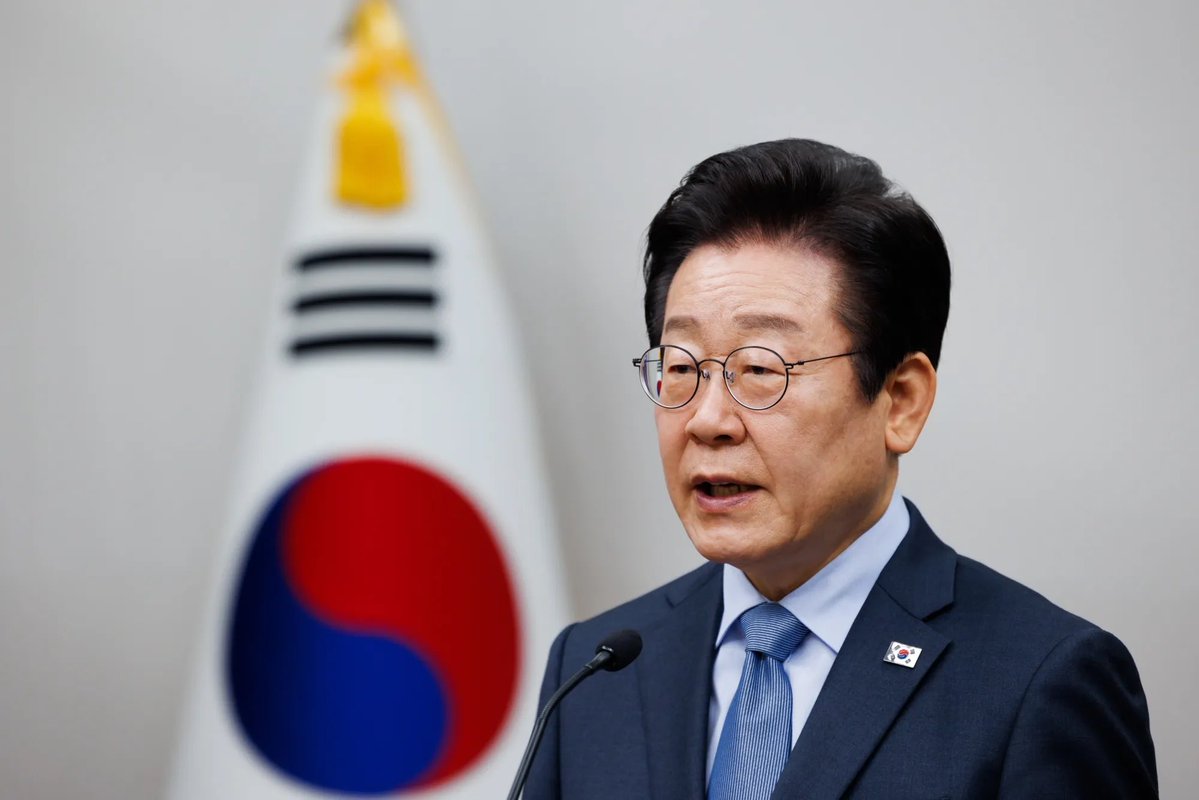
BREAKING: South Korea just announced mandatory fuel rationing. Government vehicles at public institutions barred from operating one day each week on a five-day licence plate rotation.
The world’s 10th largest economy, a G20 member, a semiconductor superpower, home to Samsung and SK Hynix, the country that fabricates a quarter of the world’s memory chips, is rationing fuel like Sri Lanka.
South Korea imports 73 to 87 percent of its oil from the Middle East. Every barrel transits the Strait of Hormuz. The strait is closed and mined. There is no alternative route for Korean crude imports at scale. The Kospi crashed 4.9 percent on Monday before Trump’s “productive conversations” post briefly eased the panic. The won is weakening. Inflation is accelerating. And now the Energy Minister is telling government workers which days they cannot drive.
Count the dominoes. Sri Lanka rationed first: Wednesdays off, QR codes at pumps, LPG vanished from southern shelves. Bangladesh followed with public holidays to conserve fuel. Pakistan imposed restrictions. India tightened allocations. Slovenia became the first EU country with QR codes and odd-even plates. Now South Korea. The rationing is no longer a developing-world phenomenon. It is migrating up the GDP ladder. The 10th largest economy. The 12th largest military budget. A US treaty ally hosting 28,500 American troops. Rationing.
Those 28,500 troops run on fuel. USFK operates bases across the peninsula that require continuous diesel, aviation fuel, and generator capacity. Joint exercises with the ROK military consume thousands of tonnes of fuel annually. Every barrel of that fuel traces back to the same Middle Eastern supply chain that South Korea’s Energy Minister just acknowledged cannot sustain civilian demand. If civilian vehicles are being restricted, military logistics are under pressure. If military logistics are under pressure, deterrence against North Korea erodes. If deterrence erodes, Pyongyang and Beijing calculate. The Strait of Hormuz is 7,500 kilometres from the Korean DMZ. The fuel that deters Kim Jong Un transits a chokepoint held closed by Iran’s 140 remaining missile launchers.
Kim Jong Un is watching. Every day that South Korea rations fuel is a day that North Korea’s calculus shifts. Not toward war, not yet, but toward the conclusion that the American alliance system has a fuel dependency that a single regional conflict can exploit. The US cannot simultaneously secure the Strait of Hormuz with carrier groups, deploy 82nd Airborne paratroopers to the Iran theater, accelerate the 11th MEU from San Diego, AND maintain full deterrence posture on the Korean Peninsula. Something gives. The fuel rationing in Seoul is the first visible signal of what is giving.
Taiwan is watching too. TSMC’s fabrication plants in Hsinchu are counting LNG reserves in single-digit days. Taiwan imports virtually all of its energy. If South Korea, with its larger strategic reserves and diversified economy, is already rationing, Taiwan’s timeline is shorter. The chips that power every Nvidia GPU, every Apple processor, every AI training run on Earth depend on a gas supply that depends on a strait that depends on a 5-day pause that depends on a Truth Social post that Iran says corresponds to nothing.
Sri Lanka. Bangladesh. Pakistan. India. Slovenia. South Korea. Six countries rationing. Three continents. One strait. The molecules do not check GDP rankings. The molecules check whether the chokepoint is open.
It is not.
open.substack.com/pub/xerion/p/a…
English
果實特🎒nuts.hl retweetledi

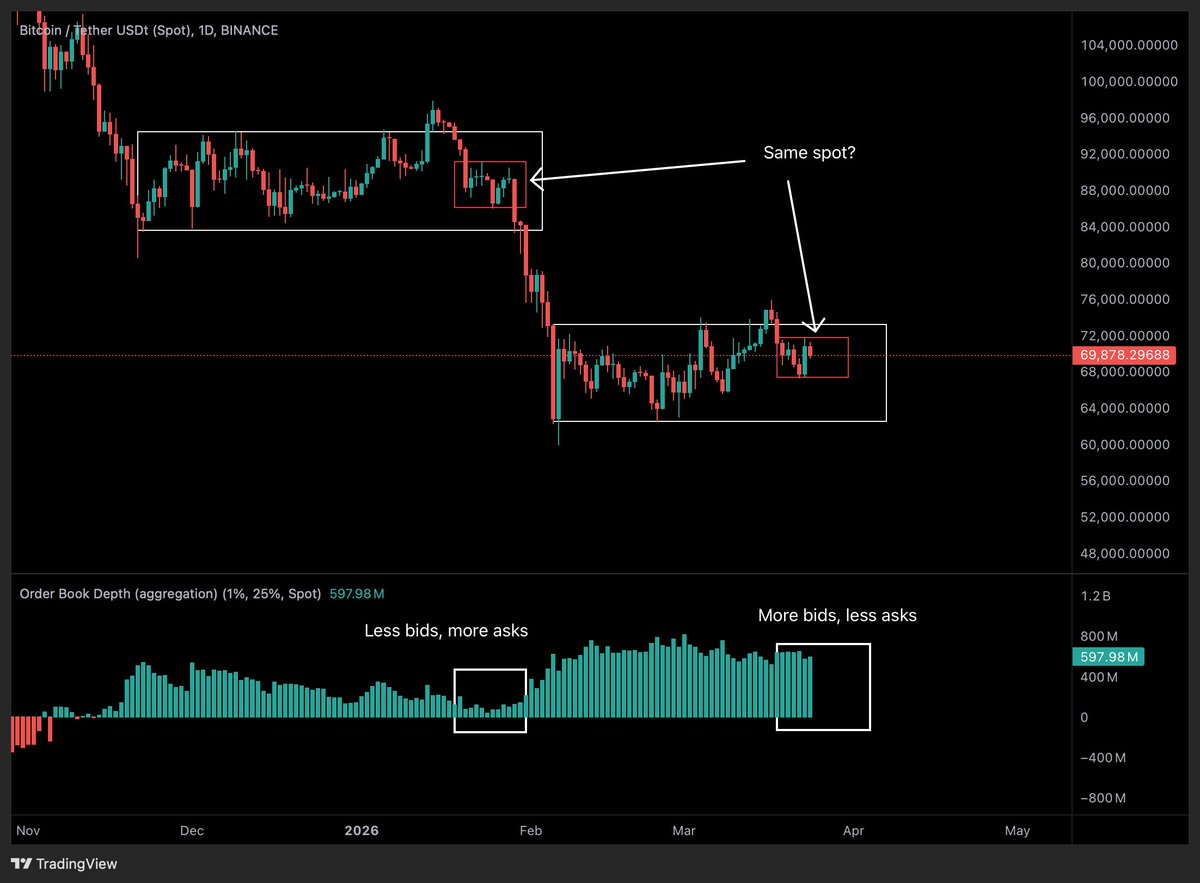
$BTC I see people are comparing current spot to previous range and what many are missing here is that now aggregated spot orderbooks have way more passive demand than they had in the previous range. Dump to low 60Ks is okay, acceptable, but not expecting bigger downtrend while such passive demand stays.
English
果實特🎒nuts.hl retweetledi

I don't think people realize just how extraordinary what we're witnessing with Iran is.
I was arguing with a dear journalist friend of mine yesterday who was telling me that Iran was winning, yes, but only on the strategic level, not tactically.
The type of thing a skinny kid getting stuffed in lockers in highschool tells himself to make himself feel better: "These people will BEG to work for me in ten years. Everyone knows jocks peak in highschool. They'll literally beg." 😏
I think that's precisely wrong, and that's what makes the Iran war different. As of now, Iran is in fact holding its own tactically too.
Think about other U.S. wars of aggression these past few decades. Take Vietnam, Afghanistan, Libya, Iraq, Serbia, etc. (the list is unfortunately very long). The pattern was roughly always the same with an immense power differential between aggressor and victim. These wars were, by and large, imperial: the empire attempting to crush a much weaker people whose only realistic recourse was guerrilla resistance. And that is when they actually had the will to resist: some - like Libya - barely even bothered, just resigning themselves to their fate (despite being, at the time, the richest country in Africa).
As spectators of these wars, if you had any moral sense, the dominant emotion was a kind of helpless disgust: you were watching a giant stomp through someone else's house.
Sure, the U.S. actually lost many - if not most - of these wars, famously replacing the Taliban with the Taliban or being expelled with their tail between their legs from Vietnam, but the power differential was no less real for it.
It's just that power doesn't always guarantee victory: sometimes the giant can't kill everyone, and eventually tires of trying. But the “victories” won this way were always pyrrhic at best: the people endured, yes, but what they were left with was a country in ashes that takes decades to rebuild. Meanwhile, in the grand scheme of things, the giant walked away with little more than a bruised ego.
Iran is - remarkably - proving to be an entirely different beast: when others were merely surviving a giant, Iran appears to be able to compete with one.
What just happened over the past 48 hours is the best illustration of this. You had the President of the United States issue a formal ultimatum: reopen the Strait of Hormuz within 48 hours or we "obliterate" your power grid.
Iran's response was essentially: we dare you, if you do this we'll make all your Gulf allies uninhabitable within a week.
And, as we saw, Trump backed down: pretexting non-existent "VERY GOOD AND PRODUCTIVE CONVERSATIONS" with Iran, he said his ultimatum no-longer applied (or, rather, became 5 days). Adding he now envisaged the Strait of Hormuz being “jointly controlled by me and the Ayatollah.” To the amusement of Iran’s diplomacy (x.com/IraninSA/statu…).
That, folks, is a textbook tactical victory. It is, remarkably, Iran demonstrating in this instance that it had escalation dominance over the United States of America. That is, the ability to credibly threaten consequences so severe that the US - for perhaps the first time since the Cold War - found it preferable to stand down.
That's no skinny kid being locked in a locker dreaming of revenge fantasies. That's the kid grabbing the bully's wrist mid-shove and watching his face change.
And it's not the only tactical victory in this war so far. Take the episode over the Israeli attack on Iran's South Pars gas facility. Iran had warned that if that happened U.S. allies in the region - including Israel - would face a symmetrical response.
And they delivered: famously devastating Qatar's Ras Laffan facility - which produced roughly 20% of global LNG supply - and leading, according to Qatar themselves, to a $20 billion loss of annual revenue for the next 5 years (oilprice.com/Latest-Energy-…).
Not only that but they also managed to hit Israel's Haifa refinery (aljazeera.com/news/2026/3/19…), one of the country's most strategic and protected sites.
The result was Trump distancing himself from the South Pars attack, saying that Israel had "violently lashed out" unilaterally and that "NO MORE ATTACKS WILL BE MADE BY ISRAEL pertaining to this extremely important and valuable South Pars Field." Israel then said it wouldn't strike Iran energy sites anymore (bloomberg.com/news/articles/…).
From where I stand, that's another tactical victory. It is, at least, Iran demonstrating that is can fight back **symmetrically** against the U.S. and its allies. Not through asymmetric resistance with IEDs hidden in the roadside or traps hidden in the jungle, but eye for eye, and against some of the most heavily protected sites on the U.S.'s side.
That's qualitatively different from any other adversaries the U.S. has directly fought in recent wars.
There's plenty more, such as the pretty relevant fact that Iran has gained control of the single most strategic energy chokepoint on earth and the U.S. is finding it impossible to break that control.
To the point where Trump has been reduced to publicly begging China - of all countries - for help, which given Trump's ego mustn't have been easy to do. Only to be told no. By China. And by everyone else he asked.
This is the topic of my latest article: how this is, in fact, the first genuine "multipolar war."
First, in the narrow sense: because Iran is revealing itself to be a genuine pole of power - not a superpower, but an actor that cannot be submitted, which is all multipolarity is.
And second, because the war itself is accelerating multipolarity everywhere else: the U.S. has never been more isolated, never looked weaker and its security guarantees have never been more hollow.
In my article I lay out the full scoreboard - military, economic, political - and explain why this war has already changed the world, regardless of how it ends.
Enjoy the read here: open.substack.com/pub/arnaudbert…
English
果實特🎒nuts.hl retweetledi

🚨 Unbelievable: They have been hiding this from us for decades!
Complete remissions of Stage IV cancers using anti-parasitics (ivermectin & fenbendazole)
Hundreds of studies show they exert 12+ distinct anti-cancer mechanisms across 12+ cancer types.
English
果實特🎒nuts.hl retweetledi

🏦 摩根大通亲口承认:战争期间,华尔街交易员跑去链上炒油了
JPMorgan 最新报告:伊朗战争爆发后,Hyperliquid 上的原油永续合约交易量爆了。
· 原因很简单:周末伊朗遭空袭,CME 休市,传统交易员干瞪眼
· Hyperliquid 的 CL-USDC 永续合约 24/7 不打烊,单日峰值成交 17 亿美元
· 现在已经是平台第三大交易品种,持仓量 3 亿刀
· 大量「非加密原生」投资者涌入——这才是关键信号
华尔街自己的报告,自己打自己的脸。
当传统市场的基础设施在关键时刻掉链子,DeFi 不是「替代方案」,是唯一方案。
这不是 crypto 的胜利,这是 24/7 市场的胜利。时代变了。
中文
果實特🎒nuts.hl retweetledi

果實特🎒nuts.hl retweetledi

如果全球互联网瞬间消失,你的电脑还能干什么?
有人刚刚开源了一个断网生存包。
项目名叫 Project N.O.M.A.D。
即使所有网线被剪断,它也能照常运转。
里面打包了整个人类文明的基础数据。
全套维基百科,全球离线地图,完整的医学参考指南。
外加可汗学院的全套教育课程。
甚至内置了一个完全本地运行的 AI 助手。
没有网,没有云端,没有订阅费。
这套系统需要多庞大的机房?
一块太阳能板,一块电池,一台迷你主机,一个无线路由。
运行功耗只有 15 到 65 瓦。
扔进房车、帆船或者地下掩体,就是一个独立的知识庇护所。
市面上卖 185 美金的生存硬盘,里面只装了一堆死板的 PDF 静态文件。
这个开源项目直接送你一个带思考能力的离线大脑。
一行命令就能部署。
只要有电,人类知识库就不会下线。
中文
果實特🎒nuts.hl retweetledi

S&P Dow Jones Indices and trade[XYZ] have joined forces to launch the first official S&P 500 perpetual contract, available exclusively on Hyperliquid.
For 69 years, the S&P 500 has been a defining reference point for global finance. Until now, access to that benchmark has been shaped by market hours, intermediaries, and geography. Today, that changes.
The S&P 500 perp is now available 24/7/365, anchored by the official index data required for deep liquidity and institutional confidence at scale.
SPDJI helped define modern indexing. They are stewards of an iconic benchmark, the standard against which portfolios across the globe are measured. We are honored to bring that legacy on-chain.
Trade[XYZ] is bringing the world's most iconic assets towards a future of global, continuous markets — a future powered by Hyperliquid.
English
果實特🎒nuts.hl retweetledi

Amazon just published a blog on x402!
It provided full reference architectures for integrating the protocol into AWS infrastructure for financial services
TLDR of what it covered:
- x402 revives HTTP’s 402 “Payment Required” status code as a programmable payment rail for autonomous AI agents, developed by Coinbase
- The flow: agent requests a resource, gets a 402 response with a payment spec, pays via USDC micropayment on-chain, resubmits with receipt; sub-2-second settlement at roughly $0.0001 per transaction
- No subscriptions, no API key management, no vendor contracts; agents pay per use on demand
- Every transaction is recorded on-chain, giving a full audit trail by design
- AWS published three reference implementations:
1) AgentCore + CloudFront + x402 (agent side)
2) CloudFront + Lambda@Edge + WAF (merchant/provider side), and;
3) a general guide for monetizing any HTTP app via x402
- FSI use cases highlighted: trading agents accessing real-time data feeds, compliance agents pulling sanctions lists, credit decisioning agents querying bureau data; all per-query instead of fixed subscriptions
- McKinsey projects agentic commerce will mediate $3 trillion to $5 trillion of global commerce by 2030
Why this is notable:
- This is AWS legitimizing x402 as enterprise infrastructure
- They’re shipping reference architectures, sample repos, and integration guides that map directly onto Bedrock AgentCore (their managed agent stack) and CloudFront (their CDN/edge layer)
- AWS is effectively telling FSI institutions: this is how your agents will pay for things.
- The fact that the blog sits under their Financial Services Industries vertical, cites McKinsey’s $3-5T projection, and frames x402 alongside compliance and audit requirements, signals that AWS sees this as a production-grade payments primitive, as opposed to a niche protocol
That’s a massive distribution and credibility unlock for x402 adoption - follow @KhalaResearch we have a full report dropping this week
I’ll link the article below

English