Eli5DeFi@Eli5defi
➥ Nvidia’s 2026 Tech Stack: The Android Moment for Physical AI
CES 2026 was not about a faster AI chip. It signaled a platform shift toward physical AI infrastructure.
@nvidia positioned itself as the operating system for robotics, autonomous machines, and real-world AI deployment.
Here is where technology is heading under Nvidia’s physical AI stack 🧵
— — —
► The Android of Generalist Robotics
CES is the world’s largest consumer technology conference, held every January in Las Vegas, where major platform shifts are first revealed.
At CES 2026, NVIDIA CEO, Jensen Huang made its intent clear: standardize robotic intelligence at the ecosystem level.
The Android of robotics analogy is practical. $NVDA is turning the robot brain into a shared software layer developers build on.
This shows up in a focused stack:
▸ Cosmos for world modeling and physical reasoning
▸ GR00T for embodied intelligence and whole-body control
▸ Isaac Sim and Isaac Lab for standardized training and evaluation
Open distribution and tight tooling integration lower the cost and complexity of building generalist robots.
—
► Separating the Brain From the Body
The most important shift in Nvidia’s 2026 stack is the separation of intelligence from hardware.
Instead of every team building perception, physics, and motor control from scratch, NVIDIA treats the robot brain as a reusable layer.
That separation is enforced through:
▸ Cosmos, which teaches robots how the physical world behaves before deployment
▸ GR00T, which applies this intelligence across different robotic bodies
This enables hardware-first robotics, where differentiation moves to form factor and deployment.
—
► From Automated to Agentic Systems
Nvidia’s next shift is behavioural: moving machines from scripted automation to agentic decision-making.
Automation follows fixed rules. Agentic systems reason about context, intent, and consequences before acting.
This shift is anchored by Alpamayo, NVIDIA’s reasoning model built on a Vision-Language-Action framework.
VLA systems combine perception, reasoning, and action planning into a single decision loop.
Instead of simply braking for a pedestrian, the system predicts intent and selects the appropriate response.
—
► Simulation Becomes the Default Training Layer
Simulation is no longer a testing phase. It is where physical AI is built.
At CES 2026, Jensen Huang described future manufacturing plants as giant robots, enabled by digital twins inside Omniverse.
With the Rubin platform’s compute density, NVIDIA can simulate factories, cities, and supply chains in real time.
Robots are trained millions of times in simulation before deployment, removing the need for physical trial and error.
—
► Why This Matters for Crypto
Physical AI extends the reach of cryptocurrency beyond mere computation, venturing into robotics where machine-to-machine coordination becomes a fundamental economic element.
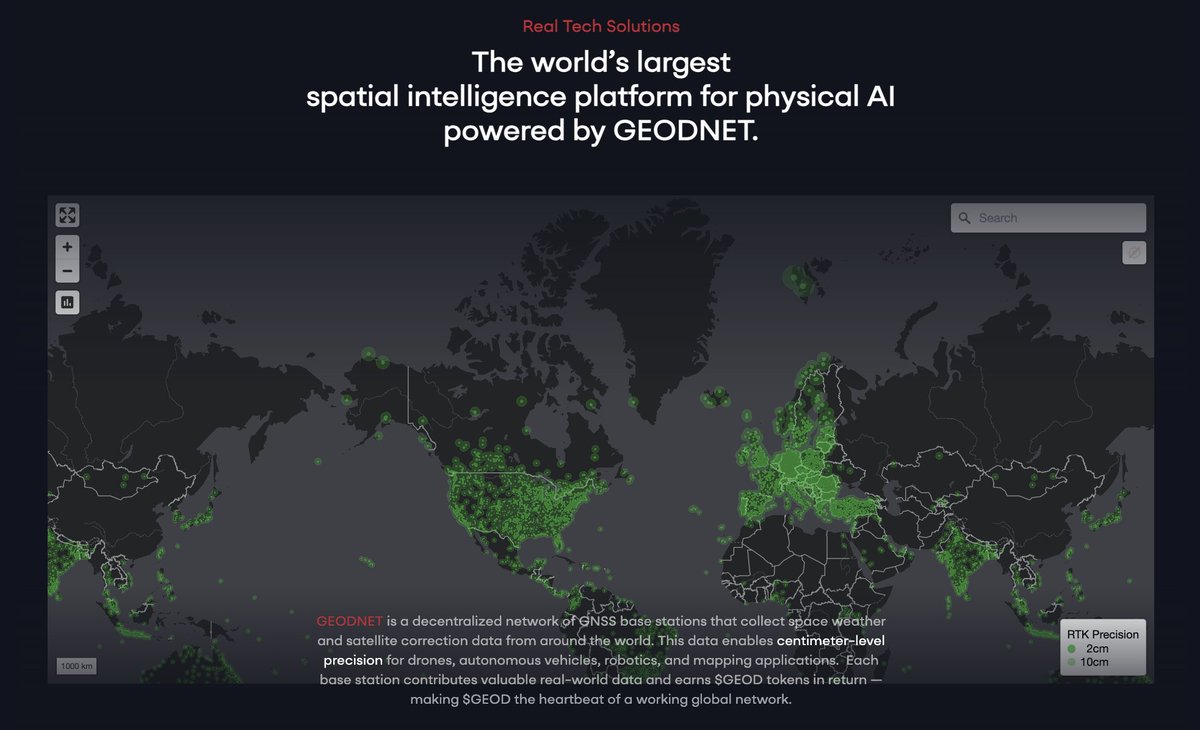
Currently, the market for crypto robotics is valued at approximately $1 billion. Early infrastructure is emerging around projects like @peaq, @GEODNET, and @openmind_agi, among others. (A comprehensive list is available in our previous post, link below.)
As robots evolve into autonomous agents, concepts such as ownership, access, and settlement transition from theoretical discussions to essential system requirements. The value increasingly concentrates in the coordination layer as machine autonomy expands.