
Dan Paull retweetledi
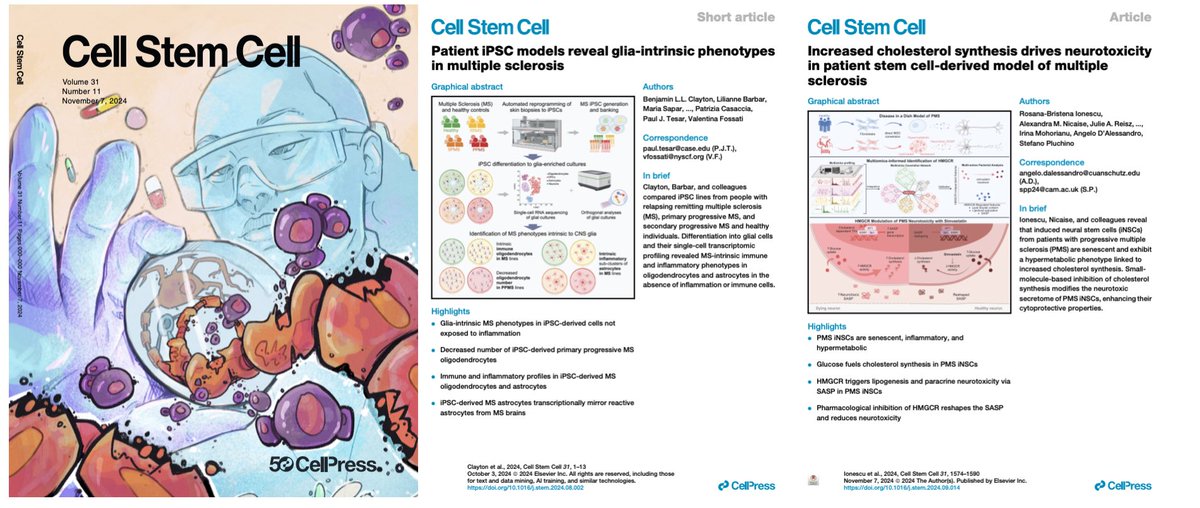
Proud to see our image selected for the November @CellStemCell cover, spotlighting two papers from my lab and @Pluchinolab that showcase the power of patient stem cell-derived models to study multiple sclerosis. (1/2)
English
Dan Paull
104 posts

@dan_paull
Feuding with robots @nyscf. Opinions are my own.


Many ask why medicine is not progressing faster. I go through biology history, argue against the talent/not enough math theory, conclude it's a lot due to slow feedback loops & why we need to make clinical trials faster. writingruxandrabio.com/p/why-havent-b… Excerpts: "A version of the second theory that I am hearing more and more is that biology suffers from a talent problem. This is what Peter Thiel suggests in one of his interviews: that the smartest people go into “harder” sciences, leaving matters as important as whether we will be able to extend human lifespan substantially in the next decades in the hands of subpar people, the ones who could not do math well enough. His interviewer, Eric Weinstein, pushes back a bit against this: after all, molecular biology itself was in large part founded by physicists. But Thiel then appeals to some of his earlier comments about the lack of polymaths in academia and argues that today’s fields are too siloed for a mathematician or physicist to easily transition into biology. I disagree with this theory and lean much more towards the “Biology is very complicated” explanation. Biologists are less good at math than other scientists, but that’s because there are many areas of biology, and productive areas at that, that do not require that much of it. [...] A layperson transported from the 90s in today’s world would not be that shocked by our medical advancements, in the same way a Geneticist from the same era would be in awe of just how much data we are able to process. So how did we get here? On June 26, 2000, the International Human Genome Sequencing Consortium announced that it completed a draft of the sequence of the human genome — the so-called “genetic blueprint for a human being.” This was, at the time, a tremendous achievement and the culmination of a more than a decade long effort. To mark the importance of the moment, President Bill Clinton held a ceremony at the White House to announce the achievement, in front of a gathering of ambassadors, scientists, company executives, disease advocates and journalists. Hopes for a revolution in medicine were high. Tremendously useful as the Human Genome might have been, the revolution did not quite materialise. [...] So what happened? Why didn’t the publication of the human genome, “the code of life”, solve all of biology? In some ways, The human genome raised more questions than it answered. For example, it showed that humans have only about 30,000-35,000 genes, two times less than a fly. Yet we are clearly more complex than a fly. How was that possible? Another perplexing finding was that most of the human genome was composed of so-called “junk DNA” — that is, DNA that did not code for any protein. The central dogma of Biology says that DNA codes for RNA, which in turn codes proteins, the molecules that carry out most of our cell’s functions. So what was all the DNA that was not coding for any protein doing there? [...] That biology is complicated is not a reason to think we cannot optimize anything about the way we do science. And of course, talent is important, although perhaps more relevant than mathematical ability itself are certain personality traits, as I argue in my essay The Weird Nerd comes with trade-offs. But, fundamentally, if I had to pick just one factor that I think is holding biology back, I would say “long feedback loops”, as argued in this pieceby Stephen Malina. Baked into this assertion is the premise that we cannot simply “understand” biology from first principles, in the same way we do for physics, and all we can hope for is iterative cycles of experimentation. Thus, the faster these cycles, the more surface area we will cover. In a domain like biology, we should expect diminishing returns from extra intelligence and better predictions, with a much bigger bottleneck being the speed with which we can test these predictions."







Will iPSCs be a next model to study patient heterogeneity? Please read our new paper on #iPS cell based #GWAS on @CellStemCell


Drug discovery for complex diseases like #Parkinsons (#PD) is challenging - we need screenable cellular phenotypes to move faster. Today in @NatureComms, we present an #AI-driven phenotyping platform that identifies #PD hallmarks in patient cells: nature.com/articles/s4146… 🧵(1/11)