Dani E. Behrendt

1.5K posts

Dani E. Behrendt banner
Dani E. Behrendt

Dani E. Behrendt

@danipersonal

// the journey is the reward

Palo Alto (posts are my own) Katılım Aralık 2007
812 Takip Edilen204 Takipçiler
Stephanie Zhan
Stephanie Zhan@stephzhan·
@karpathy and I are back! At @sequoia AI Ascent 2026. And a lot has changed. Last year, he coined “vibe coding”. This year, he’s never felt more behind as a programmer. The big shift: vibe coding raised the floor. Agentic engineering raises the ceiling. We talk about what it means to build seriously in the agent era. Not just moving faster. Building new things, with new tools, while preserving the parts that still require human taste, judgment, and understanding.
English
68
188
1.6K
1.2M
Ivan Burazin
Ivan Burazin@ivanburazin·
We rebuilt our own scheduler from scratch. We use Kubernetes for control plane deployment, but not for the actual sandbox orchestration itself. Kubernetes is insufficient for stateful + long-running + sub-100ms spin-up, all working together. We wanted all three, so we had to build it ourselves.
English
16
2
125
20.2K
Dani E. Behrendt
Dani E. Behrendt@danipersonal·
the future of software is autonomous
English
0
0
0
11
Dani E. Behrendt retweetledi
andrew chen
andrew chen@andrewchen·
“ok this startup is cool but …” 1980: … what if IBM builds this? 1995 … what if Microsoft builds this? 2010 … what if Google builds this? Today … what if builds this? reality is, if founders listened to the “what if” pessimists we’d never have any startups or new products. That’s why they’re building and the pundits aren’t My observation: When these huge waves happen, these new markets are so damn big there will be tens of thousands of new viable companies, hundreds of unicorns, and a few iconic companies that become generational. The big cos play a role but can never compete with the glorious open market known as capitalism So for all the “what if” people - sit down, log off X for a bit, and let the founders do their thing. And let’s cheer them on when they do
English
142
126
1.1K
84.5K
Dani E. Behrendt
Dani E. Behrendt@danipersonal·
@Steve_Yegge yep. and at the same time, side projects galore. which is probably the clearest signal that orgs aren’t actually adopting, individuals are
English
0
0
0
2K
Steve Yegge
Steve Yegge@Steve_Yegge·
I was chatting with my buddy at Google, who's been a tech director there for about 20 years, about their AI adoption. Craziest convo I've had all year. The TL;DR is that Google engineering appears to have the same AI adoption footprint as John Deere, the tractor company. Most of the industry has the same internal adoption curve: 20% agentic power users, 20% outright refusers, 60% still using Cursor or equivalent chat tool. It turns out Google has this curve too. But why is Google so... average? How is it that a handful of companies are taking off like a spaceship, and the rest, including Google, are mired in inaction? My buddy's observation was key here: There has been an industry-wide hiring freeze for 18+ months, during which time nobody has been moving jobs. So there are no clued-in people coming in from the outside to tell Google how far behind they are, how utterly mediocre they have become as an eng org. He says the problem is that they can't use Claude Code because it's the enemy, and Gemini has never been good enough to capture people's workflows like Claude has, so basically agentic coding just never really took off inside Google. They're all just plodding along, completely oblivious to what's happening out there right now. Not only is Google not able to do anything about it, they don't seem to be aware of the problem at all. I'm having major flashbacks to fifty years ago as a kid at the La Brea Tar Pits, asking, "why can't they just climb out?" My Google friend and I had this conversation over a month ago. I didn't share it because I wanted to look around a bit, and see if it's really as bad as all that. I've been talking to people from dozens of companies since then. And yeah. It's as bad as all that. Google is about average. Some companies at the bottom have near-zero AI adoption and can't even get budget for AI. They may have moats and high walls, but the horde is coming for them all the same. And then there are a few companies I've met recently who are *amazingly* leaned in to AI adoption. One category-leader company just cancelled IntelliJ for a thousand engineers. That's an incredibly bold move, one of many they're making towards agentic adoption. In my opinion, that company is setting themselves up for a _huge_ W. As for the rest, well, it's the Great Siloing. Everyone's flying blind. With nobody moving companies, no company knows where they stand on the AI adoption curve. Nobody knows how they're doing compared to everyone else. Half of them just check a box: "We enabled {Copilot/Cursor} for everyone!" Cue smug celebrations. They think this is like getting SOC2 compliance, just a thing they turn on and now it's "solved." And they don't realize that they've done effectively nothing at all. All because of a hiring freeze.
English
536
471
5.4K
2.8M
Dani E. Behrendt retweetledi
Aaron Levie
Aaron Levie@levie·
AI brings down the cost of building software dramatically. And now everyone can write code for any use case they can think of. But nothing changes about the concept of core competencies in a company. Companies spend their finite resources on things that differentiate them and let them serve customers better. Vibe coding customizations to software, building internal apps that don’t have an obvious solution, or prototyping software makes total sense. This will likely produce 10X or 100X more software than we have today. But vibe coding your own CRM or ERP system just won’t be a thing at scale. The long tail of work that goes into maintaining the software, fixing bugs, adding new features, keeping up with connectors and APIs, and the endless other activities that go into building software don’t go away just because software is now cheap to build. Companies will tend, over time, to apply their resources to the things that make their business unique and then rent everything else.
Peer Richelsen@peer_rich

"why would i pay for saas if i can prompt the software myself and run it" my brother in christ have you heard of open source businesses the last thing people want to do is to be in charge of development and maintenance of software

English
62
42
467
113.7K
Guillermo Rauch
Guillermo Rauch@rauchg·
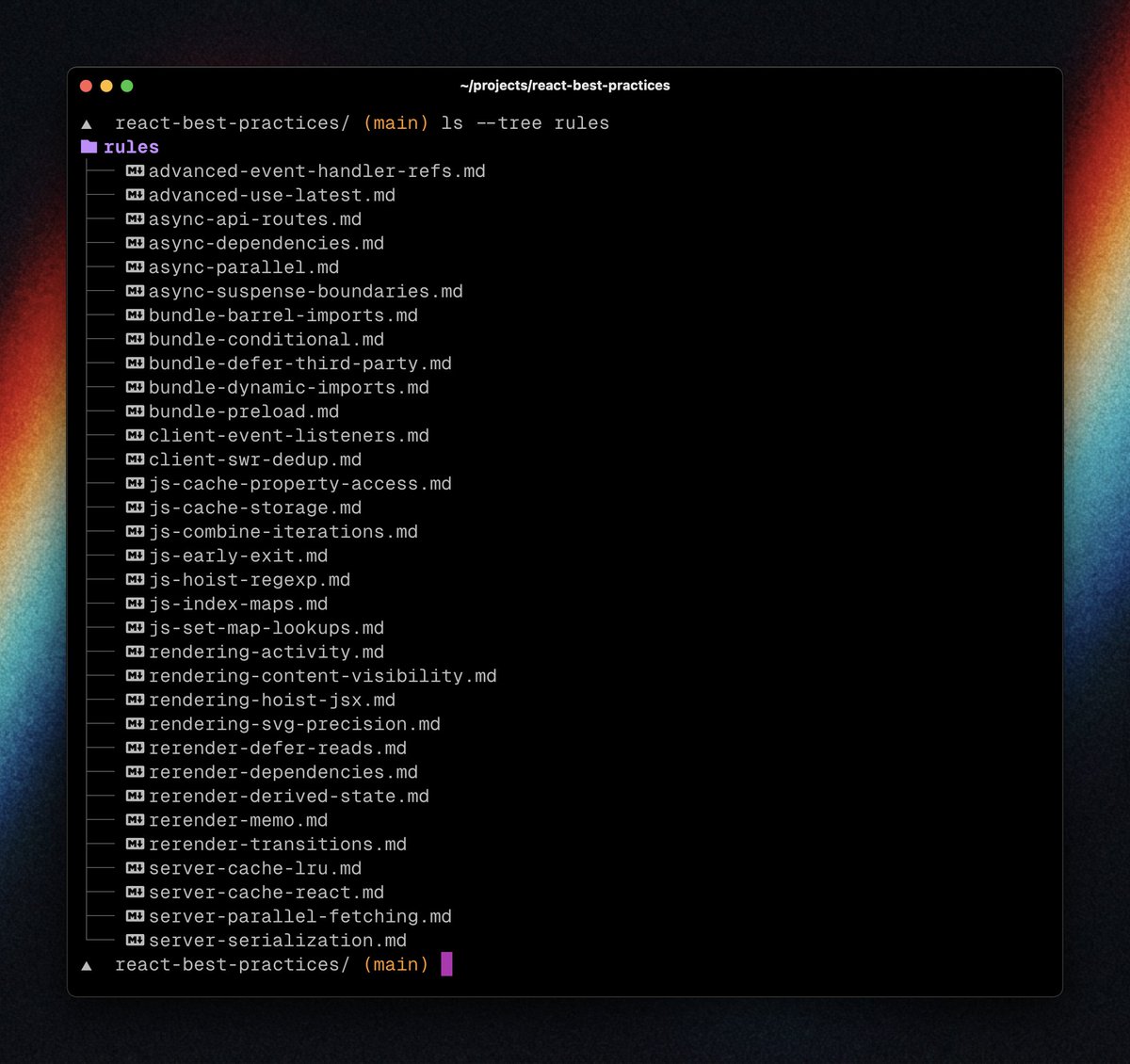
We're encapsulating all our knowledge of @reactjs & @nextjs frontend optimization into a set of reusable skills for agents. This is a 10+ years of experience from the likes of @shuding, distilled for the benefit of every Ralph
Guillermo Rauch tweet media
English
347
607
8.8K
1M
Sidi jeddou
Sidi jeddou@sidi_jeddou_dev·
If you're a developer, trust me, this is for you. These are and gonna be the best tech in 2026: -@opencode: A coding agent that works in Terminal, IDE, and it's so good. -@tan_stack: The best ecosystem for frontend, if you hate or want an alternative to Nextjs, they have TansStack Start you can deploy it on @Netlify, @Cloudflare not a locked framework :) -@convex: One of the best and modern backend framework out there, and it's also self-hosted -@shadcn: The godfather of UI libraries, I think he doesn't need an explanation. -@autumnpricing: The fastest way ever to setup Stripe in your projects and start getting payments -@better_auth: My favorite auth library now. -@clerk or @WorkOS if you're lazy and want a fast auth with so cool features out of the box that you don't want to manage yourself -@polar_sh: Since Stripe acquired lemonsqueezy and killed it, this is the best alternative in the market now -@tembo: Your way to go for code review, the team is cooking, I've talked to @connorpaton about something and found out they are ahead -@Sentry: This is a must for every project, to catch bugs and fix them, maybe be smart and use it with @tembo -@appwrite: Another cool backend framework and ecosystem to build your full-stack apps -@firecrawl: The best and fastest scrapper out there, and I really bet o it. -@ExaAILabs: Best search API for agents and modern apps -@expo: My way to go for mobile apps, I used it and from day one, I really understood 90% of the framework, Btw, I have an app on Google play and Apple store. -@mintlify: I will never build a docs and there's mintlify. Please share yours in the comments if I missed it, I would like to learn new stuff 👇
English
80
254
2.8K
178.6K
Dani E. Behrendt
Dani E. Behrendt@danipersonal·
i hear “i like using terraform” a lot from backend devs still in the old frontier ... in the ai era, describing infrastructure manually is like rearranging deck chairs on the titanic. the future is application-defined infrastructure: your code shapes the infra. @monolayer_dev
English
0
0
1
26
Dani E. Behrendt
Dani E. Behrendt@danipersonal·
You can ship full-stack applications to AWS in many ways. We built the one that lets you do it without config, yaml, or DevOps. /monolayer/ takes developers from idea to production in one flow. More time for coding. ⚡️ Read it here: techfyle.com/vh-monolayer-i…
English
0
0
0
24
Dani E. Behrendt
Dani E. Behrendt@danipersonal·
You can ship full-stack applications to AWS in many ways. We built the one that lets you do it without config, yaml, or DevOps. /monolayer/ takes developers from idea to production in one flow. More time for coding.⚡️
TechFyle@_techfyle_

Software development is faster each year, yet deployments are still a messy business. For many, Amazon Web Services, the global leader in cloud services and applications, is one of the trickiest environments. techfyle.com/vh-monolayer-i…

English
0
0
0
16
Lenny Rachitsky
Lenny Rachitsky@lennysan·
My biggest learnings from Jeanne DeWitt Grosser (ex-Chief Business Officer at @Stripe, now @Vercel COO): 1. What failed seven years ago now works with AI. In 2017, Jeanne tried to build a system at Stripe that would automatically personalize outbound emails based on company data. Despite working with world-class data scientists, it failed due to too many errors. Today, that exact same approach works. This shows how AI has made previously impossible ideas suddenly viable. 2. A single GTM engineer at Vercel reduced a 10-person sales team to 1 (in just 6 weeks). Jeanne’s team at Vercel had an engineer build an AI agent that handles inbound lead qualification, outbound prospecting, and deal loss evaluation. The agent costs $1,000 per year to run versus over $1 million in salaries for the sales team. The nine displaced team members moved to higher-value work rather than being laid off, and the remaining salesperson is 10 times more efficient. 3. Their AI deal-loss bot has become better at understanding what went wrong than humans. When Jeanne analyzed her biggest loss of the quarter, the salesperson blamed pricing. But an AI agent reviewed every email, call transcript, and Slack message and discovered the real reason: they never spoke to the person who controls the budget, and when ROI came up, the customer clearly didn’t believe the value claims. They are now using AI to analyze sales calls in real time and send alerts like “You’re halfway through the sales process and haven’t talked to a budget decision-maker yet.” 4. Wait until $1 million in revenue before hiring your first salesperson. Founders should continue selling themselves until they reach around $1 million in annual revenue with a repeatable process. The key is having a defined ideal customer profile—customers who look alike. 5. Segment customers on what drives their buying decisions, not just company size. OpenAI has roughly 3,000 employees, which would typically put them in the “mid-market” category. But they’re a top-25 website globally by traffic, so Vercel treats them as enterprise customers requiring complex sales. Effective segmentation combines company size with growth rate, web traffic, workload type, and industry—because selling to e-commerce companies requires completely different language than selling to crypto companies. 6. Most customers buy to avoid risk, not to gain opportunity. About 80% of customers purchase to reduce pain or avoid problems, while only 20% buy to increase upside. This means you should focus your sales messaging on what could go wrong without your product—like falling behind competitors or damaging their reputation—rather than just talking about exciting features. This is especially true when selling to larger companies, where individual careers are on the line. 7. Sales teams should be indistinguishable from product managers—for a bit. Jeanne hires salespeople who have such deep product knowledge that if you put one in front of a group of engineers, it should take 10 minutes to realize they’re not a product manager. This credibility allows sales teams to serve as an extension of research and development—a 20-person sales team talks to hundreds of customers weekly and can translate those conversations into product insights at scale. 8. Building your own AI sales tools may beat buying off-the-shelf software. Because AI is so new and every company’s sales process is unique, Jeanne finds that building custom internal agents often delivers more value than buying vendor solutions. A single go-to-market engineer built their deal analysis bot in just two days, perfectly tailored to their specific workflow. These engineers shadow top salespeople to understand their workflows, then build automation that would have taken months or been impossible just a few years ago. 9. Make every sales interaction great, whether customers buy or not. Jeanne replaced boring discovery calls at Stripe with collaborative whiteboarding sessions where customers drew their payment architecture. Many customers had never visualized their own systems before. They left with a useful asset and a feeling of collaboration, regardless of whether they bought. Many returned years later to purchase. Think about your go-to-market process like a product, not just a sales function. 10. Product-led growth has a ceiling—no $100 billion company runs on it alone. While product-led growth (where users can sign up and start using a product without talking to sales) works well for early growth, customers generally won’t spend a million dollars through a self-service flow. Every major technology company eventually builds a sales team for larger deals. The mistake is waiting too long, since building a predictable sales process takes time.
English
74
171
2K
770.9K
Dani E. Behrendt retweetledi
Min Choi
Min Choi@minchoi·
This story is wild Chinese state-backed hackers hijacked Claude Code to run one of the first AI-orchestrated cyber-espionage Using autonomous agents to infiltrate ~30 global companies, banks, manufacturers and government networks🤯 How the attack was carried out in 5 phases
Min Choi tweet media
Anthropic@AnthropicAI

We disrupted a highly sophisticated AI-led espionage campaign. The attack targeted large tech companies, financial institutions, chemical manufacturing companies, and government agencies. We assess with high confidence that the threat actor was a Chinese state-sponsored group.


English
232
1.8K
9.8K
1.5M
Dani E. Behrendt retweetledi
Dylan O'Sullivan
Dylan O'Sullivan@DylanoA4·
Your brain will invent fake problems for you if you don't go out and find real ones
English
162
962
8.3K
204.9K
Sergiu 🤖 AI Directories
💥 Pitch your startup: - Max 4 words - Add your link Seen by 30,000 people last week. Yes, it counts as marketing, go! 🚀
English
651
12
442
44.3K