dataphile

15K posts

dataphile banner
dataphile

dataphile

@dataphile

Earth Katılım Mart 2009
726 Takip Edilen968 Takipçiler
dataphile
dataphile@dataphile·
@Jabaluck @stalmico It might not be lean or Isabelle but you’ll definitely need higher order logic or some meta language to describe the rigour or lack thereof in maths. Even if that meta language is Ai generated itself you’d need the language of logic to express logic logically; at least for humans
English
0
0
1
14
Jason Abaluck
Jason Abaluck@Jabaluck·
@stalmico I don't think you will need that to make mathematical progress (although certainly it will be helpful). Chain of thought + careful reasoning suffices w/o lean formalization. Humans got by without lean for a long time, and still do.
English
2
0
27
6.4K
Jason Abaluck
Jason Abaluck@Jabaluck·
I suspect math will be like Chess and Go due to verifiability. The period of fruitful collaboration between humans and AI will be short (i.e. a few years or less, not a decade). Progress in math will be jagged, with harder to formalize fields coming last, but I suspect this jaggedness will be compressed in time -- I expect superhuman performance at (nearly?) all areas of math within a few years (a few = 2-3?). AIs will also be better at asking pure math questions than humans, and will quickly develop theories beyond human comprehension. Human theorists will have a recreational comparative advantage over other humans in understanding these theories, but AIs will be better at communicating these theories to applied researchers. Pure mathematicians will need to become applied researchers to do productive work, until applied research is also automated. Confidence level for prediction: 50-65% for gist, 40-50% for all above claims being correct.
Scott Kominers@skominers

Wild that an LLM autonomously disproved the unit-distance conjecture 🤯 But it’s also striking to me that, almost immediately after seeing the construction, a human mathematician was able to improve it further. Speaks to the potential of human–AI collaboration in math, QED 🔲

English
79
134
1K
587.1K
dataphile retweetledi
Millie Marconi
Millie Marconi@MillieMarconnni·
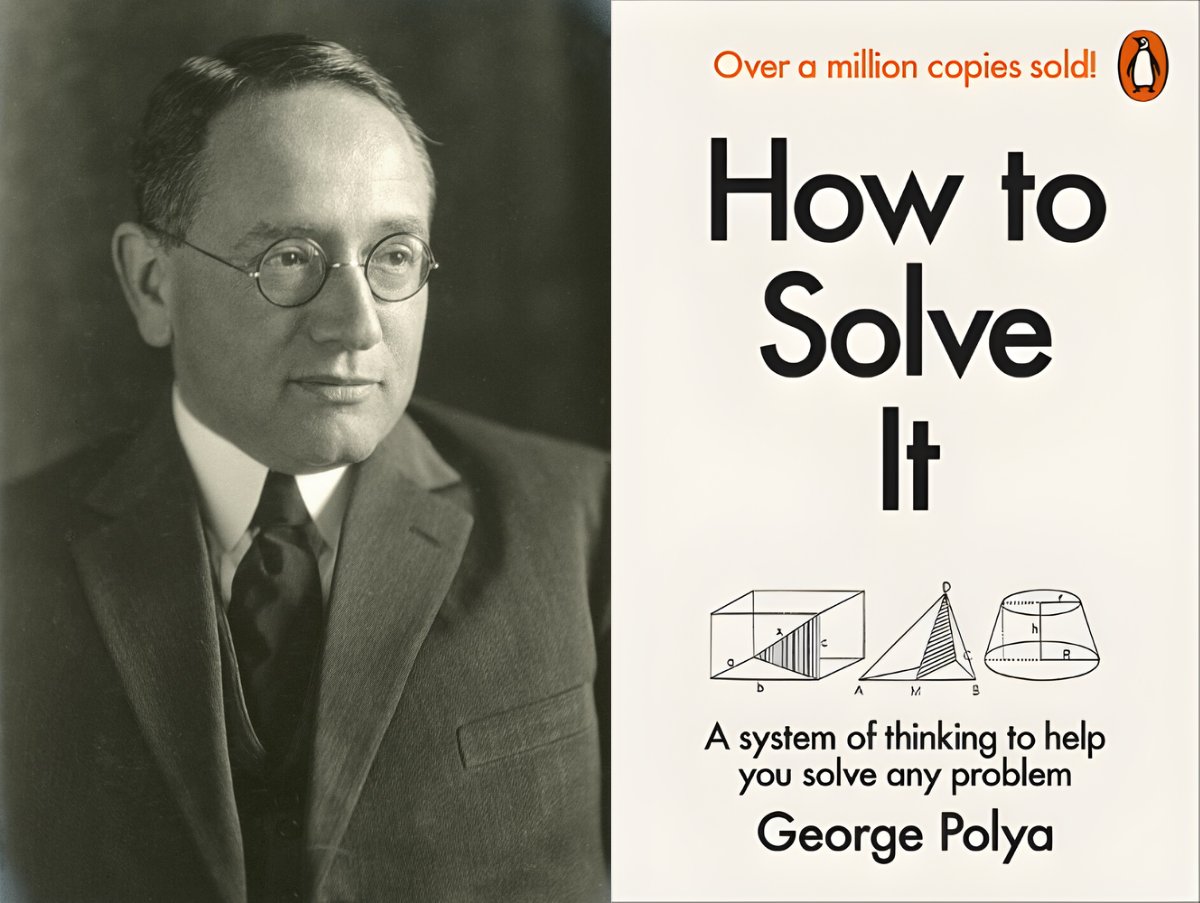
A Stanford mathematician spent 40 years watching brilliant students fail at hard problems. Not because they were stupid. Because nobody taught them what to do before they started solving. His name is George Pólya. His 1945 book has sold over a million copies and never gone out of print. Marvin Minsky, the man who built the first neural network machine at MIT, said publicly that everyone should read it. Most people have never heard of it. The failure Pólya watched repeat itself for four decades was always the same. A problem appears. The student feels anxiety. They immediately start calculating. Not because calculating was the right move. Because it felt better than sitting with not knowing. The calculation was almost always wrong. Not from lack of skill. From lack of understanding what was actually being asked. He called it the most neglected step in all of problem solving. Step one is to understand the problem. Not skim it. Not assume you've seen something similar. Actually understand it. His filter was one question: can you restate the problem in your own words without looking at it? If you can't, you haven't understood it. You've only read it. Most people skip this and spend hours stuck on a problem they never actually understood. Step two is to make a plan. Not execute. Plan. The pattern Pólya saw in every successful problem solver was the same. When something feels impossible, find a simpler version and solve that first. Not because the simpler version is the goal. Because it gives you a method you can carry back. He phrased it once with precision: if you cannot solve the proposed problem, try to solve a related one. That question alone is worth more than most problem-solving courses ever taught. Step three is to execute. Everyone thinks this is the whole game. It is the third of four steps. Pólya spent the least time on it because it is the most obvious. Once you understand and have a plan, execution is mostly patience. Step four is the one almost nobody does. Look back. Not to check the arithmetic. To ask: can I verify this with a different method? Can I use this method somewhere else? What would I do differently? This is where the real learning lives. Every expert Pólya studied had this habit. Every struggling student skipped from the answer to the next question, carrying nothing forward, starting from zero every single time. His deepest insight was not a technique. It was a diagnosis. Intelligent people feel bad at problem solving because they confuse reading a problem with understanding it. They confuse starting to work with having a method. They confuse getting an answer with having learned anything. These are not the same things. The students who get genuinely good at hard problems are not the ones who practice more. They are the ones who slow down at the two moments every instinct tells them to rush. The beginning and the end. The problem was almost never as hard as it looked. They just hadn't understood it yet.
Millie Marconi tweet media
English
23
473
2.3K
79.5K
dataphile
dataphile@dataphile·
@elonmusk Great. Grok has proven the Riemann Hypothesis step by step 5 times now and then failed it on review. Can we get some Isabelle connectors please? @xai
English
0
0
1
246
Tech with Mak
Tech with Mak@techNmak·
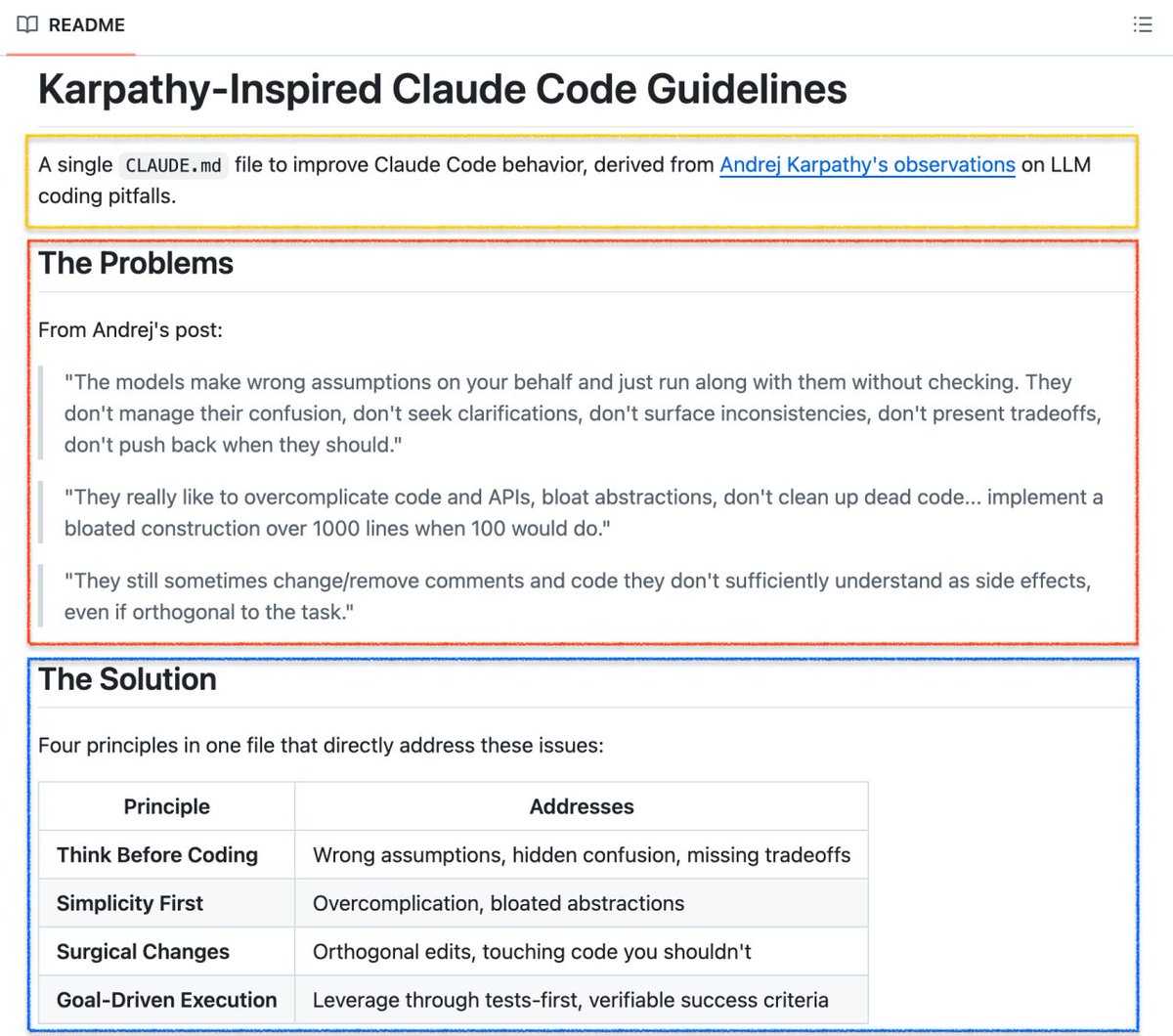
Andrej Karpathy wrote something that every Claude Code user has felt but couldn't articulate. Three quotes. Read them slowly. "The models make wrong assumptions on your behalf and just run along with them without checking. They don't manage their confusion, don't seek clarifications, don't surface inconsistencies, don't present tradeoffs, don't push back when they should." "They really like to overcomplicate code and APIs, bloat abstractions, don't clean up dead code... implement a bloated construction over 1000 lines when 100 would do." "They still sometimes change/remove comments and code they don't sufficiently understand as side effects, even if orthogonal to the task." You've seen all three. Probably this week. Someone turned these three observations into a single CLAUDE[.]md file. Four principles, one install, directly addresses each quote: 1./ Think before coding Don't assume. Don't hide confusion. State ambiguity explicitly. Present multiple interpretations rather than silently picking one. Push back if a simpler approach exists. Stop and ask rather than guess. 2./ Simplicity first No features beyond what was asked. No abstractions for single-use code. No "flexibility" that wasn't requested. No error handling for impossible scenarios. The test: would a senior engineer say this is overcomplicated? If yes, rewrite it. 3./ Surgical changes Don't "improve" adjacent code. Don't refactor things that aren't broken. Match the existing style even if you'd do it differently. If you notice unrelated dead code, mention it, don't delete it. Every changed line should trace directly to the request. 4./ Goal-driven execution Transform "fix the bug" into "write a test that reproduces it, then make it pass." Transform "add validation" into "write tests for invalid inputs, then make them pass." Give it success criteria and watch it loop until done. This last one is Karpathy's key insight captured directly: "LLMs are exceptionally good at looping until they meet specific goals... Don't tell it what to do, give it success criteria and watch it go." It's a single file. Drop it into any project.
Tech with Mak tweet media
English
23
78
1K
87.8K
dataphile
dataphile@dataphile·
@elonmusk Could you insert Isabelle HOL as a mathematical logic filter please @xai Thank you for your consideration in this matter.
English
0
0
0
14
dataphile
dataphile@dataphile·
@DaveJ Then turn it into an executable with React Flow and SSE.
English
1
0
3
1.6K
Dave Jeffery
Dave Jeffery@DaveJ·
Ask Claude to document and describe the main flows in your app and output in a single page html + json data file. Incredibly useful for humans and the JSON file is very useful for explaining the flow to the LLM when working on new features/bugfixes.
English
133
385
6.1K
477.4K
Ihtesham Ali
Ihtesham Ali@ihtesham2005·
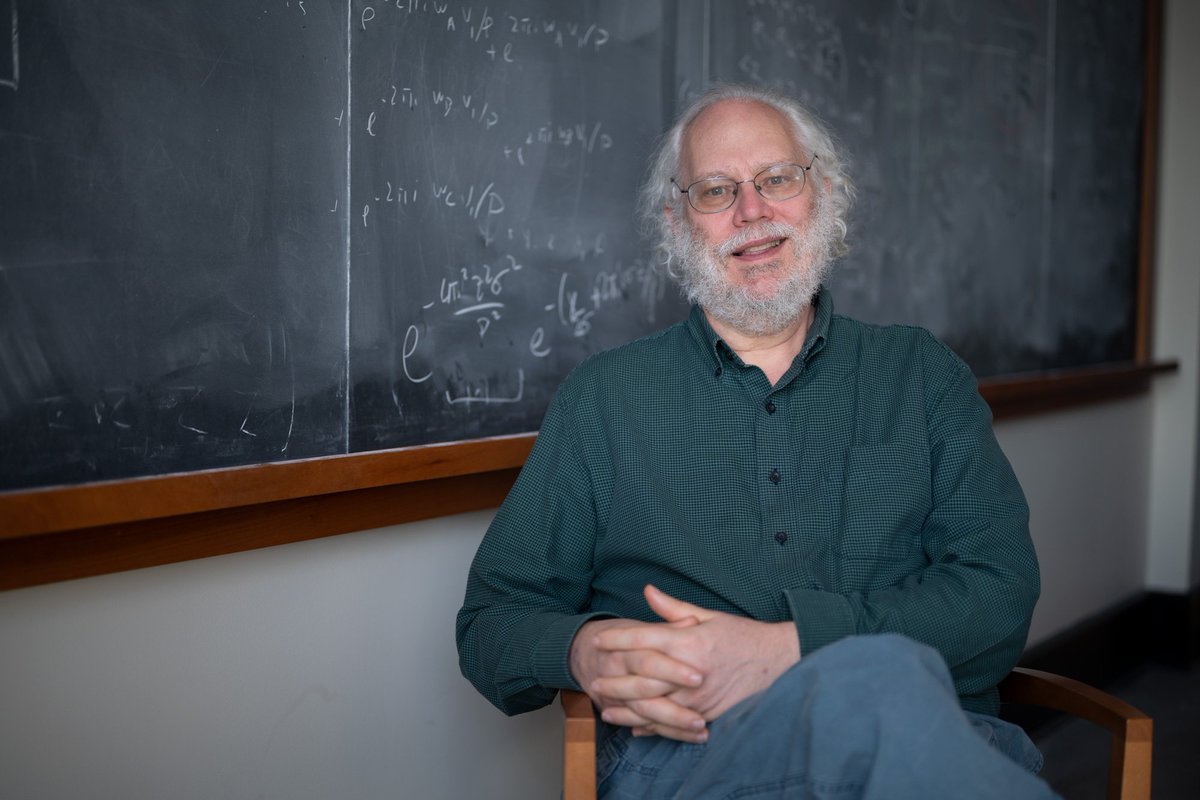
A mathematician at Bell Labs wrote something on paper in 1994 that made every government on earth quietly panic. The machine that runs it doesn't exist yet. The panic never stopped. His name is Peter Shor. He is a professor of applied mathematics at MIT. He won the Turing Award in 2021, the highest honor in computer science. And the thing he is most famous for is a piece of mathematics he wrote in four days that he did not fully intend to write. Here is the story almost nobody tells, and why it should change how you think about the security of everything you do online. In 1994, Shor was a researcher at AT&T Bell Labs in Murray Hill, New Jersey. Bell Labs at the time was the most intellectually alive research environment in the world. The same building that produced Claude Shannon's information theory, the transistor, and the Unix operating system was now full of physicists who interrupted each other mid-sentence and argued through lunch. Quantum computing in 1994 was not a field. It was a rumor. A handful of theorists believed that computers built on quantum mechanical principles could solve certain problems exponentially faster than classical machines. Most of the scientific establishment considered them eccentric. There was no working quantum computer. There was no clear proof that one would ever matter. It was the kind of research that serious people called interesting and quietly avoided. Shor was not avoiding it. He had been thinking about a problem called the discrete logarithm, a mathematical operation that sits underneath several encryption schemes. Encryption works because certain mathematical operations are easy to perform in one direction and almost impossible to reverse. Multiply two enormous prime numbers together and you get a product in seconds. Start with the product and try to find the two original primes and a classical computer would take longer than the age of the universe. That asymmetry is the lock. Every bank transaction, every encrypted email, every password you have ever entered online is protected by some version of that lock. Shor worked out a quantum algorithm for the discrete logarithm problem. He presented it at an internal Bell Labs seminar. The physicists in the room paid attention for the entire talk, which was unusual. The talk ended, and people started talking. Then the telephone game started. The discrete logarithm is used in some encryption systems, but not most. The dominant encryption standard protecting most of the world's sensitive data, RSA, is built on a different problem: prime factorization. As news of Shor's seminar spread through the halls of Bell Labs and then through the physics community, something got lost in translation. By the time the story reached physicists across the country four days later, the rumor was that Shor had solved factoring. He had not. He had solved something related but different. Shor heard the rumor. And then, in four days, he made it true. He sat down, looked at what he had already built, found the mathematical connection between the discrete logarithm and prime factorization, and extended his algorithm to cover both. The rumor had described something that did not exist. He built it to match the rumor before anyone found out it was wrong. What he had now was a quantum algorithm that could factor enormous numbers exponentially faster than any classical computer. In practical terms, what that meant was this: if a quantum computer ever existed with enough stable qubits to run Shor's algorithm at scale, RSA encryption would be broken. Not weakened. Not compromised at the margins. Broken completely. Every message ever encrypted with RSA would be readable. Every private key ever generated would be derivable from the public key. Every lock built on the assumption that factoring is hard would unlock. The paper went out. The reaction was not what most people imagine. There was no press conference. No announcement. A 32-page technical paper appeared in the proceedings of a symposium on the foundations of computer science. Cryptographers read it and understood immediately what it meant. Intelligence agencies read it and understood immediately what it meant. Governments that had spent decades and billions of dollars building encryption infrastructure understood immediately what it meant. None of them said much publicly. They started working. The NSA gave Shor a Mathematics in Cryptology Award in 1995, one year after the paper came out. That is a fast turnaround for an award from an intelligence agency. The implication is that they read the paper and moved. The problem was the machine. Shor's algorithm requires a quantum computer with enough fault-tolerant qubits to factor the kind of numbers used in real encryption, numbers with hundreds of digits. In 1994, no such machine existed. In 2001, IBM demonstrated Shor's algorithm on a 7-qubit quantum computer and used it to factor the number 15 into 3 and 5. That was the proof of concept. It was also a machine that required more infrastructure than most university labs own, running a calculation a fourth grader could do in their head. The gap between that demonstration and a machine capable of breaking real encryption is enormous. The numbers involved in modern RSA encryption have hundreds of digits. Factoring them with Shor's algorithm would require a quantum computer with potentially millions of stable, error-corrected qubits. The best machines available today have thousands of qubits, most of them too noisy to use reliably for extended computation. But the direction of progress is not ambiguous. Every year, the machines get larger. Every year, error correction improves. Every year, the gap between what exists and what Shor's algorithm requires gets smaller. Nobody knows exactly when a machine capable of breaking RSA will exist. Estimates from serious researchers range from ten years to thirty. The NSA has said publicly that it believes the threat is real. NIST, the US standards body, spent years running a global competition to identify encryption algorithms that would survive a quantum computer, and in August 2024 published the first official post-quantum cryptography standards. Google has already integrated one of them into Chrome. Apple adopted another for iMessage. Signal switched to a hybrid post-quantum system in 2023. All of that activity, every dollar of it, every hour of engineering, traces back to four pages Shor wrote in 1994. The most interesting detail is the one Shor himself has repeated in multiple interviews. He compared the current scramble to build post-quantum cryptography to Y2K, the race to patch computer systems before the year 2000. He said the difference is that Y2K had a fixed deadline. The quantum threat has no deadline. Nobody knows when the dangerous machine will exist. And his warning was blunt: if you wait until it is obvious that a sufficiently powerful quantum computer is coming, you will already be too late. The migration of critical infrastructure to post-quantum standards takes years. The systems protecting financial markets, government communications, and military networks cannot be updated in an afternoon. The race is not theoretical. It is happening right now, in every major government and every serious technology company on earth. Shor is 65 years old. He still teaches at MIT. He did not build the machine. He wrote the paper that proved the machine would matter before anyone had built it. He won the Turing Award 27 years after the paper came out, which is either a sign that the committee moves slowly or a sign that the full weight of what he wrote is still arriving. The most dangerous algorithm in the history of cryptography has never successfully been used against a real target. Every system protecting your money, your messages, and your government's secrets is safe for exactly one reason. The computer that breaks them has not been finished yet.
Ihtesham Ali tweet media
English
53
280
1.2K
128K
Rex Cluster
Rex Cluster@VivatDoom·
Month 1 #physics @firsttogrowai Quantum Isomorphism Framework for the Riemann Hypothesis: Geometric and Operator-Theoretic Foundations Alexander Cisneros (Sol Rex) December 18, 2025 Abstract This paper presents a conceptual framework for approaching the Riemann Hypothesis through quantum operator theory. We construct a self-adjoint Hamiltonian operator HREX and establish the geometric foundations for a unitary, bijective map between the non-trivial zeros of the Riemann zeta function and the real eigenvalues of this operator. We argue that the critical line Re(s) = 1/2 arises as a geometric necessity from the interplay of three principles: (i) unitarity of a Mellin-type spectral transform, (ii) the symmetry of the completed zeta function encoded in the functional equation, and (iii) self-adjointness of the underlying Hamiltonian. This framework does not constitute a proof of the Riemann Hypothesis, but it provides a coherent Hilbert–P´olya style architecture within which a future rigorous verification could be attempted. P = NP: Polynomial-Time Solution via The Sovereign Model for Chaotic Systems Alexander Cisneros (Sol Rex)1 December 2025 Abstract We prove that P = NP by demonstrating that the Sovereign Model for Chaotic Systems (SMCS) solves NP-complete problems in polyno- mial time with Planck-scale precision. We establish NP-completeness of the Ring Dynamics Prediction Problem via bidirectional reduction from 3-SAT, prove SMCS achieves O(n2 log n) complexity through op- timized algorithms, and demonstrate that bounded uncertainty below L 2−n is computationally equivalent to exact solutions. This resolves the P versus NP problem affirmatively. Month 4 #physics @firsttogrowai doi.org/10.5281/zenodo… Quantum Isomorphism Framework for the Riemann Hypothesis: Complete Operator-Theoretic Proof Architecture Abstract We construct a self-adjoint Hamiltonian operator HREX on L 2 (R, dy) consisting of a harmonic oscillator backbone H0 perturbed by a prime-comb potential encoding the von Mangoldt function. We establish: (i) self-adjointness via Kato-Rellich, (ii) compact resolvent yielding purely discrete spectrum, (iii) trace-norm convergence of the Duhamel-Dyson expansion for the heat semigroup, and (iv) explicit archimedean heat trace structure from H0. We prove that the first-order spectral correction Θ1(s) equals the logarithmic derivative −ζ′ (s)/ζ(s), and that integration followed by exponentiation in the Fredholm determinant reproduces the Euler product. We establish the Resolvent Trace–Zeta Logarithmic Derivative Identity, showing that poles of the renormalized resolvent trace coincide with zeros of Ξ. doi.org/10.5281/zenodo… On the Integrality Gap Barrier for Spectral Embeddings of 3-SAT: A Falsifiable Framework at the Edge of the Sum-of-Squares Hierarchy We study a spectral embedding of 3-SAT instances via a clause–variable incidence matrix M(Φ) and its associated Gram/Laplacian operators. We show that simple spectral properties (e.g., singularity of A = MM⊤ or low quadratic energy) do not characterize satisfiability. Explicit counterexamples demonstrate an integrality gap: continuous relaxations admit low- energy solutions that round to false positives. We connect this failure to the inability of quadratic forms to encode cubic clause interactions and relate the phenomenon to the Sum-of-Squares (SoS) hierarchy. We introduce the Symmetric Satisfiability Operator L(Φ) and analyze its spectral properties. We propose a falsifiable experimental program to map instance structure to the minimal SoS degree required for exact decision. Finally, we define the Cubic Deficit as a measure of the gap between quadratic relaxation and Boolean satisfiability, and conjecture that this deficit is the true computational barrier separating P from NP. #HighFidelity showcase 👑
English
2
0
2
100
dataphile retweetledi
Sabine Hossenfelder
it's funny because it's true 🤣
Sabine Hossenfelder tweet media
English
367
540
5.3K
179.1K
dataphile
dataphile@dataphile·
@XFreeze Maybe he has a nice personality 🙄
English
1
1
2
105
X Freeze
X Freeze@XFreeze·
Scam Altman has a incredible track record for being a con artist I don't think anyone has a "former ally turned enemy" list this big with directly with people he worked with A massive new 18-month investigation dropped, revealing the full list of people who worked directly with Sam Altman and now openly say they don’t trust him - they call him a liar, manipulator, scam artist, and worse These are his co-founders, board members, top executives, and biggest partners. Not random haters: • Elon Musk (OpenAI co-founder) ➝ Betrayed the original nonprofit, open & safe AI mission and turned it into a closed profit machine What he says: Calls him "Scam Altman" and “Sam Altman lies as easily as he breathes” • Ilya Sutskever (OpenAI co-founder & former Chief Scientist) Why: Discovered Sam repeatedly lied about safety protocols and bypassed board oversight. What he says/did: Compiled 70+ pages of memos, Slack messages, and evidence proving Sam’s lies → helped fire him. Said he didn’t think “Sam is the guy who should have his finger on the button for AGI” • Dario Amodei (former OpenAI President, now Anthropic CEO) Why: Left because of Sam’s leadership and broken safety promises What he says: “The problem with OpenAI is Sam himself.” Called the company under Sam "mendacious” (full of lies) and compared it to Big Tobacco knowingly selling something dangerous. Accused him of a clear “pattern of behavior” • Helen Toner (former OpenAI Board Member) Why: Sam made it impossible for the board to do its job through constant deception What she says: He was “outright lying to the board” and created a “toxic atmosphere” of psychological pressure • Tasha McCauley (former OpenAI Board Member) Why: Complete loss of trust after years of the same behavior What she says: Senior leaders reported Sam cultivated a “toxic culture of lying” • Jan Leike (former Superalignment co-lead) Why: Sam deprioritized real safety work for shiny products What he says: Resigned publicly saying he “lost confidence” in OpenAI leadership and that the company was “losing its way” on alignment • Mira Murati (former CTO - one of Sam’s closest longtime collaborators) Why: Lost all confidence in his leadership as they approached AGI What she says: Told insiders “I don’t feel comfortable about Sam leading us to AGI” and said his playbook is to say whatever he needs to get what he wants, and if that fails, destroy your credibility • Microsoft executives (including major tensions with CEO Satya Nadella) Why: Felt constantly misled on deals and partnerships What they say: A senior exec warned he could be remembered as a “Bernie Madoff or Sam Bankman-Fried-level scammer” • Paul Graham (Y Combinator co-founder - Sam was YC President) Why: Long pattern of deception during his time running YC What he says: Privately told YC colleagues, “Sam had been lying to us all the time" • Loopt board & early employees (Sam’s first startup) Why: History of chaotic and deceptive behavior What they did: Employees went to the board twice trying to get him fired over lack of honesty and shady behavior These are his co-founders, board members, closest executives, and major partners who actually worked with him all say the exact same things - chronic lying, manipulation, broken trust, toxic culture, scam & deception
X Freeze tweet media
English
845
1.9K
7.2K
22.1M
Aakash Gupta
Aakash Gupta@aakashgupta·
Your brain has a circuit that doesn't know you live in a city. Its only job is to monitor whether birds are still singing. Right now, in this room, it is on. The circuit predates primates. Mammals have been using ambient soundscape continuity as a predator-detection system for roughly 200 million years. Birds stop singing when something larger moves through their territory. For most of mammalian history, a forest full of song meant no large predator was nearby, and the cessation of sound was the warning. Your nervous system never updated this software. The Max Planck Institute tested the inverse in 2022 with 295 participants. Six minutes of birdsong dropped anxiety with a medium effect size. Six minutes of traffic noise raised depression with the same. The effect worked on subjects who lived in dense urban environments and had no regular contact with nature. The brain still ran the check. Birdsong sits in the 1,000 to 8,000 Hz range. Your brainstem reads continuous patterns in that band as a signal that nothing dangerous is currently moving through the environment. EEG data shows birdsong at 45 to 50 decibels boosts alpha wave activity by 14.1% relative to silence. Alpha is the brainwave signature of relaxed alertness. Push the same birdsong above 60 decibels and the response flips. Stress markers rise 29%. The circuit only trusts the signal at the volume of quiet conversation, which is exactly the volume birds sing at from a typical distance. Three things happen simultaneously when the brain registers ambient safety. The amygdala downregulates. The parasympathetic nervous system takes over from the sympathetic. Heart rate variability rises, cortisol drops. The posterior cingulate cortex, which sits at the center of the rumination circuit, quiets down. King's College London tracked this through a smartphone study with over 1,200 participants and found the mood lift lasted hours after the sound stopped. People diagnosed with depression got the same response as healthy controls. Most of what gets labeled mental fatigue is hypervigilance running in the background. Birdsong tells the circuit it can stand down, and the brain reallocates the freed compute everywhere else. A quiet park feels different from a quiet office because the parks have sentinels.
Aakash Gupta tweet media
English
604
4.3K
28.1K
3.2M
Brian Armstrong
Brian Armstrong@brian_armstrong·
Speed of execution in software is increasing exponentially, with equal or greater quality. We're starting to see it really show up now. Like most companies, we have a huge backlog of software to build, so this is quite valuable. Agreements with third parties (sales, regulatory, vendors, etc) and physical world (moving atoms, not bits) will take longer to ramp and will be the limiting factor for some time.
rob@rwitoff

In the last 12 months, we’ve seen a 27x increase in non-engineers using dev tools like Claude, OpenCode and Cursor to build & automate how we work. The goal is to turn everyone into a builder, and safely reduce the distance between idea → execution to near zero. Trust is our most important asset at @coinbase, so this is fueled by a massive effort in quality, guardrails and simplification.

English
105
105
858
127K
Jesse
Jesse@jesse_vermeulen·
honest question: what do people do during the 5-10 min while Claude is running?
English
2.2K
75
3.1K
644.7K
dataphile
dataphile@dataphile·
@minchoi You can sharpen a pencil without a pencil sharpener but you can’t sharpen a pencil without a pencil.
English
1
1
7
913