David Chivers

9.4K posts

David Chivers banner
David Chivers

David Chivers

@dave_chivers

Associate Professor of Economics at Durham University. Buy my book here https://t.co/1WMMdv8ke4
Durham, England Katılım Nisan 2009
664 Takip Edilen1.6K Takipçiler
Sabitlenmiş Tweet
David Chivers
David Chivers@dave_chivers·
Going to start a thread consisting of things that need improving... 1. Kitchen extractor fans. Noisey and don't work very well. The relief I get whenever I switch it off is the only thing good about it.
English
143
197
7.4K
1.5M
David Chivers
David Chivers@dave_chivers·
Made a Kenneth Arrow Codex pet
David Chivers tweet media
English
0
0
0
31
David Chivers
David Chivers@dave_chivers·
Does anyone know how much the UK biobank data was going for on Alibaba? Surely trillions given how much US companies want it apparently...
English
0
0
0
118
David Chivers
David Chivers@dave_chivers·
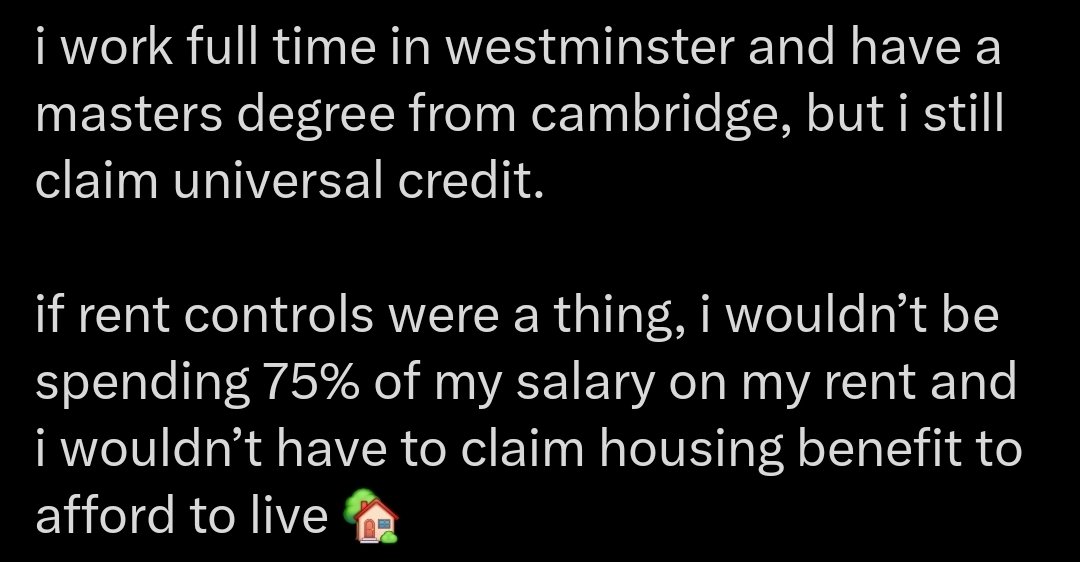
Other people may like to live in this location now given the new lower rent but cannot as someone got there first under a different system.
David Chivers tweet media
English
0
0
0
73
David Chivers
David Chivers@dave_chivers·
To make rent control fair, tenants should give up their current rentals, and all units should then be reallocated via a lottery in which everyone reapplies.
English
1
0
0
137
David Chivers
David Chivers@dave_chivers·
@AaronBastani I think given the easy workarounds (you would simply contract out lowest paid workers as a seperate firm) you may as well impose a maximum wage (although there are also workarounds here too).
English
0
0
0
73
David Chivers retweetledi
Joseph Steinberg
Joseph Steinberg@jbsteinberg·
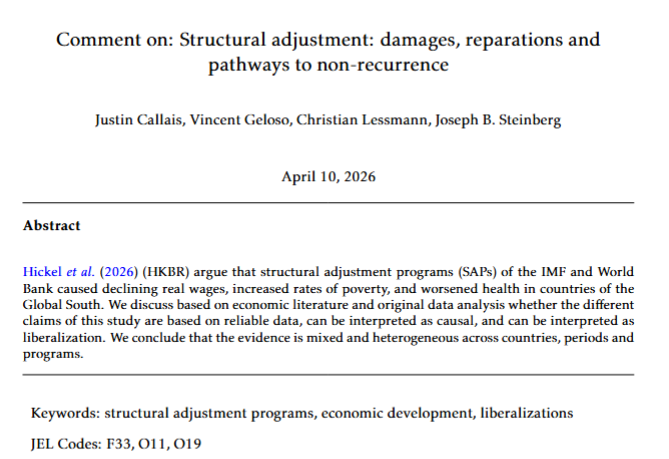
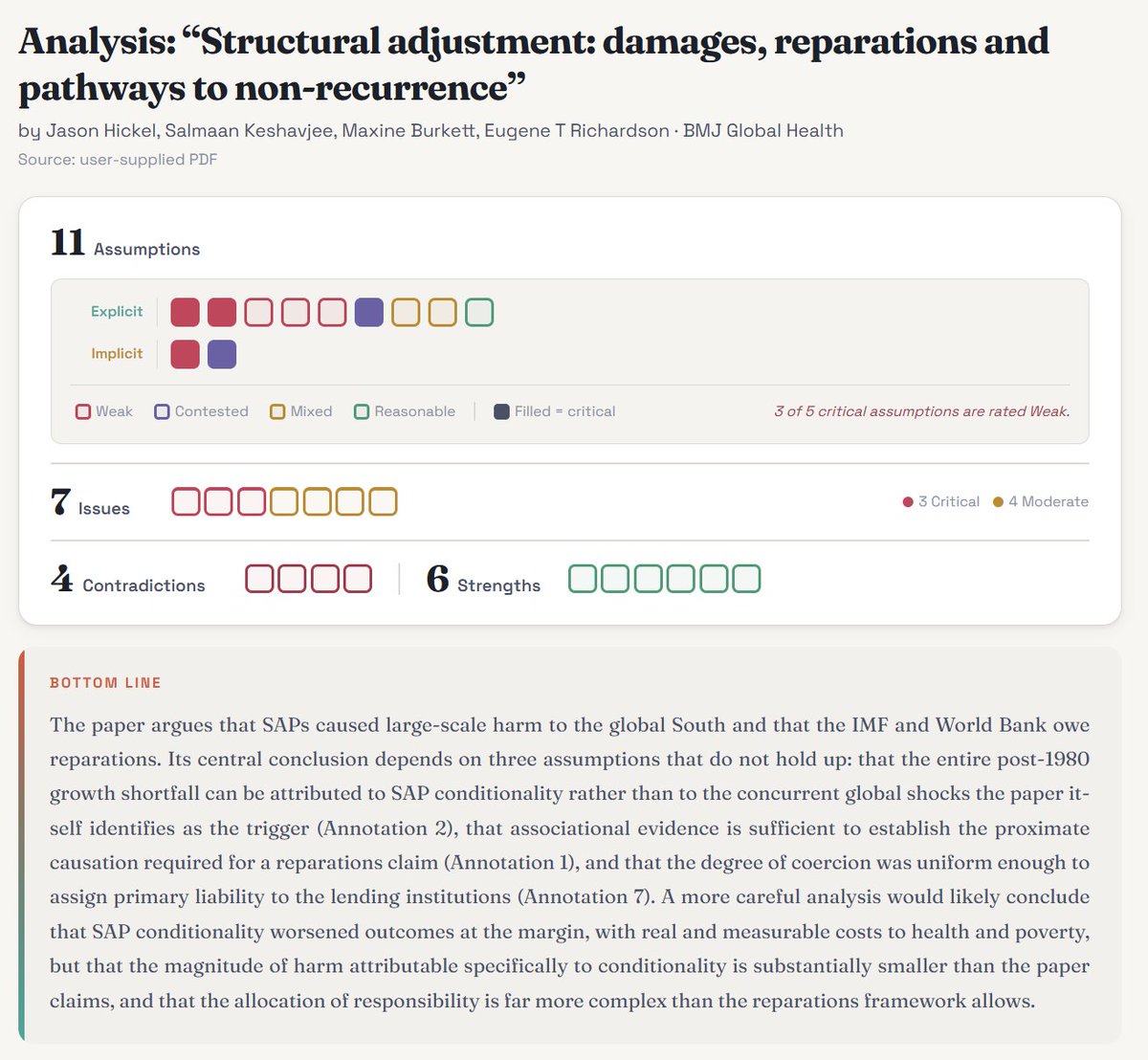
Sorry, but this doesn't cut it. My new tool showmethemodel.io explains why here: showmethemodel.io/#/results/WkoB…
Joseph Steinberg tweet mediaJoseph Steinberg tweet mediaJoseph Steinberg tweet mediaJoseph Steinberg tweet media
Jason Hickel@jasonhickel

Regarding this piece on the social impacts of structural adjustment (jasonhickel.org/s/e017221full.…)... it is quite strange that some people have criticized it by saying it does not implement original statistical assessment to establish causality. Strange, because this is very clearly *not* a research paper. Nor is it a systematic review paper. It is simply a short analysis paper, clearly labelled as such, which is intended to "discuss topical issues" as per BMJ guidelines.  It is obviously beyond the remit of such a piece to undertake original statistical assessment, and indeed the piece makes no claim to such an undertaking. Instead, it provides citations to examples of previously published research that has explored the impact of SAPs on various social outcomes, including studies that *do* undertake to assess causal effect.  In other words, it is incorrect to claim there is no evidence on the causal effects of SAPs. There is such evidence, and we cite key examples, including studies that account for endogeneity and selection biases. This literature deserves to be better known.  For instance, see: -On poverty: link.springer.com/article/10.105… -On poverty and inequality: degruyterbrill.com/document/doi/1… -On child and maternal health: link.springer.com/article/10.118… -On child health: academic.oup.com/ije/article/48… -On health system access and neonatal mortality: sciencedirect.com/science/articl… -And there are many others we were forced to cut for brevity And yes, the piece also cites political economy research that does not rely on statistical analysis, because these are also recognized as valuable contributions to the literature.  Along these lines, I encourage everyone to read Mike Davis' masterpiece "Planet of Slums", which includes a chapter on SAPs. As for the figures, none of them claim to demonstrate causality.  They are included purely as illustrations of broad trends in social indicators during the adjustment period - social indicators that are assessed by the studies we cite. Someone asked about using 1980 as the starting point for liberalization.  This is common convention: Chang, Pollin, Weisbrot, Baker, Rosnick and others use 1980 to generally distinguish between the developmentalist and neoliberal periods.   In Sub-Saharan Africa, for the majority of countries that were SAPed, comprising most of regional GDP, 1980 was the year immediately prior to first implementation.  Most of the rest first implemented in 1982 and 1983, and of course any assessment of effects should assess interventions on a country-specific basis. As for India's 1981 loan, the IMF insisted on adjustment conditions, the Indian government said they could not accept externally imposed conditions, so it was agreed they would implement "homegrown conditionality", with policies generally aligned with IMF preferences.  The policies affected food prices, which is why we see an increase in BNPL poverty. As for China, their agreement with the World Bank was signed in 1988 and implemented in 1990.  While healthcare and some other sectors began to be liberalized earlier, in the 1980s, the BNPL basket was not substantially affected until 1990. As for the question of national income, researchers have found liberalization had a negative impact on growth in non-manufacturing regions, which is evident in the case of LatAm and SSA, but this does not apply in regions with higher manufacturing. Regarding Kenya, we see an increase in infant mortality after 1986, and the same pattern in child mortality.  We note that some of this is attributable to HIV (and cite research showing that this pathway too is exacerbated by SAPs), but we also know from work by IRD and CERDI researchers that, in Kenya, HIV is responsible for a minor share of the change in the child mortality trend.  Even removing HIV, there is increasing child mortality after 1986 compared to the pre-SAP trend.  Several studies indicate that adjustment was associated with increased child deaths in Sub-Saharan Africa. In sum, existing research provides valuable information on the social harms related to structural adjustment.  And this should not be surprising; after all, we know there were mass protests and riots across much of the South during the adjustment period. They were literally called "IMF riots".  People don't riot for no reason, they riot because they are desperate. The IMF and WB themselves recognized this, and relaxed some of their more extreme conditions. Why care about all this? Because every man who was impoverished by these policies is my brother, every mother who died needlessly during childbirth is my sister. Nothing will shake my conviction in that fact.

English
1
4
42
6K
David Chivers
David Chivers@dave_chivers·
@paulnovosad You will probably find something similiar if you did this sort of analysis with charities/govs giving unconditional cash transfers which is a key Hickel idea!
English
0
0
1
77
David Chivers retweetledi
David Chivers
David Chivers@dave_chivers·
@bswud @MacRoweNick I always thought that the way to doit would be to have a subsciption service so you call a car and then it comes like uber. That way you eliminate parking issues in cities and you can have much fewer cars overall since something like 95% are just sitting parked.
English
0
0
1
21
Ben Southwood
Ben Southwood@bswud·
1. When they get to 90% of cars, the estimates I've seen are that they can 'platoon' to approximately double road capacities. But that doesn't change the fundamentals. The latent demand for transport is very large. (Jevons Effect here as well.) 2. Yes, it would be most efficient to apply it to all cars, but if reformers focus on that they will fail. (Both of these are referenced in the article!)
English
3
0
4
464
Ben Southwood
Ben Southwood@bswud·
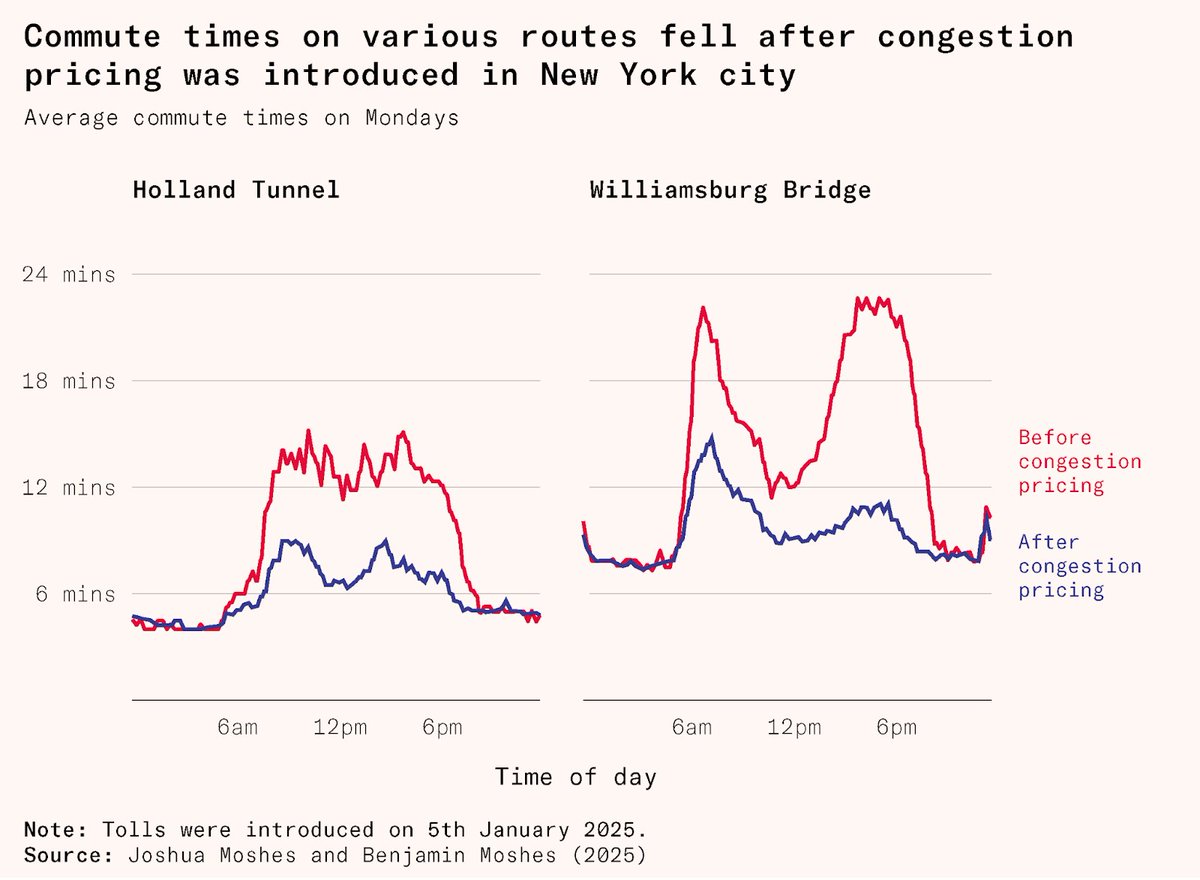
We need a tax on self-driving cars. Beneath eight states of the American Great Plains lies the Ogallala Aquifer, one of the largest bodies of groundwater on Earth. For centuries, extraction was constrained by the modest capacities of wind and hand power. At that rate, this 'fossil water' resource was effectively limitless. Farmers could draw as much as they wanted without ever running it down. worksinprogress.co/issue/escaping… But in 1949 Colorado Farmer Frank Zybach invented centre-pivot irrigation. Combined with electricity and the centrifugal pump, farmers could now draw thousands of gallons per well per minute, enough to irrigate 40 acres at a time. Since then, the aquifer has gone down 10%, losing a Lake Erie's worth of water. It is down 50% in the dry parts, where it recharges just 0.02 inches per year. Without intervention, modern pumps will bring about the total end of irrigated farming in the arid parts of the Great Plains in 20-30 years. This is what I call the Ogallala Trap. Technological change can create a new tragedy of the commons. The telegraph enabled the destruction of the passenger pigeon; sonar, radar, and diesel enabled the industrial trawling that devastated the North Sea cod in a decade; chlorofluorocarbons came close to destroying the ozone layer. Self-driving cars are about to do the same thing to roads. When you can sleep, work, or drink with friends in a moving vehicle, you will take many more journeys by car. Roads, which are free at the point of use almost everywhere, will grind to a halt. People who have to go to the office or the hospital will be stuck sharing the road with people having beers, working remotely, and taking naps. There is a fix, but it depends on acting now, before autonomous vehicles go mainstream. Voters balk at being charged more for something they already depend on. The tax needs to come in as soon as possible. Waymos are already in dozens of cities and do millions of journeys per month. We have very little time left. If we want to save our roads from omnigridlock, we must introduce road pricing for autonomous vehicles.
Ben Southwood tweet media
English
114
79
494
205.7K
David Chivers
David Chivers@dave_chivers·
@KhoaVuUmn Irony is if you think you unserstand these numbers you probably do not. Even textbooks mess them up!
English
0
0
0
1.2K
James Meadway
James Meadway@meadwaj·
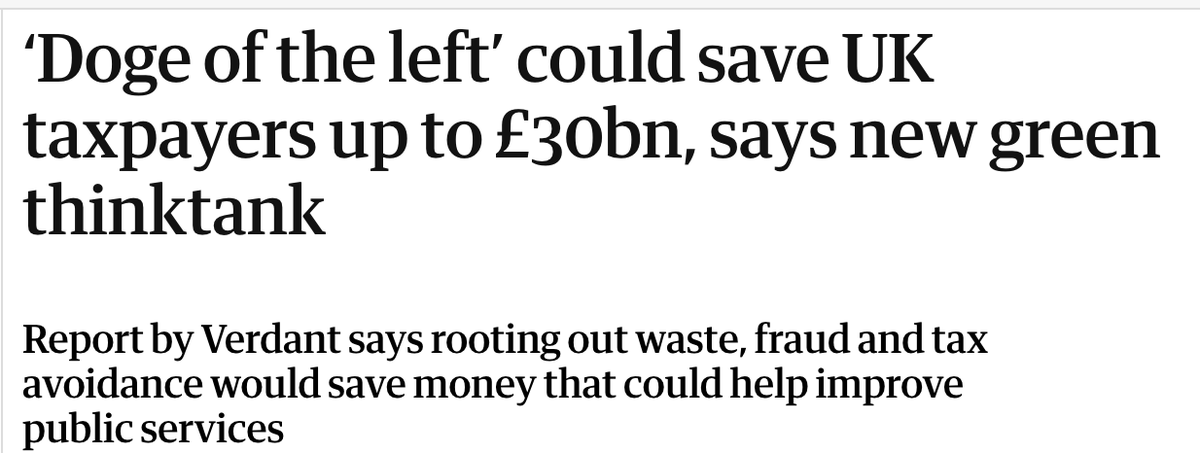
Thinktank @VerdantThinking launches today - our first report is in the Guardian: "A “Doge of the left,” could save up to £30bn a year for taxpayers by rooting out waste, fraud and tax avoidance, according to the first report from a new green thinktank.." (Link below...)
James Meadway tweet media
English
36
45
179
65.5K
David Chivers retweetledi
Luis Garicano 🇪🇺🇺🇦
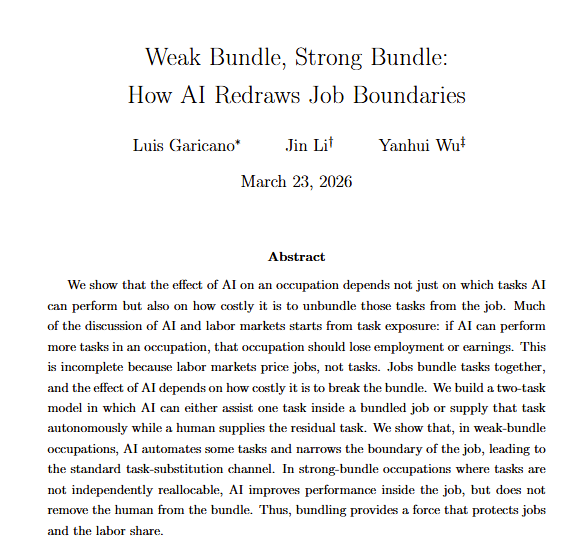
Famously (there is a beautiful Works in Progress piece on this) in 2016, Geoffrey Hinton told an audience in Toronto that medical schools should stop training radiologists, since AI would soon outperform them at reading scans. Ten years later, there are more radiologists than ever, and they earn more than they did then. Hinton was right about the task, but he was wrong (so far!) on the future of the radiology profession. Times have never been better for them. The gap between those two claims, the difference between tasks and jobs, is the subject of a paper I have written with Jin Li and Yanhui Wu, and that we release today: "Weak Bundle, Strong Bundle: How AI Redraws Job Boundaries." (Very relatedly we are also finishing the first draft of our book "Messy Jobs" on AI and Jobs!! You will be the first to hear). We start from the observation that the growing literature on AI and labor markets measures the AI shock by task exposure: people count how many tasks AI can perform in a given occupation AI can perform, and infer that more exposure means more displacement. Eloundou et al. published a paper in Science in 2024 that started this literature, and many follow the same logic. The inference they make is that the more exposed tasks, the worse the outcomes. This is incomplete, because labor markets price jobs, not tasks. A radiologist does not just sell image classification, but does many other jobs: triages cases, communicates with other physicians, trains residents, makes the difficult decisions, and signs a diagnosis. The market buys a bundled service. The question AI poses is not whether it can do one task inside the bundle. The question is whether that task can be pulled out. Thread (1/3) dropbox.com/scl/fo/689u1g7…
Luis Garicano 🇪🇺🇺🇦 tweet media
English
43
470
1.9K
407K
David Chivers retweetledi
Hamsa Bastani
Hamsa Bastani@hamsabastani·
🚨🚨 Excited to share our first *positive* results on AI in education! Most AI tutor work focuses on making the chatbot better. We suggest another lever: deciding what students should practice next to improve learning. We combine an LLM tutor with reinforcement learning to personalize problem sequencing using signals from student-chatbot interactions and solution attempts. We tested this in a 5-month randomized field experiment in a Python course across 10 high schools in Taipei. All students had the same course material and the same AI tutor. The only difference was adaptive vs. fixed problem sequencing. Result: across 770 students, adaptive sequencing improved performance on an in-person final exam taken without AI assistance by 0.15 SD, with larger effects for beginners. Our evidence suggests the gains came from stronger engagement and more productive AI use.
Hamsa Bastani tweet media
English
13
56
312
54.6K
David Chivers
David Chivers@dave_chivers·
@TomChivers Tearless onions don’t solve anything. You just stop crying from eye irritation and start crying over the loss of eye irratation.
English
1
0
2
72
Tom Chivers
Tom Chivers@TomChivers·
I immediately get annoyed by articles like this. "Some of the magic would be lost" if we use GM onions that don't make us cry? Why? If you prefer the old ones, use them. I find "we should keep things difficult on purpose" arguments incredibly frustrating ft.com/content/e09f40…
English
48
38
601
24.9K
David Chivers retweetledi
Stian Westlake
Stian Westlake@stianwestlake·
Why I'm a sceptic of Citizens’ Assemblies I was talking to the v clever @Sam__Enright recently, and made a passing remark about how I'm sceptical of claims that Citizens’ Assemblies are a great way of solving political problems. He asked me why. I thought I’d share my response. Citizens’ Assemblies are hugely popular among people interested in politics. They're particularly popular both with “sensible” anti-populists and with environmentalists (climate assemblies are especially popular among the latter group). Here are some reasons I don't like them. 1. Cognitive humility. I think a lot of love for citizens’ assemblies is predicated on the inability by the Citizens’ Assembly Advocate to countenance that voters may genuinely have different preferences to them. The mental model is something like “I believe X. Some foolish voters believe Y, because they are tricked by misinformation/Rupert Murdoch/Russian bots/their own lack of bandwidth. A citizens’ assembly would give them time to reflect on the true facts and conclude X, like me”. I struggle to think of any citizens’ assembly advocate who thinks citizens’ assemblies will reach conclusions they object to. 2. Gerrymandering. CAs seem ripe for gerrymandering. The usual CA model is that experts will provide some education on the subject before citizens deliberate and decide. The expert selection process seems like it'd be stitched up, perhaps not deliberately but by design. Example: consider a CA on how to prevent obesity and encourage healthy “food environments” (something I've heard suggested): it seems very likely to me that the experts would include lots of public health experts with strong ideological priors about the role of markets in providing food (such as the ‘commercial determinants of health’ worldview), who see food mainly as a health issue. But opponents of these positions might not be invited - for example because their funding comes from commercial sources. The choice architecture of the assembly itself is also ripe for coercive design. A transport policy friend told me about a UK CA on road building that found that citizens wanted fewer roads built (a surprising result); it turned out that they had been asked to choose between three options all of which involved less road building, and had picked one. (This problem is exacerbated by problem 1.) 3. Social desirability bias. More conceptually, I worry that CAs impose a bias to socially valorised solutions that overlook people’s selfish but legitimate motivations. Again, take the example of a CA on how to reduce obesity. Obesity is bad and socially costly (esp in systems with socialised medicine). But restrictions on unhealthy food impose a cost on individuals in terms of deliciousness and pleasure. I strongly suspect a civic discussion on obesity would focus on the societal costs and the “wise” view that we should constrain our choices in our long term interests, but underweight ideas like “chips taste yummy” which seem stupid and base - but which are legitimate desires that most people have. So CAs’ conclusions might reflect a kind of false “prosocial wisdom” that doesn't fully reflect people’s true preferences - resulting in policies that people don't actually want. I’m not saying it’s impossible to design CAs that don’t involve these biases, or that they are not known to CA experts. Arguably, the higher profile the assembly, the harder it is to get away with them (which perhaps means that things like the Irish CA on abortion that was organised as part of the referendum on the subject avoided these problems - I'm don't know enough to say). But they seem pretty fundamental issues that aren’t discussed enough in the casual commentary on CAs that I find myself reading regularly.
English
43
55
263
62.2K
David Chivers retweetledi
Philipp Heimberger
Philipp Heimberger@heimbergecon·
This new QJE paper concludes that the macroeconomic costs of climate change are far greater than earlier estimates suggested. It finds that a 1°C rise in global temperatures reduces world GDP by over 20%.
Philipp Heimberger tweet media
English
20
150
501
47.4K
David Chivers
David Chivers@dave_chivers·
Knowing about Markdown Preview Enhanced could have saved me a lot time faffing with latex and pdf files in vs code.
English
0
0
0
202
David Chivers
David Chivers@dave_chivers·
Pro tip: if you download the Happy-coder app you can talk to claude code like Alan Partridge using a dictophone and it will work on projects for you.
English
0
0
0
144