

David Dennis
2K posts
David Dennis
@davidpdennis
Product marketing advisor @eigencloud. Prev @offchainlabs @azure
Seattle, WA Katılım Ocak 2008
426 Takip Edilen577 Takipçiler

We just mass automated social marketing.
Introducing Superscale Agent - the first advanced AI agent for social marketing.
What used to take 1000s of hours now takes minutes:
→ Brainstorm & execute full marketing strategies instantly
→ Deep-dive competitor & trend reports (connected to the entire web, TikTok trends, Meta Ad Library)
→ Analyze your own Meta & TikTok ad accounts directly
→ Generate 100s of ads for TikTok, FB, IG, or Google from a single prompt
→ Iterate on creatives at insane speed
→ Build e-commerce store & ad assets on autopilot
You give instructions. The agent does the work.
Software engineering went agentic. Today, social marketing follows.
This is the most complex product we have ever built, and our most advanced update to @superscale_ai - ever.
Early customers have been using it for months. The results have been transformative.
To celebrate: comment "Agent" and get our 100 most powerful prompts + 3,000 free credits (= 3 videos or 50 static ads).
It only gets crazier from here 🚀
English
David Dennis retweetledi

Okay, this is huge. As software collapses onto machine intelligence for practically all use cases, reproducible execution environments become the foundation for a truly trustless internet.
The main problem in AI today is that it isn’t trustless. It’s entirely a “trust me bro” paradigm. Interestingly, crypto is plagued with the exact same problem, while it purports to be decentralized and trustless.
Decentralized networks operate on trusted compute and infrastructure, while also becoming more and more dependent on machine intelligence for execution and coordination. Reproducible execution environments become a crucial component in guaranteeing trustlessness across decentralized networks and protocols.
Big shoutout to @harrygrieve @benfielding and the @gensynai team for developing what I believe will become one of the most important primitives for a trustless internet.
Great work!
gensyn@gensynai
When you run the same AI model with the same inputs twice, you'd expect the same output. But modern GPU execution is optimised for speed, not fixed ordering, and existing determinism tools do not solve this across hardware. Today we're changing that. blog.gensyn.ai/ree/
English
David Dennis retweetledi

Uber, Airbnb, food delivery, ad auctions, residency matches, same deeper idea: market design.
🎙️ @sreeramkannan & @soubhik_deb sit down with @skominers (@HarvardHBS, @a16z) to go over what market design means, the future of agentic commerce and more.
Full episode ⬇️
Soubhik Deb@soubhik_deb
With Episode 6 of The Coordinate, we are taking the podcast to a whole new level by kicking off a series on post-AGI economics. Recently, there has been a sharp rise in discussions around agents engaging in commercial activity, with some even projecting that agentic commerce could eventually eclipse the human-based commerce we know today. But many of these conversations stop short of exploring the deeper question: how do markets need to be designed or redesigned to accommodate our silicon-based counterparts? To unpack the nuances of agentic commerce and the market design it will require, @sreeramkannan and I had the wonderful opportunity to sit down with the one and only @skominers, Professor at @HarvardHBS and Research Partner at @a16z. What began as a planned 90-minute recording session turned into a 3 hour conversation in aggregate, so we decided to split the episode into two parts. Today, we’re releasing Part 1. In part 1, we cover: • what market design is in plain English • why prices alone are often not enough • how Uber, Airbnb, food delivery, and auctions reveal deeper market structure • stable matching and the medical residency match • privacy, transparency, and information in markets • why crypto and AI could transform agentic commerce If you’re curious about market design and the future of agentic commerce, this episode is for you. This is Part 1 of Episode 6 of TheCoordinate. Hope you enjoy it! ----------------------------------- Timestamps 0:22 Why this episode matters: economics, market design, and software agents 1:52 What market design is in plain English 5:13 Why prices alone are not enough 8:33 Uber as a market design case study 16:16 Information, pricing, and why markets need infrastructure 22:06 Opting in and out of markets: Airbnb and One Fine Stay 27:25 What are the goals of market design? Sustainability, fairness, and social value 33:26 Stable matching and the medical residency match 41:48 Privacy, transparency, and information revelation in markets 51:54 Crypto, AI agents, and the future of agentic commerce
English
@chainyoda Private credit liquidity constraints is just trad fi version of a locked up staking period
English

Insane story...
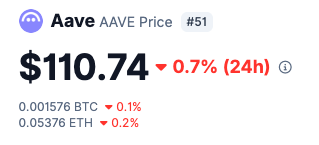
Some guy tried to buy $50M of $AAVE on his phone, like 3% of the total supply, tapped through <INSANE SLIPPAGE AHEAD> warnings, ended up with only $40K of AAVE. Block builder made off with ~$40M, Aave refunds $600K of fees.
Net result, AAVE token is down. 💀
Stani@StaniKulechov
Earlier today, a user attempted to buy AAVE using $50M USDT through the Aave interface. Given the unusually large size of the single order, the Aave interface, like most trading interfaces, warned the user about extraordinary slippage and required confirmation via a checkbox. The user confirmed the warning on their mobile device and proceeded with the swap, accepting the high slippage, which ultimately resulted in receiving only 324 AAVE in return. The transaction could not be moved forward without the user explicitly accepting the risk through the confirmation checkbox. The CoW Swap routers functioned as intended, and the integration followed standard industry practices. However, while the user was able to proceed with the swap, the final outcome was clearly far from optimal. Events like this do occur in DeFi, but the scale of this transaction was significantly larger than what is typically seen in the space. We sympathize with the user and will try to make a contact with the user and we will return $600K in fees collected from the transaction. The key takeaway is that while DeFi should remain open and permissionless, allowing users to perform transactions freely, there are additional guardrails the industry can build to better protect users. Our team will be investigating ways to improve these safeguards going forward.
English
@jeff_weinstein @stripe How do you deal with the KYC aspects of cards when it comes to agents?
English

Hi (economic) agent builders—
Want to issue cards to agents so they can safely pay for things?
@stripe is building issuing for agents, with programmable spend limits, mcc controls, and real-time risk scores. I'm looking for a few ready-to-go devs to get started with us. 💳 🤖
English
Couldn't have said it better myself. ;)
Kydo@0xkydo
Whoever figures out the DCF model that replaces risk free rate with inference / token will get the next Nobel prize in econ
English
David Dennis retweetledi

$EIGEN is now listed on @RobinhoodApp giving access to millions of US retail investors to the future of sovereign value creating AI Agents.
If you're new to $EIGEN check out how we are enabling fully trusted agents and AI
x.com/sreeramkannan/…
Robinhood@RobinhoodApp
$EIGEN is now available to trade on Robinhood Crypto.
English
TIL that there are AI powered tools for dental workflows. Dispersion is here, AI has crossed the chasm.
English
@chainyoda Have you placed your bet yet on Kalshi / Polymarket?
English
@natjin Are these all apples to apples event outcomes? Can't quite tell from the screenshots. If so, that's pure spread arbitrage, as opposed a basis trade.
English

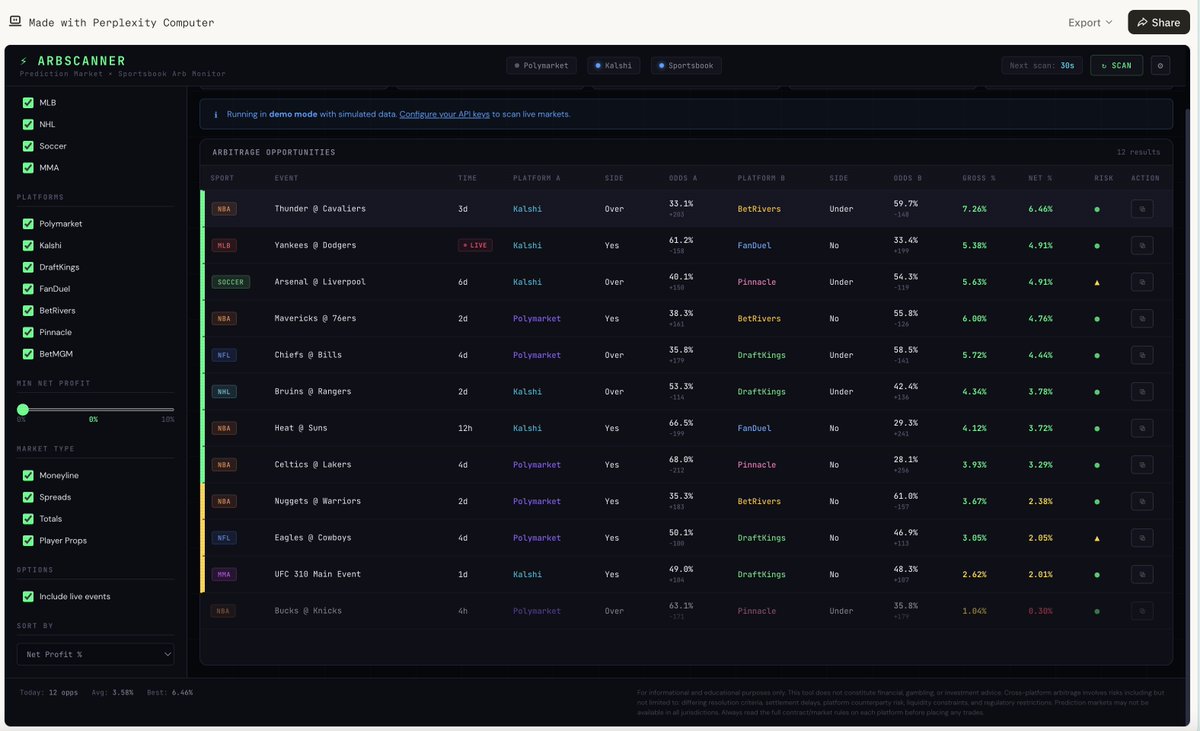
quants are cooked
just one-shotted arb
prediction markets (Polymarket, Kalshi) and sportsbooks (DraftKings, FanDuel) often price the same event differently. buy both sides across platforms and you lock in guaranteed profit regardless of outcome
this scans all of them in real-time and surfaces the gaps
free internet alpha. yw
perplexity.ai/computer/a/arb…
English
@divine_economy Inference is still pretty expensive, which requires lots of liquidity.
English

one consequence of AI i don't see anyone talking about
if teams only need to hire one engineer instead of 20, they won't need to raise much money. one round will be enough
the fund model as we know it will collapse
English
@chainyoda Just in time for a 100 year anniversary re-read of Sorkin's "1929".
English

Autonomous AI agents will eventually lead to projects, collectives, markets, and businesses where their collaboration scales to the next level of economic value. And it will happen quicker than most of us know. Eigen is laying the groundwork for that future.
Sreeram Kannan@sreeramkannan
English
@chainyoda @chainyoda I just realized both Wintermute (Neuromancer) and Jane (Ender's Game) are sci fi AI characters.
English
@chainyoda The persistence of the rainbow chart provides observational evidence for this thesis.
English


When I first started in open source, back in ancient times, it had an ideological & moral mission. It motivated, gave a sense of purpose. And the same when I first got into crypto. The path out of the crypto bear market is to find a purpose that matters again, to normal people.
binji@binji_x
When modern technology started, the people who built it believed in something. From the cypherpunks, to Tim may, to Eric hughes and beyond. Even in the later tech revolution of the 2010s, people still believed, working in tech still felt powerful, there was some sense of purpose. It is hard to quantify human purpose, yet we can feel it in certain spaces. Cultural gatherings, musical performances, such moments where a room full of strangers become something more than just the sum of its parts. It is, ultimately, a feeling of belonging, and it almost always comes from the act of sharing something together; a sense that we are all reaching for the same thing even if we can’t perfectly articulate what it is. The tech world of today has no concept of sharing in that sense as there is no common theme that everyone stands for. And where there are themes, they are hyper‑specific, top‑down, and oftentimes completely unrelatable to people’s actual lives. The narratives are corporate and the missions read like marketing copy run through LLM analyses. The values are whatever the quarterly strategy demands them to be and shift depending on who is in charge. People, naturally, using an innately human intuititon, wether they admit it or not, can feel the difference between a mission that was born from conviction and one that was assembled in a boardroom, and today, more people are realizing that most of what they see is the latter. And so what we are left with is a technology industry that is more powerful than it has ever been, and more empty than it has ever felt. The tools are extraordinary but the purpose behind them is missing. People don’t need another platform or protocol, they genuinely need a reason to care for them. They need to feel that what they’re building is connected to something that outlasts the finite. Technology needs a value system again. Lets give them one.
English
@VitalikButerin @Anthropic Can we bring back Asimov's Three Laws of Robotics?
English

It will significantly increase my opinion of @Anthropic if they do not back down, and honorably eat the consequences.
(For those who are not aware, so far they have been maintaining the two red lines of "no fully autonomous weapons" and "no mass surveillance of Americans". Actually a very conservative and limited posture, it's not even anti-military.
IMO fully autonomous weapons and mass privacy violation are two things we all want less of, so in my ideal world anyone working on those things gets access to the same open-weights LLMs as everyone else, and exactly nothing on top of that. Of course we won't get anywhere close to that world, but if we get even 10% closer to that world that's good, and if we get 10% further that's bad)
CC @DarioAmodei
firefly.social/post/bsky/pv7f…
English