
David Perkins

289 posts

David Perkins banner
David Perkins

David Perkins

@davidtperk

@renprotocol | @DukeU

NYC Katılım Kasım 2011
419 Takip Edilen1.1K Takipçiler
Sabitlenmiş Tweet
David Perkins
David Perkins@davidtperk·
I've always wanted to build something great. It's why I became a programmer. When @renprotocol was abandoned and left for dead, and the community refused to let it die, we had to figure out what to do for v2. We had to decide whether to make incremental tweaks to an unsustainable v1, or risk it all to build something new — without knowing what it would even be but hoping we'd come up with something. We decided to go for something new. It felt like jumping off a cliff and trying to build a plane on the way down, because we'd inherited the remnants of a bankruptcy and broken community without a product. Quietly and relentlessly, all day, every day, we did the work. When we weren't heard from in public, we were researching, tinkering, experimenting, and getting feedback from other projects. After enough time, we came up with something that we became obsessed with. It's great, it's uniquely Ren, and it's our baby. I can't think of anything more fulfilling than to build something of your own with a great team, share it with an open community of people and users from all around the world, and help grow it into an essential piece of the global financial infrastructure. That's what motivates me.
English

10
8
34
16.1K
David Perkins
David Perkins@davidtperk·
@jarxiao What about Solana as a globally distributed gateway is most attractive to you as a market designer?
English
0
0
0
134
Jarry Xiao
Jarry Xiao@jarxiao·
HFT latency races dissipate rent and entrench incumbents. You don’t spend money on infra to make money. You do it to not lose the money you were already making before everyone started investing in infra. Huge waste of time and human capital due to bad market structure.
English
14
11
160
37.4K
David Perkins
David Perkins@davidtperk·
MCP is music to Big HFT because they can afford colocation with proposers, faster wireless links, and cutting-edge hardware in and between every region around the world, so that once they see news in any one of those regions, they can get their toxic flow included in the batch before the news even reaches the LP that needs to cancel in some other region. It's an even higher barrier to entry and consolidation of power than the status quo.
English
0
0
2
178
Digital Asset Summit 2026
Digital Asset Summit 2026@blockworksDAS·
"MEV — that ability for people to reorder transactions to extract value, something that happens on top of Ethereum and Solana — that's just not suitable for financial markets." @drwconvexity @DRWTrading
English
65
51
310
375.6K
Georgios Konstantopoulos
Georgios Konstantopoulos@gakonst·
Reminder that the Machine Payments Protocol's killer feature is sessions. Use sessions instead of the charge intent to go faster and cheaper. Ideal for high throughput APIs. - 1 onchain transaction to open a session - infinite tiny granularity 0-fee payments bound only by the latency of your API call - whenever you're done, 1 onchain transaction to close a session You don't need to close out. You can open a session once, forever, and then keep topping that up to keep paying your service if you've spent all your balance. Docs: mpp.dev/payment-method….
English
12
12
129
18.6K
David Perkins
David Perkins@davidtperk·
Suppose it's 2 PM in Taipei, and 2 AM in New Jersey, where there's no news. Under MCL, the Taipei trader's order can't be processed and disseminated until the consensus leader receives and merges blocks from both the local leader and the New Jersey leader. For lots of markets, it's probably net inefficient to wait for blocks to arrive from an antipode where there's no news before any order book activity can be announced.
English
0
0
1
132
Logan Jastremski
Logan Jastremski@LoganJastremski·
Adding 150ms to a colocated exchange would be strictly worse, but that’s not what MCL does A trader in Taipei sees TSMC news. Under colocation, they send that order 80ms across the Pacific and hope they beat the satellite linked HFT firm to New Jersey. The information was theirs, but the profit wasn’t. Under MCL, their local leader captures it in <20ms. It’s onchain before it can physically reach any other continent. The arb opportunity you’re describing exists because of colocation, information trapped in regional pockets getting extracted by the a few firms fast enough to bridge venues. MCL doesn’t add latency to that system. It captures regional order flow at the source, aggregates it globally, and produces a price that reflects the entire planet every 150ms instead of whichever data center gets the signal first. Colocation forces the world’s information through a single funnel and rewards whoever controls the funnel. MCL makes every region the funnel
English
4
2
17
3.4K
moon shiesty
moon shiesty@moonshiesty·
MCL is equivalent to taking the current colocated regional exchange system and just adding ~120ms+ latency to every exchange (if we assume the optimal case where MCL validators are colocated next to every regional exchange) an optimal coordination mechanism already exists to synchronizes information between regional exchanges (arbitrage) at the absolute lowest latency while suboptimal for trading, MCP is optimal for censorship resistance and i believe will turn solana into the best settlement layer censorship resistance is the most important property of any decentralized blockchain and a necessary step to bring every capital market on-chain
Logan Jastremski@LoganJastremski

Colocation is a local maximum, MCL is a global maximum

English
6
1
20
7.3K
David Perkins
David Perkins@davidtperk·
@0xaporia There is no underclass more permanent than those accumulating Mac Studios just to send API requests to OpenAI
English
0
0
5
382
David Perkins
David Perkins@davidtperk·
@bread_ "merle Patricia true" kind of rolls off the tongue ngl
English
0
0
0
124
bread.mega
bread.mega@bread_·
@Ceazor7 @CastilloTrading @crypto_linn @pendle_fi @DefiIgnas @LefterisJP @base @Optimism @scupytrooples @AlchemixFi @cptgrumpus @megaeth @solana @duonine @yieldbasis @llamaintern @RamsesExchange @thisispandoraai @danielesesta MPT - merle Patricia true SALT - Small Auth, Large Trie MPT has scaling issues that we removed by inventing a new database structure (SALT) that execution equivalent Covered here: x.com/i/status/19629…
MegaETH@megaeth

x.com/i/article/1962…

English
3
0
5
1.4K
David Perkins
David Perkins@davidtperk·
@nicmeliones Congrats Nic! Nobody I'd rather work on a hair-on-fire problem with.
English
1
0
2
210
Nic Meliones
Nic Meliones@nicmeliones·
Hyped to launch my new project: Pancakes for Protagonists! It’s a playbook for the modern builder. My first post – Initiate Protagonist Mode – explains exactly what we are firing up: meliones.substack.com/p/initiate-pro… Each post is an AI-powered "spell" designed to solve a hair-on-fire problem. Here is how it works: * The Context: I explain the problem and why it matters. * The Spark: One or more mini-prompts to explore the topic. * The Master Spell: A meticulously crafted prompt you can copy, paste, and deploy to move mountains immediately. And if we have a little fun along the way? No harm in that. I am grateful to the folks who encouraged me to produce this, inspired ways to improve the format, and are already using the first spell. Let's make the magic happen.
English
2
0
3
386
David Perkins retweetledi
David Perkins
David Perkins@davidtperk·
Actually, I'm comparing a network that's planning to process 11B transactions over 7 days with 10ms execution latency on public mainnet beginning tomorrow [1] with what the entire Solana ecosystem considers "the endgame for Solana block production." [2] In that endgame, execution latency is 400ms. And that is often the case even today due to validators late-packing blocks instead of continuously propagating them. [3] You're welcome to live in the present, but our team is skating to where the puck is going, which is why we're building on @megaeth. [1] x.com/megaeth/status… [2] x.com/solana/status/… [3] x.com/DrNickA/status…
English
2
4
22
2.6K
MegaETH
MegaETH@megaeth·
Ethereum -> Solana Blocktimes: 12s -> 400ms (30x) Capacity: 17 -> 800 (47x) Solana -> MegaETH Blocktimes: 400ms -> 10ms (40x) Capacity: 1,300 -> 45,000 (34x) All proven on Mainnet. We are bringing performance back home ♥️
English
199
112
1.4K
134.2K
David Perkins
David Perkins@davidtperk·
@januszg_ The top for me was when a panelist at Bitcoin Renaissance 2024 called Ethereum a Bitcoin L2.
English
3
0
1
342
janusz
janusz@januszg_·
bitcoin l2s as a category did not fail the negative sentiment is due to people investing lots of $$$ into affinity scams that have down only tokens i don't really trust the opinions of people who's deep research & analysis called merlin a zk-rollup or those who said bitcoin had "80" l2s
English
15
4
68
6K
bread.mega
bread.mega@bread_·
@MiniBlocksIO Confirmed system is dynamic on mini blocks. EVM blocks should remain static 1/s though.
English
3
0
8
679
MiniBlocks
MiniBlocks@MiniBlocksIO·
🚀 Fascinating MegaETH behavior under load: As TPS increases, mini-block time actually decreases from ~11ms to ~9ms - meaning mini-blocks arrive MORE frequently when the network is busy. It is counter-intuitive and we do not know why exactly it happens. Explore these patterns yourself with our long-term heatmaps: miniblocks.io/network-heatma…
English
3
5
37
2.7K
Lei Yang Σ:
Lei Yang Σ:@yangl1996·
As in holders of priority rights can choose to resell their rights. If the chain enshrines a mechanism where priority rights are auctioned off at fine granularity (e.g. on the level of individual blocks) resale is much harder. Resale is potentially beneficial because of the flexibility.
English
1
0
2
211
bread.mega
bread.mega@bread_·
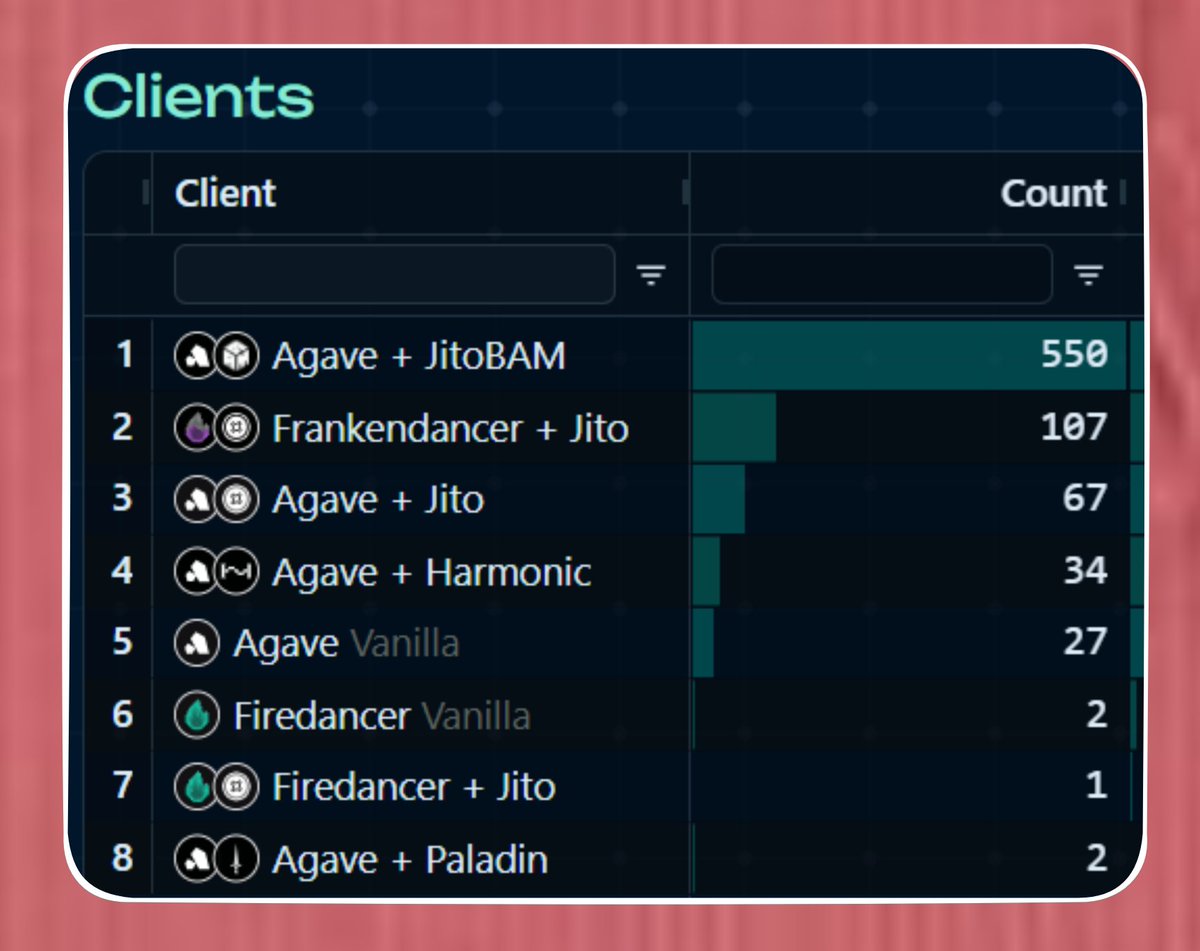
This is not the mog Solana thinks it is. Did you know Mega's Proximity Market design is actually seen in Solana, except there it's a value leak? Did you know that floorspace at Latitude (bare-metal server manager) has been skyrocketing in recent years because that's where Jito servers are located? Latitude has made so much money from the desire to colocate to the handful of Jito servers that it's spent ~$20M expanding floorspace. It doesn't matter if Solana has 800 (and dropping) validators if the majority of traffic runs through ~5 physical Jito bundlers. TLDR; - Colocation is present in ALL of these systems and is especially visible in Solana right now. - The difference is we're turning that value leak into revenue, just like we did with $USDM. Good morning everyone.
bread.mega tweet media
Logan Jastremski@LoganJastremski

Any ideas where the server is located? I’m interested in colocation

English
39
9
190
27.3K
Lei Yang Σ:
Lei Yang Σ:@yangl1996·
@davidtperk @mert @bread_ Good points!! Also not enshrining any micro auctions on the chain/protocol level even enables subauctions/resales of rights.
English
1
0
0
236
David Perkins
David Perkins@davidtperk·
@yangl1996 @mert @bread_ Two hidden advantages of keeping auctions off the critical path: (i) you can run many auctions in the time it would take to run one auction with consensus; and (ii) auction frequency can be parameterized per market pair at the app layer, rather than imposed by the chain.
English
1
1
6
238
Lei Yang Σ:
Lei Yang Σ:@yangl1996·
> which is by definition always an inefficient system that's trying to skeumorphize instead of design from first principles. at this point, most crypto systems have evolved architectures with micro auctions and the effect of consensus overhead becomes quite negligible as the game is different It is indeed interesting that most chains decide to run auctions at somewhat microscopic timescales. The potential advantage I can think of is this allows HFT revenue (MEV) to be allocated at fine granularity among bidders—down to individual transactions (i.e., profit opportunities). However, do we really need such granularity at the cost of running more auctions on the critical path which leads to higher latency and overhead? Personally my answer is NO, based on the impression that the MEV searcher market is not that decentralized anyway even with micro auctions. The immediate next conclusion is that MegaETH should not follow this design (micro auctions), which we do not. > it also of course ignores the colossal elephant in the room of read data propagation, which is the dominating latency and in the limit with read colocations as well, you get basically the same latency on the L1 I do wonder if datapoints can be given about read latency of colocated nodes for chains built by capable teams. I have a few promising ones.
English
2
0
8
807
David Perkins
David Perkins@davidtperk·
That's not the case in MCP. All of the blocks from the different leaders are merged and ordered by priority fee at the end of the slot. Transactions aren't actually executed until the aggregate block is produced. Otherwise, there'd be no point in doing MCP at all, because the whole point is to ensure censorship resistance for cancels, and you wouldn't even have to censor a cancel to snipe it because a marginally faster take could just be continuously included and executed first. If the only goal is to get from point A to point B, and you can use any kind of vehicle to do so, then it's not a category error to just compare the top speeds of a car and a skateboard. The skateboard doesn't get special treatment just because it's optimized for *googles skateboard tricks* ollies and kickflips.
English
1
0
6
520
mert
mert@mert·
if it's referring to execution latency, then it is still comparing to the wrong thing because solana blocks are built continuously, you don't wait until end of slot your last comment is weird. it's like saying "yeah my vehicle requires less gas than your vehicle, it's just architected differently. they're still vehicles." while not mentioning that your vehicle is a skateboard and the other is a car no, the "block times", while named the same, measure something completely different in each instance and hence cease to be a coherent comparative measure (for brevity, I will ignore your omission of how packets actually route in the real world re: overhead)
English
1
0
8
945
David Perkins
David Perkins@davidtperk·
Blocktime refers to execution latency, not inclusion latency. In MCP, a single proposer might guarantee within ~36ms that my tx will eventually be included somewhere in the block, but they can't give me the execution result until multiple globally distributed proposers stitch their orders together at the end of the slot. @megaeth doesn't have that consensus overhead, so it can actually give me an execution result in 10ms, hence the 40x shorter blocktime. Comparing the execution latencies of two chains isn't a category error just because they're architected differently.
English
1
0
11
882
mert
mert@mert·
I'll forgive the category error comparing a server to a distributed L1 and focus on the fact that you put the wrong data for Solana time-to-inclusion on solana p95 is roughly 36ms, not 400ms, that is slot time (the latter is not the same concept on an L2 vs. an L1) capacity (which for some reason you're using 800 on the first comparison and then 1,300 on the second comparison?) is wrong since we did 10k TPS (without synthetic tests) just yesterday and have surpassed 100k TPS several times using similar synthetics (actually 1M but who's counting) and also you're conflating sustained real demand for capacity, these numbers are not solana capacity; not to mention capacity is a function of traffic shape then again, I get this is bait
English
17
10
284
16.2K
David Perkins
David Perkins@davidtperk·
Low latency empirically does not have any effect on spreads and depth. The market makers who need to reprice aren't the only ones who get faster; the snipers who pick them off get faster too. That means market makers have a constant (N-1)/N probability of getting sniped regardless of latency, so there is no incentive for them to quote tighter or deeper due to low latency alone. I.e., efficiency does not improve in *volume space.* The effect that colo and low latency do have is on how quickly markets incorporate new information. I.e., efficiency improves in *time space.* MegaETH alone does magically improve efficiency in time space, but not in volume space. The latter requires fresh ideas. 🙂 x.com/davidtperk/sta…
English
0
1
9
1.8K
David Perkins
David Perkins@davidtperk·
Arbitrum is FCFS. Base and MegaETH do use priority ordering, but execution latency is reliable (Flashblocks are built by TEE, and MegaETH's explicit goal is ≤ 10 ms). You're right that Turbine doesn't explicitly claim FCFS (thanks for correcting), but low execution latency is absolutely implied by continuous block propagation. That's being undermined by late packers, which is a (hopefully temporary) risk for Solana. So the broader point stands that Ethereum and L2s generally provide more uniform ordering and execution latency, which makes them easier for devs to reason about.
English
0
0
1
607
mert
mert@mert·
well first of all L2s are not FCFS since there's priority ordering on at least base and arbitrum, so this is just wrong turbine also does not "claim" FCFS (or maybe I missed this?), it claims continuous block building, which is a separate category the only difference is that there's relentless competition at the solana layer and the tail 15% gets fragmented experience (which is valid, yet temporary) and we don't want centralized trust vectors solana could easily do the "uniform" approach of PBS, but we view it as a dynamic game where there's more optimal design space before consolidating so early into the game
English
1
0
1
214
MilliΞ
MilliΞ@llamaonthebrink·
Who remembers the Bankless debate between Justin Drake and Toly? Justin specifically mentioned that these timing games are inevitable while Toly shrugged it off saying that it wouldn’t make economic sense for validators to undermine the flow of txs in a shred. Now here we are. We need @TrustlessState to play that clip over a quote of this post.
Nick Almond@DrNickA

It’s a bit of an existential moment for Solana IMO. Thanks to some new analytical techniques, we can now actually see block packing behavior across the network (see IBRL.wtf). The top chart in the QT shows validators choosing to maximize extractive value at the expense of network health by delaying all state transitions to the last possible tick in a block i.e. late packing. This kills one of Solana’s killer affordances, transaction streaming. When used as designed, the network propagates shreds via Turbine continuously as the block is being built. That allows validators across the network to replay state in real time, vote early, and keep execution latency tight and predictable. Late packing breaks that model. Instead of a stream, you get a burst. State only becomes visible at the end of the slot, collapsing temporal guarantees. That matters because transaction streaming is what opens the door to hyperliquid style on-chain CLOBs with intrablock cancellations, deterministic execution, and an entire class of network economic primitives that depend on time actually meaning something on-chain. Without streaming, you can’t reason about cancels. You can’t guarantee fairness. And you can’t safely build real-time markets, no matter how good the application logic is. This is a real “can we have nice things?” moment for the network. I’m actually confident that stakers will move their SOL toward validators that preserve what’s best for Solana long term. Stakers are implicitly long term holders, and a chain that has fast, deterministic trading is one of the strongest value proposition in crypto (trillions). But getting there requires coordination. Either validators align on preserving streaming behavior, or stakers enforce it through delegation. One way or another, there’s a collaboration moment ahead if Solana wants to reach its ideal execution state. Or, we get stuck here. If you direct stake your SOL choose a validator with a good IBRL score, or stake with @jito_sol which optimises for IBRL validators and incentivises the best possible non-zero sum network behaviour.

English
31
12
339
28K