Diego Basch

29.6K posts

Diego Basch banner
Diego Basch

Diego Basch

@dbasch

If you want insights about AI, dad jokes, entrepreneur/investor stories, and tips about Buenos Aires or San Francisco, smash that follow button.

San Francisco, CA, USA Katılım Ekim 2007
316 Takip Edilen4.9K Takipçiler
Sabitlenmiş Tweet
Diego Basch
Diego Basch@dbasch·
Imagine you have been looking at the Earth from space, for millions and millions of years. It always looks the same. All of a sudden it lights up, in a matter of decades. The blink of an eye. Could you have predicted that? Of course not. Humans love to predict things. People imagined insane urban landscapes when cars started becoming popular (look at the Western US and its unwalkable cities), or a dystopic life in virtual reality when the internet was invented. Look up the word "teledildonics." Now we live in one of the most unpredictable periods ever. We have a weird new technology, and the predictions are all over the place. It's pointless to predict whether AI is going to replace job X or job Y, whether it will kill us all (it's increasingly looking like it won't), whether jobs will disappear, or whether it will cure cancer. We're just going to have to ride it and see what happens. When an expert predicts with arrogant certainty that "in 10 years AI will..." just stop reading. Rolling your eyes is optional.
Diego Basch tweet media
English
1
4
38
15.6K
Diego Basch
Diego Basch@dbasch·
@Chris_arnade I don't know if you are aware of it, but what you just quoted is 100% written by AI. It's jarring to me, even if it's paraphrasing a legit study.
English
0
0
1
66
Chris Arnade 🐢🐱🚌
Chris Arnade 🐢🐱🚌@Chris_arnade·
Not sure about creativity, but on my daily walk today (a 12 mile loop around a stream), I found a turtle laying their eggs -- in an awful location -- but I waited and when she finished (45 minutes later) I helped her across the road and then I found an escaped dog and eventually united them with their stressed owner. So, two good deeds, but few ideas.
Ihtesham Ali@ihtesham2005

A Stanford psychologist spent 4 years proving that the simple act of walking generates 60% more creative ideas than sitting, and the experiment she designed to kill every alternative explanation is one of the most decisive findings in modern psychology. Her name is Marily Oppezzo. She got the idea for the study while walking with her advisor at Stanford to discuss her thesis topic, and the paper she eventually published in the Journal of Experimental Psychology in 2014 is sharp enough that it should have ended the seated meeting on the day it came out. She ran 4 experiments on 176 people. Same person tested twice. Once sitting, once walking. The creativity tasks were the standard ones psychologists have used for decades to measure how good a brain is at generating novel useful ideas. The result was almost too clean to publish. 81% of participants in the first experiment produced more creative ideas while walking than while sitting. In the second experiment, 88%. In the third, 100%. Every single person walked into a more creative version of themselves. On average, people generated 60% more novel useful ideas the moment their legs started moving. The skeptical question is the obvious one. Maybe it was the fresh air. Maybe it was the scenery passing by. Maybe it was the change of environment doing the work, not the walking itself. Oppezzo killed every one of those explanations with one experimental decision. She put people on a treadmill facing a blank wall. No scenery. No fresh air. No environmental change. Just legs moving in place while staring at white drywall. The 60% boost held. Then she ran the experiment that closed the case completely. She took participants outside in two conditions. Half of them walked through a Stanford courtyard. The other half were pushed through the exact same courtyard in a wheelchair. Same outdoor stimulation. Same scenery passing at the same speed. The only difference was whether the legs were moving. The walkers produced dramatically more novel high-quality ideas than the wheelchair group. The outdoors did almost nothing on its own. The walking did everything. This is the part of the study that hit hardest when I read it the first time. She also tested the opposite kind of thinking. Convergent thinking. The kind where there is one right answer and you have to narrow down to it. Word puzzles where 3 words share a hidden fourth word that connects them. The seated participants did slightly better on these. Walkers got slightly worse. Walking is not a general intelligence enhancer. It does one specific thing. It opens up the divergent search inside your brain. The part that generates options. The part that produces unexpected connections. The part that takes a problem and finds five ways into it instead of one. When you need to converge on the single right answer, sit down. When you need to find the answer in the first place, get up. The mechanism is now well understood. Walking selectively activates what neuroscientists call the default mode network, the system inside your brain that runs when you are not consciously focused on anything. The DMN is where mind-wandering happens. Where memories cross-reference each other. Where ideas that have been sitting in separate folders inside your head finally bump into each other. When you sit at a desk and force yourself to concentrate, you suppress the DMN. When you walk at a natural pace, the executive part of your brain gets just busy enough handling the walking that the DMN comes online and starts doing the work that focus was blocking. The most useful finding in the entire paper is the one almost nobody quotes. The boost did not turn off the moment people stopped walking. Participants who walked first and then sat back down stayed elevated. Their next round of seated creativity work was still significantly better than people who had been sitting the whole time. The rest lingered for at least several minutes after the legs stopped moving. You do not need to do creative work while walking. You need to walk before the creative work. The brain holds the state. The history of this is the part that should haunt anyone who still does meetings in chairs. Charles Darwin built a gravel loop behind his house in Kent called the Sandwalk and walked it 3 times a day for the rest of his life. The theory of evolution was developed one lap at a time on that path. Nietzsche walked up to 10 hours a day during the years he wrote his most important books and openly said the work was conceived on his feet. Beethoven composed for the morning and walked for 5 hours every afternoon with a pencil in his pocket for when something landed. Kahneman said the best thinking of his Nobel Prize-winning career happened on leisurely walks with Amos Tversky. Steve Jobs refused to take important conversations sitting down. He held them on foot. Every one of them was using the system Oppezzo would not measure until 2014. They just did not know what to call it. The question worth sitting with is the one almost nobody asks. Every meeting you have ever attended sitting around a table was a meeting held at a fraction of the brain power that was actually available to the people in the room. Every brainstorm that got stuck inside a conference room. Every problem you tried to solve at a desk and gave up on. Every idea you could not quite get to. The intervention is the easiest one in modern science. No supplement. No app. No subscription. No training program. Just a pair of legs and 15 minutes. The Stanford lab proved it. The philosophers knew it. The neuroscience explains it. And almost everyone reading this is still trying to think their way out of problems sitting completely still.


English
6
5
145
23.2K
Diego Basch
Diego Basch@dbasch·
The best way to stop being an AI doomer is to try to implement a complex system. Invariably you will be slowed down by physics or biology at some point, intelligence will not be the bottleneck.
English
0
0
1
105
Diego Basch
Diego Basch@dbasch·
@antoniogm Pull out your KN95! I'm about to board a plane and I have two backups.
English
0
0
0
149
Diego Basch
Diego Basch@dbasch·
"Write a complete single-file HTML page with a playable Tetris game. Include keyboard controls, score, level, next piece preview, pause/restart buttons, responsive layout, and polished retro styling. Use only HTML, CSS, and vanilla JavaScript in one file." On a 3090, oneshotted in a few minutes. images.diegobasch.com/tetris.html
English
0
0
2
330
clem 🤗
clem 🤗@ClementDelangue·
llama.cpp with MTP support makes local models fast enough to use as daily drivers 🚀 Qwen3.6-27B dense generation below on A10G: From 25 tok/st to 45 tok/s (+78%)!
English
77
106
1.2K
119.7K
roon
roon@tszzl·
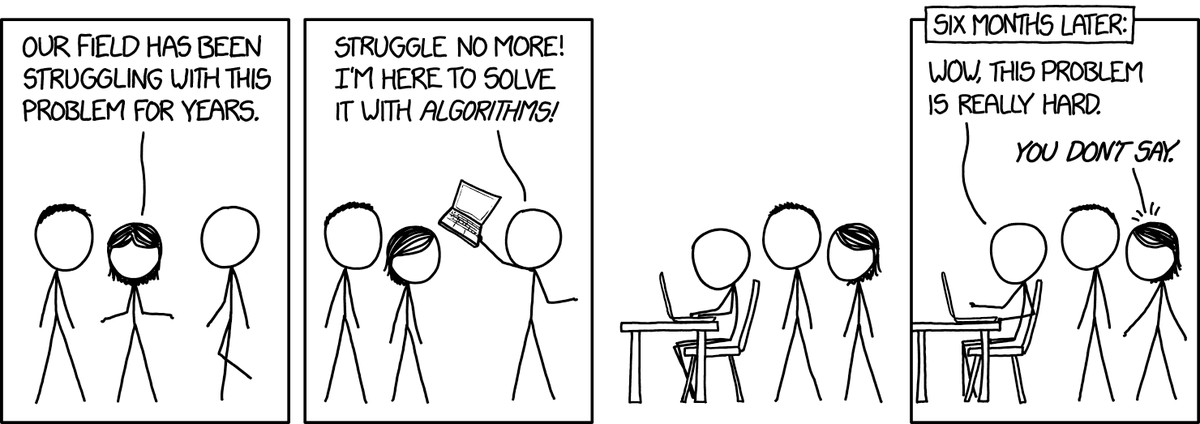
@sreejan_kumar this comic was true before artificial intelligence
English
9
1
456
13.1K
Diego Basch
Diego Basch@dbasch·
I don't know that they are unable, but most likely they have no need. Books are an example of UX. Traditionally, user interface progress is about making it easier for people to do a task. The median person dealt with a car, a tv or an oven that was much harder to use than what we have today. Could their modern counterparts operate a manual transmission, a radio or rotary phone if they needed to? Probably, after a period of adjustment. Text is no different.
English
0
0
7
512
Paul Graham
Paul Graham@paulg·
One thing I've learned from using AIs is that the median person is unable to read paragraphs of ordinary prose. Now I understand why so many recently published books consist of snippets of text — what would be called sidebars, if the book weren't composed of them.
English
185
71
2.2K
190K
Diego Basch
Diego Basch@dbasch·
"Explain" is the sleight of hand in Feynman's phrase. An explanation must be good for something. I could convey the idea of backpropagation to a 5-year-old by showing how you correct when throwing a basketball. "Ok, I adjust what I do to get the outcome I want." They wouldn't be able to implement anything, recognize an algorithm, or understand how it's different from the way an animal learns. What was the explanation good for? Some things simply cannot be explained to 5-year-olds in a meaningful sense. I'm sure there are better examples.
English
0
0
0
71
Robin Hanson
Robin Hanson@robinhanson·
Except, I know lots of innovative things I could explain to a smart 5yo who was willing to listen carefully. But when you talk on sensitive topics, the big problem is folks unwilling to listen.
Sahil Bloom@SahilBloom

This is a major life hack: Richard Feynman was known for his ability to convey complex ideas in simple, elegant ways. Remember this rule the next time someone tries to fast talk you with a bunch of fancy words, acronyms, and jargon...

English
8
0
57
4.6K
Diego Basch
Diego Basch@dbasch·
@robinhanson In the same way Taylor Swift is the most popular artist. Money is a universal status market, but maybe not the one you want to focus on.
English
0
0
1
171
Diego Basch
Diego Basch@dbasch·
@AndresB Tremendo bait. Le falta quejarse de lo caro que está el servicio doméstico.
Español
1
0
0
42
🅱🅔🅝
🅱🅔🅝@ben_mathes·
@antoniogm If you mean to imply that moving to marin is giving up, then we agree
English
1
0
5
1.4K
Diego Basch
Diego Basch@dbasch·
The only thing the vast majority of AI doomers here have ever built.
Diego Basch tweet media
English
0
0
2
139
Diego Basch
Diego Basch@dbasch·
Lego should make a version of the bunker so this guy can finally build something for once.
Diego Basch tweet media
English
0
0
1
195
Diego Basch
Diego Basch@dbasch·
@MorticiaMerval @JohnGalt_is_www Imaginate que hay 30 personas en un aula y tienen que acercar a cara o ceca, los que la pegan quedan y los que no se van. Después de cuatro o cinco tiradas te quedan uno o dos que acertaron todas. No significa nada, podría haber sido otros.
Español
0
0
6
399
LaMorticiaDelMerval
LaMorticiaDelMerval@MorticiaMerval·
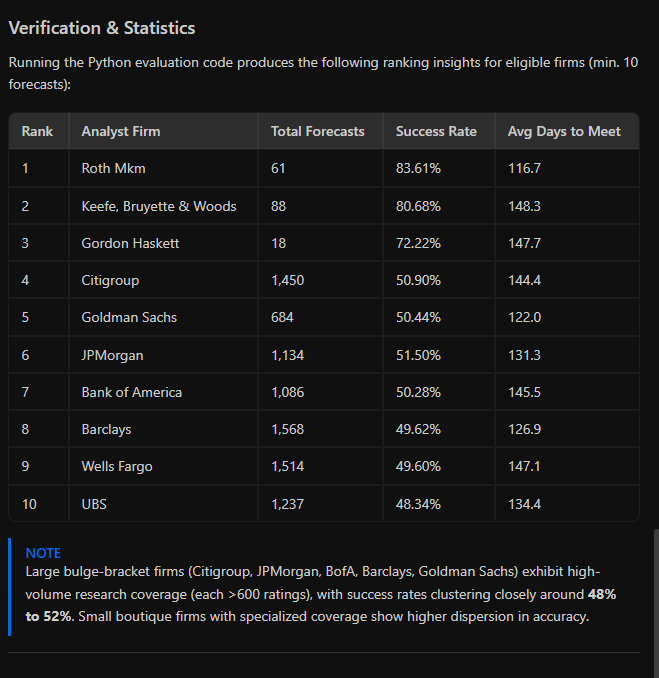
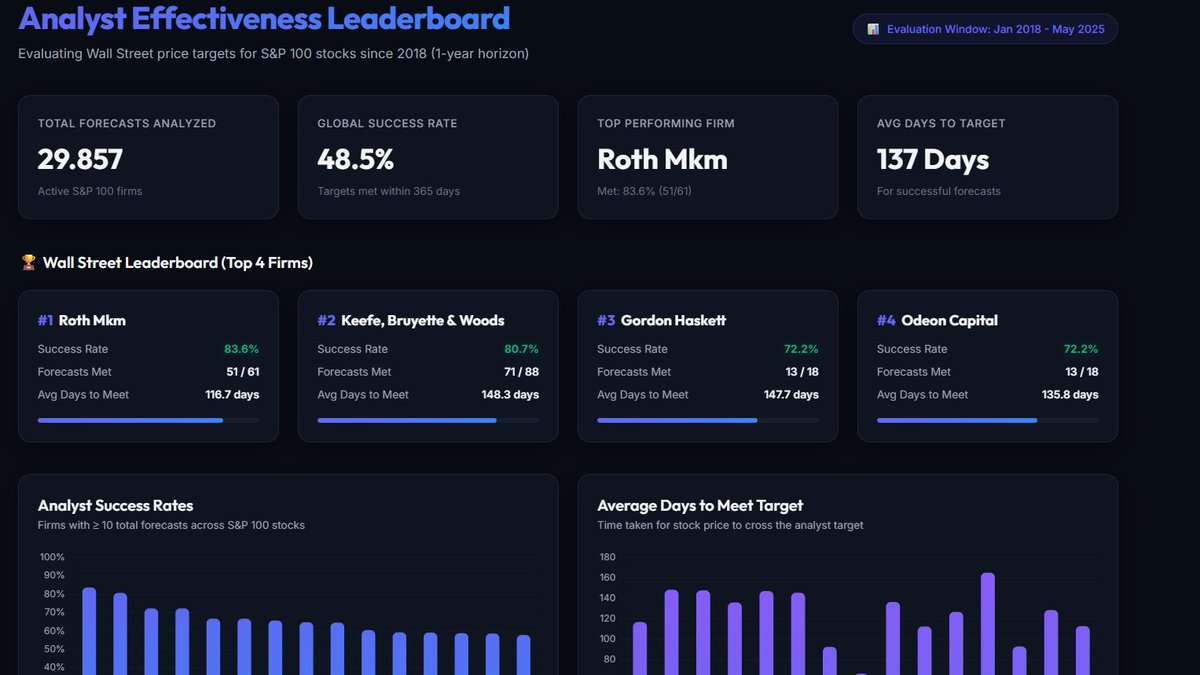
Bueno gente empecé a meterme un poco en el tema de IA agéntica y se me ocurrió probar la nueva versión de Antigravity (la 2.0), le tiré el siguiente prompt: 'Tengo que pedirte un proyecto de investigación profunda. Necesito que averigües la efectividad de los principales analistas financieros (Jefferies, Citigroup, UBS, Barclay y algunos más) quiero que investigues los pronósticos que hicieron de las principales acciones de USA (puedes tomar las 100 mas grandes o mas operadas de USA) y que me digas para pronósticos de mas de un año de antigüedad si el pronostico de precio target se cumplió o no. REGLA PRINCIPAL: NO INVENTAR DATOS. La idea es ir recopilando los diferentes aciertos, y hacer un ranking con que porcentaje de aciertos tuvo cada uno. También si es posible un promedio de en cuento tiempo se cumplieron los pronósticos. Una fuente que veo que tiene varios pronósticos es Finviz (sobre todo de mas de un año de antigüedad), pero puedes usar la que mas te guste o varias.' Despues de 15 minutos de trabajos e ir aprobando uno x uno los comandos de python (veía la descripcion de lo que haria el script, casi ni juno python) Al final me dio un resultado interesante el TOP 2 con mas de 80% de aciertos fueron 1° Roth Mkm 2° keefe, bruyete y woods Dato no menor, la mayoria de las grandes consultoras tienen un indice de aciertos de un 50% (acá tomo como fallo que si lanza un pronostico y no se cumple en menos de un año fue un fallo). PD: Ni a palos subo el codigo fuente. Pero si les paso un par de print screen del sitio interno que me armo. Bueno a ir siguiendo a esos dos a ver que onda.
LaMorticiaDelMerval tweet mediaLaMorticiaDelMerval tweet mediaLaMorticiaDelMerval tweet media
Español
12
20
404
59.3K
Brianne Kimmel
Brianne Kimmel@briannekimmel·
Narrative violation, but my rich friends in SF are incredibly happy. They didn’t come from money. They’re living a life they could have never imagined. They’re able to provide for parents and extended family. They’re proud of the life they built and passionate about their work.
English
8
3
146
19.8K
Uzi
Uzi@UziCryptoo·
This man robbed a bank for $1, sat down and waited for the police, just to get free healthcare in prison In 2011 a man named Richard James Verone walked into a RBC Bank in Gastonia, North Carolina Handed the teller a note demanding $1 One dollar Then sat down in the lobby and waited calmly for police to arrive He was 59. No job. No insurance. A growth on his chest. Two ruptured discs. Calculated that a federal conviction would guarantee him full medical coverage inside prison The judge sentenced him to 3 years He got the surgery He got the treatment He told reporters on the way out he had no regrets A 59 year old American man robbed a bank for $1 because it was cheaper than seeing a doctor
English
2K
25.9K
126.9K
5.1M